• Following Us

  • Categories

  • Check out the Archives


  • Awards & Nominations

The X-Files – How the Ghosts Stole Christmas (Review)

This July, we’re taking a trip back in time to review the sixth season of The X-Files and the third (and final) season of Millennium.

Building off episodes like Triangle and Dreamland, How the Ghosts Stole Christmas continues to develop and expand upon the sixth season’s fascination with issues of time and love.

With the closing of the X-files in The End, it seems like The X-Files has abandoned any real focus on the procedural element of the series. Instead of being a show about two people employed to investigate weird phenomenon together, it seems that The X-Files has evolved into a series about two people who investigate weird phenomena in their spare time. It seems likely that Mulder would have invited Scully on his Christmas Eve stake out even if they were working on the X-files together, but the fact that this is a recreational activity certainly recontextualises it.
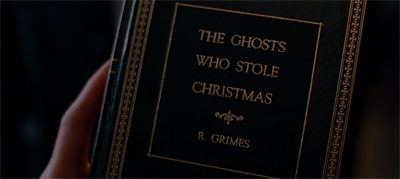
Semi-title drop!

Semi-title drop!

The first half of the sixth season of The X-Files is perhaps the most invested that the show has ever been in the nature of the relationship between Mulder and Scully. After all, the seventh season shies away from questions concerning a Mulder and Scully romance; the eighth season keeps William’s parentage a mystery until the last possible moment. The opening stretch of the sixth season is really the only point in the show’s run where the series has an extended conversation about what the two mean to one another and how they express that.

How the Ghosts Stole Christmas is essentially an episode about Mulder and Scully receiving paranormal couples’ counseling that goes horribly wrong.

"Merry Christmas, everybody!"

“Merry Christmas, everybody!”

Continue reading

The X-Files – Triangle (Review)

This July, we’re taking a trip back in time to review the sixth season of The X-Files and the third (and final) season of Millennium.

There are a lot of reasons to celebrate Triangle.

The episode gets a lot of attention for its wonderful use of long tracking shots. According to Chris Carter’s commentary, there are only twenty-four individual shots stitched together to produce the forty-five-minute episode. Considering the amount of split-screen action at the climax, that is not a lot. Triangle is an artistic tour de force for writer and director Chris Carter. The success that both Birdman and True Detective enjoyed in 2014 due to their extended takes suggests that Carter was significantly ahead of the curve.

Dragging up the past...

Dragging up the past…

There are other aspects to note. Triangle also ushers in a new mood and tone for the sixth season of The X-Files. The show had moved to Los Angeles, and would struggle with how to retain its identity in the new (and bright) surroundings of California. The Beginning and Drive had both answered the question in their own way, but Triangle ushers in a whole new approach to storytelling. Triangle is the first of a series of light and breezy episodes in the early stretch of the sixth season where The X-Files almost turns into a paranormal sitcom.

However, there is one other reason to celebrate Triangle. It is an extended forty-five minute pun on the word “ship.”

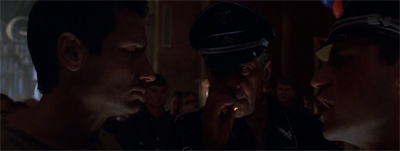
Cigarette-Smoking Nazi...

Cigarette-Smoking Nazi…

Continue reading

The X-Files – The Field Where I Died (Review)

This February and March, we’re taking a trip back in time to review the fourth season of The X-Files and the first season of Millennium.

Morgan and Wong’s four scripts for the fourth season of The X-Files are utterly unlike any other stories in the show’s nine-season run. Experimental, bold, confrontational; these four stories stretch and pull at The X-Files, as if eager to see just how far the hit show will bend.

The Field Where I Died is probably the weakest of these four episodes, but it is also the most ambitious. It is a script with big ideas and a willingness to commit to those ideas. There is no modesty here, no hesitation. There is a sense that Morgan and Wong are committing wholeheartedly to their themes and their concepts. The Field Where I Died is an episode that rubs quite a lot of people the wrong way, for a number of different reasons; however, the episode never pulls its punches. It never holds back. It never tries to be anything that it is not.

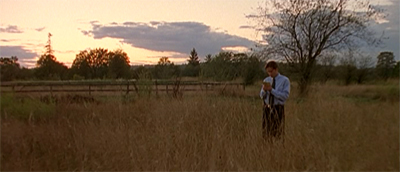
Far afield...

Far afield…

There is a lot to admire here. The Field Where I Died is not an episode with a simply formulaic concept or a conventional structure. It looks and feels completely unlike any other episode of the show. Even when the show touched on similar themes in its final season, the result was radically different. Hellbound is a much more conventional episode than The Field Where I Died. More than Home or Musings of a Cigarette-Smoking Man or Never Again, this is an episode that really seems like an odd fit for The X-Files.

Then again, that may be the beautiful thing about The Field Where I Died, for all its many flaws. It is utterly unlike anything else on television in the nineties. The fact that it can produce an episode of television so unique and incomparable is ultimately what makes The X-Files feel like The X-Files. The fact that The Field Where I Died feels so unconventional and eccentric is precisely what makes it a worthy episode of The X-Files.

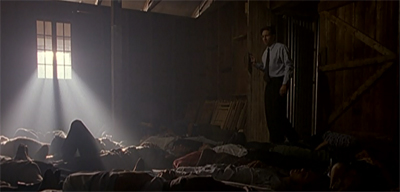
Another roaring success for Mulder...

Another roaring success for Mulder…

Continue reading

Non-Review Review: Interstellar

Interestingly, Christopher Nolan seems to have generated a reputation as a rather detached director. Common wisdom around Nolan’s films suggest that the film-maker is perhaps too cold and clinical in his approach to the material; that his films lack warmth or humour. This reputation is probably a result of the director’s fascination with non-linear storytelling. After all, The Dark Knight is his only straight-arrow-from-beginning-to-end film.

Probably also due to the narrative contortions and distortions of films like Memento or The Prestige, Nolan is generally presented as a film-maker who constructs visual puzzle-boxes. His films are frequently treated as riddles to be solved. Consider the discussion of narrative “plot holes” in The Dark Knight Rises that fixates on how Bruce Wayne got around back to Gotham, or the discussion on the mechanics of the final shot of Inception. This approaches to his work tend to divorce the viewer from his films.

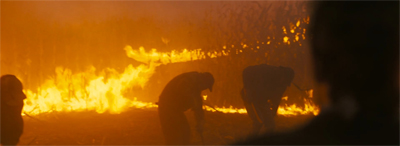
Everything burns...

Everything burns…

Interstellar will likely be Nolan’s most polarising film to date, replacing The Prestige or The Dark Knight Rises. The film offers an extended two-and-a-half hour rebuttal to accusations that Nolan is detached or distant. Much has been made about the attention to detail on Interstellar. The physics on the movie were so exact and precise that physicist Kip Thorne actually made theoretical advances while working on the film.

However, at the same time, one character posits love as a force more powerful than gravity or time. Interstellar might be precise and meticulous, but it is not a film that lacks for an emotional core; it is not a movie that lacks for warmth. Interstellar feels like a conscious attempt to cast off the image of a cynical and cold film-maker.

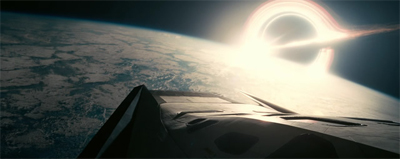
Out of this world...

Out of this world…

Continue reading

Star Trek: The Next Generation – Imzadi by Peter David (Review)

This January and February, we’ll be finishing up our look at the second season of Star Trek: The Next Generation and moving on to the third year of the show, both recently and lovingly remastered for high definition. Check back daily for the latest review.

We’ll be supplementing our coverage of the episodes with some additional materials – mainly novels and comics and films. This is one such entry.

As far as tie-in novels for Star Trek: The Next Generation go, Imzadi is the big one. It’s Peter David’s magnum opus for The Next Generation – a wonderfully clever character study that allows David to bask in the character dynamics of the show, while playing with big ideas and grand themes. It’s very easily the strongest Next Generation novel published while the show was on television, and remains a strong contender for the best Next Generation novel ever published.

tng-imzadi

Continue reading

Doctor Who: Love and Monsters (Review)

To celebrate the fiftieth anniversary of the longest-running science-fiction show in the world, I’ll be taking weekly looks at some of my own personal favourite stories and arcs, from the old and new series, with a view to encapsulating the sublime, the clever and the fiendishly odd of the BBC’s Doctor Who.

Love and Monsters originally aired in 2006.

Someone wants a word with you.

You upset my mum.

Great big absorbing creature from outer space, and you’re having a go at me?

No one upsets my mum.

– the Doctor, Rose and Elton get their priorities straight

Love and Monsters remains one of the most divisive stories of the Davies era, if not the revival in general. It’s the show’s first “Doctor-lite” episode, a production featuring as little of the lead actor in possible in order to make the season’s arduous production schedule just a little bit easier. The Christmas Invasion had added another episode to the mix, and so the idea was that Love and Monsters could be shot during the production block of The Impossible Planet and The Satan Pit in order to allow for a standard length season without increasing an already impressive workload for the leads.

As such, it’s easy to imagine that the “Doctor-lite” episodes could be throw-away adventures, episodes chopped together to meet the quota of stories for a given season – churn them out and focus the attention on to the “bigger” and “more important” adventures. Instead, the “Doctor-lite” episodes have proven to be some of the most experimental and creative episodes of the entire Davies era. While critical and fan opinion remains divided on Love and Monsters, the subsequent “Doctor-and-companion-lite” episodes – like Blink, Midnight and Turn Left – are counted among the best of their respective seasons.

Love and Monsters is a show about Doctor Who. More specifically, it’s about Doctor Who fandom, and a romantic ode to the importance that the show can have in some people’s lives.

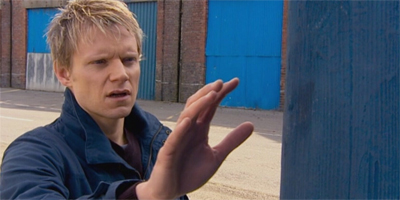
Reach out and touch faith...

Reach out and touch faith…

Continue reading

Wet Blogathon: I Wish It Would Rain Down…

This is part of the rather wonderful “Wet Blogathon” put together by Andrew over at Encore’s World of Film and Television, asking bloggers to pick their favourite scenes in the rain. It’s a great little idead and I was delighted to be invited to take part.

Though your hurt is gone, mine’s hanging on, inside
And I know, it’s eating me through every night and day
I’m just waiting on your sign –

‘Cos I know, I know, I never meant to cause you no pain
And I realize I let you down
But I know in my heart of hearts
I know I’m never gonna hold you again

Now I… Now I know, I wish it would rain down, down on me
Ohh I wish it would rain, rain down on me now
Ohh I wish it would rain down, down on me
Yes I wish it would rain down, rain down over me.

– Phil Collins, I Wish It Would Rain Down

Yes, I was quite fond of that in my young almost-emo teen-in-love days – you know the kind, when one little attraction meant the entire world. I’ve kinda gotten over it. Still, there is something inherently powerful about the imagery of rain – water pouring down from the skies. It can represent – as it does in that infamous scene from The Shawshank Redemption – a divine shower, washing the character clean of their sins, evoking imagery of baptism and rebirth. Or it can be heavenly tears – as in Se7en, for example – reflecting the tragedy of a broken world where all you can do is cry. The always wonderful Andrew over at Encore’s World of Film and Television invited me to contribute to a blogathon he’s hosting celebrating the most powerful rain imagery in film – and there’s quite a bit to choose from. There are a rake of moody and gothic applications of rain – a wide variety and more than a few outside choices to be made. However, I am going to betray my inherent sappiness by picking Chasing Amy, which offered an inherently straight-forward and almost cliché application of the heavy rain as a metaphor for turbulant emotion, but did it with such heart that even cynical old me could not resist.

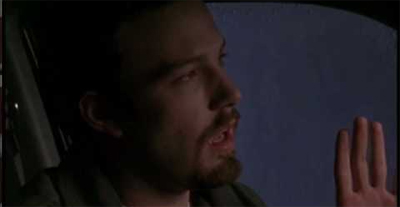
The raining champion...

Continue reading