So, as I have mentioned before, I am launching a new video series as a companion piece to In the Frame at The Escapist. The video will typically launch with the Monday article, and be released on the magazine’s YouTube channel the following week.
With that in mind, here is last week’s episode, covering Disney’s ambitions to bring Mulan to China and the story of how Hollywood became so fascinated with that market. You can watch the pilot video here, and read the companion article here.
I published a new In the Frame piece at The Escapist this evening. The teaser for Denis Villeneuve’s Dune playing in cinemas, and with the film celebrating its fifth anniversary this September, I thought it was worth taking a look back at Denis Villeneuve’s Sicario.
Sicario is a film about boundaries – both literal and metaphorical. Set at the edge of the frontier, on the Mexican border, it is story about blurred lines and brutal transgressions waged as part of a murky war with extremely abstract objectives without a singular and clearly defined enemy. As such, it becomes a story about the idea of war waged on the idea of the frontier, a grim and cynical update of both the western and the war movie for the twenty-first century.
You can read the piece here, or click the picture below.
For about a year now, I have been writing the In the Frame column twice weekly at The Escapist on Mondays and Fridays. Today, we have a very special announcement. We are looking at launching a companion video series, In the Frame. Hopefully it’ll be releasing on Mondays, but you can get a sense of what we have planned by taking a look at the teaser below or watching the video here.
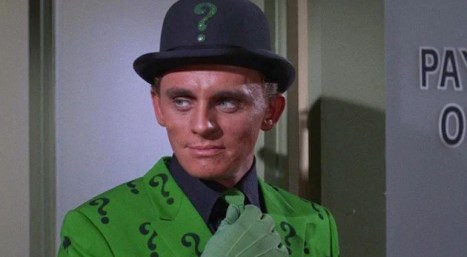
I published a new In the Frame piece at The Escapist this evening. With DC’s Fandome event unveiling a new trailer for The Batman at the weekend, it seemed like a good time to take a look the Riddler.
The Riddler is an interesting character for a number of reasons. He is considered one of the most iconic Batman villains out there, but he’s also a character who is difficult to write; who disappears for extended periods of the Caped Crusader’s history. His prominence is largely due to the work of actor Frank Gorshin in Batman!, but Gorshin’s performance has gone on to be hugely influential on later iterations of the Joker. As a result, the Riddler occupies a strange place. He is the ghost of Batman’s Silver Age, which makes him an interesting antagonist for the modern Dark Knight.
You can read the piece here, or click the picture below.
I published a new In the Frame piece at The Escapist this evening. Prompted by a conversation with a colleague Matthew Razak, I took a look at the troubled second film in the Marvel Cinematic Universe, The Incredible Hulk.
I have always had something of a soft spot for The Incredible Hulk, in large part because it feels appropriate that a movie about the Green Goliath should find itself caught between extremes. The Incredible Hulk was caught in a conflict between Edward Norton and Marvel Studios. Norton wanted an introspective character-driven superhero film, and Marvel… didn’t. In some ways, The Incredible Hulk offered as clear a roadmap to the future of Marvel Cinematic Universe as Iron Man, if only because it served to illustrate what Marvel didn’t want from their blockbusters.
You can read the piece here, or click the picture below.
I published a new In the Frame piece at The Escapist this evening. With both Shutter Island and Inception turning ten years old this year, it seemed like an appropriate opportunity to look back on Leonardo DiCaprio’s interesting double feature from 2010.
There are some interesting parallels between Shutter Island and Inception. Both are stories about men who retreat into fantasy following the death of their wife in order to process their guilt and the sense of responsibility that they have for that death. These are probably DiCaprio’s two strongest performances, and it’s striking that they came so close together. However, rewatched a decade later, it’s amazing how well these two films have aged. In hindsight, they foreshadow the decade to come, offering a glimpse of the post truth era.
You can read the piece here, or click the picture below.
I published a new In the Frame piece at Escapist Magazine this evening. Predators is ten years old, so it seemed like an appropriate time to take a look back that second (and best) Predator sequel.
In hindsight, Predators is the rare movie that understands the limitations of its core premise. Fox spent decades trying to turn Predator into a franchise, but the sequels largely disappointed. A large part of this is down to the fact that Predator is a concept anchored in a particular time and place, without the timeless quality of a movie like Alien. In contrast to the other Predator sequels, Predators is a lean and modest machine. It never pushes its central concept too far, instead offering a pulpy and enjoyable b-movie. In doing so, it mostly works as a worthy successor.
You can read the piece here, or click the picture below.
I published a new In the Frame piece at Escapist Magazine this evening. Clint Eastwood turned ninety years old yesterday, so it seemed like the perfect opportunity to write about the American icon.
For decades, Eastwood has embodied a certain ideal of American masculinity. However, he has also used his career to offer a more nuanced and sophisticated exploration of that masculinity than many observers will readily acknowledge. Eastwood is the rare movie star who completely understands his screen persona and the audience’s relationship with it, and uses that to engage in interesting discussions about what that says about American machismo.
You can read the piece here, or click the picture below.
I published a new In the Frame piece at Escapist Magazine this evening. Given some online debates raging last week, I thought it was worth taking a look back at Iron Man 3.
Iron Man 3 remains a fascinating film, seven years after its release. What is particularly interesting is how fan and general audience opinions are polarised on it. This is not a coincidence. What audiences and critics love about Iron Man 3 is what alienates fans. Iron Man 3 is the rare film in the Marvel Cinematic Universe that seems conflicted about superheroes as they exist in contemporary pop culture, and anxious about the implications of approaching them as an expression of the military-industrial complex. The result is the relatively rare Marvel Studios film that is genuinely and engagingly introspective, willing to ask play with expectations and ask questions about the genre’s place in the contemporary pop cultural landscape.
You can read the piece here, or click the picture below.
I published a new In the Frame piece at Escapist Magazine last week. There’s understandably been a lot of talk about the end of the world lately, understandably, but I thought it was worth unpacking Mad Max: Fury Road.
Fury Road is one of the best blockbusters of the past decade, appearing on countless lists of the best films of the 2010s. However, what distinguishes it from a lot of apocalyptic cinema is that it embraces hope in a very meaningful and practical way. Fury Road is largely about the impulse to retreat from horror and from untenable situations, to abandon a world that appears to be fallen. However, the film argues that such an impulse is ultimately self-destructive, as eventually such a retreat runs out of road. Instead, Fury Road contends that the proper response to a broken world is to turn around and face it head on, to fix it from the inside. It’s a brave and empowering message, and a large part of the film’s appeal.
You can read the piece here, or click the picture below.























 the m0vie blog