• Following Us

  • Categories

  • Check out the Archives


  • Awards & Nominations

The X-Files – Demons (Review)

This February and March, we’re taking a trip back in time to review the fourth season of The X-Files and the first season of Millennium.

The fourth season of The X-Files is an oddity.

That is particularly true when it comes to the show’s mythology. Not only has any sense of narrative progression stalled after the “to be continued…” hook of Talitha Cumi, the fourth season seems to branch the mythology out in multiple directions that never really get anywhere. Tunguska and Terma introduce a Russian conspiracy that quickly becomes a footnote. Tempus Fugit and Max focuses on private military contractors who are never mentioned again. Memento Mori gives Scully cancer halfway through the season, and the rest of the year tries to catch up.
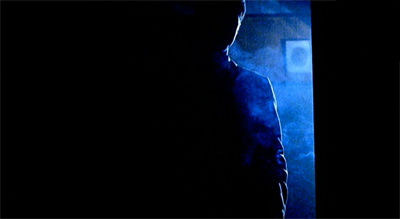
A cigarette-smoking spectre...

A cigarette-smoking spectre…

Demons is an episode that sits rather awkwardly as the penultimate episode of the season. An episode about Mulder undergoing aggressive therapy to recover lost memories seems a little out of place with everything else going on around him. After Memento Mori, you would imagine he would be worried about Scully. After Zero Sum, you imagine he would be wary about putting himself in a vulnerable position. Demons feels very much like it would make a good first season episode, a product of the time when Samantha Mulder was our lead’s primary driving motivation.

Instead, Demons sits awkwardly before the big season finalé with its own clear agenda. Scully’s closing monologue is clearly designed to lead into Gethsemane as almost a four-part season-bridging epic. However, the execution feels a little too haphazard, a little too casual, a little too disorganised. Demons feels less like the lead-in to an earth-shattering story and more like a script designed to plug a gap late in the season.
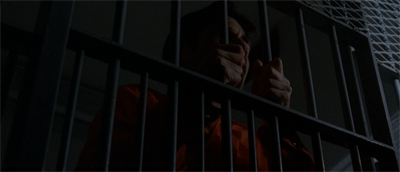
"Hey, look on the bright side, this time next year, you'll be in a psychiatric institution."

“Hey, look on the bright side, this time next year, you’ll be in a psychiatric institution.”

Continue reading

The X-Files – Musings of a Cigarette-Smoking Man (Review)

This February and March, we’re taking a trip back in time to review the fourth season of The X-Files and the first season of Millennium.

“No great man lives in vain. The history of the world is but the biography of great men.”

– Thomas Carlyle, On Heroes, Hero-Worship, and the Heroic in History

Light 'em up...

Light ’em up…

Continue reading

Star Trek – Patterns of Force (Review)

The first Star Trek pilot, The Cage, was produced in 1964. To celebrate its fiftieth anniversary, this December we are reviewing the second season of the original Star Trek show. You can check out our first season reviews here. Check back daily for the latest review.

Patterns of Force is a rather strange little episode, the type of weird and iconic adventure that Star Trek tended to do quite well. It’s very much an off-the-wall adventure, of the kind that none of the spin-off shows would attempt. “Planet of the Nazis” is a concept that belongs alongside other second-season episodes like “Planet of the Romans” or “Planet of the Gangsters.” It’s a very goofy premise, one that requires considerable suspension of disbelief before the episode even starts.

And, yet, despite the many serious problems with Patterns of Force, this is an episode that very clearly and very forcefully has something to say. Reflecting the world in which it aired, Star Trek is a show that is largely defined by the Second World War. In The City on the Edge of Forever, it was revealed that the Second World War had to happen to beckon the bright and optimistic future of Star Trek. Almost forty years later, the final televised season of the franchise would return to that idea in its opening episode.

"Computer, query. What is Godwin's Law?"

“Computer, query. What is Godwin’s Law?”

Kirk’s “final frontier” was Kennedy’s “new frontier” extrapolated centuries into the future, an optimistic and very American vision of what the twenty-third century might hold. Given that the show aired two decades following the end of the Second World War, the conflict that made America the most powerful global superpower, it makes sense that the conflict should cast a shadow over Star Trek. Various members of the production had served in the conflict, and it remained part of the national consciousness.

So an episode pitting Kirk and Spock against honest-to-goodness space Nazis seemed inevitable.

"Well, there goes syndication in Germany..."

“Well, there goes syndication in Germany…”

Continue reading

Star Trek – Spock’s World by Diane Duane (Review)

The first Star Trek pilot, The Cage, was produced in 1964. To celebrate its fiftieth anniversary, this December we are reviewing the second season of the original Star Trek show. You can check out our first season reviews here. Check back daily for the latest review.

One of the more interesting aspect of Star Trek tie-in media during the eighties was the sense of freedom enjoyed by those working on the line.

One of the more infamous examples concerned DC’s attempts to publish a monthly comic during the release cycle of Star Trek II: The Wrath of Khan, Star Trek III: The Search for Spock and Star Trek IV: The Voyage Home. The three films tended to build off one another, forming a tight continuity, but that did not stop the comic book company from trying to build off the ending of each of the films, leading to a variety of weird continuity hijinks. Spock left to work on a Vulcan ship; Kirk took command of the Excelsior; a Klingon joined the crew.

Writers working on the tie-in novels enjoyed a similar amount of freedom. By the time that Spock’s World was published in 1989, Diane Duane had been able to firmly establish her own supporting cast of characters in her various tie-in novels. Spock’s World includes appearances from Duane regulars like K’s’t’lk and Harb Tanzer, introduced in The Wounded Sky; even Lia Burke from My Enemy, My Ally puts in an appearance. It really feels like Duane has carved out her own space within the larger Star Trek universe.

However, perhaps that freedom finds its strongest expression in the fact that Duane was able to map an entire cultural and social history unto the planet Vulcan. Spock’s World reads almost like a biography of a fictional planet – charting the history of Vulcan from the planet’s earliest days through to the twenty-third century. It is a delightfully bold and intriguing Star Trek book, one utterly unlike any other tie-in ever published.

Continue reading

Space: Above and Beyond – Never No More (Review)

This November (and a little of December), we’re taking a trip back in time to review the third season of The X-Files and the first (and only) season of Space: Above and Beyond.

On the surface, Never No More and The Angriest Angel feel like a companion piece to Hostile Visit and Choice or Chance. Both are two-part episodes airing around sweeps, almost in step with the equivalent two-part episodes of The X-Files. Both push the show’s story arcs forward. Both also draw in recurring guest stars Doug Hutchinson and Michael Mantell, last seen during Choice or Chance. In many respects, Never No More and The Angriest Angel could be seen as a follow-up to that earlier two-part adventure.

However, there are a number of subtle differences that help Never No More and The Angriest Angel feel like a series highpoint – rather than another ambitious misfire. Hostile Visit and Choice or Chance seemed like episodes trying to do too much, and straying into areas where Space: Above and Beyond had always faced difficulty. They were high-concept science-fiction epic adventures that also tried to work in character arcs for the entire ensemble, set against a truly epic story about an ambitious suicide mission and subsequent rescue attempt.

It's only a paper moon...

It’s only a paper moon…

In a way, Never No More and The Angriest Angel are a lot more modest in their scope. There are big revelations here, and plot points that push the show’s arc forwards. However, these elements are not foregrounded. Never No More and The Angriest Angel are not episodes that aspire to be all things to all people. Instead, they are two character studies centred on the two strongest characters (and actors) in the cast, filling in other details as a secondary concern.

Space: Above and Beyond always worked better as a war show than as a science-fiction drama, and Never No More and The Angriest Angel seem to realise this. The two episodes play as an extended homage to the tropes and conventions of classic war stories. Never No More is the story of love divided by conflict, and The Angriest Angel is a tale of personal discovery set against the backdrop of a larger war. They combine to produce a highlight of the entire Space: Above and Beyond run.

Not a patch on his original squadron...

Not a patch on his original squadron…

Continue reading

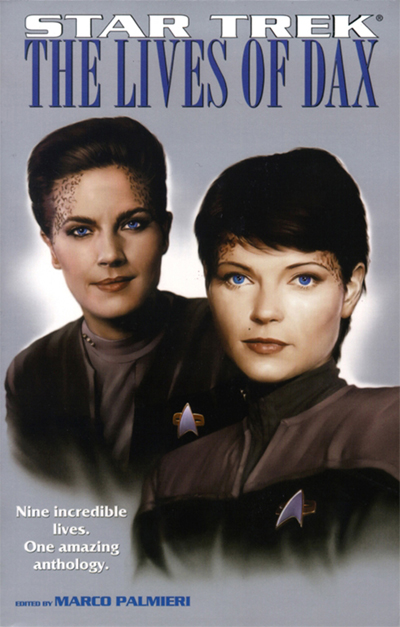
Star Trek: Deep Space Nine – The Lives of Dax: The Music Between the Notes (Curzon) by Steven Barnes

This September and October, we’re taking a look at the jam-packed 1994 to 1995 season of Star Trek, including Star Trek: Deep Space Nine and Star Trek: Voyager. Check back daily for the latest review.

Star Trek: Deep Space Nine struggled with the character of Dax on-and-off for the first three years. Terry Farrell found herself at the centre of interesting character-driven stories with Playing God and Facets, but the show tended to treat the Dax symbiont as a macguffin that just happened to be inside Jadzia. Episodes like Dax, Invasive Procedures and Equilibrium tended to marginalise Jadzia so that the symbiont itself could be pushed to the centre of a story driven by other members of the ensemble.

However, Dax is a character with absolutely phenomenal potential. There is something absolutely fascinating idea of a creature that has lived for centuries, and seen generations of history unfold within its lifetime.The symbiont has witnessed countless changes and pivotal moments. Dax has seen civilisations fall and alliances form; Dax has seen old enemies become true friends, and watched civilisations reach out into the cosmos.

The realities of a seven-season television show mean that Deep Space Nine never really got to explore the fact that Dax was living history. Perhaps Blood Oath and Trials and Tribble-ations come closest, using Dax as a rather logical bridge spanning almost a century of continuity. One of the joys of the Star Trek universe is how expansive and how limitless it is. Infinite diversity and all that. While even Dax cannot have seen everything, Deep Space Nine never felt like it captured the sense of Dax as living history.

At its best, Pocket Books’ The Lives of Dax anthology captures this sense of change and movement. The books spans the width and breadth of the Star Trek franchise, as lived through the life of one single organism. It is beautiful.

ds9-thelivesofdax1 Continue reading

The X-Files (Topps) Annual #1 – Hallow Eve (Review)

This August (and a little of September), we’re taking a trip back in time to review the second season of The X-Files. In November, we’ll be looking at the third season. And maybe more.

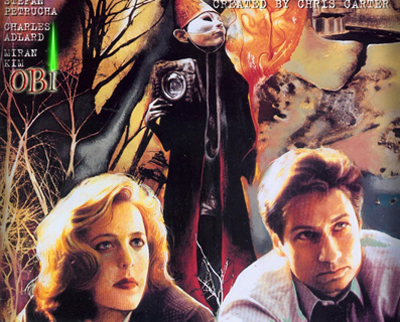
No matter how you cut it, the creative team of Stefan Petruscha and Charles Adlard were prolific. The duo only worked on The X-Files comics book for seventeen months between January 1995 and May 1996, but they put out a phenomenal amount of work. On top of sixteen issues of the monthly series, there were also two digests, a number of short stories and an annual. In most cases, some of this work would be outsourced to another creative team, but Petrucha and Adlard remain the creative team for Topps’ X-Files comic.

While this undoubtedly required a great deal of creative energy from Petrucha, churning out scripts on a regular basis, it is worth pausing to praise artist Charles Adlard. These days, for a variety of reasons, it seems that major comic book artists have difficulty producing twelve twenty-odd-page issues in a year. Not only was Adlard able to meet that objective, he was able to do that while drawing a large volume of supplementary material, including this feature-length annual.

All about Eve...

All about Eve…

It’s remarkable how consistent it all is. One of the advantages of a tie-in comic book with a steady creative theme is that there’s a much clearer authorial voice. Although Chris Carter oversaw the production of The X-Files, the demand of weekly network television mean that some episodes got more attention than others, and that particular voices tend to shine through. Darin Morgan writes his own version of The X-Files, as do Glen Morgan and James Wong or Howard Gordon or Vince Gilligan. (This isn’t a bad thing, by the way.)

On a comic, with all the issues written by the same author and illustrated by the same artist, there is a bit more consistency. Even though Hallow Eve is a stand-alone one-shot story that exists quite separate to Petrucha and Adlard’s twelve-issue meta-arc, it fits quite comfortably with their themes and subtexts. It’s an episode about history and memory, and perception and reality.

Shocking...

Shocking…

Continue reading

The X-Files – Aubrey (Review)

This August (and a little of September), we’re taking a trip back in time to review the second season of The X-Files. In November, we’ll be looking at the third season. And maybe more.

Aubrey doesn’t necessarily a make a lot of sense. Even as episodes of The X-Files go, “serial killer genes that skip a generation” feels like a logical leap. The idea that not only memories but personalities can be passed from grandfather to granddaughter is absurd even by the standards of a show that just did “magic mushrooms that cure Alzheimer’s and give people telekinesis and open portals to another world.” Perhaps it’s the fact that Aubrey tries to root its story in genetics that makes it seem so ridiculous.

And yet, once you get past that logical leap, Aubrey is a fascinating little episode. Aubrey works on quite a few levels that are disconnected from the story itself. For one thing, it is a Rob Bowman episode, and he is clearly pushing himself. For another, the guest cast features superb performances from Deborah Strang, Terry O’Quinn and Morgan Woodward. There’s also the fact that Aubrey connects almost perfectly with both the underlying themes of The X-Files as a show and of the second season in particular.

Hey little sister, what have you done?

Hey little sister, what have you done?

Continue reading

Grant Morrison and Chris Burnham’s Run on Batman Incorporated – Demon Star & Gotham’s Most Wanted (Review/Retrospective)

23rd July is Batman Day, celebrating the character’s 75th anniversary. To celebrate, this July we’re taking a look at some new and classic Batman (and Batman related) stories. Check back daily for the latest review.

Between September 2006 and July 2013, Grant Morrison crafted his epic Batman saga from the ashes of Infinite Crisis. Over the course of seven years, the Scottish author re-worked and re-imagined the Caped Crusader, boldly trying to condense the character’s convoluted and sprawling history into a single narrative. Morrison pulled elements from across the character’s continuity – including stories believed wiped out by continuity reboots and existing as alternatives or “what-ifs.”

To describe Grant Morrison’s Batman epic as ambitious doesn’t begin to do it justice. It is a story that pushed the character out of what had been his comfort zone since the eighties and nineties. He made Bruce Wayne a father; he killed Bruce Wayne off; he banished Batman to the dawn of time and forced him to fight his way back to the present; he made Dick Grayson into Batman; he turned Batman into a franchise so that it might fight twenty-first century crime.

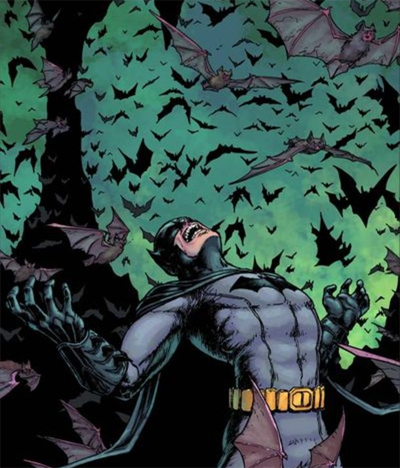
Beware the Batman...

Beware the Batman…

These are all seismic shifts to the status quo, and don’t necessarily conform to what people think about when they imagine a typical Batman story. The character of Bruce Wayne and his world changed dramatically. The very first issue of Morrison’s Batman run featured Batman capturing the last of his classic villains, allowing the Caped Crusader a change to face larger and more existential threats.

It is quite telling that Morrison’s storytelling became the driving force of Batman continuity, with DC spinning books and stories off from his central premise. Scott Snyder’s first Batman epic was The Black Mirror, a story featuring Dick Grayson as Batman, as part of Morrison’s status quo. When the company relaunched Batman & Robin as part of the “new 52”, it featured Damian Wayne as Robin, another innovation introduced by Morrison.

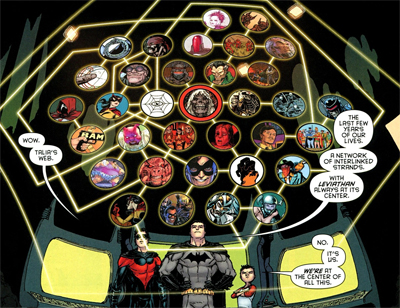
It's all connected...

It’s all connected…

Despite this sense that everything was changing, it seemed inevitable that everything would inevitably be reset. You can only change an iconic character like Batman so much, after all. If you bend Batman too far out of shape, he must inevitably snap back into his classic mould. It’s not inherently a bad thing – “Batman and Robin will never die!” to quote Batman R.I.P., and the characters endure because they revert to archetypes – but it does lend a sense of tragedy to everything.

Coming in the wake of the “new 52” reboot that represented an attempt to reset DC continuity back to its most archetypal configuration, it makes sense that Grant Morrison and Chris Burnham would write the second volume of Batman Incorporated as a tragedy. Morrison would announce his intention to step away from mainstream brand-name superhero stories in the wake of Batman Incorporated, and you can sense some of that fatigue in this story about how everything eventually gets set back to zero.

Everything falls apart...

Everything falls apart…

Continue reading

The Amazing Spider-Man – The Gauntlet: The Juggernaut – Something Can Stop the Juggernaut (Review/Retrospective)

This April, to celebrate the release of The Amazing Spider-Man 2, we are taking a look at some classic and modern comics featuring Spider-Man (and friends). Check back daily for the latest review.

Something Can Stop the Juggernaut is a bit of an oddity in the grand scheme of The Gauntlet, if not the larger scheme of Brand New Day. One of the stated goals of Brand New Day was to present readers with a thoroughly modernised version of Spider-Man, an iteration of the character who had been distilled to his purest essence, unburdened by the weight of decades of character development and continuity.

As the “new” in Brand New Day suggests, a large part of the editorial stance on Brand New Day was the opportunity to do something novel with The Amazing Spider-Man. It was a conscious break with the old, and an attempt to push the character in new directions. After all, the early issues made an effort to shuffle new characters into the established ensemble and to feature new villains and threats for our hero to face.

Leaping into action...

Leaping into action…

(To the point where the emphasis on classic foes was one of the selling points of The Gauntlet – a sense that the comics were finally trying to bring many of these iconic baddies into the twenty-first century alongside a reinvigorated and re-energised Spider-Man. Indeed, it’s interesting how much of The Gauntlet makes a point to reference or mirror Peter’s continuity reset into Brand New Day. Much like Peter in One More Day, many of his classic foes lose their new-found families to reset them to villainy, except without the benefit of a magical reset button at the end.)

So drawing back in celebrated creator Roger Stern to craft a sequel to a beloved eighties Amazing Spider-Man story feels rather surreal. The three-part Something Can Stop the Juggernaut exists as an explicit to Stern’s deservedly beloved classic Nothing Can Stop the Juggernaut, right down to classic flashbacks to the comic, follow-up references to various characters, and the fact that events spiral from that story.

Spidey is a little tied up...

Spidey is a little tied up…

Something Can Stop the Juggernaut is crafted as a celebration of vintage Spider-Man, which works very well in the context of The Gauntlet. As the on-going epic spirals towards its climax in Shed and Grim Hunt, it’s nice to hace a reminder of a classic Spider-Man story. After all, Grim Hunt makes a point to stress the perfection of another classic Spider-Man story, albeit in a very different way.

Something Can Stop the Juggernaut seems to exists to assure readers that the legacy and history of Spider-Man is still valid and meaningful, not rendered moot by the continuity-tinkering shennanigans of One More Day.

The Juggernaut who fell to Earth...

The Juggernaut who fell to Earth…

Continue reading