• Following Us

  • Categories

  • Check out the Archives


  • Awards & Nominations

Space: Above and Beyond – Sugar Dirt (Review)

This November (and a little of December), we’re taking a trip back in time to review the third season of The X-Files and the first (and only) season of Space: Above and Beyond.

The end is nigh.

There is a generally funereal atmosphere to the last few episodes of Space: Above and Beyond, creating the sense that the show was well aware of – and had perhaps come to terms with – its own inevitable cancellation. Stardust had assured viewers (and the show itself) that the dead can be heroes too. Sugar Dirt seems a lot angrier about the series’ situation. It is the story of our heroes surrounded and outgunned on all sides; abandoned to their fate by those in authority.

Sadly, McQueen couldn't quite save the show...

Sadly, McQueen couldn’t quite save the show…

Continue reading

Space: Above and Beyond – Stardust (Review)

This November (and a little of December), we’re taking a trip back in time to review the third season of The X-Files and the first (and only) season of Space: Above and Beyond.

Stardust was the second episode of Space: Above and Beyond to air on a Friday, as had originally been planned.

Of course, it was too late to help the show. By this point in its run, Space: Above and Beyond was a dead show walking. Stardust seems to wryly acknowledge as much. It opens with an inmate on death row, watching the clock tick down to midnight. The show is essentially about sacrifices made by the already-dead, and it’s hard not to get a sense that it captured the mood of the staff on the show as well. A wry wink at the audience, like all the introspective reflection in the earlier episodes.

Cold wars...

Cold wars…

It is also interesting how Stardust positions itself as a possible companion piece to The X-Files. The X-Files casts a pretty significant shadow over Space: Above and Beyond. It was very much an attempt by Fox to capitalise on the success of The X-Files as a genre show. It drafted in two of the most reliable executive producers working on The X-Files. The first two episodes were directed by a veteran of The X-Files. David Duchovny had popped by R & R as something of a goodwill ambassador.

Space: Above and Beyond had played with these comparisons before. The Farthest Man From Home had teased a conspiracy narrative about alien and government cover-ups. Level of Necessity featured a riff on Mulder, with a tall dark-haired paranormal investigator wandering into the show. Stardust makes the connection more explicit, riffing on some of the themes that The X-Files had pushed to the fore at the end of its second season and into the third, exploring links between Native Americans and extraterrestrials.

The honoured dead...

The honoured dead…

Continue reading

Space: Above and Beyond – R & R (Review)

This November (and a little of December), we’re taking a trip back in time to review the third season of The X-Files and the first (and only) season of Space: Above and Beyond.

R & R is what might be described as a “monkey’s paw” situation.

Space: Above and Beyond finally gets to air on Friday nights. It had been promised a Friday night slot in early development, before Fox moved it to Sunday to make room for Strange Luck. Glen Morgan and James Wong had been promised the coveted Friday night slot again in January 1996, but it never materialised. Finally, late in the season, Fox manage to air an episode of Space: Above and Beyond on a Friday night. That episode would even air directly before The X-Files. And not just any episode of The X-Files. Jose Chung’s “From Outer Space”, a classic.

Everything is Coolio!

Everything is Coolio!

However, as the Host himself points out in R & R, everything has its price. Here, it seemed like Fox had chosen the most stereotypically network-friendly episode of Space: Above and Beyond to air in that Friday night slot. So there were hot young people at night clubs, celebrity cameos, romance, angst, melodrama, absurdity. It is one of the most grotesquely heightened episodes of Space: Above and Beyond ever produced, to the point that Hawkes picks up and drops a drug addiction as only one of the episode’s three primary plot threads.

R & R is not a good episode of television. It is the weakest that Space: Above and Beyond has been in quite some time, and the weakest it would be from this point onwards. It seems like a cruel irony that it finally managed to get that Friday night slot it so desperately wanted.

Chalk it up as a misfire...

Chalk it up as a misfire…

Continue reading

Space: Above and Beyond – The Angriest Angel (Review)

This November (and a little of December), we’re taking a trip back in time to review the third season of The X-Files and the first (and only) season of Space: Above and Beyond.

Existentialism is something of a recurring theme in the work of Glen Morgan and James Wong.

It echoes through their work. Mulder’s choice of action ultimately serves to define him in One Breath, in contrast to the other more senior male characters in the narrative. The duo’s second script for Millennium, 5-2-6-6-6, opens with a quote from existentialist philosopher Jean Paul Sartre. Even the pair’s feature film work – The One and the Final Destination films – touch broadly on existentialist themes.

Pressed (up) on the issue...

Pressed (up) on the issue…

However, The Angriest Angel is perhaps the most candid of their scripts, with McQueen explicitly explaining how his actions are serving to define his identity. In his power-house opening monologue, McQueen describes these defining moments as make-or-break points. “Everyone, everyone in this life knows when the moment is before them. To turn away is simple. To ignore it assures survival. But it is an insult to life. Because there can be no redemption.”

This is perhaps the most elegant and effective summary of Morgan and Wong’s approach to character development. McQueen articulates it clearer than any of their characters, but the philosophy applies just as much to Scully in Beyond the Sea or Never Again as it does to Tyrius Cassius McQueen. Indeed, it would come to define their work on Millennium, with the second season repeatedly suggesting that the end of the world was as much a personal event as a massive social occurrence.

Slice of life...

Slice of life…

Continue reading

Space: Above and Beyond – Never No More (Review)

This November (and a little of December), we’re taking a trip back in time to review the third season of The X-Files and the first (and only) season of Space: Above and Beyond.

On the surface, Never No More and The Angriest Angel feel like a companion piece to Hostile Visit and Choice or Chance. Both are two-part episodes airing around sweeps, almost in step with the equivalent two-part episodes of The X-Files. Both push the show’s story arcs forward. Both also draw in recurring guest stars Doug Hutchinson and Michael Mantell, last seen during Choice or Chance. In many respects, Never No More and The Angriest Angel could be seen as a follow-up to that earlier two-part adventure.

However, there are a number of subtle differences that help Never No More and The Angriest Angel feel like a series highpoint – rather than another ambitious misfire. Hostile Visit and Choice or Chance seemed like episodes trying to do too much, and straying into areas where Space: Above and Beyond had always faced difficulty. They were high-concept science-fiction epic adventures that also tried to work in character arcs for the entire ensemble, set against a truly epic story about an ambitious suicide mission and subsequent rescue attempt.

It's only a paper moon...

It’s only a paper moon…

In a way, Never No More and The Angriest Angel are a lot more modest in their scope. There are big revelations here, and plot points that push the show’s arc forwards. However, these elements are not foregrounded. Never No More and The Angriest Angel are not episodes that aspire to be all things to all people. Instead, they are two character studies centred on the two strongest characters (and actors) in the cast, filling in other details as a secondary concern.

Space: Above and Beyond always worked better as a war show than as a science-fiction drama, and Never No More and The Angriest Angel seem to realise this. The two episodes play as an extended homage to the tropes and conventions of classic war stories. Never No More is the story of love divided by conflict, and The Angriest Angel is a tale of personal discovery set against the backdrop of a larger war. They combine to produce a highlight of the entire Space: Above and Beyond run.
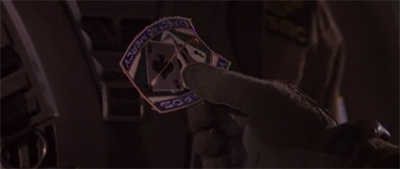
Not a patch on his original squadron...

Not a patch on his original squadron…

Continue reading

Space: Above and Beyond – Who Monitors the Birds? (Review)

This November (and a little of December), we’re taking a trip back in time to review the third season of The X-Files and the first (and only) season of Space: Above and Beyond.

Who Monitors the Birds? is a phenomenal piece of television.

Space: Above and Beyond is a show that only ran one season, languishing on Sunday nights before Fox decided to just scrap the idea of consistently scheduling it and just bounced it around the network timetable. It was not a breakout hit. It did not inspire a revival or resurrection in the way that other science-fiction properties have done. It has a very devoted and strong cult following, but its name is more likely to evoke a vague remembrance than anything more concrete.

spaceaboveandbeyond-whomonitorsthebirds13

And yet, despite that, Space: Above and Beyond was still a massively influential piece of television. Despite the fact that it was structured as a throwback to classic war movies, it was also a very progressive piece of television. The influence of Space: Above and Beyond can be keenly felt on Ronald D. Moore’s Battlestar Galactica, even though the show seldom gets any real credit for that influence. In some respects, Space: Above and Beyond was well ahead of its time.

Who Monitors the Birds? is put together with incredible skill and confidence. It is an episode that holds up fantastically, and which serves as a demonstration of the series’ lost potential.

spaceaboveandbeyond-whomonitorsthebirds3


Continue reading

Space: Above and Beyond – The Enemy (Review)

This November (and a little of December), we’re taking a trip back in time to review the third season of The X-Files and the first (and only) season of Space: Above and Beyond.

On paper, The Enemy seems like a good idea.

Space: Above and Beyond has a reasonably large cast. It has devoted character-centric episodes to the three leads, and done a nice bit of world-building around that. To this point, the shows have typically split the characters up, pushed some to the fore and others to the background.  The show is now about a third of the way through the first season, so it makes a great deal of sense to do a show that actually stresses the ensemble dynamic.

Nothing to fear, but fear itself...

Nothing to fear, but fear itself…

A story like The Enemy makes a great deal of sense. When you have an ensemble, you can generate drama from next to nothing. Lock five people in a room together, you’re sure to generate some friction. Character practically defines itself as they play off one another. If you can crank up the tension, it will all come together. So a war story where our heroes find themselves trapped together and cracking under the pressure seems like a solid basis for a good story.

The problem is that The Enemy is just a clumsy mess of a script, and one that stumbles over what should be a fairly robust set-up.

"I'm still not sure that producing the episode could be considered a war crime..."

“I appreciate that it was traumatic, but I’m still not sure that producing the episode could be considered a war crime…”

Continue reading

Space: Above and Beyond – Ray Butts (Review)

This November (and a little of December), we’re taking a trip back in time to review the third season of The X-Files and the first (and only) season of Space: Above and Beyond.

Ray Butts is a collection of familiar war movie clichés.

Space: Above and Beyond is effectively a gigantic Second World War movie in space, and Ray Butts allows creators Glen Morgan and James Wong to roll two of the most instantly recognisable war movie archetypes into a single character. The eponymous officer is at once a soldier traumatised by his past experiences and a tough new commander for a young unit. He is a source of friction on the show, kept ambiguous and mysterious for most of the episode’s runtime.

We salute you...

We salute you…

Ray Butts piles on the questions. The show doesn’t reveal his orders for quite a while, asking the audience to decide whether they trust the orders – let alone the man assigned to carry them out. The show also plays up questions around Butts himself; is Butts a man trying work through his own issues in his own way, or simply a risk-taking and borderline incompetent commanding officer? Ray Butts doesn’t have too many surprises, but it works because Morgan and Wong know how to structure an episode of television.

After the misfiring ambition of The Dark Side of the Sun, it feels almost like Ray Butts puts Morgan and Wong back in their element.

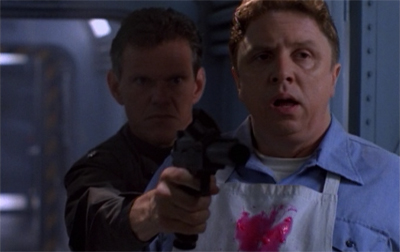
Don't shoot the chef!

Don’t shoot the chef!

Continue reading

Space: Above and Beyond – The Dark Side of the Sun (Review)

This November (and a little of December), we’re taking a trip back in time to review the third season of The X-Files and the first (and only) season of Space: Above and Beyond.

Space: Above and Beyond is half-way between an epic space opera and a wartime saga.

The Dark Side of the Sun confirms something suggested as early as The Pilot. While creators Glen Morgan and James Wong have a firm grasp of the war story aspect of the show, they are a bit less comfortable with the science-fiction elements. While The Farthest Man From Home was a solid old-fashioned “love in wartime” epic, The Dark Side of the Sun is steeped in stock science-fiction elements and interesting ideas, but seems to falter in the execution.

Wild cards...

Wild cards…

It feels very much like Morgan and Wong are trying to push the show’s science-fiction elements to the fore, but aren’t entirely comfortable with those elements. The result is a curious little episode, one that does a decent amount of character and world-building, while also baking some intriguing ideas and concepts into this potential future for mankind. At the same time, there’s an awkwardness to it all, as if The Dark Side of the Sun is trying to establish the show’s sci-fi credentials and can’t quite figure how everything fits together.

The Dark Side of the Sun is a show that feels like it could have used a bit more time and another draft or two, perhaps a reminder that Morgan and Wong are still relatively new at this sort of thing.

Cold dead eyes...

Cold dead eyes…

Continue reading

Space: Above and Beyond – The Farthest Man From Home (Review)

This November (and a little of December), we’re taking a trip back in time to review the third season of The X-Files and the first (and only) season of Space: Above and Beyond.

Due to network anxiety about the investment in Space: Above and Beyond, The Pilot had a very clear three-act structure building to a very explicit resolution. Not only did The Pilot figure the beginning of the war with the aliens, it also featured a crucial moral-boosting victory. It ended with the squad fully-formed and ready for action. It packed a lot of stuff in, and worked quite well as its own self-contained story; even if it left a host of broad narrative threads for the rest of the series to follow.

The Farthest Man From Home is pretty solid as far as first standalone episodes go. Free from the constraints of having to work as a potential movie-of-the-week, The Farthest Man From Home is free to do a little development and foreshadowing, but doesn’t have to wrap up everything in a neat bow by the time that the closing credits role. It’s also spared a lot of the exposition that made The Pilot feel so heavy – Hawkes’ status as an InVitro is fleetingly mentioned, and the Silicates don’t come up.

It's a wasteland out there...

It’s a wasteland out there…

Instead, The Farthest Man From Home is free to focus on the story that it wants to tell, and in marking out narrative space  for the development of both the larger war arc and West’s own personal journey. The Farthest Man From Home is a rather loose episode, but it’s loose in a way that makes sense for a second episode. It eases the audience into the world of Space: Above and Beyond a lot more fluidly than The Pilot did.

That said, there’s still an awkwardness here as Morgan and Wong struggle to figure out what the show is about and the form that it will eventually take. Examined in hindsight, while The Farthest Man From Home establishes a lot of important stuff for the show, it is also clearly a work in progress for the series – an early iteration of a show that would grow and change over the course of its first season. This is perhaps the second draft of Space: Above and Beyond, a solid base to build on for what lies ahead.

Tag it and move on...

Tag it and move on…

Continue reading