• Following Us

  • Categories

  • Check out the Archives


  • Awards & Nominations

Star Trek: Deep Space Nine – The Collaborator (Review)

Star Trek: Deep Space Nine is twenty years old this year. To celebrate, I’m taking a look at the first and second seasons. Check back daily for the latest review or retrospective.

It’s surprising how long we’ve had since a solid Bajoran episode of Star Trek: Deep Space Nine. Barring the dark reflection of Bajor as a power-broker (and brief allusion to a colony in the Gamma Quadrant) in Crossover, the last episode to really explore the planet’s political and religious structure was probably Sanctuary, which aired more than half a season earlier. After a reasonably high concentration of Bajoran political adventures in the first season and the first half of the second, it seems that further explorations will be more broadly spaced.

Indeed, the first season ended (and the second season began) with a five-episode run that was heavily anchored in the show’s Bajoran surroundings. However, as of late, it feels we’ve been strangely disengaged from the show’s stated objective of welcoming Bajor to the Federation. With episodes like The Maquis, it seems like the show is making a conscious effort to disentangle Cardassian politics from those of Bajor.

In a way, this probably represents Deep Space Nine growing into the form that it will take for the rest of its run. The second season has really been about Deep Space Nine figuring out what it wants to be, and what it doesn’t want to be. With The Collaborator‘s focus on Bajoran politics feeling conspicuous by the lack of other Bajor-centric episodes in this half of the season, it seems like Deep Space Nine doesn’t want to be a show about Bajor.

Enough rope to hang himself...

Enough rope to hang himself…

Continue reading

Star Trek: Mirror, Mirror #1 – Fragile Glass (Review)

Star Trek: Deep Space Nine is twenty years old this year. To celebrate, I’m taking a look at the first and second season. Check back daily for the latest review or retrospective.

We’ll be supplementing our coverage of the episodes with some additional materials – mainly novels and comics and films. This is one such entry.

One of the benefits and the curses of tie-in material is the ability to connect the dots – to tie together two parts of continuity separated by time and space, filling in the blanks in some character or plot arc. Often, this feels extraneous at best. In order for the televised stories to work, there must be enough information conveyed effectively to the audience so they can make their own leaps. Trying to plug imaginary and unnecessary holes is seldom satisfying.

On the other hand, there are occasionally gaps that are worth exploring. These are gaps that have been explained on the show, but which are still large enough that creators can fit their own interesting stories between them. The divide between Mirror, Mirror and Crossover is one such gap, as we go from the original Star Trek‘s version of the mirror universe to the very different iteration seen on Star Trek: Deep Space Nine.

Tom DeFalco’s Fragile Glass attempts to sketch in some of the details around this gap. While it’s not entirely satisfying as either a missing link or a story in its own right, it does offer some nice pulpy fun and gets considerable mileage out of the “Spock vs. Kirk” premise.

I am not Spock...

I am not Spock…

Continue reading

Star Trek: Deep Space Nine – The Maquis, Part II (Review)

Star Trek: Deep Space Nine is twenty years old this year. To celebrate, I’m taking a look at the first and second seasons. Check back daily for the latest review or retrospective.

Oddly enough, for an episode designed to serve as a launching pad for Star Trek: Voyager, The Maquis, Part II really feels like the point where Star Trek: Deep Space Nine becomes Ira Steven Behr’s show. Deep Space Nine had been created by Michael Piller and Rick Berman. While Berman oversaw the franchise as a whole, Piller had been a guiding influence during the first two seasons of Deep Space Nine. However, his attention would wander to both Voyager and the pending films based on the Star Trek: The Next Generation film franchise.

As a result, producer Ira Steven Behr would be left in the driving seat of Deep Space Nine. Behr had some experience with the franchise. he was part of the wonderful writers’ room responsible for the massive upswing in the quality of The Next Generation, but left after a year on that show – describing it as “the Connecticut of Star Trek.” Years later, he was aggressively pursued by Piller to work on Deep Space Nine, where Piller felt his philosophy might be more at home.

The Maquis, Part II is far from Behr’s first writing credit on the show, and it’s certainly not the first time his influence has been felt. It is, however, the point at which it feels like Behr’s creative vision is firmly cemented the show’s outlook. Piller would move further away over the course of the next year, and Behr’s influence would grow even stronger, but this is the point where Behr’s vision of Deep Space Nine really takes hold.

Burning bridges...

Burning bridges…

Continue reading

The X-Files – Ghost in the Machine (Review)

I like Ghost in the Machine more than I really should. I mean, I know it’s a mess. The plotting is uninspired. The characters are thin. There’s a last minute link to the show’s overall conspiracy arc thrown in to compensate for the fact that plugging a device into a USB socket is hardly the most thrilling of climaxes. And yet, despite that, I think there’s an endearing weirdness to Ghost in the Machine that appeals to me.

It’s an AI story that has clearly written by a team who (by their own admission) know nothing about computers, and so there’s an almost ethereal quality to the whole thing – Mark Snow’s looping electronic score, the sparse theatrical set design of the COS mainframe, and director Jerrold Freedman’s obvious affection for Dutch angles all contribute to the sense that something rather strange is happening at the very edge of the frame.

Watch out...

Watch out…

Continue reading

Star Trek: Deep Space Nine – Whispers (Review)

Star Trek: Deep Space Nine is twenty years old this year. To celebrate, I’m taking a look at the first and second seasons. Check back daily for the latest review or retrospective.

You could make a credible argument that each of the first three Star Trek shows beautifully encapsulated their time and place. The original show was the very embodiment of the sixties zeitgeist, providing a channel for commentary and insight into counter-culture and the Vietnam War, and an outlet for various fixations and phobias. Star Trek: The Next Generation was a show that spoke to a version of America which was emerging from the Cold War, a clean and sterile morning for a new America.

Star Trek: Deep Space Nine was positioned somewhat strangely, as the idealism and enthusiasm of the early nineties gave way to paranoia and insecurity. If the hyperreal technicolour production values of the original Star Trek spoke to the energy and enthusiasm sixties, then the drab grey Orwellian design of Deep Space Nine was a reflection of the late nineties.

Whispers is really the first time that the show has pushed its sense of paranoia to the fore, and it confirms that Deep Space Nine will be a show of its time, anchored in the nineties.

It's all a bit askew...

It’s all a bit askew…

Continue reading

Star Trek: Deep Space Nine – Armageddon Game (Review)

Star Trek: Deep Space Nine is twenty years old this year. To celebrate, I’m taking a look at the first and second seasons. Check back daily for the latest review or retrospective.

It’s been a while since we’ve had a fairly generic “could have happened on any Star Trek episode of Deep Space Nine. So it’s a lot easier to forgive Armageddon Game its simplicity and lack of nuance. This isn’t a story specific to Deep Space Nine. The basic concept could – rather easily – have been tailored to fit Star Trek: The Next Generation or even Star Trek: Voyager, with two crew members on the run for their lives on an alien world.

Armageddon Game is another story idea from Morgan Grendel, a writer who tends towards extremes. The Inner Light remains one of the best episodes of Star Trek ever produced. The Passenger ranks among the worst episodes of Deep Space Nine ever to make it to the screen. Armageddon Game sits somewhere in the middle.

Talk about chemistry...

Talk about chemistry…

Continue reading

Star Trek: Deep Space Nine – Necessary Evil (Review)

Star Trek: Deep Space Nine is twenty years old this year. To celebrate, I’m taking a look at the first season. Check back daily for the latest review or retrospective.

Commence Station Security log. Stardate 47282.5. At the request of Commander Sisko, I will hereafter be recording a daily log of law enforcement affairs. The reason for this exercise is beyond my comprehension, except perhaps that humans have a compulsion to keep records and lists and files. So many, in fact, that they have to invent new ways to store them microscopically, otherwise their records would overrun all known civilisation. My own very adequate memory not being good enough for Starfleet, I am pleased to put my voice to this official record of this day. Everything’s under control. End log.

Necessary Evil continues to deliver on the promise of “things you can’t do anywhere but Star Trek: Deep Space Nine that Michael Piller made at the start of the show’s second season. It’s a genuinely ambitious piece of Star Trek, all the stronger for the fact that it’s idea that could go horribly and spectacularly wrong. Movies like Blade Runner demonstrated that it is possible to blend the aesthetics of science-fiction and film noir, but it seems like a mix that would sit rather uncomfortably in the bright utopian future of Star Trek.

However, Deep Space Nine was never afraid to experiment with its format. This wasn’t always successful, but it did give the show a unique flavour. And when it did work, as it does here, it offered something new and exciting to the franchise’s playbook.

Time for a Changeling...

Time for a Changeling…

Continue reading

Star Trek: Deep Space Nine – Rules of Acquisition (Review)

Star Trek: Deep Space Nine is twenty years old this year. To celebrate, I’m taking a look at the first season. Check back daily for the latest review or retrospective.

The Nagus was a surprising high-point of the first season of Star Trek: Deep Space Nine. It represented a conscious effort to rehabilitate and reappraise the Ferengi, the aliens introduced as potentially major adversaries in the first season of Star Trek: The Next Generation, only to wind up as mostly unfunny comic relief. The Nagus dared to suggest that the Ferengi might not be the monsters the Federation considers them to be, suggesting that their culture – while different – was no less worthy of respect or consideration than that of the Klingons.

Rules of Acquisition is a clear follow-up, right down to the way that it includes Grand Nagus Zek. However, it’s nowhere near as charming and successful as The Nagus, because it feels like it’s just treading water. It teases potential developments down the line, but the story seems locked in a familiar holding pattern – right down to the rather convenient ending that inevitably sees Quark snatching defeat from the jaws of victory.

It’s not quite a bad episode, certainly not on the scale of the colossal misfire that was Melora, but it’s also not a particularly good one.

Nothing to see here...

Nothing to see here…

Continue reading

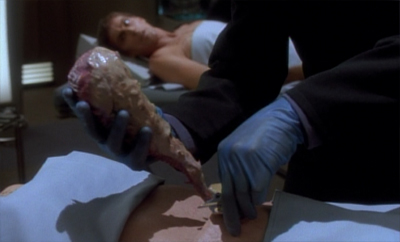
Star Trek: Deep Space Nine – Invasive Procedures (Review)

Star Trek: Deep Space Nine is twenty years old this year. To celebrate, I’m taking a look at the first and second seasons. Check back daily for the latest review or retrospective.

Invasive Procedures is an interesting episode. It has a great high concept, some nice character beats, and offers an inside glimpse at an astonishingly interesting alien culture. Verad is a compelling guest character and Sisko gets to be pretty badass, continuing the presentation of the character as some weird composite of James T. Kirk and Jean-Luc Picard.

There are however, a number of very sizeable flaws. The most obvious being that – despite this is nominally a “Dax” story – Dax winds up feeling more like a plot point than a character in her own right.

Slugging it out...

Slugging it out…

Continue reading

Star Trek: Deep Space Nine – Season 1 (Review)

Star Trek: Deep Space Nine is twenty years old this year. To celebrate, I’m taking a look at the first season. Check back daily for the latest review or retrospective.

Well, that was actually pretty satisfying. Star Trek: Deep Space Nine has probably the most satisfying debut season of any of the Star Trek spin-offs. While the show’s first year can’t quite measure up to the very first season of Star Trek ever produced, it can hold its head high among the spin-offs. Although I will concede that the bar isn’t exactly high when it comes to measuring the first year of the tie-in television shows.

When I began a recent re-watch of Star Trek: The Next Generation, I was glad to finish the show’s rocky first season. It was a slog, like the work one has to put in before delving into “the good stuff.” I recently picked up the blu ray of the first season of Star Trek: Enterprise. While there are a couple of nice episodes, there are quite  a few I’d forgotten entirely because they were so bland. There are more I would like to forget. Star Trek: Voyager‘s first season is the single largest missed opportunity in the history of the franchise.

So Deep Space Nine‘s first year doesn’t have to do that much beyond “not sucking” in order to earn the coveted title of “best pilot season of a Star Trek spin-off.” However, as I watched the season, I was continually impressed with the quality of work done. There are a few duds (and a few classics), but the first year demonstrates remarkable insight into what is unique about the show’s premise. It doesn’t always have the courage to follow through on that promise, but it at least acknowledges it.

ds9-season1a

Continue reading