• Following Us

  • Categories

  • Check out the Archives


  • Awards & Nominations

Non-Review Review: Sin City

We’re currently blogging as part of the “For the Love of Film Noir” blogathon (hosted by Ferdy on Films and The Self-Styled Siren) to raise money to help restore the 1950’s film noir The Sound of Fury (aka Try and Get Me). It’s a good cause which’ll help preserve our rich cinematic heritage for the ages, and you can donate by clicking here. Over the course of the event, running from 14th through 21st February, I’m taking a look at the more modern films that have been inspired or shaped by noir. Today’s theme is “comics noir” – noir filtered through comic book panels.

Sin City is, I suppose, one of those films that lives or dies based solely on its visual style. Although the heavy hardboiled atmosphere compliments the stark black and white contrast, it’s those beautifully and meticulously staged images which come into the mind when one thinks of the Frank Miller adaptation. Based on the writer and artist’s collection of noir-themed comic books set in (Ba)Sin City, Robert Rodriguez’s adaptation manages to faithfully capture the tone and style of its source material. Being honest, it’s one of those movies which can’t help but catch your eye – it’ll just follow up with a punch to the gut.

That little red dress...

Continue reading

Is 300 Racist? A Counter-Argument…

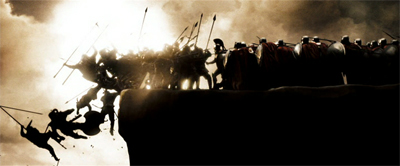
I know that we’re officially about five years past this discussion, but I was thinking about it lately. 300, as imagined by Zack Snyder and Frank Miller, gets a lot of slack for its perceived Islamophobia and racism towards Persians (modern-day Iranians). There’s a rather excellent article here outlining one perspective, which makes the argument that it’s a fundamentally racist film. I sat down and I watched it, and I kept the ideas in mind, and I jotted down some thoughts. it should be noted that I’m just a layman, I’m an expert or a professor in film or literature, but it seemed to me that a lot of the critics were taking the film far too seriously at face value.

I'd want to make this argument on sure footing...

Continue reading

Daredevil: Yellow (Review)

The rest of the story you know too well. It’s been told a lot of ways, with many other people in my life, but this is the way I choose to remember it when I think of you.

– Matt Murdock

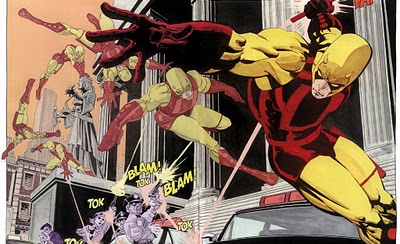
The first part of Tim Sale and Jeph Loeb’s informal ‘colours’ trilogy (Spiderman: Blue and Hulk: Grey being the rest of it), Daredevil: Yellow has a lot going for it beyond the two talents behind a trilogy of iconic Batman stories (Haunted Knight, The Long Halloween, Dark Victory). Cynics would describe it as the last classic that Loeb wrote. The truth is that it offers a wonderful eulogy for the carefree comic book stories of old, simple and ridiculous fare with simple storylines and clear-cut good guys and bad guys. It’s a nostalgia trip – which means it isn’t quite as compelling as the duo’s work on Batman – but it does lend the collection a nice feel to it. If you are in anyway interested in the olden days of comic books without the retro-post-modernism that typically accompanies such fare, this is the story for you.

Daredevil's come on leaps and bounds from his early days...

Continue reading

Could Quentin Tarantino Make “Daredevil”?

Last week it surfaced that Quentin Tarantino was invited to make Green Lantern before Martin Campbell took on the project. Being honest, I am actually more interested in what his Casino Royale would have looked like – he was interested in directing the project and keeping Brosnan in the leading role. It certainly would have been different from Campbell’s reimagining of the Bond series. But during the interview, Tarantino revealed that he might once have been interested in the idea of directing a comic book movie, but that has passed:

So there’s a little part of me that’s like, ‘Wow, if I was in my 20s, this would be the genre I’d want to specialize in’. But they weren’t making them then, or at least not the right ones. But there also is an aspect where I’ve kind of outgrown that a little bit.

I don’t think I’m alone in thinking that Green Lantern – with it’s massive space opera tapestry, inevitable reliance on hockiness that really won’t stand up to deconstruction and newl-emerged status as an A-list comic book hero – would not be ideally suited to Tarantino’s unique skillset. I racked my head thinking of some – Black Panther, Ant-Man, Starman – but I think I kinda settled on the hero would perhaps best suit his style. Daredevil.

Can Tarantino save Daredevil?

Continue reading

Daredevil by Frank Miller Omnibus Companion

I’ve always seen Daredevil as a peculiarly Catholic superhero. Don’t ask me why. Maybe it’s the devil imagery. Frank Miller clearly sees the character as an Irish Catholic (he admitted that he believes the character practices) in an interview at the end of the first omnibus. It just seems to fit. There’s just something so human and organic about the character – so vulnerable and flawed – that he seems like some sort of lost soul amidst the pantheon of god-like superheroes. A man torn between heaven and earth. The fact that probably the greatest story told using the character is titled Born Again and his mother is a nun (as close as you can plausibly get to a virgin, I suppose) doesn’t exactly hurt, either.

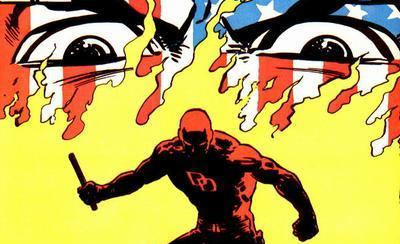
Daredevil puts a novel twist on flag-burning...

Continue reading

Daredevil by Frank Miller & Klaus Janson Omnibus

Comics twenty-five years ago were a very different place. Wackiness was more than welcome – it was encouraged. Deus Ex Machina endings were so common it was a wonder that they ever put the god back into the machine in the first place. The thought bubble hadn’t quite faded from use. But – most importantly – the colours were all bright and cheerful and the phrase “grim and gritty” hadn’t yet entered mainstream vocabulary.

Enter Frank Miller.

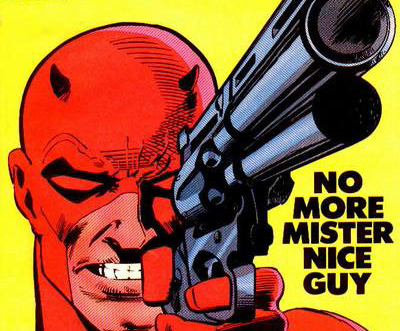
Frank Miller wasted no time making his mark on the character...

Continue reading

Batman: Year One

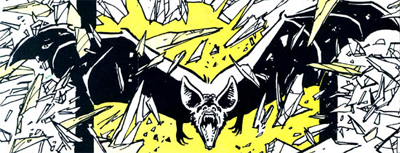
This is probably on a shortlist for the best Batman story of all time, alongside Frank Miller’s other definitive work on the character, The Dark Knight Returns. Whereas Millar focused on the eventual end of the character’s crusade against crime, here he focuses on the origin of the character. Expanding from the one-page origin which accompanied Batman #1, Miller brings his keen eye to Batman’s psychology, but also the world in which Batman functions. This isn’t the gothic construction of Tim Burton, but a grimy urban cesspool like Christopher Nolan’s. In the world that Miller carves out for the hero, he greatest opponents aren’t the disfigured freaks who would become his adversaries, but the architecture of greed and corruption that defines Gotham.

Imagine if it had been a seagull that crashed through his window that fateful night...

Imagine if it had been a seagull that crashed through his window that fateful night...

Continue reading

Batman: Gothic (Review)

Legends of the Dark Knight was an interesting concept – tell self-contained stories using different creative teams set at various points during Batman’s crime-fighting career. As such, those stories would make the title easy to pick up, without tying it excessively to continuity. It’s a simple and an interesting premise, and it did produce all manner of intriguing Batman stories. Grant Morrison’s Gothicis perhaps one of the most intriguing of those stories, taking the character well outside what readers might have expected.

It’s all upside down…

Continue reading

Absolute Batman: The Dark Knight (Returns) (Review/Retrospective)

The Absolute Edition also collects The Dark Knight Strikes Again. Miller’s belated sequel is worthy of discussion on its own terms, and I plan to revisit it at some point. For the moment, however, here is the review of the original Dark Knight Returns.

It’s really quite difficult to discuss The Dark Knight Returns today. Part of the reason is because of the massive influence that Frank Miller’s Batman epilogue had on the medium, and part of it is because Miller himself has done a fairly efficient job at deconstructing his own definitive Batman work in stories like The Dark Knight Strikes Again and All-Star Batman and Robin the Boy Wonder. It’s impossible to approach Miller’s work here entirely divorced from either reality, and the result is a rather strange and dramatic legacy for one of the most iconic Batman stories ever told. It remains fairly essential reading for anybody even remotely interested in the Caped Crusader, the superhero genre or even the medium as a whole. It’s a classic, albeit one that is sometimes quite difficult to pin down.

Lightning strikes…

Continue reading