• Following Us

  • Categories

  • Check out the Archives


  • Awards & Nominations

Non-Review Review: Tarzan (2013)

Tarzan is a mess. The core tale of a boy raised by apes who struggles to reconnect with his human heritage will always have resonance – the character has endured much more successfully than Edgar Rice Borroughs’ other pulp hero, John Carter. However, this motion-capture adaptation feels like it spends more time pandering and condescending than it does trying to tell an interesting or engaging story.

All the “big” Tarzan moments are hit with the enthusiasm of checking off a list (from “me, Tarzan — you, Jane” to “ooo-ee-ooo-ee-ooo-ee-ooo!”), but there is a staggering lack of trust in the idea of Tarzan to carry a Tarzan movie. Tarzan is a family film that very heavily talks down to its audience – a family constructed around the idea that children aren’t smart enough to follow basic narrative structures. So not only is the plot incredibly one-dimensional, predictable and linear, it is repeatedly and patronisingly explained to the audience.

I am Tarzan, hear me roar!

I am Tarzan, hear me roar!

The last decade has seen an explosion in family-friendly movies that don’t talk down to the younger members of the audience. They recognise that children are not idiots and are capable of following basic plot structures and recognising archetypes. Generally speaking, the success of classic Pixar speaks to the idea that children are shrewder than most animators would have conceded. The strong family films of the last few years have followed suit, realising that kids don’t just want bright colours and snazzy animation – they want the same thing any viewer wants, a good story well told.

Tarzan feels like something on an unnecessary hold-over. The movie looks fairly good – even if the motion capture isn’t cutting edge, the 3D is rendered very well; even if the environments outside the jungle look like levels from a videogame, the jungle itself feels vibrant. However, the script isn’t even willing to stand aside and let the visuals carry the story. The result is a patronising and condescending mess that feels like it is talking down to an audience that it grossly under-estimates.

Bird song...

Bird song…

Continue reading

Non-Review Review: Tracks

Tracks looks absolutely stunning. Photographer Rick Smolan is credited as an inspiration for the look and feel of the film, which makes a great deal of sense – Smolan was the photographer tasked by National Geographic with documenting Robyn Davidson’s trek across Australia. His pictures, accompanying Davidson’s article in National Geographic, captured the raw beauty of the Australian countryside. Director John Curran and cinematographer Mandy Walker create a rich a vivid study of the journey.

The story itself is told at a leisurely pace, allowing the audience to absorb the scale of Davidson’s remarkable accomplishment – as if documenting the sheer breadth of the continent. Tracks isn’t quite perfect. It occasionally indulges a little too heavily in clichés while refusing to delve too far under the skin of its protagonist. Still, it’s a beautifully produced piece of cinema featuring a wonderful central performance and some absolutely breathtaking imagery.

"I walked through the desert with a camel with no name..."

“I walked through the desert with a camel with no name…”

Continue reading

Non-Review Review: We are the Best! (Vi är bäst!)

We are the Best! is an endearing coming of age tale about three unlikely friend who decide – rather spontaneously – to found their own punk rock band. A charming, light-hearted and whimsical story about teenage friendship, We are the Best! occasionally feels a little too unfocused and a little too generic, but it’s elevated by a witty script and three great central performances from young actors Mira Barkhammar, Mira Grosin, and Liv LeMoyne as the central (and unlikely) trio.

Young punks...

Young punks…

Continue reading

Non-Review Review: The Raid 2

The Raid is a modern action classic. It’s a rather simple premise executed with incredible flair – a bunch of cops find themselves trapped in a high-raise tower with an army of organised thugs, forced to fight their way to freedom. It’s not the most original of plots, but it works quite well as a framework upon which to hang some genuinely breathtaking martial arts set pieces. It was a showcase for director Gareth Evans and fight choreographers Iko Uwais and Yayan Ruhian.

The Raid 2 has much to recommend it – with Evans and his collaborators dramatically increasing the mayhem captured on screen. There are any number of memorable fight sequences contained within the film, with Evans, Uwais and Ruhian finding all sorts creative manners of dispatch. The stunts are bigger, the scale larger and the ambition more palpable. In terms of sheer action quotient, the bar has been well and truly raised.

It is a bit of a bloody mess...

It is a bit of a bloody mess…

Unfortunately, The Raid 2 lacks the elegant simplicity of its predecessor. Confined to a single building for one hundred minutes, The Raid was tight and claustrophobic – moving like a locomotive. Running almost an hour longer, The Raid 2 is rather bloated and overstated. Evans’ ambition extends beyond stunt work and fight sequences, and so he tries to craft a crime epic that seems half-way between Infernal Affairs and Only God Forgives, lacking the humanity of the former and the operatic sensibilities of the later.

The result is an overblown mess of a film that really comes together for a powerhouse final forty minutes. The last act of The Raid 2 manages to capture the frantic momentum of the first film, with a sense of constantly escalating scale and brutality. Unfortunately, the rest of the film doesn’t quite measure up.

Raiding the pantry...

Raiding the pantry…

Continue reading

Non-Review Review: Rio 2

Rio 2 is a solidly-constructed sequel. It lacks the emotional heft that has come to distinguish most of the more memorable family films. Instead, it opts for a constant barrage of music and colour to keep the young audience engaged. Nothing ever lingers too long, with a set piece or a musical number sure to kick off within a scene or two. There’s nothing wrong with this approach – Rio 2 is a perfectly enjoyable piece of family film.

At the same time, it never slows itself down (or even tones itself down) long enough for use to invest in the characters. There is always something happening, which means that our characters never seem to catch their breath. Given the movie’s story touches on heavy themes like connecting with one’s roots, cultural identity, and environmentalism, there is a sense that these ideas might work better if given room to breath a bit.

Still, the result is engaging and diverting, if not entirely satisfying.

All the way to Rio...

All the way to Rio…

Continue reading

Non-Review Review: Noah

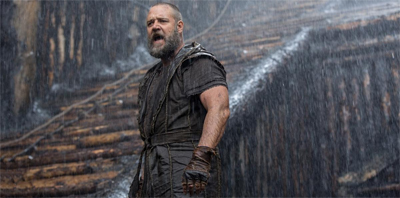
Noah is very hard to process. It’s very much an adaptation of its source material – very clearly a biblical epic that draws from The Book of Genesis in terms of tone and mood and imagery. It’s a story that is harrowing and horrifying, couched in allegory and metaphor and built around an idea of divinity that is difficult to comprehend.

At points, Darren Aronofsky’s biblical epic seems to move in dream-time; the imagery is abstract, the scope almost impossible to comprehend; time and scale are conveyed through disjointed slideshows that invite the viewer to composite them together, creating a sense that this is more abstract than conventional storytelling.

noah3

Like The Fountain before its, Noah is a story that seems to exist without place and time. Witnessing the devastation that mankind has done to the world around it, it seems like our protagonists have stumbled into a post-apocalyptic wasteland with burnt trolleys and abandoned pipes scattered across scorched Earth.

Past, present and future co-mingle, creating a sense that this is a world without time as we might conventionally understand it. After all, this isn’t the real world. This is a story. The internal logic is prone to shift like uncertain ground, the viewer never quite sure if they’ve properly found their footing. Aronofsky’s vision is at times frustratingly oblique, but more than occasionally brilliant.

noah9

It captures a lot more of The Book of Genesis than most of its critics would concede – in mood and tone as much as literal interpretation. At the same time, it makes a pretty compelling example of why big crowd-pleasing biblical epics don’t tend to draw from The Book of Genesis, favouring later – less difficult and polarising – biblical material.

It’s very hard to imagine Noah as a commercial exercise – to recognise a group that will respond to a story that is willing to be so bold in tackling its subject material. And yet, at the same time, it is an absolutely intriguing piece of cinema.

noah2

Continue reading

Non-Review Review: Divergent

As far as adaptations of popular young adult novels go, Divergent lacks the strong charismatic lead of The Hunger Games or even the campy pleasure of The Mortal Instruments. Working with a premise that feels like it would have made for a delightfully cheesy piece of sixties socially-conscious science-fiction, Divergent proceeds to take absolutely everything far too seriously. Cliché moments play to an over-the-top soundtrack, terrible dialogue is delivered with earnest profundity, the movie failing to take any joy in anything that it does.

There’s a sense of cynicism in Divergent, with the sequels already mapped out, and the studio committed to their release. The result is a movie that never feels compelled to rush, instead spending most of its runtime spinning its wheels, covering familiar ground. It’s over-long and poorly paced, with the first two acts often feeling like a hyper-extended training montage, meaning that by the time anything starts happening the audience can’t wait for it to end. The result is a heavy-handed and over-cooked attempt at social commentary, one reeking of anti-intellectualism and simplistic pandering.

Don't worry, her training covers this...

Don’t worry, her training covers this…

Continue reading

Non-Review Review: Yves Saint Laurent

Jalil Lespert’s Yves Saint Laurent feels more like a mood piece than a biography. Beautifully shot, wonderfully acted and sensuously performed, there’s no real sense of structure to Lespert’s account of one of the most influential fashion designers of the past half-century. While the movie trods familiar bio-pic ground, with betrayals and addictions and scandal and love, it works best as a snapshot of its subject in motion. It doesn’t offer any particular insight into the life and times of Yves Henri Donat Mathieu-Saint-Laurent, instead trying to capture some of the mood of the designer’s life.

Drawing back the curtain...

Drawing back the curtain…

Continue reading

Non-Review Review: Deceptive Practice – The Mysteries and Mentors of Ricky Jay

A veteran magic performer since his childhood, with a career stretching back over half a century, Ricky Jay is an absolutely fascinating subject. Jay is a master magician in his own right, but he’s also a writer, historian and actor. He is this gigantically important pop culture figure, having worked with directors like David Mamet or Paul Thomas Anderson – having appeared in film and television roles unconnected to his stage career. At one point, Jay even reads a poem written about him, The Game In The Windowless Room.

Jay has this incredible diversity of skills and interests, and it’s absolutely intriguing to delve into those interests. Deceptive Practice: The Mysteries and Mentors of Ricky Jay suffers a bit from never really pinning down the man himself, but it does demonstrate his long and abiding affection for the artform of magic, as well as some insightful glimpses at the long history and pedigree of this most mysterious performance art.

deceptivepractice1

Continue reading

Non-Review Review: Good Ol’ Freda

This film was seen as part of the Jameson Dublin International Film Festival 2014.

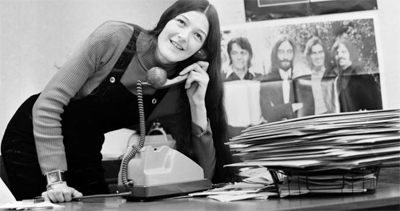
Freda Kelly was secretary to The Beatles, and the head of the official Beatles fan club. She managed letters and schedules and magazines and wages and all these different aspects of the lives of John, Paul, Ringo and George. However, she remains something of a peripheral figure in the grand tapestry of Beatles lore. According to most of the commentators in Good Ol’ Freda, there’s a very simple reason for this.

“My mother never played the fame game,” her daughter notes. Freda never published a tell-all book. She never betrayed confidence. Indeed, one of the stories in Good Ol’ Freda has her firing two assistants for one’s attempt to pass off the hair of a sibling for the hair of a Beatle. Integrity was very much the watchword of Freda Kelly, and it’s something that comes across in the documentary, as Freda rather pointedly refuses to be drawn on more personal or intimate questions.

As a result, there’s very little information here that won’t be familiar to fans of the Fab Four. There are some nice insights and an occasionally endearing anecdote – poor Ringo and his nine fan letters! – but Good Ol’ Freda never really pries too deeply into lives Freda managed for a decade at the peak of their popularity. Instead, Good Ol’ Freda works best as a character study of its subject, a glimpse of a woman who was caught up in a maelstrom and walked out almost completely unaffected.

goodolfreda2

Continue reading