• Following Us

  • Categories

  • Check out the Archives


  • Awards & Nominations

Non-Review Review: Sausage Party

Perhaps the most charming thing about Sausage Party is that it exists in the first place.

After all, a computer-generated animated movie about foul-mouthed hyper-violent and aggressively sexual anthropomorphised food products was always going to be something of a tough sell. More than that, there was always a risk that the film’s best joke could not sustain the necessary ninety-minute runtime. “Let’s do an R-rated comedy animated in the style of a Dreamworks or Pixar film!” is very wry, but it seems like the kind of idea that brews in the early hours of the morning at a wild party and is promptly forgotten.
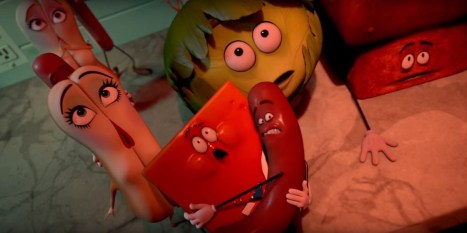
Food for thought...

Food for thought…

At one point in Sausage Party, the heroic hotdog Frank encounters a group of ancient foodstuffs hiding out in the liquor aisle of the shopping market that he calls home. These old and experience foodstuffs recall how they carefully cultivated and curated the mythology of the supermarket, building a religion that treated consumers as “gods” and which encouraged the store’s food and drink to dream of being “chosen.” There is even a hymn that the food sings every morning. A wisened old liquor bottle explains that this whole plan was the result of a massive stoner session.

In some ways, Sausage Party feels like it had a similar genesis, beginning with a goofy joke among friends that escalated and evolved into a surprisingly fleshed-out and developed world. Sausage Party works remarkably well given that it is essentially one very clever joke spread across ninety minutes, padded out with healthy doses of absurdity and puns. While the movie can occasionally feel a little indulgent and meandering, that charm carries it a long way. Sausage Party is one extended gag, but it is just about funny enough to pull it off.

Sweet mother of mercy...

Sweet mother of mercy…

Continue reading

Non-Review Review: War Dogs

At one point in the movie War Dogs, manipulative sociopath Efraim Diveroli presents his naive business partner David Packouz with a gift.

It is a sequence that is as illustrative of War Dogs as it is key for Efraim. The gift in question is a golden hand grenade, a gesture of tremendous subtlety on the part of the film and its secondary lead. See, Efraim and David are self-described gun runners. More than that, they are ostentatious over-the-top gun runners with no sense of tact and the bare minimum of business sense. What better way for Efraim to convey this to David (and for the film to convey it to the audience) than through the gift of a gold-plated hand grenade.

"Quick question: do we HAVE to be framed with these picture of Bush and Cheney? I mean, I think people get it."

“Quick question: do we HAVE to be framed with these picture of Bush and Cheney? I mean, I think people get it.”

However, the kicker comes in the inscription that Efraim has engraved on the bottom of the ridiculous gift. “The world is yours,” the grenade seems to promise its owner. It is, of course, a line from Scarface. It is, in fact, a line from both versions of Scarface. It is the bitterly ironic sentiment that closes out the film, an encapsulation of the greed and hubris that led the two gangster protagonists their downfall. Conveyed through advertising, it was also a stinging commentary on the American Dream. It was the height of irony, a cynical sting at the end of a moral fable.

There is a sense that Efraim does not necessarily understand irony. Having watched War Dogs, it is not entirely clear that the film does either.

Cool gun runnings.

Cool gun runnings.

Continue reading

Non-Review Review: Lights Out

For the bulk of its runtime, Lights Out is a very old-fashioned and very clever horror movie.

The basic premise of Lights Out is quite clever, even on its own terms. The central antagonist of the film is a demonic entity that seems to move through darkness. Characters are safe from its influence so long as they remain in the light. It is a very smart riff on a primal fear. The fear of darkness is the most primal of fears, the anxiety about the unknown and what might lurk in the shadows. Lights Out takes that universal fear and mines it for scares, in a fashion that is very classic while also quite clever.

A bit of the old ultraviolet...

A bit of the old ultraviolet…

The premise alone is enough to drive Lights Out, to power an eighty-one-minute horror film. However, director David Sandberg and writer Eric Heisserer go a great deal further. In the style of many classic horror stories, Lights Out positions its demon as an allegorical device. This demon that stalks its prey through darkness is treated as an apt metaphor for depression, a creature that has latched on to a small suburban family and tormented them quietly for years. It is a premise that The Babadook used to great effect, and it adds a little extra heft to Lights Out.

However, there is a sense that Lights Out is just a little bit too clever for its own good. The film follows its basic premise to a very clever and innovative conclusion within the world that it has created. The problem is that the movie’s final big plot development rather brutally undercuts the central allegory in such a way that the film trips over its own wit. Still, discounting those final few minutes, Lights Out is a visceral thrill-ride and a joy from start to almost-finish.

Red sky at night...

Red sky at night…

Continue reading

Non-Review Review: Suicide Squad

Suicide Squad is a mess.

Like many contemporary blockbusters, it is overplotted and convoluted. For a film with a (relatively) straightforward story and an impressively large ensemble, Suicide Squad twists and turns in a way that makes it impossible to pin down. The film never seems entirely sure when enough is enough, and always seems ready to pile more on top. The film is never entirely sure what the audience should know at a given moment, particularly compared to the characters. Character development is secondary to a series of quick gags and cheap one-liners.

Whacky.

Whacky.

At the same time, there is a certain charm to the film, once it gets past the clunky exposition or the twisty plot or the inevitable myriad of complications that serve to eat up screentime. The core concept of a team of supervillains enlisted to deal with a national crisis is a great story hook, and Suicide Squad featured a collection of intriguing characters brought to life by a fairly great cast. Suicide Squad works best when it lets those characters cut loose, when it cedes the screen to Margot Robbie or Will Smith. There is an energy and verve to it that is contagious.

That energy does not make up for the movie’s shortcomings, but couple with David Ayer’s sense of momentum, it helps to keep the train from coming off the rails for most of the movie’s two-hour runtime.

'Sup Squad?

‘Sup Squad?

Continue reading

Non-Review Review: The Shallows

The Shallows has a pretty great high concept that it stretches just far enough that it begins to creak, but not so far that it snaps back in the audience’s face.

The Shallows is very much a pulpy creature feature horror film, with a healthy dash of tourist anxieties thrown in for good measure. It is a film about a young surfer who finds herself stranded on a rock about two hundred metres from shore as she is menaced by a really determined shark. It is very much a high-tension high-stakes survival thriller, one that lends itself to pithy summaries like Jaws meets Phone Booth or Buried, where the part of Iraq is played by a menacing computer-generated shark.”

Still waters...

Still waters…

It is an absurd set up to sustain across a ninety-minute runtime, and it is to the credit of The Shallows that the movie realises this. The Shallows never resists the absurdity of its premise. It never hesitates or second-guesses itself. The film moves incredibly quickly, recognising that any moment where the tension slips is a moment at which the audience might begin question the underlying assumptions that hold the film together. Like its animal antagonist, The Shallows understands that it needs to keep moving forward if it is to survive.

The result is a survival horror movie less interested in subverting or deconstructing classic genre tropes than it is revelling in the pulpy possibilities of a story like this. The Shallows is much stronger for that.

Oh buoy...

Oh buoy…

Continue reading

Non-Review Review: The BFG

The BFG works better as setting and setpieces than it does as a story.

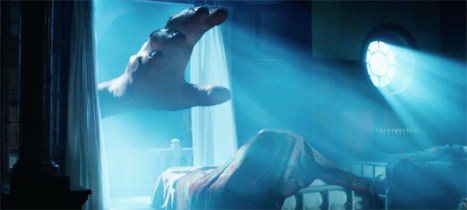
The first half of the film is largely episodic in nature, allowing director Steven Spielberg the opportunity to craft a delightful fantasia built upon the work of Roald Dahl. The world that The BFG builds through motion capture and computer-generated imagery combined with models and sets is quite striking. As befits an adaptation of Roald Dahl’s classic children’s novel, the film is rich in imagination. The first half of the film often feels like a child in a candy store, wandering with its protagonist from one magical set piece to the next.

Keeping it handy...

Keeping it handy…

It is enchanting in a way that evokes the best of Spielberg’s output, the wonder and imagination that has inspired a whole generation of filmmakers. More than that, Spielberg controls the camera with a deft ease that helps viewers to get a sense of why he is so often copied and so rarely equalled. For its first half, The BFG is pure and whimsical Steven Spielberg. Indeed, the film has a somewhat understated eighties setting, which serves to underscore the sense that Spielberg is consciously reconnecting with his crowd-pleasing blockbuster phase. He does not miss a step.

However, The BFG struggles in its second half once the script tries to impose a story upon these meandering and wandering adventures. Although this second half is very much carried over from the source material, it sacrifices a lot of the whimsy and charm that made the first half so endearing. In fact, although the ending is adapted quite faithfully from the novel, it also feels like a concession to modern big-budget film aesthetics. The BFG is a film that works quite well, up until the point that it chooses to emphasise “big” over “friendly.”

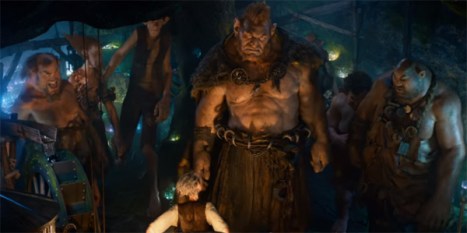
They might be giants.

They might be giants.

Continue reading

Non-Review Review: Finding Dory

Finding Dory is a demonstration of everything that Pixar does well, a bright and colourful treat for kids that offers enough depth for adults.

Pixar have one of the strongest track records in animation, even acknowledging recent missteps like Cars 2 or The Good Dinosaur. At its best, the studio is transcendent, producing films that speak as keenly to parents as they do to children, building entire worlds from pixels that feel so textured and real that audiences do not need 3D to end up lost in them. Inside Out is the most recent demonstration of the studio’s prowess in that regard, a film that deserved to be in the conversation as one of the very best movies of 2016.

I think I see her!

I think I see her!

Finding Dory is not quite at that level. The movie seems unlikely to be remembered as one of the studio’s finest efforts alongside Wall-E or Up. However, second tier Pixar is still fantastic. There is a solid argument to be made that Finding Dory is the film of the summer, a family-friendly treat that can appeal to whole audiences. Kids of all ages will react fondly to the colourful (and beautifully rendered) characters, while the movie also resonates on more profound levels for the more mature members of the family.

As with the best Pixar films, Finding Dory speaks to the idea of family and growing up. The film is held together by a beautiful metaphor about what it means to find a family, and about the idea of returning home as an emotional rather than a literal journey. It is a fascinating and powerful film, but also one with as much heart and energy as anything in the Pixar canon.

Something fishy is going on...

Something fishy is going on…

Continue reading

Non-Review Review: Ghostbusters (2016)

It is very strange to think of Ghostbusters as a film.

For the past year or so, the word has existed as part of a storm ravaging the pop cultural landscape. It became the source of heightened controversy, its own front in the pop culture wars that had already consumed video gaming and the Hugos. To venture an opinion on the film was to wade into that storm, to chase the tornado and to find your opinion subject to all manner of criticism and second-guessing. If you were interested in the film, you were a raving feminist crushing the hopes and dreams of a generation. If you were sceptical, you were a misogynist.

Rocked and loaded.

Rocked and loaded.

With that in mind, it is strange to think of Ghostbusters as actually existing as a film that can actually be watched in a cinema. The film has been the source of so much discussion and debate – so much thought and energy – that it somehow feels “bigger” than two-hour long supernatural action comedy directed by Paul Feig and starring a great cast. Trying to separate the film from that larger discussion feels like a Herculean task of itself, one compounded by the fact that it is neither terrible nor brilliant.

Being sensational or being awful would make the matter a bit easier, because it would tie neatly into one of the two narratives swirling around the film’s production. Instead, it is merely very good. It is an enjoyable supernatural action comedy with a great cast that is always fun to watch, even if it isn’t perfect. In the end, it is just a film. A very good, very enjoyable, slightly flawed film.

Stream of thought...

Stream of thought…

Continue reading

Non-Review Review: The Legend of Tarzan

The Legend of Tarzan is a dysfunctional film.

It is an interesting film in many ways, eschewing a lot of the conventional choices when it comes to adapting the Lord of the Jungle for the silver screen. There are a lot of reasons why this adaptation might want to steer clear of familiar trappings like the origin story or opt for an unconventional starting point, and the result is one of the most intriguing of the year’s big blockbusters. The Legend of Tarzan never follows the path of least resistance, and the resulting film is more fascinating for that.

"Anyone for tea?"

“Anyone for tea?”

It is also a lot less satisfying. Tarzan is an archetypal character. Many of the character’s trappings linger in popular memory. Even people who have never seen a Tarzan film will recognise the character’s battle cry. The loincloth is just as iconic as Superman’s red underwear. There are certain expectations in a Tarzan adaptation. Defying many of those choices is a bold storytelling decision, but that decision creates an absence at the heart of the film. Director David Yates and star Alexander Skarsgård never manage to fill that void.

The result is a film that is fun to puzzle out, but not entirely engaging on its own terms. Characters repeatedly acknowledge “the Legend of Tarzan”, whether sketched on posters or memorialised in song. However, the film spends so much of its first half picking apart the legend that it struggles to put it back together at the climax.

Note: there is more colour in this frame than in the entire film.

Note: there is more colour in this frame than in the entire film.

Continue reading

Non-Review Review: Absolutely Fabulous – The Movie

Absolutely Fabulous: The Movie is that it feels very much like an extended special of the classic British sit-com. Sure, the film has an expanded budget that allows for some suitably glitzy location work. Of course, the film is stuffed to the gills with even more celebrity cameos than you could shake a stick at. However, there is very much a sense that Absolutely Fabulous has not been radically transformed in the transition from goggle box to silver screen. This is very much in the spirit and style of the source material.

That is perhaps both the best and worst thing that could be said about Absolutely Fabulous: The Movie.

Saundering off...

Saundering off…

Continue reading