• Following Us

  • Categories

  • Check out the Archives


  • Awards & Nominations

Non-Review Review: Outlaw King

Outlaw King opens with a very impressive tracking shot, or what at least appears to be a very impressive tracking shot. The sequence lasts more than eight minutes, wherein the audience follows the action at the Scottish surrender to King Edward I. The camera follows various actors at they move through the scene, from inside the tent with King Edward I to the congress outside in the mud. The scene features an impressive sword fight, before heading back into the tent and out the other side, to the point where Kind Edward I has a massive trebuchet waiting.

The Scottish have surrendered. The revolution has failed. The lords of the region have bowed before the British Crown and sworn fealty to the throne. This gigantic instrument of war seems redundant, pointless. It has no purpose in this particular situation. Nevertheless, King Edward insists that the trebuchet be loaded, and discharged towards a prominent Scottish castle on the nearby hill. Edward explains that this is a gesture of authority, making it clear that the surrender is “final.” He adds, “Also, it took three months to build. So I don’t want to waste it.”
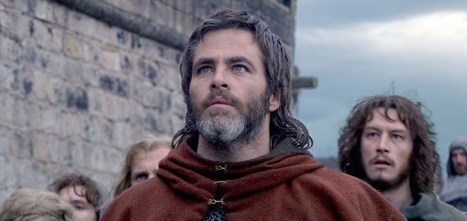
Great Scot!

It is an interesting introductory scene for a number of reasons. Most obviously, it is incredibly technically impressive. Director David Mackenzie is really just showing off here, demonstrating how much control he has over the film, how carefully managed the choreography is, how perfectly he can time the rhythms of the action to the movement of his camera. The introductory scene very skillfully introduces most of the major players and key dynamics that will inform the action that follows, in manner that is graceful and never overwhelming. It’s technically impressive.

At the same time, the entire sequence feels just a little bit like Edward’s gigantic trebuchet and perhaps even a little bit like the film as a whole. It is a wonderfully constructed piece of work that feels over-elaborate and over-complicated for what it is doing. Outlaw is a beautiful film underpinned by some intriguing ideas about power and violence, much like Mackenzie’s work on Hell or High Water. Unfortunately, Outlaw King lacks the warmth and humanity of Hell or High Water. Like that absurd trebuchet, it feels a little overly ornate and never entirely sure of its purpose.
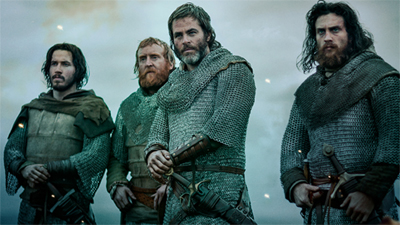
A Brucie Bonus.

Continue reading

Non-Review Review: Bohemian Rhapsody

Bohemian Rhapsody is more invested in being a fairly standard music biopic than with being a slightly more specific Queen biopic.

There’s a weird sense of familiarity that runs through Bohemian Rhapsody, which has nothing at all to do with its central characters and everything to do with the kind of story that it is telling. If anything, Bohemian Rhapsody will appear completely foreign and alien to dedicated fans of Queen, or anybody with even a passing knowledge of the bad’s history and discography. Instead, it will feel most comforting and familiar to the aficionados of the old tried-and-true biographical feature film formula memorably lampooned by Walk Hard.

Spotlighting its subject.

Bohemian Rhapsody repeatedly brushes up against conflicts between history as it occurred and the rhythms of that standard narrative template. In every single case, Bohemian Rhapsody chooses to side with the narrative template rather than the historical record. It is debatable whether there is anything inherently wrong with this, to be fair. This sort of film-making is an act of adaptation. It is often necessary to conflate, distort of fabricate events in order to convey an essential truth about some real-life person or character, because real life is not a narrative, despite best efforts to impose one upon it.

However, it is one thing to manipulate or distort the finer details of a narrative to hint at a deeper truth. It is another thing entirely to warp reality to fit an assembly blueprint that reveals next to nothing about any of its subjects.

A pale reflection of the man himself.

Continue reading

Non-Review Review: They’ll Love Me When I’m Dead

They’ll Love Me When I’m Dead serves as a convincing argument that The Other Side of the Wind works better as a story than as an actual object that exists.

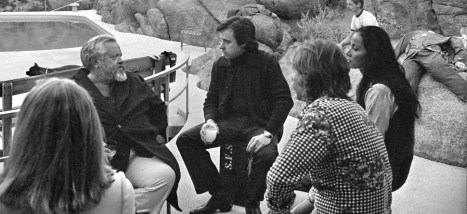
They’ll Love Me When I’m Dead is a feature-length documentary that is only a few minutes shorter than its subject, providing an exploration of The Other Side of the Wind, from its conception through it development and into its long and storied afterlife. It is a very exciting and engaging tale, one that sweeps across Hollywood history, delving into a variety of nooks and crannies. It is a story that is intertwined with dissolving marriages and international politics, of bad luck and tremendous arrogance. All of this existing in the shadow of Orson Welles.

They’ll Love Me When I’m Dead offers an account of the production of Orson Welles’ ill-fated experimental piece of metafiction. It is perhaps a testament to The Other Side of the Wind that it occasionally feels like They’ll Love Me When I’m Dead can perhaps be folded into the wild ambitions of an ageing filmmaker working on a project that would not materialise during his life-time. Towards the end of They’ll Love Me When I’m Dead, archive footage of Orson Welles finds the auteur musing on his next project.

“Maybe it isn’t even the picture,” he confesses to the press. “Maybe it’s just talking about the picture.” Maybe The Other Side of the Wind is not the real headline. Maybe They’ll Love Me When I’m Dead is the real headline.

Continue reading

Non-Review Review: Overlord

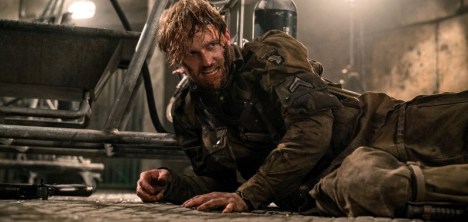
Overlord is a film that works a lot better in concept than in does in execution.

The idea of constructing a pulpy monster narrative around Nazi atrocities during the Second World War has a certain appeal to it. Not only does it evoke the sort of trashy fiction that that often existed at the margins of popular culture, but it also suggests the speculative lenses through which audiences process trauma, the way in which mass media filters horrors almost beyond human comprehension into something tangible and visceral, creating an uncanny and uncomfortable prism through which anxieties over these horrors might be channeled.

Russelling up some fun.

The horrors inflicted by the Nazis are almost impossible to fully comprehend; the systemic brutality inflicted upon those marginalised groups under their authority, the destruction that they wrought across Europe. These traumas linger in the popular memory. While the reality of those atrocities must never be forgotten or downplayed, there is something very powerful in the idea of translating that to the screen through the cinematic language of horror. Like Wolfenstein, Overlord seems to suggest an impressionistic portrait of the horrors of the period.

This approach is intriguing, and there are moments when Overlord works very well, when the film is creepy and unsettling in all the ways that it should be creepy and unsettling. However, the film suffers greatly when the script tries to impose a familiar framework on these horrors, when it runs through the checklist of storybeats expected for a major modern cinematic release. Put simply, Overlord works best when it aspires to be Captain America: The First Avenger, but as a horror film” and it works worst when it just tries to be Captain America: The First Avenger.

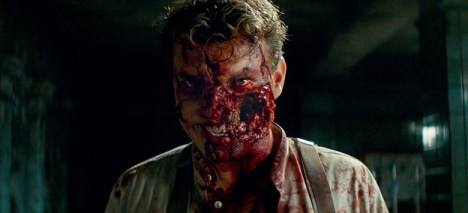
I want to take his face… off.

Continue reading

Non-Review Review: Sorry to Bother You

Sorry to Bother You is striking, vibrant and vital. And essential.

Boots Riley’s directorial debut is a work of striking confidence, one that emerges almost perfectly formed with the skill and craft of a director much more experienced. Sorry to Bother You knows exactly what it is doing from one moment to the next, without any sense of hesitation of self-doubt. Sorry to Bother You is strikingly self-assured, maintaining an incredible level of high-energy across its runtime. This sustained propulsive dynamism in infectious, as the movie bounces from one big idea to the next.

Dialing up the social commentary.

The most obvious antecedents of Sorry to Bother You are the vibrant science-fiction social satires of the eighties, most notably the work of Paul Verhoeven that used a hyper-stylised aesthetic to depict the grosteque excesses of capitalism. Of course, the true horror of Sorry to Bother You lies in the sense of how the world itself has moved to close the gap over the past three decades. Although Sorry to Bother You unfolds primarily in a lightly fictionalised Oakland, the most unsettling aspect of the film is how close it feels to the modern status quo.

Sorry to Bother You is a work of bold vision.

Few satires are a patch on this.

Continue reading

CinÉireann – Issue 9 (September 2018)

The latest issue of CinÉireann has just been released.

It’s full of the usual great stuff, mostly thanks to editor Niall Murphy. However, there’s also some other great stuff in there including Conor Murphy‘s regular column on cinematic education and Ronan Doyle‘s “Queer Ire” column. I contributed a piece on Black ’47, the Irish famine western that is one of my favourite films of the year so far, discussing it in the context of the mainstreaming of the postcolonial western.

As ever, there is some fantastic talent involved in the issue, and it is an honour to get a chance to write for CinÉireann. A massive “thanks” to the fantastic Niall Murphy over at Scannain for letting me be a part of it.

You can read CinÉireann as a digital magazine directly. You can even subscribe and get future issues delivered to you directly. Or click the picture below.

Non-Review Review: Venom

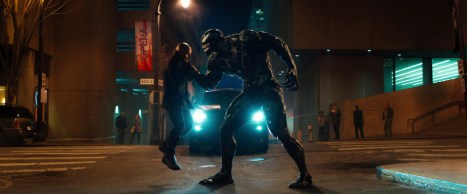
Transformative trauma is a cornerstone of the superhero genre.

Sometimes that trauma is emotional; the deaths of Thomas and Martha Wayne, the loss of Uncle Ben, the explosion of Krypton. Sometimes that trauma is physical; having piping hot metal coated over your bones as your memory is wiped, physically mutating into something unrecognisable as human, having your entire body turn to trauma. To misquote Stan Lee, “with great power comes great responsibility.” More often than not, it also comes with great suffering.

Back in black.

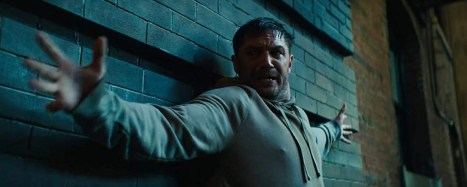
In its best moments, Venom seems to realise this. At the core of Venom is the traumatised character of Eddie Brock, who has watched his entire life fall apart and who suddenly finds himself sharing his body with a murderous alien entity with monstrous appetites. Brock is played by Tom Hardy, one of those rare actors with both immense physical presence and incredibly vulnerability. Unshaved and scruffy looking, with faded tattoos and wearing clothes that look like they haven’t been washed, Eddie looks like he’s been through hell even before his transformative experience.

There are moments when Venom almost plays as a weird psychological thriller about a character experiencing a real-time break from reality, a reporter who is losing his fragile grip on reality after suffering one too many personal and professional setbacks. As the situation gets worse, Eddie starts hearing voices in his head and losing control of his body. He finds himself in a situation where terrible things happen, but he is able to disassociate himself from the brutality and violence. Venom never quite commits to this idea, but it simmers through the story.

Wall’s well that ends well.

The first two acts of Venom are ropey and uneven, suffering from a fuzzy lack of detail and no strong focus on any of the film’s central ideas. Nevertheless, the film survives largely on the strength of Tom Hardy’s performance and the weirdness of the concept. However, things fall to pieces in the third act. Part of this is because Venom feels the need to transform into a regular superhero movie as it reaches its conclusion. Part of this is because Ruben Fleischer cannot direct action. Part of this is because of collision of clumsy exposition and muddled computer-generated imagery.

Venom loses what little control it has of itself as it reaches its climax.

MRI are we here?

Continue reading

100. Inception (#14)

Hosted by Andrew Quinn and Darren Mooney, The 250 is a (mostly) weekly trip through some of the best (and worst) movies ever made, as voted for by Internet Movie Database Users. New episodes are released every Saturday at 6pm GMT, with the occasional bonus episode thrown in.

This time, Christopher Nolan’s Inception.

Dom Cobb is one of the best extractors in the world, an artist who sneaks into people’s dreams and steals their secrets. However, after one botched job, Cobb is approached by a mysterious industrialist with an ambitious proposal: inception. If Cobb can plant an idea in his chief rival’s head, Cobb can finally go home to his long lost family.

At time of recording, it was ranked the 14th best movie of all-time on the Internet Movie Database.

Continue reading

Non-Review Review: A Star is Born (2018)

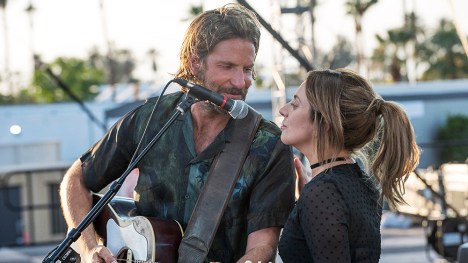
At one point in A Star is Born, Bobby Maine outlines his brother’s approach to music for the benefit of Ally.

According to Bobby, Jackson believes that all music can be broken down to “twelve notes between an octave.” By Jackson Maine’s logic, Bobby explains all musical expression is “those same twelve notes, played over and over again. All any artist can offer the world is how they see those twelve notes.” It is a strange moment, one that comes very close to self-awareness from writer and director Bradley Cooper, suggesting something very close to a mission statement for his directorial debut.

Ain’t playin’.

A Star is Born is the fourth major American motion picture with that name and that premise. There are countless other stories built around the same basic concept, which has itself been translated into various settings and contexts across the globe. The story of A Star is Born is familiar. An older man discovers a talented young woman and elevates her to stardom, while his own grip on celebrity slips away between his fingers. It is an archetypal Hollywood story, and perhaps a defining American fairytale. All Cooper can do is tell that familiar story in his own way.

There are certainly moments when A Star is Born seems to take this idea to heart. In terms of basic trappings and mechanics, A Star is Born gestures towards modernity, understanding that it needs to update its core premise in the way that each of its three forerunners did. There are any number of details within A Star is Born that position the film within the modern cultural context. This is a twenty-first century take on a familiar story, and it looks distinct enough from the earlier three iterations.

Has a nice sing to it.

However, there’s a recurring anxiety within A Star is Born, a sense of trepidation. In terms of style and sensibility, Cooper’s adaptation hews closest to the country-and-western infused seventies remake with Barbara Streisand and Kris Kristofferson, which is a canny choice; it is probably the least seen and the least iconic iteration of the story, making it ripe for reinvention. However, there is also a strong sense that A Star is Born is reluctant to cross the four decades that have passed since that particular iteration of the familiar story.

The result is a film that feels at odds with itself. A Star is Born is inherently a metafictional text, suggesting a rebirth of Lady Gaga from a pop star to a credible leading actor in a prestige piece. Gaga acquits herself well in the role, but A Star is Born feels uncertain and untrusting of her. Repeatedly, A Star is Born seems to refuse to let Gaga be Gaga, instead adhering to a very fixed and very nostalgic seventies ideal of “authenticity.” This is a film that ends with the assertion that a modern pop star can only find herself when using her voice to deliver an ageing rocker’s words.

Doesn’t quite hit all the right notes.

Continue reading

Non-Review Review: Night School

Night School works better than it probably should, while never quite escaping its fundamental flaws.

Night School suffers from a lot of the structural issues that affect modern studio comedies. Most obviously, the film feels over-extended. It’s not just the run time, which clocks in at a muscular one-hundred-and-ten minutes, which is asking a lot for a broad comedy with a very simple premise. It is the individual jokes within the comedy, which are often stretched to breaking point and beyond. Perhaps the most egregious example is an early gag about finding hair in food at a restaurant, which goes on for what feels like five minutes built around the same standard social set-up.

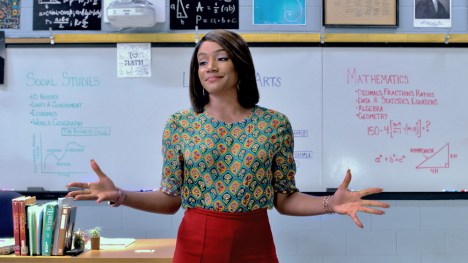
To teach’s own.

There are very few major surprises in Night School. There are a few small and smart ideas buried in the mix, but they often feel crowded out by the broad jokes and the familiar clichés. There’s a recurring sense that Night School doesn’t always play to its strengths, at least below the headline. At the same time, the film understands that it lives or dies by the chemistry between its two leads, offering a conventional persona-driven conflict of manners that places Kevin Hart and Tiffany Haddish in opposition to one another before inevitably moving them into alignment.

Night School is diverting, if unsatisfying. It manages a passing grade, if little more.

Hart to Hart.

Continue reading