• Following Us

  • Categories

  • Check out the Archives


  • Awards & Nominations

Non-Review Review: Wild Mountain Thyme

“Welcome,” narrates Christopher Walken in the opening moments of Wild Mountain Thyme. “Welcome to Ireland. My name’s Tony Reilly. And I’m dead.”

Even before it as released, Wild Mountain Thyme had positioned itself as a viable candidate for the “best bad movie of 2020”, a title that merits some distinction from actually and actively bad movies like Artemis Fowl or Songbird. There is something inherently performative about the idea of “best bad movies”, which requires them to be inherently entertaining in decidedly unconventional ways. Of course, Cats is perhaps the great example of this is recent memory, a terrible movie that has been swiftly reclaimed as a cult classic.
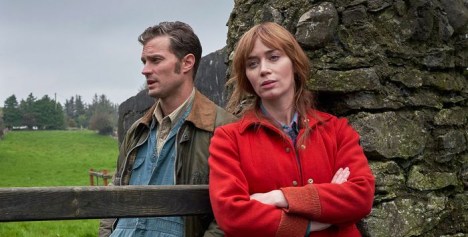
Fifty shade of green.

The premiere of the trailer for Wild Mountain Thyme immediately grabbed the internet’s attention, as did news about the plot of the play from which writer and director John Patrick Shanley was drawing. There was something about the combination of factors at play: the terrible accents, the twee portrayal of rural Ireland obviously written from an outsider’s perspective, Shanley’s interview comments about the Irish, and rumours about an insane third act twist. There was some anticipation that this could be an equivalent to something like Steven Knight’s Serenity.

Of course, the truth is that competing at this level, drawing that sort of interest and fascination, requires a certain spark. For all the problems with Serenity, it was not a film that lacked for ambition. Knight followed his impulses unwaiveringly and unquestioningly, and there’s something intoxicating in watching a film steer itself so confidently towards a premise so completely insane, with no real idea of how to execute the twists that it wants to employ. Sadly, Wild Mountain Thyme lacks that energy and vigour. Indeed, the worst thing about it is how dull it is.
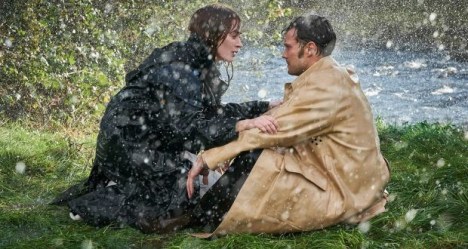
Making a splash.

Continue reading

Non-Review Review: Nomadland

Nomadland is essentially two competing and irreconcilable films.

The first, and more successful film, is a character study of its protagonist. Frances McDormand plays Fern, a widow who has embarked on a life on the road following the death of her husband and the destruction of the community in which she lived. Fern is a wanderer, a restless soul who finds herself trapped between the harsh demands of life on the road and the freedom that such a lifestyle affords her. She is a restless soul wandering across the vast open plains of the United States of the America.

Fern From Home.

The second, and irreconcilable, film is a snapshot of a particular class of people that developed in the aftermath of the Great Recession. As jobs were destroyed and houses were repossessed, large numbers of people found themselves dispossessed and force to live an itinerant existence largely dependent upon the gig economy to keep their heads above the ever-rising tide. There is something almost documentarian about this film, drawing as it does from Jessica Bruder’s non-fiction book and featuring many actual “nomads” in supporting roles.

Nomadland quite rightly refuses to condescend to the people who have found a way to survive on the margins. However, the decision to focus on a character like Fern robs the movie of a lot of its potential sting and insight. Watching Nomadland, there’s something almost empowering about the way that Fern’s existence plays out, a sense in which Fern is living the way that she always wanted to on some level. This feels rather cynical and calculated in the context of the very real and devastating trauma of the financial crisis and the destruction that it wrought.

Continue reading

Non-Review Review: News of the World

News of the World is a gentle and sweet modern western, albeit more than a little disjointed.

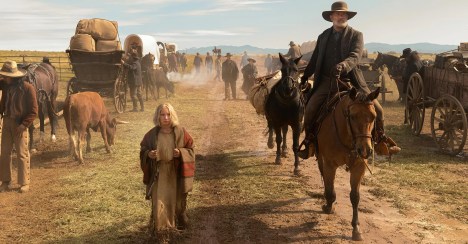
Adapted from Paulette Jiles’ novel of the same name, News of the World is essentially an update on the classic western template exemplified by The Searchers. Captain Jefferson Kyle Kidd is a veteran of the Civil War who makes his living travelling through the Southern United States, reading the news to assembled crowds. On one journey, Kidd comes across a carriage that has been destroyed. Its driver has been killed, and its sole occupant – a young girl – abandoned.

“Jo, hanna! Time to go!”

Kidd determines that the young girl is named Johanna. She was taken from her parents when she was very young and raised by the Kiowa tribe. She was recently recovered, and the army is attempting to send her back to her last surviving relatives. Of course, with her escort killed and the Union forces scattered trying to manage Reconstruction, Kidd finds himself tasked with caring for the young woman and ferrying her across the nation to reunite her with her mother’s extended family.

There’s a surprising and endearing warmth to News of the World, which largely comes from casting Tom Hanks in the lead role. In some ways, this feels like the movie’s most telling update to that classic western formula, replacing John Wayne’s true grit with Tom Hanks’ hanksian decency. News of the World is perhaps a little too episodic and too uneven for its own good, occasionally feeling like a more mainstream counterpart to something like The Sisters Brothers, but it works largely thanks to the central performances of Tom Hanks and his co-star Helena Zengel.

Horsing around.

Continue reading

New Escapist Column! Twenty Years Later, “Battle Royale” Still Stands Apart…

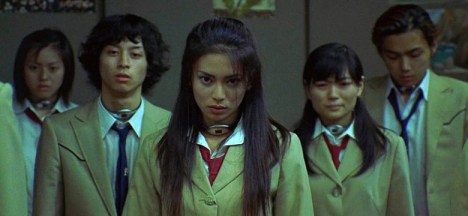
I published a new In the Frame piece at The Escapist this evening. Because Battle Royale is twenty years old this month, it seemed like a good opportunity to take a look back at the iconic Japanese film.

In the years since the release of Battle Royale, there has been an explosion of dystopian young adult fiction based around similar premises: the idea of children forced to kill other children to survive. There are plenty of examples of this subgenre, most notably The Hunger Games, Divergent and The Maze Runner. However, Battle Royale has aged better than these other films for two core reasons. First of all, it acknowledges the horror of its premise, rather than sanitising it. Second of all, it understands that this social decay is perhaps more mundane than sensationalist.

You can read the piece here, or click the picture below.

Non-Review Review: Let Him Go

Any plot summary of Let Him Go inevitably does the film a disservice.

After all, the basic narrative of Let Him Go invites comparisons to the “da’ction” genre that was popularised by Taken. (In fact, Honest Thief is in cinemas at the moment, proving that even the pandemic cannot kill the Liam Neeson midlife action film.) At its core, Let Him Go is a story about an older couple who embark on a journey to rescue their lost daughter-in-law and their grandson from an increasingly ominous set of circumstances. It becomes obvious as the film progresses that George and Margaret are mounting a rescue mission in hostile territory.

Peak Da’ction? (Or “Dad-ction”, for our American readers?)

In reality, Thomas Bezucha’s film is a much more meditative and contemplative affair than that description suggests. Let Him Go offers a quiet and introspective character study of an elderly couple venturing through the wilds of the American heartland, navigating their shared grief offer the loss of their son in a freak accident as much as their anxieties around the possible fate of their grandson. Much of Let Him Go consists of George and Margaret trying to navigate a strange world, but also one another.

The results are compelling. Let Him Go features flashes of violence and brutality, but it works best as something of a mood piece. It’s a melancholy reflection on a warped and hostile landscape, playing as an update on the classic western template for the modern era.

Bucking the trend.

Continue reading

Non-Review Review: Stardust (2020)

Stardust is not just a terrible movie, it often feels like a very direct insult to its subject.

To some extent, Stardust was inevitable. The commercial and awards success of Bohemian Rhapsody had cemented the musical biopic as an organic extension of the jukebox music genre that had enjoyed popular success with Mamma Mia and Mamma Mia: Here We Go Again. Given that the logical extension had been to move from a Freddie-Mercury-centric biopic to an Elton-John-centric biopic with Rocketman, it seemed that iconic British musical artists from the seventies were ripe for this sort of treatment.

“But the film is a saddening bore.
For she’s lived it ten times or more.
She could spit in the eyes of fools.
As they ask her to focus on…”

David Bowie loomed large in that line-up, so a Bowie biopic seemed the next logical step. Of course, there are two fundamental problems with Stardust. The first is one of genre. Whether fairly or not, the musical biopic has a certain structure and rhythm to it. This was the case with the early iterations of the genre like Ray and Walk the Line, and it was spoofed mercilessly with Walk Hard. That formula is evident in Bohemian Rhapsody and Rocketman, unironically reiterated. That formula has its uses, but David Bowie was an artist who defied those sorts of tropes and beats.

However, the second fundamental issue with Stardust is particular to the movie. A large part of the appeal of musical biopics is the soundtrack, with the plot often feeling like a set of hooks on which the movie might hang iconic and beloved songs. The soundtrack album is a huge part of the commercial appeal of these projects. Rocketman arguably pushed this idea to its extreme by embracing the cinematic language of the musical, but it was there in Walk the Line and Bohemian Rhapsody.

“Time takes a cigarette, puts it in your mouth.
You pull on your finger, then another finger, then cigarette.
The wall-to-wall is calling, it lingers, then you forget.”

With that in mind, it is notable that Stardust is effectively a jukebox musical biography without any jukebox music. The Bowie estate declined to license Bowie’s music for the film, which should have been enough to stop the project dead or at least require a major rethink of the approach to it. Without a killer Bowie soundtrack, trying to emulate Bohemian Rhapsody and Rocketman would be a fool’s errand. There is probably a way to tell the story of David Bowie’s life without including his music, but a formulaic musical biopic is not it.

One almost has to admire the stubbornness in committing to a format almost wholly reliant on a soundtrack that is legally unavailable to the film in question. Almost.

“Making love with his ego,
Ziggy sucked up into his mind,
Like a leper messiah.”

Continue reading

Non-Review Review: Songbird

Perhaps the most surprising thing about Songbird is how tame and lifeless it is.

The trailer arrived in a multimedia firestorm, positioning the movie as a piece of “pandemic-xploitation”, set against the backdrop of a hypothetical future where the current global pandemic had raged for four years. In this climate, public health officials have begun abusing their power, the black market thrives, the government has set up ominous and secretive “Q-zones” to house those affected. “Once you go to the Q-zone, you don’t ever really leave,” an influencer remarks early in the film. The United States operates under “marshal law”, as virus has “mutated” to attack the brain.

Sick privilege, bro.

All of this sounds very crass and very charged, something similar to what happened with the release of The Hunt earlier in the year. Songbird and The Hunt are movies that position themselves as genre pieces with biting resonance to a highly charged and combustible situation. However, like The HuntSongbird is ultimately something of a damp squib. It makes grand gestures towards the current moment, importing all manner of iconography and language associated with the pandemic to give it a patina of relevance, but ultimately ties it to a fairly conventional story.

This is perhaps the biggest difference between something like The Hunt and something like Songbird. The Hunt was ultimately a standard genre movie that disguised itself as something more relevant, but it was reasonably well constructed. In contrast, Songbird is an absurdly slipshod production. The film often feels like it was cobbled together over a weekend to ensure that it would be released at a point where it was still relevant and timely. The result is a shoddily made and vapid piece of work, that somehow feels even more vulgar than a full-throated exploitation film might.

Cooking up a Stormare…

Continue reading

Non-Review Review: The Midnight Sky

The Midnight Sky is an ambitious and sporadically interesting mess.

There are a lot of individual elements that work relatively well in George Clooney’s most recent directorial effort. Indeed, the most surprising thing about this apocalyptic space drama is the way in which is eschews a lot of the stylistic trappings of the recent “sad astronaut” subgenre. Conceptually, The Midnight Sky feels like a companion piece to films like GravityInterstellarThe Martian, First Man, and Ad Astra. It is a story about isolation and about a space mission with the potential to go horribly wrong. However, Clooney gives the film a distinct texture, brighter and bolder.

Drinking it all in.

However, The Midnight Sky never coheres in a satisfying manner. Part of this is simply structural, with Clooney having to consistently cut between two sets of characters in radically different situations in a way that constantly undermines momentum. However, part of this is also narrative, with The Midnight Sky essentially built around a powerhouse closing twenty minutes that are obvious from the opening ten, but have to be delayed and postponed with a series of tonally disjointed episodic adventures to prevent the film from ending too soon.

This is a shame. There are hints of a much better movie in The Midnight Sky, but the film itself gets lost in space.

“Nuke the sky from orbit. It’s the only way to be sure.”

Continue reading

Non-Review Review: The Prom

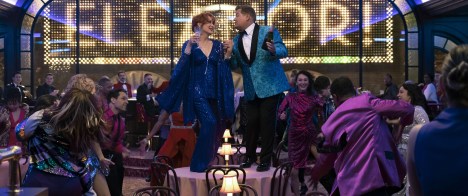
The Prom arrives on Netflix as part of director Ryan Murphy’s deal with the streaming service, similar to the adaptation of The Boys in the Band.

On one level, The Prom is perfectly suited to Murphy’s aesthetic as a director. It is an adaptation of a Broadway musical about Broadway musicals, one that collides with a stereotypical depiction of the American heartland in a way that invites a heightened and almost caricatured version of both. The Prom is a larger than life production, and feels very much of a piece with Murphy’s output as writer, director and producer – from American Horror Story to Ratchet to Glee. There is no sense that any approach to The Prom could ever be “too much”, and so it’s a good fit for Murphy.

Making a whole production of it.

At the same time, The Prom ultimately feels rather empty. Murphy is very good at offering stylised hyperreal worlds, but The Prom feels like a hollow confection. This problem is compounded by a tonal issue; the movie is never entirely sure how cynical or how earnest it wants to be, and so is frequently caught halfway between extremes. The Prom never seems entirely sure whether it’s a brutal parody of feel-good nonsense or a triumphant example of escapist entertainment, so it never works in either register.

This is a shame, given the talent involved in the production and the occasional momentum that the film manages to build through its high-energy song-and-dance numbers and its game cast. Sadly, though, it never manages to hit the high notes that it needs to.

It’s a bit Broad(way)…

Continue reading

“It Will Always Be Broken!” The Strange Melancholy of Martin Scorsese’s “Hugo”…

The podcast that I co-host, The 250, has been running a season of coverage of director Martin Scorsese. Last weekend, we discussed Scorsese’s Hugo. It’s a fun, broad discussion. However, watching the film and talking about the film got me thinking about the film’s strange melancholy.

Martin Scorsese is a more complex and nuanced filmmaker than a casual glimpse at his filmography might suggest.

The clichéd depiction of Scorsese is largely shaped and defined by his most popular movies: Taxi Driver, Raging Bull, Goodfellas, CasinoGangs of New York, The Departed, The Wolf of Wall StreetThe Irishman. Based on these films, there is a tendency to pigeonhole Scorsese as a director who makes violent films about violent men, usually filtered through the lens of the seedy underbelly of organised crime or urban decay. This does not quite capture the breadth and the scope of Scorsese’s interests.

Indeed, Scorsese is a much more interesting filmmaker than that list of classics might suggest, reflected in films as diverse as Alice Doesn’t Live Here Anymore, New York, New York, The Last Waltz, After Hours, The Colour of Money, Age of InnocenceThe Last Temptation of Christ, Kundun and The Aviator. However, even allowing for that range, Hugo stands out as an oddity in Scorsese’s filmography. The film was something of a flop when it was released opposite The Muppets, and is often glossed over in accounts of Scorsese’s career and history.

This is shame. Hugo suffers slightly from arriving in the midst of a late career renaissance for Scorsese that includes some of the best and most successful films that the director ever produced: The Departed, Shutter Island, The Wolf of Wall Street, The Irishman. In the context of that body of work, Hugo is often overlooked. This is a shame, as it’s a magical and wonderful film. It manages to be a children’s film as only Martin Scorsese could produce, suffused with a melancholy and introspection that is rare in the genre.

Continue reading