• Following Us

  • Categories

  • Check out the Archives


  • Awards & Nominations

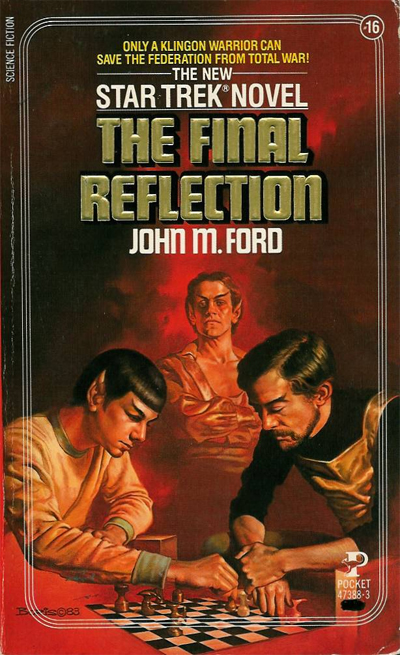
Star Trek – The Final Reflection by John M. Ford (Review)

To celebrate the release of Star Trek: Into Darkness this month, we’ll be running through the first season of the classic Star Trek all this month. Check back daily to get ready to boldly go. It’s only logical.

We’ll be supplementing our coverage of the episodes with some additional materials – mainly novels and comics and films. This is one such entry.

The Final Reflection was written in 1984. Development on Star Trek: The Next Generation would only be announced in 1986. Sure, there were a bunch of successful movies being produced, but these only amounted to a couple of hours of Star Trek once every few years. And, even then, the movies were aimed at a much broader audience, without the same development and continuity that a television show could offer. Not that Star Trek ever really had that tight a sense of continuity, of course, but it must have seemed unlikely that things could ever go back to the way they had been. Certainly, in 1984, nobody could have anticipated the eighteen-straight years of Star Trek running from Encounter at Farpoint to These Are the Voyages.

As a result, fans had to look to other avenues to expand and develop the rich Star Trek universe. The novels were one such avenue, although they developed slowly. Mission to Horatius had been published while the show was on the air, but it was very clearly aimed at a younger audience. Spock Must Die! would be published in 1970. However, the spin-off fiction developed relatively slowly. Star Trek had yet to become a massive franchise with tie-in multimedia commercial opportunities.

Perhaps because the Star Trek novels had not quite turned into a massive franchising opportunity, and they weren’t under the same level of publicity or scrutiny that they would be in the years to come, writer John M. Ford was able to do something quietly revolutionary with his first Star Trek novel, The Final Reflection. He was able to venture away from our core cast of iconic characters and instead develop the Klingon Empire.

More than that, though, he was able to paint the Klingons as the good guys.
tos-thefinalreflection5

Continue reading

Star Trek – A Taste of Armageddon (Review)

To celebrate the release of Star Trek: Into Darkness this month, we’ll be running through the first season of the classic Star Trek all this month. Check back daily to get ready to boldly go. It’s only logical.

It’s amazing to think that A Taste of Armageddon and The Return of the Archons were produced on consecutive weeks by the same television show. Both are politically-charged pieces of pop culture, heavily influenced by the realities of the Cold War, but they adopt two completely different philosophies towards the conflict. The Return of the Archons is a story about the need for freedom and individuality, and how the struggle for those inalienable rights is a battle that must be fought. While it’s debatable whether Landru is a representation of the forces of communism, the episode is unquestionably about the triumph of Western liberal values.

In contrast, A Taste of Armageddon can’t help but feel a little cynical about the whole damn thing.

A shooting war...

A shooting war…

Continue reading

Star Trek – Arena (Review)

To celebrate the release of Star Trek: Into Darkness this month, we’ll be running through the first season of the classic Star Trek all this month. Check back daily to get ready to boldly go. It’s only logical.

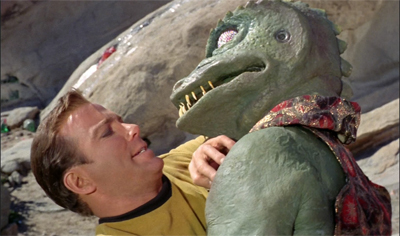
Arena is a fascinating piece of Star Trek, because it’s such an iconic and important piece of franchise history, despite the fact that it’s far from the best that the show has to offer. Indeed, the basic premise of the show is rather generic science-fiction B-movie stuff. Kirk is forced to compete against a lizard-like alien by some god-like beings to ensure the survival of his crew. The script, by producer Gene L. Coon, is credited to a story written by Fredric Brown. Despite its similarities to Brown’s short story of the same name, Arena also shares quite a few plot points with a 1964 episode of The Outer Limits, Fun & Games. None of this is to suggest that Coon was consciously channelling these sources when he wrote the teleplay, just to illustrate how generic the basic plot is.

However, despite (or perhaps because of) this rather straightforward and familiar set-up, Arena is a truly memorable episode of Star Trek. Like quite a few other episodes of the original Star Trek, the episode produced images and concepts that have resonated well outside Star Trek fandom, to the point where elements like the Gorn or Kirk’s highly dubious improvised weapon will be recognisable to people who have never actually seen the episode. However, the episode is also vitally important to the Star Trek franchise itself, as it offers a more thorough expansion and exploration of the back story that has been inconsistently hinted at throughout this first season. Arena is really the first episode to feature a fully-formed framework for the internal logic of the Star Trek universe, one that has informed half-a-century of the franchise.

Plus, you know, Kirk wrestles a lizard man.

Don't pretend you aren't loving every minute of this, Shatner!

Don’t pretend you aren’t loving every minute of this, Shatner!

Continue reading

Star Trek – Romulans: Pawns of War by John Byrne (Review)

To celebrate the release of Star Trek: Into Darkness this month, we’ll be running through the first season of the classic Star Trek all this month. Check back daily to get ready to boldly go. It’s only logical.

We’ll be supplementing our coverage of the episodes with some additional materials – mainly novels and comics and films. This is one such entry.

Where were the Klingons? That seems to be one of the most frequently asked questions when a modern writer re-visits the early part of the first season of Star Trek. It makes sense. The Klingons are the franchise’s flagship aliens, and their long-term relations with the Federation mark one of the show’s earliest examples of continuity. The Organian Peace Treaty from Errand of Mercy is mentioned once or twice, but it informs a lot of the appearances of the Klingons in the classic Star Trek, as the warriors are prevented from engaging in direct warfare with the Federation.

However, when first introduced in Errand of Mercy, towards the end of the first season, the Klingons have just declared war on the Federation. However, it seems like this has been expected for a long time. Kirk speaks of the Klingons like old enemies. Kor knows that captain of the Enterprise by name. There’s a sense of a pre-established history, which makes their appearance towards the tale-end of the season all the more perplexing. Apparently they have been there all along, even if we haven’t seen them before.

John Byrne’s Alien Spotlight issue might have been themed around the Romulans, and the collected edition might be Romulans: Pawns of War, but it seems more devoted to exploring what exactly the Klingons were up to behind the scenes between their appearances on Star Trek.

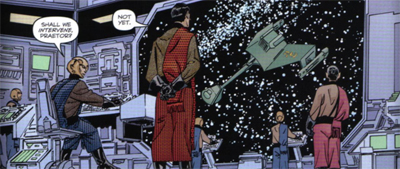
Cry havok, and let slip the dogs of war...!

Cry havok, and let slip the dogs of war…!

Continue reading

Doctor Who: The Monster of Peladon (Review)

To celebrate the fiftieth anniversary of the longest-running science-fiction show in the world, I’ll be taking weekly looks at some of my own personal favourite stories and arcs, from the old and new series, with a view to encapsulating the sublime, the clever and the fiendishly odd of the BBC’s Doctor Who.

The Monster of Peladon originally aired in 1974.

Oh, have a heart, Sarah. I’ve been meaning to pay a return visit to Peladon for ages.

I can’t think why.

– the Doctor and Sarah Jane

What made The Curse of Peladon so fantastic was the fact that it felt so unique and different, as compared to all the Third Doctor adventures that had appeared before. Sure, the Doctor had travelled in time and space in Colony in Space, but The Curse of Peladon was really the first time that the colour television series had indulged in designing a truly alien world populated with truly alien creatures. Since the series had begun transmission in colour with Spearhead from Space, there had been nothing quite like it, and that was what made The Curse of Peladon so refreshing.

As such, the idea of doing The Monster of Peladon seems a bit questionable, especially when it’s going to feature the same world, the same aliens and be two episodes longer than the original adventure.

Not an underrated gem, I'm afraid...

Not an underrated gem, I’m afraid…

Continue reading

Star Trek: The Next Generation – Loud as a Whisper (Review)

To celebrate the twenty-fifth anniversary of Star Trek: The Next Generation, and also next year’s release of Star Trek: Into Darkness, I’m taking a look at the recent blu ray release of the first season (and a tiny bit of the second), episode-by-episode. Check back daily for the latest review.

At the very least, Loud as a Whisper has its heart in the right place. At least of most of its run time. Essentially an issue-driven (and guest-star-driven) show that is determined to prove to the audience that a disability need not define a person, it’s a little undermined by a subplot where Pulaski and Geordi discuss the possibility of making the Chief Engineer “normal” again. However, once you get past the earnestness of it all, Loud of a Whisper seems a little clunky as television drama, with all manner of potentially interesting ideas that are never really explored. The result is a massively disappointing story that feels a bit like a clumsy after-school special.

What goes around...

What goes around…

Continue reading

Star Trek: The Next Generation – The Neutral Zone (Review)

To celebrate the twenty-fifth anniversary of Star Trek: The Next Generation, and also next year’s release of Star Trek: Into Darkness, I’m taking a look at the recent blu ray release of the first season, episode-by-episode. Check back daily for the latest review.

Watching The Neutral Zone, it’s hard not to feel that the first season of Star Trek: The Next Generation should have wrapped up with Conspiracy. At least that would have represented a bold step forwards, even if it wasn’t the direction that the show would ultimately take. In contrast, a lot of The Neutral Zone falls back into the trite, patronising arrogance that we’ve seen our crew demonstrate repeatedly over this first year, treating three refugees from twenty-first century Earth as an excuse to lord their superiority over the viewers at home. It’s a rather strange direction to take, and it certainly doesn’t make for good television. Which feels like a bit of a waste, given that the B-plot is actually quite workable.

"We're back."

“We’re back.”

Continue reading

Star Trek: The Next Generation – Conspiracy (Review)

To celebrate the twenty-fifth anniversary of Star Trek: The Next Generation, and also next year’s release of Star Trek: Into Darkness, I’m taking a look at the recent blu ray release of the first season, episode-by-episode. Check back daily for the latest review.

Conspiracy stands out from the first season of Star Trek: The Next Generation. In fact, it stands out from pretty much the majority of the Star Trek canon, feeling distinctly unpleasant and unnerving throughout. It is not just the gore – which remains one of the most weirdly graphic scenes in Star Trek history, to the point where it was edited out of the original BBC broadcast of the show.

There’s something more unnerving and uncomfortable about Conspiracy, as it represents the first time we’ve really seen the Federation and Starfleet so thoroughly corrupted and subverted. Sure, we’ve had rogue officials, obfuscating bureaucrats and meddling administrators, but Conspiracy represents a thoroughly cynical examination of some of the core concepts that Star Trek takes for granted.

It isn’t indicative of what The Next Generation would eventually evolve into, even seeming considerably darker than Star Trek: Deep Space Nine normally delved, but it does represent something bold and new, something that we never would have seen in the original Star Trek. I think that is what makes it such a fascinating episode in this rocky first season, even ignoring its sizeable flaws.

A can of worms...

A can of worms…

Continue reading

Star Trek: The Next Generation – Symbiosis (Review)

To celebrate the twenty-fifth anniversary of Star Trek: The Next Generation, and also next year’s release of Star Trek: Into Darkness, I’m taking a look at the recent blu ray release of the first season, episode-by-episode. Check back daily for the latest review.

After Arsenal of Freedom, I was wary of Symbiosis. Star Trek has always liked exploring socially and morally relevant ideas through the vehicle of science-fiction. I can understand the appeal of it – science-fiction allows us to divorce basic arguments for all manner of clouding context and to address them in the purest or terms. I think Star Trek is at its most powerful exploring these themes (as The Next Generation would do in episodes like The Outcast), but there’s a risk involved. Nobody wants to be lectured about a simplistic moral principle for forty-minutes, and nobody wants to see a complex issue boiled down past all recognition.

So it’s pretty nice that Symbiosis works quite well. The show is a bit bumpy in places, but it does a lot of things well enough that it’s an entertaining watch. Indeed, it feels like the kind of episode we should have seen a lot earlier in the year.

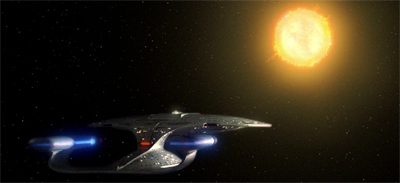
Star gazing...

Star gazing…

Continue reading

Star Trek: The Next Generation – Heart of Glory (Review)

To celebrate the twenty-fifth anniversary of Star Trek: The Next Generation, and also next year’s release of Star Trek: Into Darkness, I’m taking a look at the recent blu ray release of the first season, episode-by-episode. Check back daily for the latest review.

I think Heart of Glory is, ironically, one of the first times that Star Trek: The Next Generation is consciously trying to force its way out of the shadows of its illustrious predecessor. Episodes like The Naked Now and Justice felt like hold-overs from the classic sixties Star Trek, with little acknowledgement that the world (both inside and outside the show) had dramatically changed in the two decades since Star Trek appeared. I used the adjective “ironically”, because Heart of Glory actually sees the return of one of the most classic Star Trek aliens, and one of the most recognisable pop culture extraterrestrials.

The series bible famously stated the show had no real interest in going back to the Klingons, but Heart of Glory suggests that following up with the funky foreheaded aliens might have been the smartest thing that the first season did.

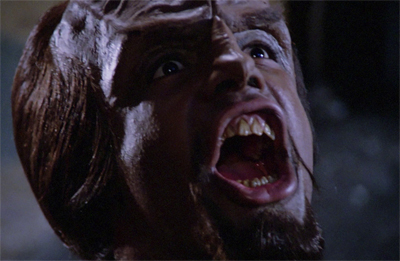
I am Klingon, hear me roar!

I am Klingon, hear me roar!

Continue reading