• Following Us

  • Categories

  • Check out the Archives


  • Awards & Nominations

Star Trek: Enterprise – Bounty (Review)

Next year, Star Trek is fifty years old. We have some special stuff planned for that, but – in the meantime – we’re reviewing all of Star Trek: Enterprise this year as something of a prequel to that anniversary. This April, we’re doing the second season. Check back daily for the latest review.

Just when it seemed like Star Trek: Enterprise was on a roll, it produces Bounty.

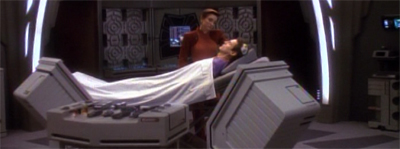
To be fair to writers Mike Sussman and Phyllis Strong, and showrunners Rick Berman and Brannon Braga, Bounty has all the makings of a network-mandated episodes. It is easy to see the stock plot elements manufactured from a checklist provided by the network. T’Pol in her underwear! Space battles! Klingons! The script also demonstrates a clear reluctance about some of these elements, as uncomfortable to be making Bounty as the viewers are to be watching it.

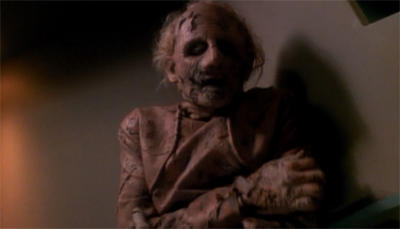
An enlightening experience?

An enlightening experience?

It is perhaps telling that Bounty was buried as the second half of a “double feature” with First Flight on initial broadcast. Not a feature-length adventure or a two-part episode, the scheduling of Bounty seems a little conspicuous, as if everyone involved is trying to get it out of the way as quickly and quietly as possible. Viewers watching UPN on 14th May 2003 would have tuned in for First Flight as usual. If they were lucky, they simply tuned out afterwards and returned to watch The Expanse a week later.

It is a much smoother transition from First Flight to The Expanse, but that does little to justify Bounty. The last stretch of the second season has generally done a good job of bidding farewell to a particular style of Star Trek. However, Bounty is an episode the embodies the worst tendencies of Enterprise. Sadly, those tendencies that may not actually be going anywhere.
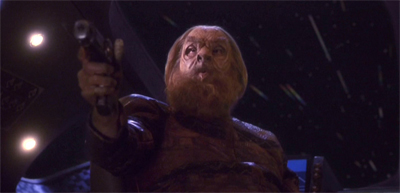
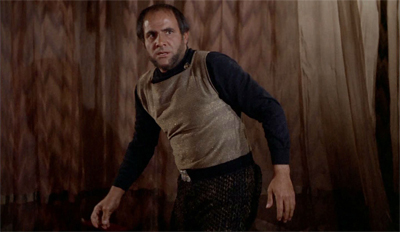
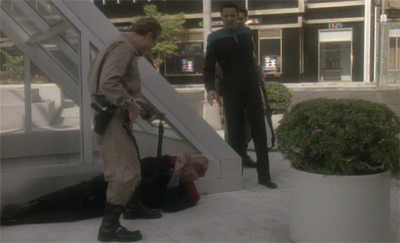
"You're gonna sit there, and like it."

“You’re gonna sit there, and like it.”

Continue reading

Star Trek: Enterprise – The Andorian Incident (Review)

Next year, Star Trek is fifty years old. We have some special stuff planned for that, but – in the meantime – we’re reviewing all of Star Trek: Enterprise this year as something of a prequel to that anniversary. This January, we’re doing the first season. Check back daily for the latest review.

The Andorian Incident is a strange little episode. On the surface, it’s a fairly standard and competently-executed hostage thriller. However, that only scratches the surface. The Andorian Incident is an episode that promises so much more, teasing the potential of Star Trek: Enterprise to evolve into perhaps the most “Star Trek-y of Star Trek shows”, exploring the foundation of the United Federation of Planets and how mankind really found its place in the wider cosmos, building a intergalactic confederation build on peace and tolerance.

The Andorian Incident seems more like a statement of intent from the show, which is a crucial part of any first season.

A bolt from the blue...

A bolt from the blue…

Continue reading

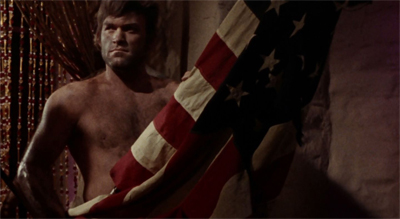
Star Trek – The Omega Glory (Review)

The first Star Trek pilot, The Cage, was produced in 1964. To celebrate its fiftieth anniversary, this December we are reviewing the second season of the original Star Trek show. You can check out our first season reviews here. Check back daily for the latest review.

Gene Roddenberry is a controversial figure who casts a fairly large shadow. It is very hard to talk about Star Trek – particularly the classic Star Trek – without talking about Roddenberry’s influence and vision. Roddenberry was fond of myth-making when he was alive, of playing up his own contributions to Star Trek while marginalising or dismissing the other people who shaped or defined the franchise.

Roddenberry is a polarising figure among fans and critics, insiders and outsiders. To some, Roddenberry was the man who created Star Trek. While this doesn’t immunise him against criticism, it does provide a sense of context – whatever sins he may have committed and whatever faults he may have had must be offset against that. To others, Roddenberry was prone to exaggerate his accomplishments at the expense of people like David Gerrold or Gene L. Coon who shaped the franchise just as much as (if not more than) he did.

Flagging trouble ahead...

Flagging trouble ahead…

While those are two extremes, they are not the only possible views of Roddenberry. There are a broad range of opinions that might be offered, and not all of them are mutually exclusive. Ask a dozen people who know their Star Trek about Roddenberry, and are likely to come up with a dozen nuanced and defensible positions on the man and his legacy. Nobody seems entirely what to make of Roddenberry and his creative contributions to the franchise.

The Omega Glory is an interesting episode, one that invites as much debate as any of Roddenberry’s contributions to the franchise.

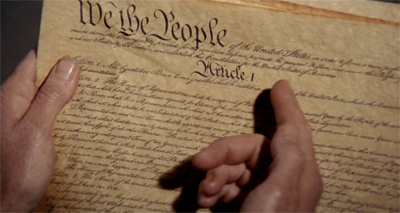
A strong constitution to make it through this one...

A strong constitution to make it through this one…

Continue reading

Star Trek – Return to Tomorrow (Review)

The first Star Trek pilot, The Cage, was produced in 1964. To celebrate its fiftieth anniversary, this December we are reviewing the second season of the original Star Trek show. You can check out our first season reviews here. Check back daily for the latest review.

Return to Tomorrow is similar to By Any Other Name in a number of ways.

Most superficially, it’s an episode about aliens in human bodies, who find themselves learning (or, in this case, remembering) how to appreciate all that mankind has to offer. The plot similarity is rather broad, but it seems strange that By Any Other Name and Return to Tomorrow would be produced right after one another, and that no significant effort would be made to space them apart on initial broadcast. (Both aired in February of 1968.)

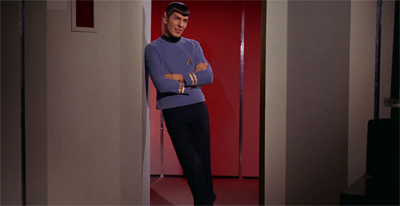
Leonard Nimoy only gets to smile once a year, so the show makes the most of it...

Leonard Nimoy only gets to smile once a year, so the show makes the most of it…

However, there are more fundamental and underlying similarities between Return to Tomorrow and By Any Other Name. Both are episodes that are very much engaged with the underlying philosophy of the franchise, particularly concerning humanity’s place in the universe. Indeed, there’s an argument to be made that Return to Tomorrow and By Any Other Name both work much better as statements of philosophical intent than they do as stories in their own right.

Co-written by Gene Roddenberry, Return to Tomorrow is a rather generic piece of television, but one that feels like a considered statement of the franchise’s central themes.

"Things are going to be a little different around here..."

“Things are going to be a little different around here…”

Continue reading

Star Trek – Journey to Babel (Review)

The first Star Trek pilot, The Cage, was produced in 1964. To celebrate its fiftieth anniversary, this December we are reviewing the second season of the original Star Trek show. You can check out our first season reviews here. Check back daily for the latest review.

Journey to Babel is pretty influential, as episodes of Star Trek go. It is an episode that really cements idea of the Federation that came to be at the heart of the franchise, suggesting that the organisation really is a diverse intergalactic alliance of diverse alien species, rather than a union between Earth and Vulcan. More than that, the episode suggests that the individual members of the Federation might not exist in perfect harmony with one another, but may each operate with their own agenda and motivations.

However, what is really remarkable about Journey to Babel is how much of this unfolds in the background. All this world-building and -embellishing is very much a secondary concern for writer D.C. Fontana. Despite its scale and its scope, Journey to Babel is a decidedly personal story about a family in crisis. It works remarkably well, offering viewers a bit more insight into Spock as a character and where he came from.

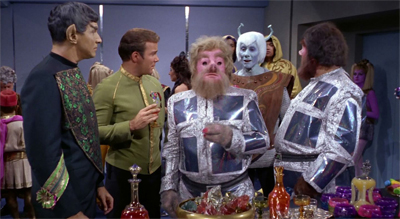
Party on, Gav...

Party on, Gav…

Continue reading

Star Trek – Spock’s World by Diane Duane (Review)

The first Star Trek pilot, The Cage, was produced in 1964. To celebrate its fiftieth anniversary, this December we are reviewing the second season of the original Star Trek show. You can check out our first season reviews here. Check back daily for the latest review.

One of the more interesting aspect of Star Trek tie-in media during the eighties was the sense of freedom enjoyed by those working on the line.

One of the more infamous examples concerned DC’s attempts to publish a monthly comic during the release cycle of Star Trek II: The Wrath of Khan, Star Trek III: The Search for Spock and Star Trek IV: The Voyage Home. The three films tended to build off one another, forming a tight continuity, but that did not stop the comic book company from trying to build off the ending of each of the films, leading to a variety of weird continuity hijinks. Spock left to work on a Vulcan ship; Kirk took command of the Excelsior; a Klingon joined the crew.

Writers working on the tie-in novels enjoyed a similar amount of freedom. By the time that Spock’s World was published in 1989, Diane Duane had been able to firmly establish her own supporting cast of characters in her various tie-in novels. Spock’s World includes appearances from Duane regulars like K’s’t’lk and Harb Tanzer, introduced in The Wounded Sky; even Lia Burke from My Enemy, My Ally puts in an appearance. It really feels like Duane has carved out her own space within the larger Star Trek universe.

However, perhaps that freedom finds its strongest expression in the fact that Duane was able to map an entire cultural and social history unto the planet Vulcan. Spock’s World reads almost like a biography of a fictional planet – charting the history of Vulcan from the planet’s earliest days through to the twenty-third century. It is a delightfully bold and intriguing Star Trek book, one utterly unlike any other tie-in ever published.

Continue reading

Star Trek – Friday’s Child (Review)

The first Star Trek pilot, The Cage, was produced in 1964. To celebrate its fiftieth anniversary, this December we are reviewing the second season of the original Star Trek show. You can check out our first season reviews here. Check back daily for the latest review.

Errand of Mercy was a highlight of the first season. A wry script from producer Gene L. Coon introduced the Klingons as an antagonist for the Federation. Made up to look like space!Mongols, the Klingon Empire was presented as an imperial force hell-bent on expanding its sphere of influence. In case the parallels were a little too subtle, they were locked in a Cold War with the Federation. As such, they were the perfect stand-ins for Communist aggressors trying to undermine American foreign policy.

Of course, Errand of Mercy was brutally cynical in its depiction of the Federation. The episode suggested quite heavily that the Federation was just as imperialist and adversarial as the Klingons. They might couch their foreign policy in friendly language and polite overtures, but their end goals are quite similar. Smaller political entities are nothing but pieces shuffled around a board in a deadly game of chess. Errand of Mercy was not flattering in its portrayal of Kirk, presenting him as little more than a warmonger.

"Damn dirty Klingon!"

“Damn dirty Klingon!”

Errand of Mercy was a massive success. It remains a fan favourite to this day. In some respects, that is due to the introduction of the Klingons, but it is also an exceptional hour of scripted science fiction. So it makes sense that the show would return to the Klingons when it was renewed for a second season. Friday’s Child was the third episode produced during the second season, and returns to quite a few themes hit on by Errand of Mercy. Those themes would recur.

Friday’s Child demonstrates the obvious risks of an episode like Errand of Mercy. It’s an episode that essentially takes the “Klingons as space!Communists” seriously.

We come in peace...

We come in peace…

Continue reading

Star Trek: Deep Space Nine – The Die is Cast (Review)

This September and October, we’re taking a look at the jam-packed 1994 to 1995 season of Star Trek, including Star Trek: Deep Space Nine and Star Trek: Voyager. Check back daily for the latest review.

The Die is Cast is, like Improbable Cause before it, a wonderful piece of television.

As with most Star Trek: The Next Generation and Star Trek: Deep Space Nine two-parters, The Die is Cast maintains continuity and consistency with its predecessor, but it feels like a very different episode than Improbable Cause. After all, the curtain has been pulled back. The assassination attempt is no longer the driving force of the narrative (in fact, it’s barely referenced), with the plot focusing on Enabrain Tain’s pre-emptive strike against the Dominion.

A bruised ego...

A bruised ego…

It’s interesting that it falls to the Cardassians and the Romulans to drive the Dominion plot onwards. There’s been no real development of this long-form plot since Sisko and his crew escaped at the end of The Search, Part II. Episodes like The Abandoned and Heart of Stone have seen the crew encountering individual members of the Dominion, and shows like Visionary have had characters sitting around talking about them, but nothing has actually happened. It is mostly business as usual.

As such, the episode’s title feels beautifully appropriate – it’s the crossing of a threshold, a point from which there can be no return. Not just for Tain or the Cardassians, but the show itself.

Odo's sympathy for Garak runs dry...

Odo’s sympathy for Garak runs dry…

Continue reading

Star Trek: Deep Space Nine – Life Support (Review)

This September and October, we’re taking a look at the jam-packed 1994 to 1995 season of Star Trek, including Star Trek: Deep Space Nine and Star Trek: Voyager. Check back daily for the latest review.

Life Support is the first episode of Star Trek: Deep Space Nine to air after Star Trek: Voyager went on the air. It’s amazing how quickly Deep Space Nine settled back into the role of “the other Star Trek show on television.” A lot of attention was focused on launching Voyager, with the show put in the awkward position of launching (and, in the years ahead, supporting) the new television network UPN. As a result, Voyager got a lot of press and a higher profile.

Deep Space Nine fell back into familiar routines. Life Support is far from an exceptional piece of Deep Space Nine. In fact, it’s a deeply flawed piece of television. However, it feels free of the identity crisis that dominated the first half of the third season. This is Deep Space Nine free of the expectations of being “the only Star Trek on television”, and allowed the freedom to just keep doing whatever it wants to do.

It doesn’t do any of the things that it wants to do particularly well, but it does them in its inimitable way.

Dead air...

Dead air…

Continue reading

Star Trek: Deep Space Nine – Past Tense, Part I (Review)

This September and October, we’re taking a look at the jam-packed 1994 to 1995 season of Star Trek, including Star Trek: Deep Space Nine and Star Trek: Voyager. Check back daily for the latest review.

It’s weird to think that Past Tense aired at the very end of the period where Star Trek: Deep Space Nine was the only Star Trek on television. The two parts were broadcast in early January 1995, after the release of Star Trek: Generations but before the broadcast of Caretaker, the pilot episode of Star Trek: Voyager.

In a way, these are the most “Star Trek”-y episodes of the third season of Deep Space Nine. Embracing the franchise’s utopianism and optimism, the two episodes are even structured as a gigantic homage to The City on the Edge of Forever. Unlike the somewhat cynical and jaded run of episodes leading into them, Past Tense seems to exist as an episode that could draw fans of Star Trek: The Next Generation into Deep Space Nine.

Panic in the streets...

Panic in the streets…

It would have made sense to position the episodes earlier in the season, where they might have done a better job of attracting casual Star Trek viewers jonesing for a fix after The Next Generation went off the air. Unconnected to the serialised long-form plot of Deep Space Nine, engaging with important social issues of contemporary society and playing with familiar Star Trek tropes like time travel, it’s hard to imagine an episode of the third season of Deep Space Nine better suited to reeling in viewers.

As it stands, though, Past Tense aired at the last possible moment where Deep Space Nine could truly claim to be “the only Star Trek on television”, making the two-parter feel more like a footnote than a crescendo. It’s a shame, as Past Tense remains a vastly underrated instalment of the show’s third season.

Arresting drama...

Arresting drama…

Continue reading