• Following Us

  • Categories

  • Check out the Archives


  • Awards & Nominations

Millennium – Antipas (Review)

This July, we’re taking a trip back in time to review the sixth season of The X-Files and the third (and final) season of Millennium.

Antipas is the second of three scripts written by Chris Carter and Frank Spotnitz over the third season of Millennium. It is also the first of Lucy Butler’s two appearances during the third season, although she has little more than a cameo in Saturn Dreaming of Mercury. This is actually the second time that Chris Carter has written for the character of Lucy Butler, having scripted her début back in Lamentation towards the end of the first season. Antipas feels like a conscious effort to connect back to that first appearance.

To be fair, Lucy Butler has been radically different in each appearance. It is difficult to get a read on the character or to suggest a “definitive” take. Finding the “real” Lucy Butler is as difficult as identifying the “real” Millennium Group or as arbitrary as naming the “real” version of Millennium. That said, there are thematic throughlines. Four of her five appearances are tied into children, for example; the show fairly consistently portrays Lucy as a demonic mother figure in contrast to Frank as a loving father.
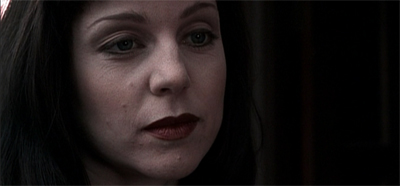
Here's Lucy!

Here’s Lucy!

While the idea of Lucy as a creepy mother ties Antipas into A Room With No View just as much as Lamentation, the script seems to hark more firmly back to Lucy’s character motivation in Lamentation than to her scheming in A Room With No View. In Antipas, Lucy is once again obsessed with biological motherhood, trying desperately to conceive – and even to claim another child as her own. In Lamentation, she sought to mother a child with Doctor Ephraim Fabricant; in Antipas, she seems to aspire towards Frank Black.

Along the way, Antipas is packed with fevered dream imagery and uncanny visuals. As with a lot of the episodes around it, Antipas feels like a very odd piece of television. When Carter wrote Lamentation, this oddness was enough of a break from the norm to power an entire episode. Antipas lacks the sort of strong centre that a piece of television like this needs to ground it. The result is an intriguing and unsettling, if not quite compelling and engrossing, episode of television.
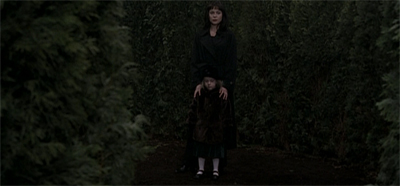
A-mazing nanny...

A-mazing nanny…

Continue reading

Millennium – TEOTWAWKI (Review)

This July, we’re taking a trip back in time to review the sixth season of The X-Files and the third (and final) season of Millennium.

The best thing that can be said about TEOTWAWKI is that it knocks quite a few items off Chris Carter’s “millennial anxieties” checklist – touching on issues of school shootings, gun control, Y2K, anarchy, survivalism, and a few more.

There are some good and interesting ideas in TEOTWAWKI. It is written by Chris Carter and Frank Spotnitz, the first script credited to either writer since the first season of the show. It seems like both writers were clearly thinking about Millennium while working on the fifth season of The X-Files, storing up ideas for late use. TEOTWAWKI is not a script suffering from a lack of ideas. In fact, it has too many ideas packed too tightly. The script isn’t particular graceful; none of the threads dovetail as neatly into one another as they really need to.

Blood money...

Blood money…

This is a recurring theme across the third season of Millennium. There are shows with interesting and compelling ideas, but they are mixed together in a way that doesn’t work – often mingling with some of the more unfortunate creative decisions driving the show. Episodes in the third season frequently feel like curate’s eggs – scrambled messes with good bits and bad bits that are ultimately impossible to separate. TEOTWAWKI might be an interesting mess, but it is still a mess.

TEOTWAWKI makes it clear that The Innocents and Exegesis were not a rough spell as Millennium tried to find its sea legs. This is the way that things will be going forward, at least for a while.

"Doomsday Defense" was a better read...

“Doomsday Defense” was a better read…

Continue reading

Star Trek: Enterprise – Cease Fire (Review)

Next year, Star Trek is fifty years old. We have some special stuff planned for that, but – in the meantime – we’re reviewing all of Star Trek: Enterprise this year as something of a prequel to that anniversary. This April, we’re doing the second season. Check back daily for the latest review.

It is weird to think that Star Trek was dying in early years of the twenty-first century.

After all, the original series had greatly increased its cultural cachet at the height of the Cold War. The adventures of James Tiberius Kirk offered an optimistic alternative to total nuclear annihilation and a doomsday clock that was rapidly approaching midnight. Logic would suggest that utopian fantasy was all the more essential when contrasted against harsh reality. In fact, it seemed like cynicism and pessimism thrived in the (relatively) peaceful and prosperous decade following the collapse of the Cold War. The X-Files and Star Trek: Deep Space Nine were inescapably products of the nineties.

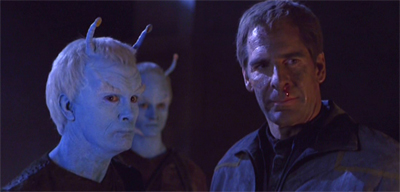
I'm blue dabba dee dabba dii...

I’m blue dabba dee dabba dii…

So one imagines that the dread and fear that took root in the wake of 9/11 might somehow make the optimism and hope of Star Trek all the more essential. After all, pundits and commentators wasted no time in suggesting that irony and cynicism were passé. Stephen Thompson, editor of The Onion, suggested that the age of irony had ended only a week after the attacks.  Graydon Carter, editor of Variety, observed, “I think it’s the end of the age of irony. Things that were considered fringe and frivolous are going to disappear.” In a highly publicised Time article, Roger Rosenblatt rejoiced.

Of course, irony was far from dead, as films like Team America: World Police demonstrated. The Colbert Report became a cultural phenomenon. The Onion is still in business. However, the speed with which these commentators latched on to the idea of the death of irony suggested that the mood had changed perceptibly. Maybe not definitively, maybe not completely, but there was a change in the air. If ever there was a time for the optimism and the utopianism of Star Trek, it would be this particular moment.

"This is the point where everything changed..."

“This is the point where everything changed…”

However, it seemed like 9/11 eroded the franchise’s faith in utopia. Understandably – and perhaps inevitably – Star Trek: Enterprise found itself warped by images and iconography associated with the attacks. The tradition idyllic alien worlds associated with the franchise – visible in early episodes like Strange New World and Civilisation were quickly replaced by landscapes evoking the popular mood – apocalyptic cityscapes of Shadows of P’Jem and Shockwave, Part II, the deserts of Desert Crossing, the militaristic settings of Detained and The Communicator, or even the darkness of Rogue Planet.

It was as if 9/11 had warped the psychological landscape of the Star Trek universe, throwing everything into doubt. Far from responding to that real-world tragedy with optimism and hope, it seemed that Enterprise only lost certainty in itself. Cease Fire is an episode that feels plagued by self-doubt and insecurity, even as it tries to find its way back to the franchise’s trademark idealism. It may not quite find its way back to the path, but it makes a reasonable effort.

It's all in ruins...

It’s all in ruins…

Continue reading

The X-Files – Kaddish (Review)

This February and March, we’re taking a trip back in time to review the fourth season of The X-Files and the first season of Millennium.

Kaddish is the last solo script that Howard Gordon wrote for The X-Files.

The writer would remain part of the writing staff until the end of the fourth season, contributing to scripts like Unrequited or Zero Sum. However, Kaddish would be the last script credited to Howard Gordon alone. So Gordon does not quite get the clean farewell that Darin Morgan got with Jose Chung’s “From Outer Space” or that Glen Morgan and Howard Wong received with Never Again. Instead, Howard Gordon remains a pretty significant presence on the show even after writing his final solo script.

The word made flesh...

The word made flesh…

Nevertheless, Kaddish is packed with a lot of the images and themes associated with Gordon’s work. As with Fresh Bones or Teliko, it is a horror story set within a distinct ethnic community. As with Firewalker or Død Kälm or Grotesque, there is an element of body horror at play. As with Lazarus or Born Again, this is essentially a supernatural revenge story. Kaddish offers a distilled collection of the tropes and signifiers that Gordon helped to define for The X-Files, making it an appropriate final script for the writer.

It helps that Kaddish is a surprisingly sweet and thoughtful little horror story.

The outside looking in...

The outside looking in…

Continue reading

Millennium – Weeds (Review)

This February and March, we’re taking a trip back in time to review the fourth season of The X-Files and the first season of Millennium.

Weeds concludes the loose “suburban trilogy” running through the first season of Millennium. In fact, Weeds was filmed directly after Wide Open, but was pushed back in the broadcast schedule so as to air after The Wild and the Innocent. While this change in broadcast and production order is nowhere near as confusing as the scheduling hijinx happening with The X-Files at the same time, it does give an indication that the production team recognised the potential similarities between Weeds and Wide Open.

Both episodes are about the violation of a supposedly “safe” space, bypassing and subverting all the potential security put in place to keep the home secure. In Wide Open, the killer visits open houses and hides in wardrobes until the family go to sleep that night; in doing so, he avoids setting off any alarms. In Weeds, a secure and gated community discovers that they cannot keep their children safe; someone within the community is preying on the residents’ children. As with The Well-Worn Lock, there is a sense that families are not safe, even when they think that they are.

Community watch...

Community watch…

As with Wide Open, Weeds feels just a little bit sensationalist. It is the kind of episode that attracts criticisms about gratuitous violence or exploitation. Millennium was never quite as excessive or as sadomasochistic as its critics would suggest, but there are definite tendencies towards those extremes on display at certain points in the run. While Millennium is very clearly driven by a core moral philosophy, it can occasionally seem a little too comfortable with its brutality or depravity.

Indeed, Weeds hits on quite a few of the stock fears that run through the first season of Millennium: children are victimised by a person in a position of trust and authority; there is biblical quotation; there is sadistic (and disturbing) torture filmed in a heavily stylised manner. There is something almost cynical and calculated about how Weeds hits these familiar buttons; these impulses towards excess haunt the first season of Millennium, and are building to something of a catharsis in Loin Like a Hunting Flame.

There will be blood...

There will be blood…

Continue reading

Millennium – Wide Open (Review)

This February and March, we’re taking a trip back in time to review the fourth season of The X-Files and the first season of Millennium.

The middle stretch of the first season of Millennium is preoccupied with suburban horror.

In The Well-Worn Lock, Wide Open and Weeds, Millennium presents the audience with threats to supposedly “safe” suburban families. In each case, the threat is shown not to come from outside these homes, but is instead nestled snugly inside. In The Well-Worn Lock, Joe Bangs is a respected family patriarch and a monster. In Weeds, Edward Petey is both an active member of his gated community and a predator. Wide Open is perhaps a little more sensationalist, featuring a serial killer who sneaks into houses that are on display, hiding inside until after dark, and then brutally murdering any adults in the home.

Home (in)security...

Home (in)security…

There is an intriguing thematic continuity here between what might loosely be termed “the suburban trilogy.” Indeed, Weeds was shuffled around in the broadcast order so it would not air directly after Wide Open, perhaps because of this similarity. This thematic continuity is quite striking, like the presence of Scully proxies and surrogates in the stretch of the second season of The X-Files running from One Breath to Irresistible or the subtle fixation on “cancer” from the end of the third season into the fourth season of The X-Files.

Like The Well-Worn Lock before it and Weeds after it, Wide Open is not particularly elegant in its meditations about suburbia under siege. The story is a bit clunky, prone to the same trashy exploitative excess that can be found in some of the weaker moments of the first season. Nevertheless, Wide Open largely works – it manages to tap into a fairly universal fear in a decidedly unsettling manner, inviting the audience to wonder whether there may actually be monster lurking in their own closets or under their own beds.

Standing guard against the world...

Standing guard against the world…

Continue reading

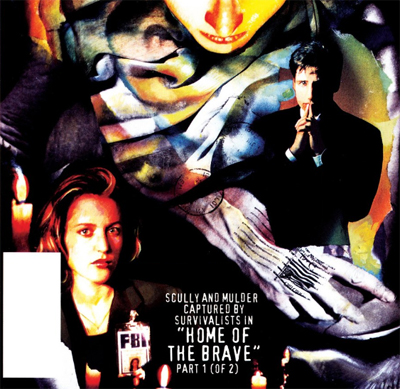
The X-Files (Topps) #15-16 – Home of the Brave (Review)

This November (and a little of December), we’re taking a trip back in time to review the third season of The X-Files and the first (and only) season of Space: Above and Beyond.

And so, we approach the end of an era.

The end of the third season of The X-Files brought down the curtain in a number of different ways. It was the last season of The X-Files to air beginning-to-end on Friday nights, turning it into a truly global phenomenon. It was the last season to air before Chris Carter launched Millennium and the last season broadcast before the show began to focus on The X-Files: Fight the Future; perhaps making it the last season of the show to have Chris Carter’s completely undivided attention for quite some time.

This is the end...

This is the end…

Amid all these changes, the shifting of the creative team on the tie-in comic book is not the biggest change taking place, but it contributes to a larger sense that The X-Files is changing. Writer Stefan Patrucha and artist Charles Adlard had worked on The X-Files since Topps launched the comic. On top of their sixteen issues of the regular series, the duo had worked on an annual, two digests and a variety of short (and special) stories during their tenure.

It is very strange to see the pair departing, because their work on X-Files tie-in comic book ranks as one of the most consistently interesting tie-ins published in mainstream comics.

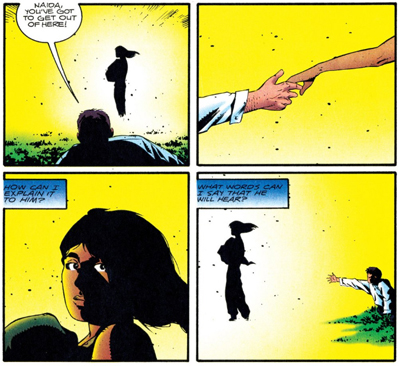
Don't go into the light...

Don’t go into the light…

Continue reading

The X-Files – Quagmire (Review)

This November (and a little of December), we’re taking a trip back in time to review the third season of The X-Files and the first (and only) season of Space: Above and Beyond.

Quagmire is a delightful little episode, one of third season episodes that most effectively embodies what casual fans (or even those who have never seen the show) think of when they hear the words The X-Files.” In Wanting to Believe, author Robert Shearman describes Quagmire as something akin to a “live action Scooby Doo, and he’s not far wrong. This is Mulder and Scully searching together in the darkness, looking for a monster that may or may not be there. You don’t get more archetypical X-Files than that.

One of the defining features of the third season of The X-Files has been a sense of consolidation. It feels like the show experimented a great deal in its first two years, but the third season is very much about cementing and solidifying its identity. It is no wonder, then, that the third season has such a high concentration of archetypal episode – episodes you can show an interested viewer and say this is The X-Files in a forty-five minute nutshell.” In that respect, Quagmire ranks with D.P.O. or Pusher or Clyde Bruckman’s Final Repose as a great introduction to the show.

There's something in the water!

There’s something in the water!

Of course, Quagmire is a very good introduction to The X-Files for new viewers, but it is also something of a farewell. It is Kim Newton’s last script for the show. Newton had joined the writing staff at the start of the third season. Her other major credit was Revelations. Like Revelations, there is a sense that Quagmire was heavily re-written before it made it in front of the cameras. In this case, it is something of an open secret that Quagmire received a fairly significant polish from departing story editor Darin Morgan, whose fingerprints are all over the finished draft.

If Darin Morgan bid farewell to The X-Files with Jose Chung’s “From Outer Space”, then Quagmire serves as something of a coda to his time on the show. If that is the case, it makes for an uncharacteristically upbeat postscript to Morgan’s work on the show.

They really collared the bad guy...

They really collared the bad guy…

Continue reading

Space: Above and Beyond – The Angriest Angel (Review)

This November (and a little of December), we’re taking a trip back in time to review the third season of The X-Files and the first (and only) season of Space: Above and Beyond.

Existentialism is something of a recurring theme in the work of Glen Morgan and James Wong.

It echoes through their work. Mulder’s choice of action ultimately serves to define him in One Breath, in contrast to the other more senior male characters in the narrative. The duo’s second script for Millennium, 5-2-6-6-6, opens with a quote from existentialist philosopher Jean Paul Sartre. Even the pair’s feature film work – The One and the Final Destination films – touch broadly on existentialist themes.

Pressed (up) on the issue...

Pressed (up) on the issue…

However, The Angriest Angel is perhaps the most candid of their scripts, with McQueen explicitly explaining how his actions are serving to define his identity. In his power-house opening monologue, McQueen describes these defining moments as make-or-break points. “Everyone, everyone in this life knows when the moment is before them. To turn away is simple. To ignore it assures survival. But it is an insult to life. Because there can be no redemption.”

This is perhaps the most elegant and effective summary of Morgan and Wong’s approach to character development. McQueen articulates it clearer than any of their characters, but the philosophy applies just as much to Scully in Beyond the Sea or Never Again as it does to Tyrius Cassius McQueen. Indeed, it would come to define their work on Millennium, with the second season repeatedly suggesting that the end of the world was as much a personal event as a massive social occurrence.

Slice of life...

Slice of life…

Continue reading

Non-Review Review: Transcendence

Transcendence is a passable b-movie suffocated by pretension and self-importance. What amounts to a conventional paint-by-numbers story about technology-gone-mad is suffocated by the weight it affords itself. The movie feels like it wants to be a meditation on technology and human independence, but instead feels like a re-heated fifties science-fiction horror lightly flavoured with millennial anxieties. There are good ideas here – the movie’s second act comes quite close to working, sandwiched between a fuzzy first act and a messy climax – but none of the fun that might excuse the sizeable flaws.

There's an app for that...

There’s an app for that…

Continue reading