• Following Us

  • Categories

  • Check out the Archives


  • Awards & Nominations

Robin: Year One (Review/Retrospective)

23rd July is Batman Day, celebrating the character’s 75th anniversary. To celebrate, this July we’re taking a look at some new and classic Batman (and Batman related) stories. Check back daily for the latest review.

Chuck Dixon is one of the definitive Batman writers, particularly in the context of the nineties. Dixon enjoyed a long and well-regarded run on Detective Comics in the nineties, serving as one of the three writers driving the Batman franchise – along with Doug Moench and Kelley Jones on Batman and Alan Grant on Shadow of the Bat. Dixon even got to stay involved with the Bat titles for a little while after No Man’s Land in 1999, when the entire line had a massive turnover in talent.

However, while Dixon is an incredibly influential writer on Batman, he had as much of an influence on Dick Grayson. Dixon was the writer who handled Dick Grayson’s first on-going Nightwing series, building off a miniseries written by Denny O’Neil. Dixon worked on Nightwing for seventy issues between 1996 and 2002. He even returned to the title with collaborator Scotty Beatty after its one hundredth issue to write Nightwing: Year One, an origin story covering the former Robin’s transition into his new superhero persona.
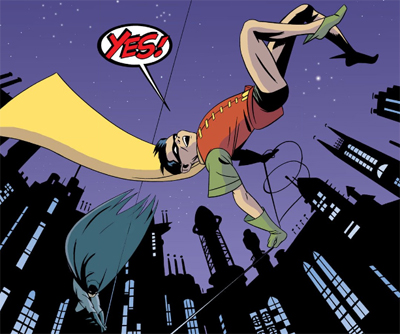
Swinging into action...

Swinging into action…

As such, it makes a great deal of sense for Dixon to collaborate with writer Scott Beatty on Robin: Year One, a prestigious miniseries spanning four extended issues and featuring wonderful artwork from Javier Pulido. Pulido’s distinctive artwork lends itself to vibrant colours and dynamic expression, as demonstrated during his wonderful stint as part of the rotating art team on The Amazing Spider-Man. If ever a comic book lent itself to Pulido’s style, Robin: Year One is it.

Dixon does some nice work trying to explain the dynamic between Batman and Robin, and even to argue why Robin is an essential part of the mythos. Most interestingly, he, Beatty and Pulido try to integrate the arrival of Robin with the atmosphere and mood established by Frank Miller and David Mazzucchelli in Batman: Year One.

Suit up!

Suit up!

Continue reading

Star Trek: The Next Generation – Brothers (Review)

This January and February, we’ll be finishing up our look at the second season of Star Trek: The Next Generation and moving on to the third year of the show, both recently and lovingly remastered for high definition. Check back daily for the latest review.

Brothers is Star Trek: The Next Generation getting back to business at usual. Well, not quite usual, but close enough. Following the monumental season-bridging epic that was The Best of Both Worlds and the breathing space afforded by Family, Brothers is a good old-fashioned science-fiction adventure story revolving around one of the show’s most popular character and really written to satisfy a laundry list of Star Trek tropes and conventions.

Although its notable for maintaining a thematic consistency that is threaded through the fourth season, and also for affording Brent Spiner to play three different roles, the most striking aspect of Brothers from a production point of view is the fact that it is written by Rick Berman. Berman had been serving as producer on the show since Encounter at Farpoint, but this was his first scripting contribution. He’d only write one more episode of The Next Generation before the show went off the air.

Given Berman’s production style, it feels strangely appropriate that Brothers is so carefully and meticulously structured and constructed.

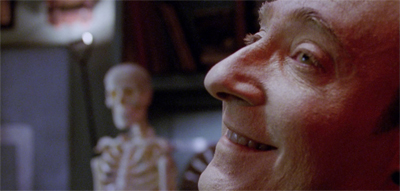
"Let's put a smile on that face..."

“Let’s put a smile on that face…”

Continue reading

A View to a Bond Baddie: Dr. Julius No

‘To celebrate James Bond’s 50th birthday on screen, we’re going to take a look at the character and his films. We’ve already reviewed all the classic movies, so we’ll be looking at his iconic baddies, and even at the character himself.

In many ways, Dr. No feels like a rather strange first instalment for a franchise that has managed to persist from half a century. Many of the trademarks we associate with the series are absent. There’s no pre-credits sequence. No powerful theme song involving the title of the film. Even the music playing over that iconic gun barrel shot sounds weird. There are no gadgets and gizmos, save for a Geiger Counter. The movie’s iconic Bond girl, Honey Rider, only shows up past the mid-point of the film.

As such, it’s amazing that the Bond villain emerged almost fully formed, with Dr. No providing perhaps the archetypal James Bond baddie.

He didn’t spend 6 years in evil physics school to be called “Mister”…

Continue reading

Blood on Film: Violence and Morality…

I am always fascinated about discussions over violence in movies. Mostly because it’s one of those “hot button” issues which always comes up in some context or another and is typically portrayed as an argument with two extremes. This week, while promoting his new movie Faster, actor Billy Bob Thornton offered his own opinion of modern movie-making:

In our current state of affairs, especially in the entertainment business, we’re living in a time when we’re making — in my humble opinion — the worst movies in history.

They’re geared toward the video game-playing generation. And these video games, which I’m on my son about constantly, these games are people killing for fun, and I think traditionally in movies, there’s always been some kind of lesson in the violent movies.

In fairness, Thornton is a typically controversial figure (for example, recently alienating Canadian fans), but it’s an interesting idea to look at – the assumption that violence (and specifically how it is handled) can contribute to a movie’s quality (or lack thereof). Is he being just a little melodramatic?

Well, it is the second of December...

Continue reading