• Following Us

  • Categories

  • Check out the Archives


  • Awards & Nominations

Star Trek: Enterprise – Damage (Review)

Next year, Star Trek is fifty years old. We have some special stuff planned for that, but – in the meantime – we’re reviewing all of Star Trek: Enterprise this year as something of a prequel to that anniversary. This August, we’re doing the third season. Check back daily for the latest review.

The stock comparison for Damage is In the Pale Moonlight.

This makes a great deal of sense. After all, both are Star Trek episodes that hinge on a series of morally questionable decisions made by the lead actor in a moment of sheer desperation. In In the Pale Moonlight, Benjamin Sisko starts a chain of events that builds towards the assassination of a Romulan Senator to trick the Romulans into joining the war effort. In Damage, Jonathan Archer resorts to piracy in order to obtain the parts necessary to make a meeting with Degra in order to plead against the use of the Xindi weapon.
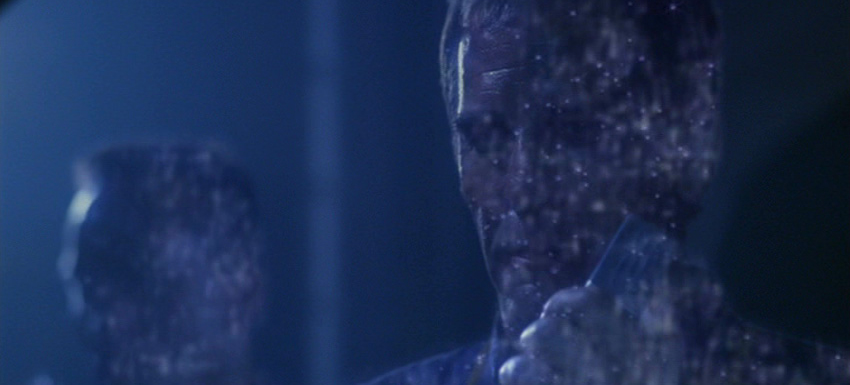
A met a man who wasn't there...

A met a man who wasn’t there…

There are some notable differences, of course. In purely practical plotting terms, Sisko dominates the narrative of In the Pale Moonlight; the entire story is related directly by Sisko to the audience in the form of a personal log. In contrast, Damage is split between the demands of Archer’s own arc in the episode and various other continuity elements; the episode needs to get Archer back to his ship and devote a considerable amount of time to T’Pol’s addiction. As a result, it lacks the keen focus that made In the Pale Moonlight so compelling.

At the same time, there is something much more direct about Damage. Sisko is quite detached from the horrors of In the Pale Moonlight, with the audience insulated from his choices through the use of a framing device and Sisko himself insulated through his use of Garak to conduct all the unpalatable actions. In contrast, Archer makes a point to bloody his own hands over the course of Damage. He doesn’t have somebody else to make the decision for him; he leads the boarding party himself.
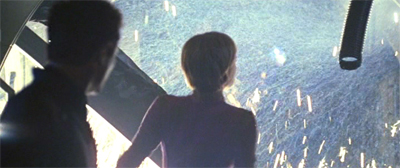
Everything comes apart...

Everything comes apart…

It is a very bold an unsettling choice, a culmination of a character arc that has been pushing Archer towards this sort of horrific choice since Anomaly. The third season of Star Trek: Enterprise has not been entirely consistent when it comes to its character arcs, working better in broad strokes than in fine detail. Nevertheless, Damage represents a very clear commitment to the promise of the third season of Enterprise; an interrogation of the franchise’s core values in an increasingly morally ambiguous world.

Damage is a deeply uncomfortable and unsettling episode of Star Trek, but it is arguably a necessary one. It is, in many ways, a criticism of the moral absolutism that informs a lot of discussion about terrible situations, suggesting that reality is often a lot more complicated than people might hope it would be.

Drowning his sorrows...

Drowning his sorrows…

Continue reading

Star Trek: Enterprise – Season 2 (Review)

Next year, Star Trek is fifty years old. We have some special stuff planned for that, but – in the meantime – we’re reviewing all of Star Trek: Enterprise this year as something of a prequel to that anniversary. This April, we’re doing the second season. Check back daily for the latest review.

The second season of Star Trek: Enterprise is a strange beast, breaking down into roughly three sections.

The first section runs from Shockwave, Part II through to A Night in Sickbay. There is a nice energy to these episodes, with the first appearance of the Romulans in Minefield and nice internal continuity between otherwise stand-alone adventures like Minefield and Dead Stop. Carbon Creek is a fun diversion and A Night in Sickbay at least tries to do something novel and exciting – even if the show can’t quite pull it off. This stretch of the season feels like an organic development from the first season, a collection of episodes of variable quality; balancing the desire to try new things with nods to the franchise’s strengths.

ent-theexpanse9

The final stretch runs from Judgment to The Expanse. The third season looms large over these episodes, with a sense of impending change in the air. These episodes seem to bid farewell to a version of Star Trek that has existed since the third season of Star Trek: The Next Generation. Judgment gives the Klingons one last epic story, Regeneration checks in on the Borg. The Breach offers a traditional Star Trek morality play, while Cogenitor brutally subverts it. Even episodes like Horizon and First Flight call back to the earliest episodes of Enterprise, as if to offer one last reflection on what might have been.

However, the second season is dominated by a long middle stretch – episodes running from Marauders through to The Crossing. While episodes like Future Tense provide an occasional reprieve, this middle stretch of the season is workmanlike and functional. This is the first two seasons of Enterprise as they are often dismissed: a lite version of Star Trek: Voyager in the same way that Star Trek: Voyager is a lite version of Star Trek: The Next Generation. In that long and dull middle stretch, it feels like the writing staff might as well be blowing dust off of scripts written for the seventh season of The Next Generation.

ent-shockwavepart2o

Unfortunately, while the first and third sections of the season have a lot to recommend them, it is the middle stretch that sets the mood for the season. The second season of Enterprise has more than a couple genuine stinkers – Precious Cargo, The Crossing and Bounty come to mind – but the season never hits the sustained lows of the third season of Star Trek, the first and second seasons of The Next Generation or the second season of Voyager. However, there is long string of episodes that are just dull and uninspired; formulaic and familiar.

In that extended run in the middle of the season, there are episodes that can be easily reduced to “[earlier episode or pop culture reference] by way of [earlier episode or pop culture reference]” without missing anything much. Marauders is The Magnificent Seven by way of Star Trek”, The Communicator is A Piece of the Action by way of First Contact”, Singularity is “Bliss by the way of The Game”, Vanishing Point is “Realm of Fear by way of Remember Me”, Precious Cargo is “Elaan of Troyius by way of The Perfect Mate”, Dawn is The Enemy by way of Darmok.” And so on.

ent-futuretense16

The result is a second season that is exhausting and draining. Watching it on original broadcast was a disheartening experience; each week seemed to bring more of the same. The long stretch from the end of October to the start of April was unforgiving; each week seemed to offer more evidence that Star Trek was tired and played out, a franchise disengaged from not only the world around it but also from the changing rules of its own medium. Coupled with the spectacular (but entirely foreseeable) failure of Star Trek: Nemesis, the second season of Enterprise seemed to seal the franchise’s fate.

There is a very real tragedy to all this. For all that the tail end of the second season sees a massive up-swing in quality and energy, it is perhaps too little and too late. By the time that Judgment had begun a late-season revitalisation, Rick Berman had already announced a bold new direction for the third season. That last stretch is a lame duck. In a way, the second season of Enterprise plays like a microcosm of the series itself; a dramatic upswing in quality and ambition at a point where fate has already made its decision.

ent-cogenitor

Continue reading

Daredevil – Stick (Review)

To celebrate the launch of Marvel’s Daredevil and the release of Avengers: Age of Ultron, we are reviewing all thirteen episodes of the first season of Marvel and Netflix’s Daredevil. Check back daily for the latest review.

Sitting smack bang in the middle of the season, Stick is something of an oddity.

It demonstrates just how episodic Daredevil can be in structure. Stick lets its focus move away from Matt’s conflict with Wilson Fisk, offering an episode built around a guest star and shedding some light on one of the members of Fisk’s cabal. “Ride with me tonight,” Stick urges Matt. “Help me destroy Black Sky, keep it off the streets, and I promise you this: Wilson Fisk will know the taste of fear the day he faces you ’cause he’ll know that you kicked the guy he’s afraid of right in the nuts.” Fisk is still a target here, albeit one temporarily shifted to the background.

daredevil-stick20

There are obviously ripples from Stick that reverberate through the rest of the season. Nobu’s loss here helps to mount more pressure on Fisk in Shadows in the Glass, while it leads to a very physical confrontation between Nobu and Matt in Speak of the Devil. At the same time, it remains curiously disengaged from the show around it. Despite the fact that the casting of Scott Glenn was announced with the fanfare reserved for primary cast members like Rosario Dawson or Vincent D’Onofrio, this is his only appearance in the whole thirteen-episode season.

Of course, there might very well be a reason for this. Stick is the only episode of the first season with a closing scene that hints at something far beyond the scope of this individual show – a coming “war” between mystical and magical forces. In some ways, Stick feels like it takes advantage of the episodic structure of a thirteen-episode season to relegate all the obligatory set-up and world-building for material outside the show to a single episode in the middle of the season. This is perhaps the ideal place for it, not distracting from the beginning or the end of the run.

daredevil-stick5

A lot of this feels like set-up for the Defenders project that will unite all four of the Netflix and Marvel miniseries, bringing together characters like Matt Murdock, Jessica Jones, Luke Cage and Danny Rand to fight an incredible evil in much the same way that The Avengers brought together Iron Man, Captain America, Thor and Hulk. Stick seems to allude to something decidedly more epic in scope than the details of this individual thirteen-episode run. It is, essentially, the second act of Iron Man 2 structured as a mid-season episode of Daredevil.

However, it all works. Stick might be divorced from the larger plot concerns of the season around it, but it never loses sight of its main characters. After a run of episodes focusing on Wilson Fisk, Stick brings the focus back to Matt Murdock. The return of Matt’s childhood mentor might be tied to some larger plot, but it also helps explain Matt’s character a bit more. Meeting Stick, we get to know a little bit more about how Matt ended up this way.

daredevil-stick

Continue reading

The X-Files – Unrequited (Review)

This February and March, we’re taking a trip back in time to review the fourth season of The X-Files and the first season of Millennium.

Unrequited opens with Mulder and Scully’s attempts to stop an assassination attempt by an invisible man, before jumping back twelve hours to explain how our heroes got into this situation. With that set-up, Unrequited falls into a lot of the narrative traps associated with an in media res teaser. After all, there’s not really anything special about the teaser. There is no mystery to be solved, no strange behaviour to explain. What questions are we meant to ask, based on that opening scene? How are we meant to look at the rest of the episode differently, knowing what we know?

Sure, Mulder and Scully are protecting Major General Benjamin Bloch. That would seem to be a little bit outside the remit of “the FBI’s most unwanted”, but that is not too strange a situation for the duo. They are FBI agents, so there is a certain flexibility in their job description. The Field Where I Died – an episode with a much more effective non-linear teaser – featured Mulder and Scully collaborating with the ATF. So it isn’t as if the set-up should be striking or compelling.

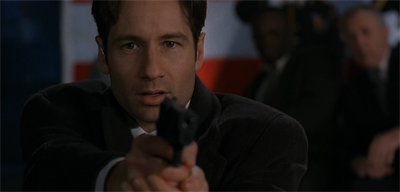
Stop, or my Mulder will shoot!

Stop, or my Mulder will shoot!

It seems like we are meant to focus on the monster of the week – Vietnam veteran Nathaniel Teager. Teager has the ability to turn himself invisible, which is quite something. Sure enough, the teaser to Unrequited offers a glimpse of that ability in action. But why is it important to have show us that ability in a scene from the climax of the episode? With a few adjustments, Teager’s first murder in the back of the limousine would serve the same purpose; introducing the audience to his powers without the need to recycle several minutes of footage from the climax.

After all, the most dissatisfying aspect of the in media res teaser is not the fact that it is completely inessential. Instead, the decision to use footage from the climax means that the audience has to sit through the same sequence twice. The teaser for Unrequited works well enough the first time around, but the sequence is not clever or inventive enough to merit a live-action replay towards the end of the hour. It just saps momentum from episode, rendering the final sequences somewhat tedious. That is the biggest problem with the opening of Unrequited, even beyond laziness.

Flags of our father figures...

Flags of our father figures…

Continue reading

Millennium – Sacrament (Review)

This February and March, we’re taking a trip back in time to review the fourth season of The X-Files and the first season of Millennium.

If Force Majeure and The Thin White Line seem to call forwards towards the weird and eccentric second season, Sacrament is a bit more modest. In many ways, Sacrament seems to foreshadow the last stretch of episodes in the first season. The forces of evil seem to encircle the Black family, creeping closer and closer to the big yellow house and everything it represents. For the first time, Sacrament explicitly puts Frank’s family at the heart of a case; this time focusing on the kidnapping of his sister-in-law from her child’s christening.

In many respects, this points towards the direction the show will take in its final stretch of episodes. Lamentation and Powers, Principalities, Thrones and Dominions will see the forces of evil explicitly violate the Black residence, insidiously eroding the idealised life that Frank has tried to build for his family in their new Seattle home. The cliffhanger at the end of Paper Dove pushes the concept to its logical conclusion, as a secret that Frank has tried to keep from his family finally comes home to roost.

Worst. Uncle. Ever.

Worst. Uncle. Ever.

As with WeedsSacrament demonstrates that writer Frank Spotnitz has an uncanny understanding of how Chris Carter built Millennium. It is an episode that is soaked through with the core themes of the series; it is a story about good and evil, and how evil taints everything that it touches. As with a lot of Millennium, Sacrament is not subtle; the moment that Tom Black is identified as the brother of our protagonist, it is inevitable that the forces of evil will come barrelling down upon him.

Nevertheless, Sacrament demonstrates a clear understanding of what it wants to be, and is a pretty effective snapshot of Millennium at this moment in time. The first season of Millennium is often overlooked and overshadowed amid the controversies surrounding the second or third seasons, but Sacrament stands as a great example of what the first season was trying to do.

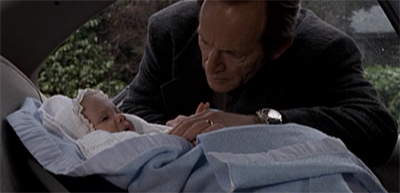
Our father...

Our father…

Continue reading

Star Trek: Enterprise – Season 1 (Review)

Next year, Star Trek is fifty years old. We have some special stuff planned for that, but – in the meantime – we’re reviewing all of Star Trek: Enterprise this year as something of a prequel to that anniversary. This January, we’re doing the first season. Check back daily for the latest review.

The first season of Star Trek: Enterprise is caught at a crossroads.

On the hand, it needs to be something new and exciting. The first Star Trek show of the new millennium, Enterprise has to find a way of updating the franchise and pushing forward. It has to find a way to challenge audience expectations and demonstrate that – after fourteen consecutive years and twenty-one overlapping seasons – Star Trek still has something fresh and exciting to offer fans. After all, the television landscape had changed significantly since the late eighties. It was time for Star Trek to change with it.

ent-brokenbow3

On the other hand, there’s a clear desire to seek familiar comforts. Star Trek has been on the air consistently for over a decade now. That wouldn’t be the case if the franchise didn’t have its own merits. There’s a sense that the first season of Enterprise is drawn to the idea that it can keep doing what worked before, offering generic Star Trek stories with a new cast and a new theme tune. This is still Star Trek, after all. There’s nothing gained by changing it to the point where it is unrecognisable.

Throughout the first season, these two impulses seem to be at odds with one another, leading to a surreal sense of whiplash. Episodes that feel as unique as Breaking the Ice, Dear Doctor or Shuttlepod One sit alongside generic shows like Civilisation, Sleeping Dogs or Rogue Planet. The show frequently pushes itself in interesting directions, only to pull relent as it approaches the point of committal. The result is a first season that is uneven, but intriguing, one that has great potential – if not necessarily the will to fulfill it.

ent-shockwavepart1m Continue reading

Star Trek: Enterprise – Fight or Flight (Review)

Next year, Star Trek is fifty years old. We have some special stuff planned for that, but – in the meantime – we’re reviewing all of Star Trek: Enterprise this year as something of a prequel to that anniversary. This January, we’re doing the first season. Check back daily for the latest review.

Fight or Flight is reasonably solid as second episodes go. It’s very clear that Rick Berman and Brannon Braga are making a conscious effort to avoid the mistakes of Star Trek: Voyager. There’s a sense that they are trying to give Star Trek: Enterprise its own unique mood and flavour. As such, Fight or Flight feels like a story that isn’t just tailor-made for Enterprise, but is tailor-made for early in the first season of the show. It isn’t a story that could be done by another spin-off, and it’s also not a story that could be done by Enterprise even a year later.

While Fight or Flight works on a conceptual level, the execution feels a little strange. While Broken Bow was a big and bombastic Star Trek pilot with its own feel and rhythm, Fight and Flight feels almost quaint. As a piece of television, it’s constructed in a very meticulous and very precise manner, one that seems suspiciously outdated for a show broadcast in late 2001.

Slugging it out...

Slugging it out…

Continue reading