• Following Us

  • Categories

  • Check out the Archives


  • Awards & Nominations

Doctor Who: Silence in the Library (Review)

To celebrate the fiftieth anniversary of the longest-running science-fiction show in the world, I’ll be taking weekly looks at some of my own personal favourite stories and arcs, from the old and new series, with a view to encapsulating the sublime, the clever and the fiendishly odd of the BBC’s Doctor Who.

Silence in the Library originally aired in 2008.

There’s the real world, and there’s the world of nightmares. That’s right, isn’t it? You understand that?

Yes, I know, Doctor Moon.

What I want you to remember is this, and I know it’s hard. The real world is a lie, and your nightmares are real.

– Cal and Doctor Moon get to the root of what makes Moffat scripts terrifying

Ah, Silence in the Library. The Steven Moffat story that isn’t, that doesn’t. The first Steven Moffat script that isn’t the strongest story in its season by a clear margin; the first Steven Moffat adventure that didn’t claim the Hugo for Doctor Who. The biggest problem with Silence in the Library and Forest of the Dead is that they can’t quite measure to The Empty Child, The Doctor Dances, The Girl in the Fireplace or Blink. That’s hardly an unforgivable sin, and there’s no shame in not being quite as good an episode of Doctor Who as Midnight was.

I’m quite fond of the two-parter, even though I’ll concede that it has its problems. The most obvious of which is the fact that – four years into the revival – the audience has had a chance to come to appreciate “Moffat-isms”, with many viewers able to recognise the writer’s preferred genre tricks and tropes. Silence in the Library is far from the most original script of the season, but it’s well written and well executed.

It’s just a little too familiar.

Going by the book on this one...

Going by the book on this one…

Continue reading

Doctor Who: The Unicorn and the Wasp (Review)

To celebrate the fiftieth anniversary of the longest-running science-fiction show in the world, I’ll be taking weekly looks at some of my own personal favourite stories and arcs, from the old and new series, with a view to encapsulating the sublime, the clever and the fiendishly odd of the BBC’s Doctor Who.

The Unicorn and the Wasp originally aired in 2008.

Oh, it’s you… I was just doing a little research… I say, what are you doing with that lead piping? But that’s impossible. Oh, no!

– Professor Peach discovers the point of crossover between Agatha Christie and Doctor Who

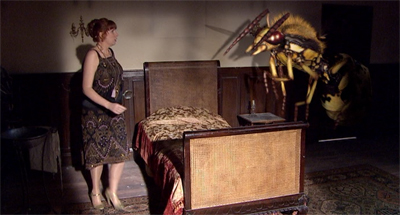
The Unicorn and the Wasp is the most fun episode of the fourth season, by a significant margin. It’s a high-concept high-energy run-around that has a great deal of fun playing with a genre mash-up, as the Doctor intrudes on an Agatha Christie mystery (starring Agatha Christie!) to create curious horror/sci-fi/mystery/class drama hybrid of an episode. It’s an episode that really benefits from the lighter tone of the fourth season. Despite some of the darkness creeping in at the edge of the frame, especially towards the final scenes, it’s an astonishingly light-hearted and playful episode.

In spite of Christie’s stern admonishings, it’s hard not to seize on the story with same glee as the Doctor does.

A sting in the tale...

A sting in the tale…

Continue reading

Doctor Who: The Doctor’s Daughter (Review)

To celebrate the fiftieth anniversary of the longest-running science-fiction show in the world, I’ll be taking weekly looks at some of my own personal favourite stories and arcs, from the old and new series, with a view to encapsulating the sublime, the clever and the fiendishly odd of the BBC’s Doctor Who.

The Doctor’s Daughter originally aired in 2008.

Not what you’d call a natural parent, are you?

They stole a tissue sample at gunpoint and processed it. It’s not what I call natural parenting.

Rubbish. My friend Nerys fathered twins with a turkey baster. Don’t bother her.

You can’t extrapolate a relationship from a biological accident.

Er, Child Support Agency can.

– Donna and the Doctor discussing parenting

The Doctor’s Daughter is the weakest script of the fourth season. It’s just a mess of high concepts and ideas and in-jokes mashed together and then cut down to fit into a forty-five minute time slot. It’s a fundamentally flawed episode that has some meritorious elements, but a whole host of other ingredients that just fall flat. It’s the speed bump in the fourth season of the show, Russell T. Davies’ final season of Doctor Who, which had started out of the gate so very strong.

I suppose the real positive of The Doctor’s Daughter is that it doesn’t cause too much damage as it stumbles.

The ball's in his court...

The ball’s in his court…

Continue reading

Doctor Who: The Poison Sky (Review)

To celebrate the fiftieth anniversary of the longest-running science-fiction show in the world, I’ll be taking weekly looks at some of my own personal favourite stories and arcs, from the old and new series, with a view to encapsulating the sublime, the clever and the fiendishly odd of the BBC’s Doctor Who.

The Poison Sky originally aired in 2008.

They’ve taken it. I’m stuck on Earth like, like an ordinary person. Like a human. How rubbish is that? Sorry, no offense, but come on.

– take that, Jon Pertwee!

Like The Sontaran Stratagem before it, The Poison Sky is pretty effective at accomplishing what it sets out to do. The first two-parter was always a troubled part of the Davies era, and so it feels strangely appropriate that the production team should manage to nail it on the fourth and final go-round. The Poison Sky isn’t the best episode of the show’s superlative fourth season, but neither it nor The Sontaran Stratagem are the worst, either. Instead, it’s a solidly entertaining feature-length adventure featuring the return of various old favourites from the classic show (U.N.I.T.! Sontarans!) and the revived series (Martha! the Valiant!).

It is goofy, silly, and fluffy, but it’s entertaining fluff.

His finger on the button...

His finger on the button…

Continue reading

Doctor Who: Planet of the Ood (Review)

To celebrate the fiftieth anniversary of the longest-running science-fiction show in the world, I’ll be taking weekly looks at some of my own personal favourite stories and arcs, from the old and new series, with a view to encapsulating the sublime, the clever and the fiendishly odd of the BBC’s Doctor Who.

Planet of the Ood originally aired in 2008.

How many Ood in total?

I’d say about two thousand, sir.

We can write them off. That’s what insurance is for.

– Halpen and Kess remind us that these are not nice people

Planet of the Ood is a bit blunt. And by “a bit”, I mean “a lot.” It’s an allegorical exploration of unchecked capitalism and slavery, using the science-fiction setting to tell a story with a familiar moral.Then again, Planet of the Ood largely works because that moral remains rather timely and relevant, but also because it’s a fantastically produced piece of television. It’s fast and pacey, it looks stylish, it has a fantastic cast and an efficient script. Sure, there are rough edges, but Planet of the Ood continues a fairly strong start for the fourth season.

Soaring...

Soaring…

Continue reading

Doctor Who: The Fires of Pompeii (Review)

To celebrate the fiftieth anniversary of the longest-running science-fiction show in the world, I’ll be taking weekly looks at some of my own personal favourite stories and arcs, from the old and new series, with a view to encapsulating the sublime, the clever and the fiendishly odd of the BBC’s Doctor Who.

The Fires of Pompeii originally aired in 2008.

Pompeii. We’re in Pompeii. And it’s Volcano Day.

– turns out the Doctor likes Steven Moffat scripts as well

What does it mean to be “just passing through” history? To watch events play out, knowing the expected outcome to every major event? To realise that the people you meet have all turned to ash before you were even born? If the Doctor travels through history fighting monsters and saving the world, how can he allow people to die needlessly? Surely it would be just as feasible for him to prevent the Challenger disaster as it is to foil the Nestene? Why can’t he warn people about impending natural disasters? Why do people killed by the Judoon matter more than people killed in car accidents or lightning storms or murdered by other human beings?

The answer is, of course, “because this is a television show”, but it puts the Doctor in a decidedly uncomfortable position. The show is fond of championing the Doctor as a romantic idealist out to make the universe a better place, and one who can’t abide oppression or suffering. And yet he only ever intervenes in cases involving aliens or futuristic technology. Rather than seeming like an agent of radical social change, this tends to make the Doctor feel a bit like an agent of the status quo.

It’s something the show has wrestled with quite a bit, particularly during the Jon Pertwee era. The Fires of Pompeii doesn’t necessarily provide satisfying answers to those questions within the narrative, but it does a lot to develop the role of the Doctor and his own relationship with history.

Come with me if you want to live...

Come with me if you want to live…

Continue reading

Doctor Who: Partners in Crime (Review)

To celebrate the fiftieth anniversary of the longest-running science-fiction show in the world, I’ll be taking weekly looks at some of my own personal favourite stories and arcs, from the old and new series, with a view to encapsulating the sublime, the clever and the fiendishly odd of the BBC’s Doctor Who.

Partners in Crime originally aired in 2008.

Would you rather be on your own?

No. Actually, no. But the last time, with Martha, like I said, it, it got complicated. And that was all my fault. I just want a mate.

You just want to mate?

I just want a mate!

You’re not mating with me, sunshine!

A mate. I want a mate.

Well, just as well, because I’m not having any of that nonsense. I mean, you’re just a long streak of nothing. You know, alien nothing.

There we are, then. Okay.

– Donna and the Doctor sort out the ground rules

From the outset, Partners in Crime makes it clear that the fourth season of Doctor Who is probably going to be lighter going than the show’s third year. To be fair, it was heavily foreshadowed by a Christmas special that drew heavily from the work of Douglas Adams, whose influence is keenly felt across this entire season – right down to repeated references to the bees disappearing.

Casting Catherine Tate, best know for her work on The Catherine Tate show, as the season’s female companion was a bit of an indicator, but Partners in Crime makes it quite clear – playing more as an affectionate spoof of a classic Doctor Who run-around rather than something equal parts witty and terrifying.

Then again, given that the end of the third season featured the death of one tenth of the world’s population, the assassination of the President of the United States, the destruction of a companion’s life and the Doctor’s crushing realisation that he’s so lonely he’d retire to serving as the Master’s warden, one might argue that “lighter” was the only way to go.

Things are looking up...

Things are looking up…

Continue reading

Doctor Who: The Enemy of the World (Review)

To celebrate the fiftieth anniversary of the longest-running science-fiction show in the world, I’ll be taking weekly looks at some of my own personal favourite stories and arcs, from the old and new series, with a view to encapsulating the sublime, the clever and the fiendishly odd of the BBC’s Doctor Who.

The Enemy of the World originally aired in 1967-68.

One chance, my friend. I said one chance.

– Patrick Troughton gets his David Tennant on

The Enemy of the World is an absolute joy from start to finish. Far too often, six-part Doctor Who serials tend to feel over-padded or over-stuffed, more a result of budget and production constraints than of any creative imperative to tell a story spread across six weeks. Instead, The Enemy of the World is a thoughtful, playful and fin six-part adventure that shows off Patrick Troughton at his best, with Dennis Whitaker’s script toying with various genre expectations and some interesting ideas about who the Doctor really is.

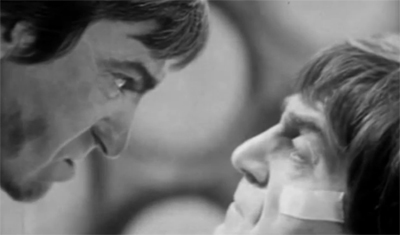
Face to face...

Face to face…

Continue reading

Star Trek: Deep Space Nine – The Wire (Review)

Star Trek: Deep Space Nine is twenty years old this year. To celebrate, I’m taking a look at the first and second seasons. Check back daily for the latest review or retrospective.

The Wire might just be the best episode of the second season of Star Trek: Deep Space Nine. In fact, it ranks with Duet and In the Hands of the Prophets as one of the best episodes of the show so far. Written by Robert Hewitt Wolfe and showcasing the dramatic talents of both Siddig El Fadil and Andrew Robinson, The Wire is a powerhouse of dramatic writing – an intimate character study capable of provoking tensions and ambiguities on par with the season’s universe-altering installments.

Garak has only appeared a handful of times so far. Indeed, considering how important he would become to the series, it’s interesting how rare his early appearances are. However, The Wire is really the episode that pins Garak down and tells us everything that we could possibly need to know about Garak, without ever actually telling us everything we might want to know. It’s a careful distinction, and Wolfe’s script walks that line skilfully while Andrew Robinson’s performance is perfectly modulated.

Bashir's bedside manner...

Bashir’s bedside manner…

Continue reading

Doctor Who: Doomsday (Review)

To celebrate the fiftieth anniversary of the longest-running science-fiction show in the world, I’ll be taking weekly looks at some of my own personal favourite stories and arcs, from the old and new series, with a view to encapsulating the sublime, the clever and the fiendishly odd of the BBC’s Doctor Who.

Doomsday originally aired in 2006.

Daleks, be warned. You have declared war upon the Cybermen.

This is not war. This is pest control.

We have five million Cybermen. How many are you?

Four.

You would destroy the Cybermen with four Daleks?

We would destroy the Cybermen with one Dalek. You are superior in only one respect.

What is that?

You are better at dying.

– the Cyberleader and Dalek Sec compete for the title of “bitchiest Doctor Who villain”

Part of my frustration with Doomsday is the same problem that I have with the rest of the second season’s weaker episodes. Like Fear Her or Rise of the Cybermen, the second season finalé lacks ambition. It feels complacent, it feels comfortable. It feels like putting the Daleks and the Cybermen together in one episode is enough to merit attention, without anything more than exchanging pithy one-liners. It feels like the separation of the Doctor and his companion is the biggest and most important thing in the universe, without really convincing us that this isn’t the best possible outcome. It feels like the easiest way to make these threats palpable is to set them in modern London, without any real sense of consequence or scale.

The tears of a Time Lord...

The tears of a Time Lord…

Continue reading