• Following Us

  • Categories

  • Check out the Archives


  • Awards & Nominations

Star Trek: Deep Space Nine – Hard Time (Review)

This February and March, we’re taking a look at the 1995 to 1996 season of Star Trek, including Star Trek: Deep Space Nine and Star Trek: Voyager. Check back daily Tuesday through Friday for the latest review.

Hard Time is a fantastic (and vastly underrated) episode of Star Trek: Deep Space Nine.

The episode tends to get overlooked in discussions about the fourth season of Deep Space Nine, perhaps owing to the high average quality of the season or the fact that it arrives in the middle of what is admittedly the season’s weakest run of episodes. However, in spite of all that, Hard Time is an exemplary piece of Deep Space Nine. It is certainly the best of the series’ “O’Brien must suffer” episodes, and a showcase for Star Trek veteran Colm Meaney. In its exploration of trauma and recovery, and cycles of violence, it taps into the heart of the show.

Not phased in the slightest...

Not phased in the slightest…

That said, Hard Time arrives at a point where Deep Space Nine is nudging closer and closer to serialisation. The show has begun to embrace long-form storytelling, as evidenced by the ripple effect of the changes to the status quo in The Way of the Warrior and the way that little plot threads weave through the season. The show has not yet reached the point at which it can structure six- or ten-episode arcs, but it is getting close. Deep Space Nine is clearly moving towards what is (for Star Trek at least) a fairly novel style of television storytelling.

As such, Hard Time is particularly striking for the fact that it is a purely episodic adventure. The episode puts Miles O’Brien through hell, having him struggle with post-traumatic stress disorder while trying to reintegrate into society. This is the kind of plot that feels more suited to a long-running mini-arc than Worf and Dax’s arguments about the relative merits of bladed weapons or Worf’s decision to move to the Defiant. Instead, O’Brien’s trauma is dealt with over the course of a single episode. Hard Time plays as a defence of the tradition television episode structure.

Growing the beard...

Growing the beard…

Continue reading

Star Trek: Deep Space Nine – Rules of Engagement (Review)

This February and March, we’re taking a look at the 1995 to 1996 season of Star Trek, including Star Trek: Deep Space Nine and Star Trek: Voyager. Check back daily Tuesday through Friday for the latest review.

Rules of Engagement is that old Star Trek standard: the trial episode.

The franchise has never really had a lot of luck with the format over the years. The Menagerie, Part I and The Menagerie, Part II were primarily of interest for the way that they repurposed The Cage and offered viewers a glimpse of an alternate kind of Star Trek. Later in that same first season, Court Martial was a disjointed and uneven (and even illogical) story. Later series did not fare much better; neither A Matter of Perspective nor Dax nor Ex Post Facto could be considered highlights of their seasons or their shows or the wider franchise.

Worf really doesn't understand the proper way to lodge an objection...

Worf really doesn’t understand the proper way to lodge an objection…

However, The Measure of a Man remains the exception that proves the rule. Not only a strong episode of itself, it stands as one of the best episodes in the history of the franchise. More than that, it represented a turning point in the history of Star Trek: The Next Generation; it is perfectly reasonable to point to The Measure of a Man as the moment that The Next Generation finally delivered on its potential after almost two seasons of struggling to find a unique voice. It seems entirely possible that the franchise has been chasing that high ever since.

Unfortunately, Rules of Engagement is an example of the rule rather than the exception. It is a misguided and clumsy episode that has a number of interesting ideas that fail to coalesce into a satisfying whole.

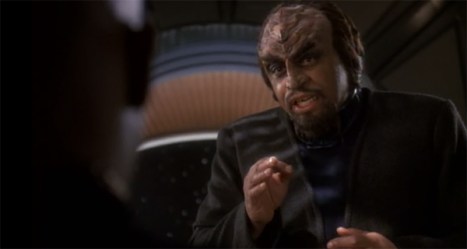
Klingon lawyered up... Kl'awyered up, if you will.

Klingon lawyered up…
Kl’awyered up, if you will.

Continue reading

Star Trek: Deep Space Nine – Accession (Review)

This February and March, we’re taking a look at the 1995 to 1996 season of Star Trek, including Star Trek: Deep Space Nine and Star Trek: Voyager. Check back daily Tuesday through Friday for the latest review.

In its third and fourth seasons, Star Trek: Deep Space Nine is undergoing something of a transformation; a metamorphosis.

This is only natural. Shows evolve and grow as they go on. The production team discovers what works and what doesn’t, allowing them to play the strengths of the premise and the ensemble. It happens to most shows, if they live long enough. It happened to Star Trek: The Next Generation when Michael Piller came on board in its third season. It will happen to Star Trek: Voyager when Michael Piller departs in its third season. Change and transformation is inevitable, for television shows as much as for people.

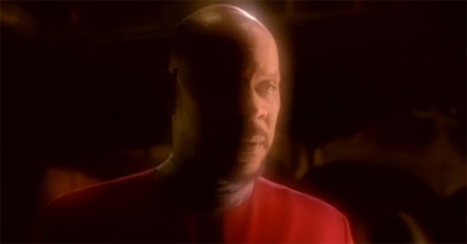
That healthy orb-experience glow...

That healthy orb-experience glow…

The third and fourth seasons of Deep Space Nine saw a change taking place. Ira Steven Behr had taken more and more control of the show since the late second season, starting with The Maquis, Part II. Michael Piller had stepped back from the show in its third season, completely ceding control with Life Support. The show was changing in a material sense. The Dominion came to the fore, Bajor faded to the background; Worf joined the cast, Odo found his people, the Klingons were an on-going concern again.

By this point in the fourth season, the transformation is almost complete. Deep Space Nine is very close to its final form, standing on the edge of its biggest departures from the established Star Trek canon. Part of those changes involves a reconfiguring of what Bajor means to the series. Accession begins the process of drawing down the curtain on the Bajor arc as it began with Emissary all those years ago, allowing Sisko to find some peace in his position and a sense of closure in his appointment before the show’s emphasis on Bajor changes dramatically.

Gotta have faith...

Gotta have faith…

Continue reading

Star Trek: Deep Space Nine – Bar Association (Review)

This February and March, we’re taking a look at the 1995 to 1996 season of Star Trek, including Star Trek: Deep Space Nine and Star Trek: Voyager. Check back daily Tuesday through Friday for the latest review.

The politics of Star Trek can occasionally be difficult to pin down.

There are obvious reasons for this, of course. Television is a collaborative medium, the result of lots of different creative voices. It is hard to argue that Star Trek has an consistent set of politics, because those creative voices have very different politics. Even on the original show, episodes like Errand of Mercy and The Omega Glory suggested that Gene L. Coon and Gene Roddenberry had very different perspectives on the Vietnam War. Certainly, Star Trek: The Next Generation and Star Trek: Deep Space Nine have very different viewpoints.

Don't beat yourself up, Quark...

Don’t beat yourself up, Quark. We have some Nausicaans to do it for you.

However, it is also the case that the franchise has always been quite careful when engaging with political discourse, particularly in the context of its nineties incarnation. The myth of Star Trek paints the show as progressive and liberal, but the truth is that the series rarely broke new ground in the nineties and into the new millennium. Episodes like Rejoined and Judgment were very much the exception rather than the rule, engaging with big political and social issues in a very clear manner. A lot of the time, the franchise played it fairly safe.

That is part of what makes Bar Association such an interesting episode of television. As with Rejoined, there is a sense that the Star Trek franchise should take the liberal politics of Bar Association for granted. After all, while there is some ambiguity as to exactly what form of economic theory is employed by the Federation, it certainly isn’t capitalism. However, it is interesting to hear the franchise (perhaps literally in this case) put its money where its mouth is, allowing a major character to quote Marx and Engels.

Strike while the bar is hot...

Strike while the bar is hot…

Continue reading

Star Trek: Deep Space Nine – Return to Grace (Review)

This February and March, we’re taking a look at the 1995 to 1996 season of Star Trek, including Star Trek: Deep Space Nine and Star Trek: Voyager. Check back daily Tuesday through Friday for the latest review.

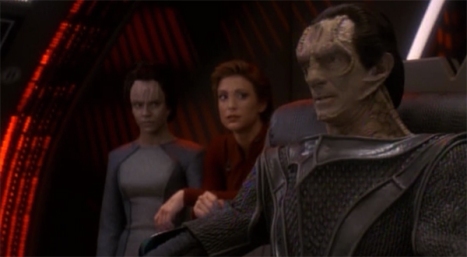
More than any other character in the ensemble, Gul Dukat is an embodiment of the relative strengths and weaknesses of Star Trek: Deep Space Nine.

There are plenty of other great characters on Deep Space Nine. More than the characters on any other Star Trek show, the lead and supporting characters on Deep Space Nine are afforded the chance to change and grow over the course of the run. In fact, Return to Grace even introduces the character of Damar in a fairly thankless supporting role; over the remaining three-and-a-half seasons of the show, Damar will grow into a well-developed and multi-faceted character in his own right.

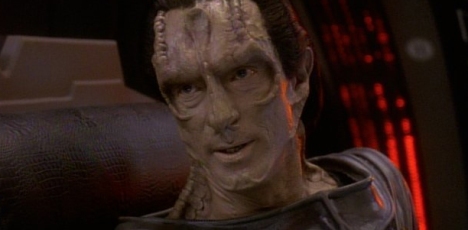
He looks like Dukat that got the cream...

He looks like Dukat that got the cream…

Nevertheless, it is Dukat who exemplifies the approach to character and storytelling that make Deep Space Nine such an interesting show. Large swathes of the character’s arc feel improvised and unpredictable. It would be next to impossible to chart Dukat’s character arc from Emissary to What You Leave Behind in a way that makes sense. As with a lot of Deep Space Nine, it seems like the production team just threw the character into the air, allowing the story to take him where it may.

With Return to Grace, it seems that the story takes Dukat into the role of “space pirate.”

The freight stuff...

The freight stuff…

Continue reading

Star Trek: Deep Space Nine – Paradise Lost (Review)

This February and March, we’re taking a look at the 1995 to 1996 season of Star Trek, including Star Trek: Deep Space Nine and Star Trek: Voyager. Check back daily Tuesday through Friday for the latest review.

Part of what is so remarkable about Star Trek: Deep Space Nine is how prescient it seems.

The Star Trek franchise is renowned for its central metaphors and allegories, its fondness for addressing contemporary issues through abstract philosophical discussions. Even the most casual of television fans can point to episodes like Let That be Your Last Battlefield or A Private Little War as examples of the franchise’s engagement with contemporary social issues. (Of course, they may not be able to actually name those episodes.) Of course, the reality was always more complicated than that, but this social engagement is part of the popular memory of the franchise.

Armed and dangerous...

Armed and dangerous…

While there is a tendency to overstate the importance of social commentary and engagement in the history of the Star Trek franchise, it is a massive part of the cultural behemoth. Although not every (and arguably not even most) Star Trek episodes are explorations of moral philosophy that apply to the contemporary world, they are an essential part of each and every Star Trek series. Sometimes these episodes are brilliant, and sometimes they are heavy-handed. Sometimes they are earnestly sincere, and sometimes they are hopelessly misguided.

However, Deep Space Nine stands out in comparison to its contemporaries. Even twenty years after the show aired, it seems like Deep Space Nine speaks to contemporary anxieties and uncertainties.

The Changeling Face of Evil...

The Changeling Face of Evil…

Continue reading

Star Trek: Deep Space Nine – Homefront (Review)

This February and March, we’re taking a look at the 1995 to 1996 season of Star Trek, including Star Trek: Deep Space Nine and Star Trek: Voyager. Check back daily for the latest review.

Homefront and Paradise Lost are a fascinating example of what Star Trek: Deep Space Nine does best, both in terms of theme and storytelling.

In many ways, Homefront and Paradise Lost are among the most culturally relevant episodes produced during the series’ seven-season run. The two-parter speaks to a lot of concerns and anxieties that were part of the public consciousness during the nineties, but exploded in the early years of the twenty-first century. Homefront and Paradise Lost feel more powerful in the era of airport security screenings and extraordinary powers than they did on their original broadcast. These are among the most important episodes the franchise ever produced.

Broken link...

Broken link…

However, the two-parter is also a great example of how the production team on Deep Space Nine approach storytelling. Not just in terms of arc-building and serialisation, but also in terms of structure and pacing. Unlike The Way of the Warrior, which was very clearly a single ninety-minute episode of television, Homefront and Paradise Lost are very clearly structured as two separate episodes of television. It is a subtle distinction, but one which has a significant impact in how the creative team tell their story.

More than that, Homefront and Paradise Lost represent a great example of the strengths of the production team’s improvisational approach to long-form plotting.

More like Starfleet INsecurity, amirite?

More like Starfleet INsecurity, amirite?

Continue reading

Star Trek: Deep Space Nine – Our Man Bashir (Review)

This February and March, we’re taking a look at the 1995 to 1996 season of Star Trek, including Star Trek: Deep Space Nine and Star Trek: Voyager. Check back daily Tuesday through Friday for the latest review.

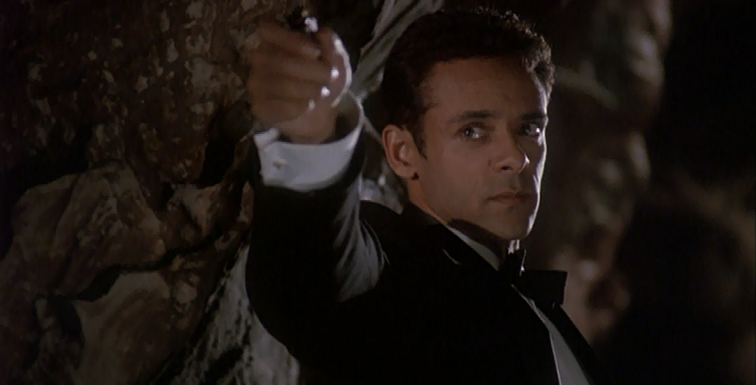
Our Man Bashir is an underrated masterpiece.

It is possibly the best holodeck (or holosuite) episode in the history of the franchise; only Ship in a Bottle can really compete. A lot of this is down to the production value of the episode; Our Man Bashir looks and sounds beautiful, a delightfully detailed throwback to its source material. The production team on the Star Trek franchise seldom get enough credit for their skill at realising alien worlds and cultures from scratch, but their beautiful evocation of sixties design is breathtaking. Our Man Bashir is a clear forerunner to Trials and Tribble-ations, less than a year away.

"The name's Bashir, Julian Bashir..."

“The name’s Bashir, Julian Bashir…”

However, there is more to it than that. Like Little Green Men, Our Man Bashir succeeds as a (relatively) light-hearted run-around that never loses track of its characters. The first three seasons of Star Trek: Deep Space Nine struggled with the character of Julian Bashir; audience members could wait entire seasons for a good Bashir episode. With the fourth season, three come along at once. Our Man Bashir might look light and fluffy – and it largely is – but it never loses sight of its core character dynamics in the midst of all the fun unfolding around them.

More than that, Our Man Bashir plays into the broader themes and strengths of the fourth season. The climax of the episode feels like Deep Space Nine is ruminating on its new-found place dictating the direction of the Star Trek canon. Bashir’s decision to “save the day by destroying the world” feels oddly prophetic. The fifth season of the show would find the writers destroying some of the most fundamental rules of the franchise in an effort to keep things vital.

Got some bottle...

Got some bottle…

Continue reading

Star Trek: Deep Space Nine – Little Green Men (Review)

This February and March, we’re taking a look at the 1995 to 1996 season of Star Trek, including Star Trek: Deep Space Nine and Star Trek: Voyager. Check back daily Tuesday through Friday for the latest review.

Little Green Men might just be the best Ferengi episode from the seven-year run of Star Trek: Deep Space Nine.

It helps that the episode is very clearly a passion project for writers Ira Steven Behr and Robert Hewitt Wolfe. More than any other Star Trek show, Deep Space Nine had a deep and abiding affection for classic cinema. Michael Piller might have tried to steer the first two seasons of Star Trek: Voyager back to classic western storytelling tropes, while Rick Berman and Brannon Braga might have promised that Star Trek: Enterprise would be a “back to basics” reimagining of the show, but Deep Space Nine was a show that adored old-school Hollywood.

Quark's Family Vacation...

Quark’s Family Vacation…

This was reflected in a number of ways. In Past Tense, Part II, B.C. planned to escape to Tasmania because Errol Flynn was born there. There was also the fact that Ira Steven Behr could never resist the lure of a good homage to classic cinema – even when it was not the best of ideas. Meridian was written as an attempt to adapt Brigadoon to the Star Trek universe; Fascination was based on the 1935 adaptation of A Midsummer Night’s DreamRules of Acquisition was basically YentlProfit and Loss was Casablanca.

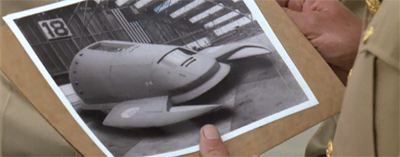
It seemed almost inevitable that at some stage the cast and crew of Deep Space Nine would find themselves colliding with classic Hollywood.

"Well, it's not a saucer..."

“Well, it’s not a saucer…”

Continue reading

Star Trek: Deep Space Nine – Indiscretion (Review)

This February and March, we’re taking a look at the 1995 to 1996 season of Star Trek, including Star Trek: Deep Space Nine and Star Trek: Voyager. Check back daily Tuesday through Friday for the latest review.

Much like Hippocratic Oath before it, Indiscretion serves to set the baseline of quality for the fourth season of Star Trek: Deep Space Nine. While The Way of the Warrior and The Visitor were ambitious deviations from form, Hippocratic Oath and Indiscretion offer a much clearer vision of what the show will look like from this point forward. As with Hippocratic Oath, a heavy two-hander a-plot is paired with a lighter b-plot that explores the day-to-day life on the eponymous space station, a structure that allows for world-building with sacrificing momentum.

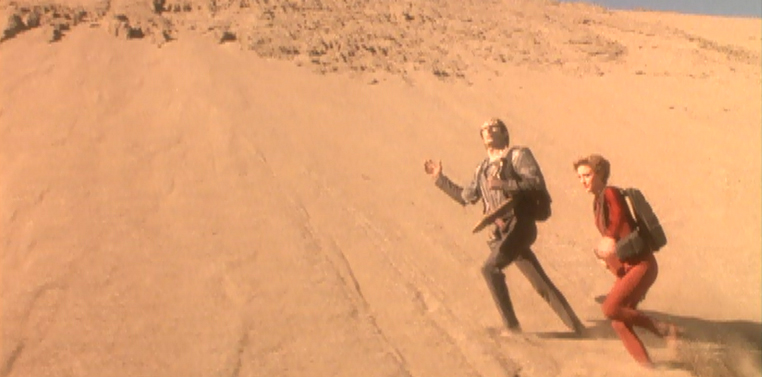
Indiscretion works very well on its own terms. It throws together two of the show’s more fascinating a well-defined characters, putting Major Kira and Gul Dukat on a road trip from hell that inevitably throws them headfirst into conflict with one another. Watching Nana Visitor and Marc Alaimo interact is worth the price of admission alone, and Indiscretion throws a fairly heated personal conflict into the mix to create some tense and compelling drama. Indiscretion works very well as forty-five minutes of television.

Road trip!

Road trip!

However, it also works quite well as an exercise in setting up a longer game. As with most of the episodes that end up rippling through the continuity of Deep Space Nine, it is hard to be sure if the writers knew exactly where they wanted to go with the plot threads stemming from this instalment. Some of the difficulties dealing with the episode’s biggest legacy suggest that more thought might have gone into it. Nevertheless, Indiscretion is an episode that is clearly written with one eye on the future of the show.

As much as it stands on its own two feet, the episode is clearly written with a view to drama that it might enable further down the line. It is a story that seems to be written so that its consequences might fuel further storytelling opportunity. Deep Space Nine had toyed with the idea of serialised storytelling before, but this marks the point where the show just rolls up its sleeves and jumps right on in.

"You know, I think she likes me."

“You know, I think she likes me.”

Continue reading