• Following Us

  • Categories

  • Check out the Archives


  • Awards & Nominations

Star Trek: Deep Space Nine – Children of Time (Review)

Time is the fire in which we burn.

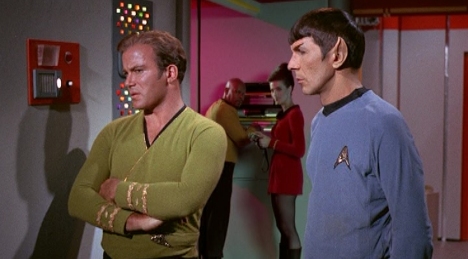
Children of Time comes towards the end of the franchise’s thirtieth anniversary season. By all accounts, the thirtieth anniversary season had been a resounding success. Star Trek: First Contact managed to please audiences and critics with a journey back to the beginning of the Star Trek universe. Star Trek: Deep Space Nine offered a crowd-pleasing homage to The Trouble With Tribbles in Trials and Tribble-ations. Even Star Trek: Voyager got in on the act with Flashback, Future’s End, Part I and Future’s End, Part II.

More than that, the franchise was thriving by just about any measure. Three casts were active simultaneously; two casts on television and one in cinemas. The thirtieth anniversary had garnered incredible media attention and had helped to remind audiences that the franchise was still chugging along a decade after its resurrection. To many observers, it appeared that the Star Trek had been resurrected. Against all odds, the television show that had been cancelled by NBC after only three seasons seemed to have been granted a form of immortality.

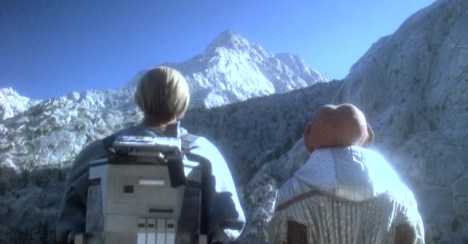
Walking into the sunset.

Walking into the sunset.

However, things were not as rosy behind the scenes. In fact, the franchise had been underperforming since the end of Star Trek: The Next Generation. The ratings would not become a real problem until the launch of Star Trek: Enterprise, but there were early signs that the franchise was in decline. Both Deep Space Nine and Voyager underwent cast revisions in their fourth seasons to try to solidify the ratings. Deep Space Nine got to keep its existing cast and add one new face, while Voyager had to fire one cast member to make room for the newest player.

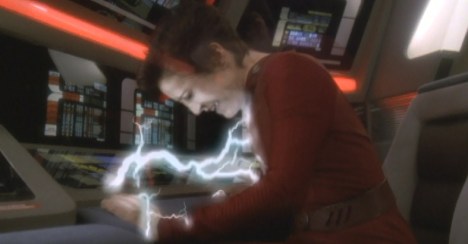
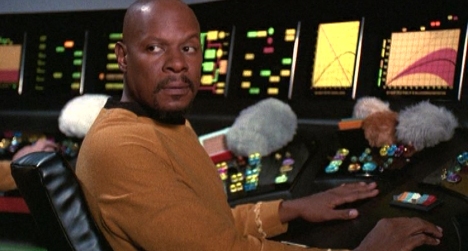
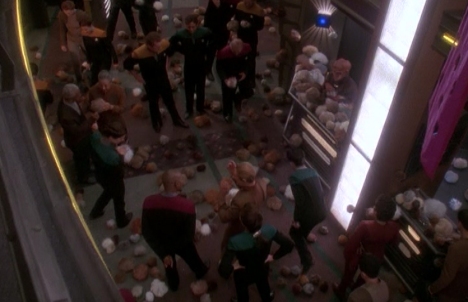
Children of Time feels very much like a meditation and contemplation upon the theme of legacy, asking the characters on Deep Space Nine to wonder what they might leave behind.

Shocking.

Shocking.

Continue reading

Star Trek: Deep Space Nine – Soldiers of the Empire (Review)

Soldiers of the Empire is a very effective illustration of just how far Star Trek: Deep Space Nine was willing to push the Star Trek franchise.

It is an episode that unfolds primarily on a Klingon Bird of Prey. This is nothing new. After all, Star Trek: The Next Generation produced A Matter of Honour in its second season, assigning Riker to serve on a Klingon ship as part of an exchange programme. However, that episode was told primary from a human perspective, the story centring on Riker adjusting and adapting to an alien culture before saving the day. When Worf joined the Klingon fleet in Redemption, Part II, the story kept cutting back to life on the Enterprise in his absence.

"Mahk-cha!"

“Mahk-cha!”

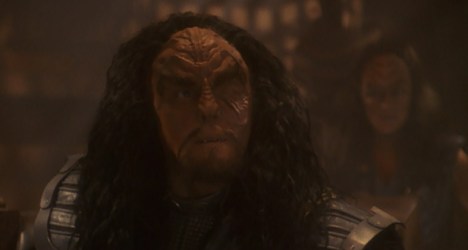
In contrast, Soldiers of the Empire is primarily focused upon the Klingon cast and the Klingon crew. Worf and Dax join the IKS Rotarran to support General Martok in his first command since escaping the Dominion prison camp at the end of By Inferno’s Light, but they are very much bystanders. Although Worf and Dax provide vital narrative functions in introducing the audience to Klingon customs and cultures, the narrative arc of the show belongs to Martok and the crew of the Rotarran. This is not a story about Worf and Dax, this is a story about Martok.

The result is an episode that really pushes the limits of the storytelling possibilities on Deep Space Nine, a reminder that the production team remain as ambitious as ever in the show’s fifth season. Soldiers of the Empire suffers from a few minor plotting issues, but it is exciting and compelling in a way that captures the very best of Deep Space Nine.

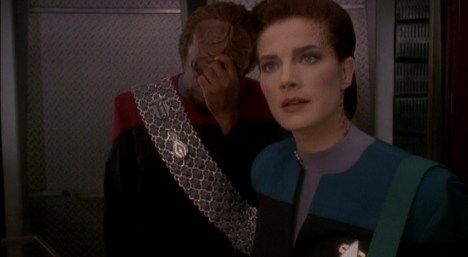
A sharp stabbing pain.

A sharp stabbing pain.

Continue reading

Star Trek: Deep Space Nine – Business as Usual (Review)

Business as Usual is, appropriately enough, a very typical Star Trek morality play.

It is a relatively rare example of Star Trek: Deep Space Nine engaging in the sort of pointed social commentary that many fans expect of the genre, the rather straightforward moral lesson couched in science-fiction trappings; The Devil in the Dark as a commentary on “the other”, A Taste of Armageddon as a condemnation of the Vietnam War, Let That Be Your Last Battlefield as a critique of racism in general. There are all but expected in a Star Trek show, but Deep Space Nine rarely plays them particularly straight.

Disarming conversationalists...

Disarming conversationalists…

Deep Space Nine has told issue-driven stories before, with In the Hands of the Prophets serving to explore the gap between creationists and those who believe in evolution or Past Tense, Part I and Past Tense, Part II constructed as a direct commentary on Los Angeles’ plans to lock up their homeless population. However, the series tend to favour broader commentaries about grander themes. The show arguably as a timeless quality because it tends not to dwell too heavily upon specific ideas, instead meditating on particular themes like authority and conflict.

Indeed, Star Trek: Voyager is a lot more traditional in this respect. That writing staff has a clear fondness for the archetypal Star Trek morality play, constructing episodes as metaphors for contemporary issues; Remember explores Holocaust denial, Distant Origin deals with creationism, Displaced offers a reactionary take on immigration. Even non-issue-driven episodes like Darkling and Fair Trade make a point to stress the franchise’s utopian values in a manner much more overt than Deep Space Nine.

The hard sell.

The hard sell.

With that in mind, Business as Usual feels strangely old-fashioned. It is very much an episode of Deep Space Nine in terms of setting and character, in that no other Star Trek show would have a lead character knowingly and willingly become an arms dealer. However, it feels very much like an archetypal Star Trek show in that it is an episode about how the arms trade is implicitly immoral and horrific. It is a very worthwhile message, and in no way diminished by its obviousness, but it does feel surprisingly clear cut when compared to episodes like The Ship or Rapture.

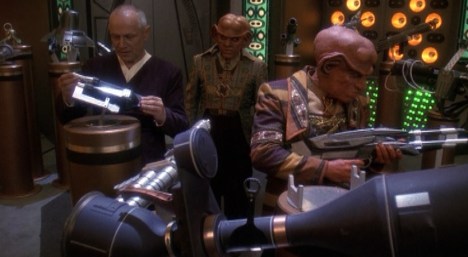
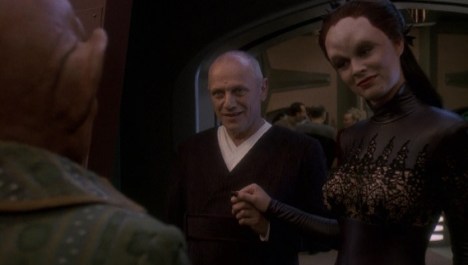
Business as Usual is essentially a very conventional Star Trek story that is elevated by one of the best guest casts in the history of the franchise.

"No, Mister Quark, I expect you to buy!"

“No, Mister Quark, I expect you to buy!”

Continue reading

Star Trek: Deep Space Nine – For the Uniform (Review)

For the Uniform forms the second entry in a loose trilogy of Michael Eddington stories, sitting between For the Cause and Blaze of Glory.

Much like The Begotten before it, For the Uniform feels like Star Trek: Deep Space Nine is tidying up a bunch of loose ends before it barrels into the second half of the season with In Purgatory’s Shadow and By Inferno’s Light. It is offering one last story built on the status quo established by The Maquis, Part I and The Maquis, Part II before things change dramatically. It is also quite heavy on the kind of impressive space battles that will become a major part of the final two seasons.

Terrorise this!

Terrorise this!

The episode even puts an increased emphasis upon the series’ military themes, with much made of the crippling blow dealt to the Defiant by Eddington’s virus and the operational protocols that this attack necessitates. With Nog standing on the edge of the bridge echoing Sisko’s orders to Engineering, For the Uniform occasionally feels more like like a submarine movie than an episode of Star Trek. This is to say nothing of the attention paid to the Defiant’s departure from Deep Space Nine itself, which plays up the military protocol of such a launch.

However, there is more to For the Uniform than all of that. It is an episode that touches upon a number of key themes for Deep Space Nine. It is a story about moral compromise and ambiguity, about narrative and mythmaking. It is a tale about obsession and vindictiveness, rooted in the flaws of its central character. For the Uniform struggles a little bit in how it approaches Sisko’s monomaniacal pursuit of Eddington, wrapping up so fast that the closing lines offer a sense of tonal whiplash. Nevertheless, it is a bold and breathtaking piece of television.

Shadow boxing...

Shadow boxing…

Continue reading

Star Trek: Deep Space Nine – The Ascent (Review)

Discussions of Star Trek: Deep Space Nine tend to focus on the big sweeping events and the epic scope.

It is easy to see why this is the case. Over the course of the show, alliances break and empires fall. Characters are elevated from the lowest rungs of the social ladder to command over entire planets. Whereas Star Trek: The Next Generation worked hard to flesh out alien cultures like the Romulans and the Klingons, it never committed to the kinds of sweeping long-form narratives that unfolded across the run of its younger sibling. The fall (and rise and fall again) of Cardassia, the broken and mended peace with the Klingons, the Dominion War.

"And to round out the thirtieth anniversary, we're going to climb the Paramount logo."

“And to round out the thirtieth anniversary, we’re going to climb the Paramount logo.”

Deep Space Nine deserves (and receives) a great deal of credit for telling these stories. Indeed, the franchise would not make another attempt at storytelling on this scale until the final two seasons of Star Trek: Enterprise. However, focusing on the bigger picture tends to gloss over the other strengths of Deep Space Nine. As much as the show crafts epic long-running stories of betrayal and redemption that span seasons of broadcast television, it interspaces these epic beats with lots of smaller character moments.

The Ascent is a wonderful example of this. The fifth season of Deep Space Nine is one of the most sweeping and epic seasons in the history of the franchise, but it still finds time for the smaller beats. The Ascent is essentially a set of low key character studies, playing to the strengths of both the cast and the characters.

An uphill struggle.

An uphill struggle.

Continue reading

Star Trek: Deep Space Nine – Let He Who Is Without Sin… (Review)

It would be tempting to treat Let He Who Is Without Sin… as an anomaly.

After all, it is very much the worst episode of the fifth season. There is a very strong argument to be made that it is the worst episode between Meridian and Profit and Lace, which makes it easier to forgive. After all, it is not as though Star Trek: Deep Space Nine has been regularly churning out episodes like Twisted, Tattoo, Alliances, Threshold and Investigations. The second worst episode of the fifth season is The Assignment, and the biggest problem with that episode is that it is both painfully generic and ground zero for a set of major future problems.

This episode is pants.

This episode is pants.

Still, it is important not to gloss over just how terrible Let He Who Is Without Sin… actually is and the very specific ways in which it is terrible. While these sorts of misfires are quite rare in the context of the series’ fourth and fifth seasons, Let He Who Is Without Sin… is not a fluke. The episode did not materialise from nowhere. It is very much the result of a number of creative impulses within Deep Space Nine firing in the worst possible ways. Unlike The Assignment, this episode does not fail because the concept and execution is an awkward fit for Deep Space Nine.

Let Who Is Without Sin… fails in ways that are very specifically tied to Deep Space Nine.

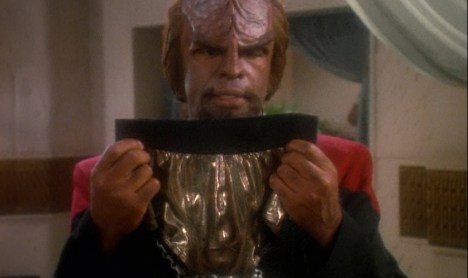
"It's okay, Worf. The writers promised that was only the first draft they sent through."

“It’s okay, Worf. The writers promised that was only the first draft they sent through.”

Continue reading

Star Trek: Deep Space Nine – Trials and Tribble-ations (Review)

Trials and Tribble-ations is a love letter to the franchise.

The thirtieth anniversary of Star Trek was a big deal. In many ways, the thirtieth anniversary celebration marks the end of the franchise’s cultural peak. Star Trek: The Next Generation is still fresh enough in the cultural consciousness that the anniversary is a big deal, even if the ratings on Star Trek: Deep Space Nine and Star Trek: Voyager are not necessarily what everybody would want them to be. The decline that would last through to the end of Star Trek: Enterprise only really comes into play in the wake of the big anniversary.

You know when you've been Gumped.

You know when you’ve been Gumped.

The thirtieth anniversary of the franchise was an embarrassment of riches, particularly from the perspective of a rather limp fiftieth celebration. Even the disappointment of Flashback was dwarfed by the abundance of affectionate homages and triumphant celebrations of a television series that had gone from a cult failure repeating endlessly in syndication to a pop cultural juggernaut with two television series and a successful film franchise running simultaneously. Trials and Tribble-ations was very much the cornerstone of all this.

Sure, there were other celebrations to mark the franchise’s big three-oh. While Flashback might of been a bit of a disappointment as a big anniversary special, Future’s End, Part I and Future’s End, Part II were a loving ode to Star Trek IV: The Voyage Home. Indeed, Star Trek: First Contact went even further and threw Star Trek II: The Wrath of Khan into the mix, blending the franchise’s most acclaimed and most financially successful films together for the occasion. Captain Janeway even crossed paths with the cast of Frasier to mark the occasion.

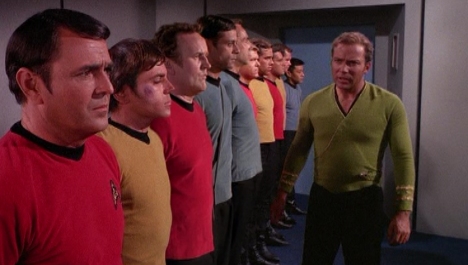
Quite the lineup.

Quite the lineup.

In spite of all of that, Trials and Tribble-ations stands quite apart from all the noise around it. There is a legitimate debate to be had about whether it is unequivocally the best of these productions, although it stands a very strong chance of winning that particular argument. However, there is no denying that it is the best celebration of the thirtieth anniversary. It is an adoring and affectionate love letter to the Star Trek franchise, one that seems to have been produced with giddy grin on its face and a skip in its step.

However, Trials and Tribble-ations works even beyond that. It is not simply a loving tribute to a monument of American popular culture, although that would be entirely justified. It is an acknowledgement to the decades of fandom that kept Star Trek alive during its occasional adventures in the wilderness.  Trials and Tribble-ations does not just praise Star Trek for surviving thirty years despite being cancelled after three seasons, but which captures the enthusiasm that sustained the series across those thirty years.

Doesn't scan.

Doesn’t scan.

It would be easy for a thirtieth anniversary special to treat the occasion as an act of cultural archeology, the careful and ritual unearthing of a popular artifact with all due reverence paid. Indeed, this was arguably the central problem with Flashback, an episode more interested in Star Trek as a memory and as a subject of nostalgia than a living breathing organism. Trials and Tribble-ations instead opts to treat Star Trek as a living and breathing organism, something tangible and material rather than abstract and ethereal.

Indeed, the episode ends with the revelation that the past is not another country. Sometimes you can bring something back. Even if that thing is a tribble.

You can go home again...

You can go home again…

Continue reading

Star Trek: Deep Space Nine – Apocalypse Rising (Review)

Apocalypse Rising stands quite apart from the other Star Trek: Deep Space Nine season premieres.

Most obviously, it the only single-part season premiere across the entire seven seasons of Deep Space Nine. Emissary and Way of the Warrior were two-hour television movies. The Homecoming fed into the franchise’s first official three-part story. The Search, Part I and The Search, Part II were obviously a two-part episode, while Image in the Sand and Shadows and Symbols provided a two-part introduction to the seventh season. A Time to Stand segued directly into Rocks and Shoals while also setting up a six-episode arc.

The times, they are a-changeling...

The times, they are a-changeling…

This is not to suggest that Apocalypse Rising is a more typical Star Trek season premiere. It is not a continuation of Broken Link in the same way that The Best of Both Worlds, Part II is a direct continuation of The Best of Both Worlds, Part I or that Basics, Part II is a direct follow-on from Basics, Part I. While Apocalypse Rising does resolve a cliffhanger left dangling by Broken Link, that cliffhanger was only really set up in the final two minutes of the episode. Indeed, the cliffhanger dangling from Broken Link recalls the endings of The Jem’Hadar or The Adversary.

Apocalypse Rising is also notable for being the first season premiere that is not positioned as a jumping on point, that is not intended to either expand the scope of the show or recruit new viewers. One of the luxuries of avoiding the traditional cliffhanger structures to bridge seasons was the freedom to begin each season with a relatively clean slate and introduce new elements. The Search, Part I and The Search, Part II introduced the Defiant and retooled the show to focus on the Dominion. The Way of the Warrior brought Worf over and shifted emphasis to the Klingons.

Klingon to the status quo...

Klingon to the status quo

While Apocalypse Rising does represent a slight shift in the tone of the show, it is not a radical new departure. More than that, it leans rather heavily on the show’s established mythology and in some ways indicates a desire to get the show back on track following an extended detour into war with the Klingons during the fourth season. Apocalypse Rising confirms what was made clear during the fourth season of the show, that Deep Space Nine has eventually evolved into its final form. Apocalypse Rising is a show so comfortable with itself that there’s no need to reinvent.

Although a little cramped and rushed in places, Apocalypse Rising represents a strong start to a stellar season. It is an efficient and effective piece of television, one that demonstrates the clarity of focus driving the season that will follow.

Drinking games...

Drinking games…

Continue reading

Star Trek: Deep Space Nine – Broken Link (Review)

This February and March (and a little bit of April), we’re taking a look at the 1995 to 1996 season of Star Trek, including Star Trek: Deep Space Nine and Star Trek: Voyager. Check back daily for the latest review.

What is perhaps most surprising about Broken Link is how quiet and subdued it all it.

The fourth season began with a bang, with the dissolution of the alliance between the Klingons and the Federation that had been established in Heart of Glory and dramatised in Star Trek VI: The Undiscovered Country. In fact, The Way of the Warrior featured the largest and most impressive combat sequence in the history of the Star Trek franchise to that point. Even allowing for The Sacrifice of Angels and What You Leave Behind, the fourth season premiere still ranks as one of the most elaborate set pieces in the franchise’s history.

Pray... for... Odo...

Pray… for… Odo…

Broken Link consciously circles back to that. It features the first reappearance of Robert O’Reilly as Gowron since The Way of the Warrior. The episode makes it clear that the problems depicted in The Way of the Warrior are only worsening. There is no small suggestion that Gowron is hoping to turn the cold war between the Federation and the Klingon Empire into a shooting war. Broken Link is very much a show about taking the status quo that was established in The Way of the Warrior and ramping it up.

However, what is most striking about Broken Link is the manner in which it escalates the situation. Not a single weapon is discharged in Broken Link, which is the last season finalé of Star Trek: Deep Space Nine not to feature a combat sequence of some description. The actual plot of the episode is remarkably straightforward and linear, keenly focused on a single member of the ensemble rather while relegating politics into the background. Even in terms of the scripting of the episode, care is taken to slow the pace down and allow character-driven dialogue scenes.
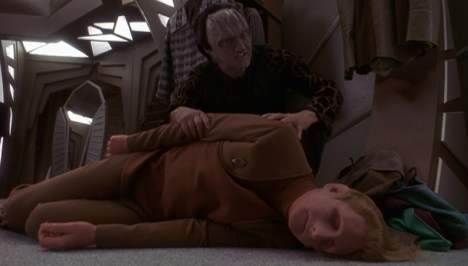
Oh no, Odo!

Oh no, Odo!

The result is a strangely intimate season finalé, one free of the bombast that comes with the season-bridging two-parters favoured by Star Trek: The Next Generation and Star Trek: Voyager. It is interesting to compare Broken Link to something like Basics, Part I, if only because the latter would never make room for Jadzia joking about being surrounded by “naked men” or Garak playing “Star Trek Cluedo” with Odo in sickbay. In fact, Broken Link is even relatively quiet by the standards of Deep Space Nine, lacking the galactic status quo shift of The Jem’Hadar or A Call to Arms.

As with a lot of the fourth season, there is a sense that the production team have made a point to learn from the third season: to improve upon what works and to fix what doesn’t. The Adversary was something of a happy accident at the end of the third season, a script thrown together at short notice when Paramount vetoed a season-ending cliffhanger that would be loosely adapted for Homefront and Paradise Lost. The slow character-centric tension of The Adversary was never intended to close the third season, but Broken Link realises that such an approach worked well.
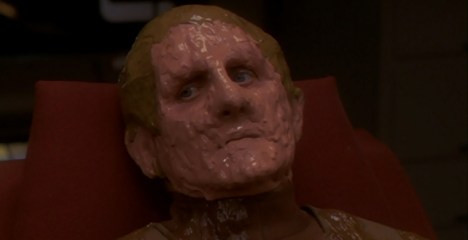
"Melting! Melting! Oh, what a world!"

“Melting! Melting! Oh, what a world!”

The result is an episode that feels incredibly comfortable in its own skin. Deep Space Nine is well aware of what it is, regardless of the direction and input that the studio offered the production team at the start of the fourth season. In fact, despite its somewhat relaxed pace and the space that it affords its character interactions, Broken Link is remarkably focused on what it wants to do. The closing line of the episode (and the season) is clever, consciously tying back the bold new direction of The Way of the Warrior back into the series’ own larger endgame.

In hindsight, Broken Link is something of a misleading title. Instead, it ties everything together.

Only a stone's throw away...

Only a stone’s throw away…

Continue reading

Star Trek: Deep Space Nine – For the Cause (Review)

This February and March (and a little bit of April), we’re taking a look at the 1995 to 1996 season of Star Trek, including Star Trek: Deep Space Nine and Star Trek: Voyager. Check back daily for the latest review.

For the Cause essentially refocuses the fourth season of Star Trek: Deep Space Nine, rallying the season’s strength as the finalé approaches.

After a bunch of lackluster episodes, from Rules of Engagement through to Shattered Mirror and The Muse, the show finds its voice once again. For the Cause is not just a great episode of television, it is an episode uniquely tailored to this particular show. For the Cause would not work on any of the other for Star Trek shows, so precisely is it calibrated to what makes Deep Space Nine unique. It is a story about trust and betrayal, but also one that chips away at the romance of Starfleet and the Federation.

Pinning his colours to the mast...

Pinning his colours to the mast…

What is particularly interesting about the stretch of episodes running from here through to Broken Link is the sense that Deep Space Nine is getting back to basics. The fourth season is somewhat overshadowed by the addition of Worf to the cast and the emphasis placed on the Klingons in The Way of the Warrior. Although the production team do a great job working within the studio mandate, this shift in focus has meant that many more traditional elements of Deep Space Nine have been shunted into the background.

The final stretch of the fourth season finds the show returning to ideas that were threaded through earlier seasons and were shifted slightly out of focus with the return of the Klingons. For the Cause brings the Maquis back to the fore. To the Death, The Quickening and Broken Link focus on the Dominion threat. Body Parts returns to Ferengi politics. To be fair, the Maquis were the only element that totally faded from view over the fourth season, so it makes sense to return to them first.

A stunning betrayal...

A stunning betrayal…

Continue reading