• Following Us

  • Categories

  • Check out the Archives


  • Awards & Nominations

The Spirit Archives, Vol. 2 (Review/Retrospective)

Join us the December as we take a dive into the weird and wonderful Will Eisner Spirit Archives, the DC collections of the comic strip that helped define the medium.

With this second collection of six months worth of strips, we can see Eisner’s vision of The Spirit really cement itself, as well as the true beginnings of the more experimental work that the writer and artist would do with the newspaper strip. While a lot of people would argue that Eisner truly hit his stride in the postwar era of The Spirit, I think we can see him beginning to truly hone his craft here, and can get a sense of an artist slowly testing the horizons of an eight-page newspaper comic strip. It might not be his best work on the title, but it’s still fascinating stuff.
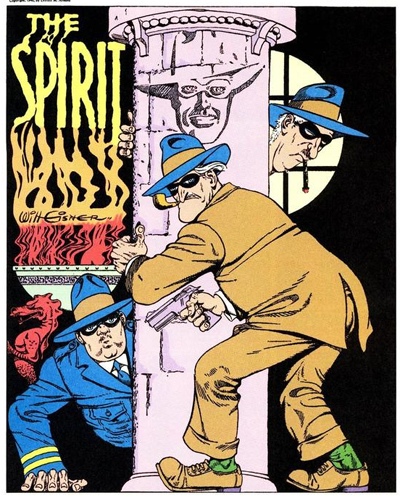
Accept no substitutes…

Continue reading

The Spirit Archives, Vol. 1 (Review/Retrospective)

Join us the December as we take a dive into the weird and wonderful Will Eisner Spirit Archives, the DC collections of the comic strip that helped define the medium.

It’s hard to overstate the impact that Will Eisner had on comic books as a medium. The writer, entrepreneur and artist is known as “the father of the graphic novel”, with A Contract With God regard as one of te very first examples of the format. Eisner made massive in-roads into developing comics as a medium that merited discussion and attention, trying frantically to break out of the ghetto where the artform is so frequently trapped. While he has made countless pivotal contributions, arguably Eisner’s largest and most influential body of work can be found in The Spirit, the weekly comic strip that the author syndicated across America. Packaged with any number of respected newspapers, it was among the most widely-read comic strips in the country, but it also allowed Eisner the freedom to expand and develop his craft.

DC have collected the bulk of the character’s history in a series of their superb “Archive Editions”, from the first strip published through to Eisner’s last work on the title (with a supplementary volume published by Dark Horse). Here, in the first volume, we can see the artist honing his craft and developing the series into one of the most important in comic book history.

That’s his name!

Continue reading

Infinite Crisis: Justice League – Crisis of Conscience (Review)

This month I’m taking a look at DC’s massive “Infinite Crisis” Event. Although it was all published in one massive omnibus, I’ll be breaking down the lead-in to the series to tackle each thread individually, culminating in a review of the event itself. Check back for more.

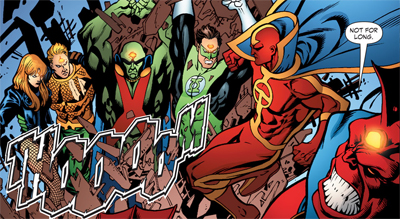
Crisis of Conscience exists of something of a bridge between Identity Crisis and Infinite Crisis. Of course, other tie-ins (like Villains United) have already explored that fertile ground, but Crisis of Conscience is very much about exploring the implications of that earlier crisis crossover. After all, how can the heroes trust one another, or themselves, when they’ve been tampering and playing with memory and personality. Ultimately, Crisis of Conscience doesn’t necessarily resolve anything. It really just lines up all the final pieces before we jump into Infinite Crisis proper. However, it’s an interesting exploration of just how far these characters have come since the innocence of the Silver Age.

Holding out for a hero…

Continue reading

Infinite Crisis: Rann-Thanagar War (Review)

This month I’m taking a look at DC’s massive “Infinite Crisis” Event. Although it was all published in one massive omnibus, I’ll be breaking down the lead-in to the series to tackle each thread individually, culminating in a review of the event itself. Check back for more.

I’ve always been a fan of the “hokey science-fiction” corner of the DC Universe. Adam Strange is perhaps my second-favourite Silver Age DC hero (behind the Flash). I loved Alan Moore’s trip to the stars during his Swamp Thing run. While many thought that Stars my Destination, the penultimate mega-arc of James Robinson’s Starman, went on far too long, I loved every page. Geoff Johns’ Green Lantern is one of my favourite modern comic book runs. I confess all this so that my bias is upfront, when I admit that Rann-Thanagar War is one of my favourite Infinite Crisis tie-ins, even though it’s one of those least directly connected to the event itself.

All the Strange, Strange heroes…

Continue reading

Infinite Crisis: Day of Vengeance (Review)

This month I’m taking a look at DC’s massive “Infinite Crisis” Event. Although it was all published in one massive omnibus, I’ll be breaking down the lead-in to the series to tackle each thread individually, culminating in a review of the event itself. Check back for more.

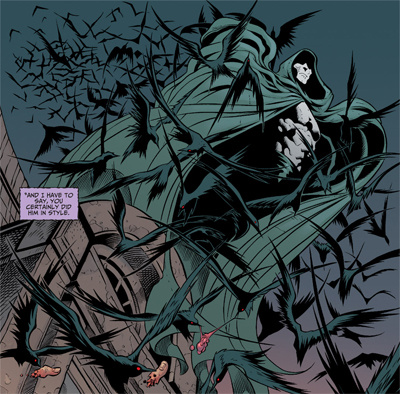
It seems like, within the last decade or so, DC has had a great deal of difficulty organising its “magic and mystic” books. DC generally provided a nice home for books like Alan Moore’s Swamp Thing or John Ostrander’s Spectre, but it seemed like there wasn’t really an abundance of successful magic-themed books in the early part of the new millennium. DC would consciously attempt to remedy this with their “dark” line as part of the “new 52” relaunch, but Day of Vengeance feels like something of an awkward earlier attempt to streamline that corner of the shared universe and to prepare it for some sort of creative relaunch.

One for sorrow, two for joy… What for a few dozen?

Continue reading

Infinite Crisis: The Adventures of Superman – Lightning Strikes Twice (Review)

This month I’m taking a look at DC’s massive “Infinite Crisis” Event. Although it was all published in one massive omnibus, I’ll be breaking down the lead-in to the series to tackle each thread individually, culminating in a review of the event itself. Check back for more.

I think it’s quite nice that DC went to the effort to collect the vast majority of tie-ins to Infinite Crisis inside this gigantic omnibus, even when the book didn’t necessarily get its own miniseries like Villains United or The O.M.A.C. Project. Like Sacrifice, Lightning Strikes Twice was a crossover between the Superman books leading into the events of one of the lead-in miniseries. In this case, writer Judd Winick was setting up the events of Day of Vengeance, the magic-themed crossover designed to tidy up and reenergise the mystical side of the DC Universe.

Super-punch!

Continue reading

Infinite Crisis: Superman – Sacrifice (Review)

This month I’m taking a look at DC’s massive “Infinite Crisis” Event. Although it was all published in one massive omnibus, I’ll be breaking down the lead-in to the series to tackle each thread individually, culminating in a review of the event itself. Check back for more.

I can see how Infinite Crisis earned its reputation as an overly-convoluted event. Even its tie-ins had tie-ins. In this case, the Superman: Sacrifice story, an arc spread across Superman, Action Comics and Wonder Woman, serves as a tie-in to Greg Rucka’s The O.M.A.C. Project, which was itself part of the lead-in to the big event. As you can imagine, it’s a rather strange trail of continuity to follow, as events here play out as a subset of a story that is itself a subset of something larger. While that is a problem of itself, the biggest problem with Superman: Sacrifice is that it takes an interesting enough central concept and reduces it to an over-extended four-issue arc about characters hitting each other really hard.

There’s blood on his hands…

Continue reading

Infinite Crisis: The OMAC Project (Review)

This month I’m taking a look at DC’s massive “Infinite Crisis” Event. Although it was all published in one massive omnibus, I’ll be breaking down the lead-in to the series to tackle each thread individually, culminating in a review of the event itself. Check back for more.

Infinite Crisis was certainly an ambitious project in scope. With the bulk of the major tie-ins collected in a gigantic 1,500-page omnibus, you really get a sense of just how expansive this gigantic crossover was. It’s remarkable how thematically consistent (and yet tonally distinct) so many of these tie-ins were, but The O.M.A.C. Project makes for a suitably grand opening to this gigantic epic crisis crossover, perfectly encapsulating a lot of the core themes that DC seem to have been striving for, while setting up an interesting central conflict.

What do you call a Corps of One-Man-Army-Corps?

Continue reading

The Demon by Jack Kirby (Review/Retrospective)

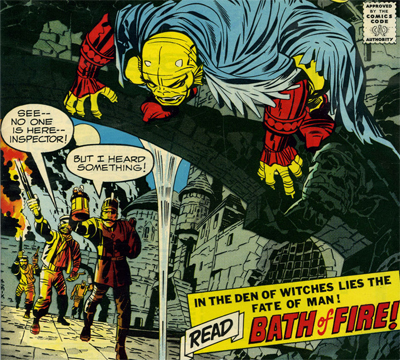
Of all of Jack Kirby’s seventies DC work, I think that everything must be somebody’s favourite. His Fourth World books bristled with ambition and perhaps serve as the most high-profile, influential and long-running of Kirby’s work with the publisher, but you never have to look too hard to find a proponent of the author and artist’s work on O.M.A.C. or Kamandi. While I am fond of all of Kirby’s DC work, enjoying the raw energy and sheer volume of ideas he brings to his high concepts, I have a soft spot for The Demon, if only because it’s a delightfully off-the-wall example of Kirby’s multiple interests bouncing off one another and familiar archetypes to create something that is often quite difficult to pin down.

Night of the Demon!

Continue reading

DC Comics Classics Library: Roots of the Swamp Thing (Review)

Sometimes a creator leaves such a massive impression on a character that it’s almost hard to believe that the character ever existed before the writer in question began their run. Alan Moore’s Swamp Thing is one such run, a modern day comic book classic which still reads as one of the best continuous runs by an author on any serial publication, ever. However, despite the fact that Alan Moore effectively defined the monster, Swamp Thing actually enjoyed a long publication history even before Moore began writing the title.

Roots of the Swamp Thing only collects the first thirteen issues of the first Swamp Thing title, but it’s enough to get a flavour for the title under Len Wein and artist Bernie Wrightson. While it still remains in the shadow of an author who took over later, it’s not a bad monster book in its own right. It still struggles a bit to find its own identity, but there’s some interesting ideas – and it’s easy enough to find some of the ideas Moore would develop to great success gestating between the lines.

It’s alive!

Continue reading