• Following Us

  • Categories

  • Check out the Archives


  • Awards & Nominations

The X-Files – Red Museum (Review)

This August (and a little of September), we’re taking a trip back in time to review the second season of The X-Files. In November, we’ll be looking at the third season. And maybe more.

While Firewalker is a solid episode ill-served by its position in the schedule and its similarity to an early episode of the show, Red Museum is just a mess.

The production issues with Red Museum are infamous. It was intended as the first part of a crossover between The X-Files and Picket Fences, both airing on Friday nights. The idea was that fans could tune into The X-Files on Fox for the first part of the story, and then move over to CBS after the credits rolled to pick up the case on Picket Fences. It was an ambitious effort – too ambitious. Although showrunners Chris Carter and David E. Kelley agreed on the idea, CBS vetoed it. It resulted in two orphaned hours of television, Red Museum and Away in the Manger.

Well, not quite. The result is something of a malformed two-parter composed of two individual malformed episodes.
He likes to watch...

He likes to watch…

Continue reading

Spider-Men (Review/Retrospective)

This April, to celebrate the release of The Amazing Spider-Man 2, we are taking a look at some classic and modern comics featuring Spider-Man (and friends). Check back daily for the latest review.

Spider-Men feels very light. It is the first official crossover between the mainstream Marvel Universe and the Ultimate Universe, something that readers had been promised would never happen. However, despite the fact that this is a big event that has been more than a decade in the making – something rumoured since the earliest days of Ultimate Spider-Man – Spider-Men feels decidedly low-key.

It’s pretty much a collection of vignettes rather than a compelling story in its own right, allowing Bendis to run through a checklist of material to smooth the transition between ultimate!Peter Parker and his successor, Miles Morales.

"Well, this is awkward..."

“Well, this is awkward…”

Continue reading

Andy Diggle’s Run on Daredevil – Shadowland (Review/Retrospective)

This April, to celebrate the release of The Amazing Spider-Man 2, we are taking a look at some classic and modern comics featuring Spider-Man (and friends). Check back daily for the latest review.

Shadowland is a disappointing climax to a wonderful decade of Daredevil. From the moment that Kevin Smith launched the second volume of the character through to the end of Ed Brubaker’s run, the Man Without Fear enjoyed a wonderfully consistent run of stories including runs from some of the best writers and artists working in comics, pushing the character in bold new directions and well outside his comfort zone.

Shadowland has a lot of problems, but the most obvious is that it betrays its central character. Matt Murdock is one of the most fascinating protagonists in comics, a proud (and occasionally arrogant) individual who might have the best of intentions but isn’t always able to make the right choices. Watching Murdock deal with his own mistakes and setbacks was a pretty compelling hook, as the comic pushed its protagonist into increasingly uncomfortable positions.

Unfortunately, the same cannot be said for Shadowland. Despite an interesting premise, it all falls apart when it decides that “a demon did it” is an acceptable explanation for Murdock’s latest errors in judgement.

Devilish delight?

Devilish delight?

Continue reading

Fear Itself (Review/Retrospective)

This March, to celebrate the release of Captain America: The Winter Soldier, we’ll be taking a look at some classic and not-so-classic Avengers comic books. Check back daily for the latest updates!

Part of what is so remarkable about Fear Itself is how uncomfortably it fits into the “huge event” role that Marvel cast for it. Matt Fraction’s seven-issues-and-change epic crossover event is really just a Thor story arc that dips its toe in the waters of Ed Brubaker’s Captain America. Instead, Marvel cast it as this gigantic universe-altering mega-important miniseries with over 100 crossovers and tie-ins from all corners of the Marvel Universe.

Positioned to capitalise on the release of both Kenneth Branagh’s Thor and Joe Johnson’s Captain America: The First Avenger, Fear Itself seems like a story told in the wrong place at the wrong time. Like Brian Bendis’ Secret Invasion would undoubtedly have worked better as an arc of New Avengers than as a full-blown “nothing is ever the same again” epic, Fear Itself would have been a much stronger comic had it been allowed to play out on a smaller stage.

Hammer time!

Hammer time!

Still, despite the problems inherent in large-scale epic crossovers, Fear Itself works surprisingly well. Indeed, it it probably the strongest Marvel “mega-event” of the past decade if only because it is built on a strong ideological premise and develops some of the underlying themes and ideas of Fraction’s other Marvel work. Treated as a seven-issue story arc from Matt Fraction’s The Mighty Thor, it’s a fascinating climax of ideas that bubble away in the background of his run.

The choice to let Fraction craft Fear Itself, with assists from Ed Brubaker on the prologue and epilogue to the event, is inspired. Fraction is not the most consistent of comic book writers, but he is also incredibly wry and self-aware. There’s a sense of charming self-deprecating to Fear Itself, as Fraction allows the characters involved to reflect on the absurdity of it all without ever losing track of their humanity. Fear Itself might be far from perfect, but it is clever, fun and thoughtful. And those are endearing virtues.

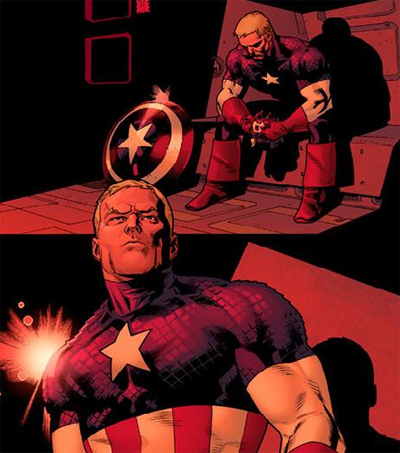
Suit up!

Suit up!

Continue reading

Star Trek: The Next Generation – Q-Squared by Peter David (Review)

This January and February, we’ll be finishing up our look at the second season of Star Trek: The Next Generation and moving on to the third year of the show, both recently and lovingly remastered for high definition. Check back daily for the latest review.

We’ll be supplementing our coverage of the episodes with some additional materials – mainly novels and comics and films. This is one such entry.

Q-Squared is probably Peter David’s most ambitious Star Trek: The Next Generation novel. “Q-Squared is almost my challenge to the reader to keep up with me,” he boasted in Voyages of the Imagination. Essentially a meditation on reality and free will within that construct, Q-Squared is a breathtakingly confident endeavour. It’s an interesting reflection on the potentiality embraced by The Next Generation, the broadening of the franchise’s perspective to embrace the best of all possible worlds.

Q-Squared hit stands in early July 1994, just over a month after All Good Things… brought the curtain down on The Next Generation for one last time. It’s tempting to look at the two stories as companion pieces. All Good Things… is an exploration of the time that the crew spent together – jumping backwards and forwards to trace our heroes over the course of their lives. In contrast, Q-Squared jumps sideways – looking at what might have been, or what could have been.

tng-q-squared

Continue reading

Star Trek: The Next Generation/Doctor Who – Assimilation² (Review)

This January and February, we’ll be finishing up our look at the second season of Star Trek: The Next Generation and moving on to the third year of the show, both recently and lovingly remastered for high definition. Check back daily for the latest review.

We’ll be supplementing our coverage of the episodes with some additional materials – mainly novels and comics and films. This is one such entry.

It’s amazing that Assimilation² represents the first official crossover between Star Trek and Doctor Who. After all, the nineties saw a trilogy of comics and novels in which Star Trek crossed over with Marvel’s X-Men. At the same time, though, the miniseries’ combination does seem a little odd. Pairing the Cybermen and the Borg is a bit of a no-brainer, but the Eleventh Doctor feels like a bit of a strange fit on board Picard’s Enterprise.

The Ninth or Tenth would arguably offer more of a contrast with Picard’s restrained and dignified command style. The Tenth Doctor and Donna arriving on the luxury Enterprise practically writes itself. (“Now that’s what I call a spaceship. You’ve got a box, they’ve got a Stella Liner.”) Picard and the Eleventh Doctor feels like a particularly bland pairing, if only because there’s no way they’d try each other’s patience. The Eleventh Doctor would probably work better in the context of Sisko’s Deep Space Nine or either Kirk’s Enterprise.

Still, although Assimilation² never quite takes full advantage of its central hook, it’s a diverting enough mish-mash of two science-fiction staples.

Cue Who?

Cue Who?

Continue reading

Star Trek: The Next Generation – Dark Mirror by Diane Duane (Review)

Star Trek: Deep Space Nine is twenty years old this year. To celebrate, I’m taking a look at the first and second seasons. Check back daily for the latest review or retrospective.

We’ll be supplementing our coverage of the episodes with some additional materials – mainly novels and comics and films. This is one such entry.

Dark Mirror was released a few mere months before Crossover was broadcast – one of those moments of pop culture synergy where it turns out that two different individuals can have the same idea, but with infinitely different nuance or emphasis. Indeed, the timing syncs up so well that Crossover actually aired between the hardcover and soft cover printings of Dark Mirror, suggesting that a return to the mirror universe was something of an inevitability for Star Trek, in one form or another.

Duane’s approach to the mirror universe is markedly different to that of writers Michael Piller and Peter Allan Fields, with both Dark Mirror and Crossover taking the ending of Mirror, Mirror and running with it in opposite directions. Piller and Fields used the aftermath of Kirk’s meddling as a means to explore the consequences of interference in a culture that Kirk didn’t quite understand – a mechanism to explore the way that the original Star Trek didn’t seem to grasp moral relativity, and to explore political complexities outside Kirk’s value system.

In contrast, Dark Mirror is a more philosophical meditation on the nature of good and evil, a more metaphysical exploration of a fictional world built around the concept of selfishness and strength, and how such a universe would have to work on different physical laws than that of Star Trek: The Next Generation.

tng-darkmirror

Continue reading

Star Trek: Deep Space Nine – Crossover (Review)

Star Trek: Deep Space Nine is twenty years old this year. To celebrate, I’m taking a look at the first and second seasons. Check back daily for the latest review or retrospective.

At the time, Crossover must have seemed like a very odd choice for a late-second-season episode of Star Trek: Deep Space Nine. Of course, the mirror universe episodes would become a quasi-annual occurrence on the show, similar to the “O’Brien must suffer” adventures. However, in May 1994, it must have seemed like a really strange choice to do an entire episode as a sequel to a much-loved second-season installment of the original Star Trek.

Still, Crossover remains the strongest of Deep Space Nine‘s mirror universe episodes, most notably because it treats the rather absurd premise with a certain amount of weight and integrity, but also because it feels so delightfully weird.

Half the cast has been waiting two years to do that...

Half the cast has been waiting two years to do that…

Continue reading

Kurt Busiek’s and George Perez’s Avengers – Avengers/JLA (Review/Retrospective)

April (and a little bit of May) are “Avengers month” at the m0vie blog. In anticipation of Joss Whedon’s superhero epic, we’ll have a variety of articles and reviews published looking at various aspects of “Earth’s Mightiest Heroes.”

Read our review of The Avengers here.

Avengers/JLA is about as nerdy as a comic book crossover can get. Really. It takes two teams of superheroes which were both formed to allow existing heroes to team up… and then teams those two teams up. It’s pure geek chic, after all. I have no shame in admitting that I enjoyed on a purely fanboyish level, my inner eight-year-old ecstatic at the idea of taking so many toys out of so many different boxes and bashing them together which such delightful cheer. It’s not an essential story, nor a brilliant one, nor a creative one – but it does exactly what it says on the tin. It gives us a gigantic crossover between two of the more recognisable Marvel and DC superhero teams.

The very definition of awesome...

Continue reading

Geoff Johns’ Run on Green Lantern – War of the Green Lanterns (Review)

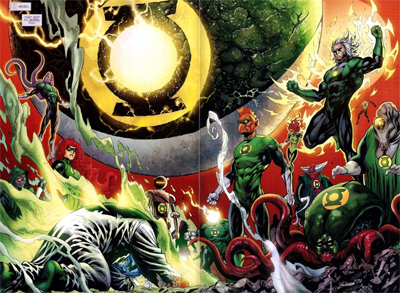
I think that Geoff Johns deserves to take the majority of the credit for pushing the Green Lantern series forward as one of the mostly highly regarded properties in DC’s stable of intellectual property. That the Green Lantern continuity was allowed to remain almost entirely intact represents a huge vote of confidence in Johns as a creator, and the work that he has done. Still, War of the Green Lanterns can’t help but feel like a bit of a disappointment. An attempt to do a “mini-event” contained to the franchise (similar to the successful Sinestro Corps War), War of the Green Lanterns suffers because it doesn’t have the same thematic through-line as its predecessor, one that engaged the reader throughout the carnage and crossovers. That’s not to say War of the Green Lanterns doesn’t have any good ideas, but that it’s too jumbled and mixed up to be great.

Mogo doesn't socialise...

Continue reading