• Following Us

  • Categories

  • Check out the Archives


  • Awards & Nominations

Star Trek (DC Comics, 1989) #1-12 – The Trial of James T. Kirk! (Review)

This June, we’re taking a look at some classic Star Trek movie tie-ins and other interesting objects. Check back daily for the latest reviews and retrospectives.

The late eighties and early nineties saw a change in the world of Star Trek tie-ins. During the eighties, tie-in writers had typically been afforded a great deal of freedom in telling their stories – allowed to explore the fringes of the Star Trek universe with little regard to how things matched up. The period saw a number of truly spectacular Star Trek tie-ins that count among the best work ever released with the Star Trek brand on it – John Ford’s The Final Reflection or Diane Duane’s My Enemy, My Ally.

However, with the release of Star Trek V: The Final Frontier and the broadcast of the third season of Star Trek: The Next Generation, there was a shift in how the franchise approached tie-in novels and comic books. Gene Roddenberry had arguably lost control of his creation, with the Harve Bennett and Nicholas Meyer taking control of the feature films while Rick Berman and Michael Piller were the driving creative forces on the television show.

Crossing swords...

Crossing swords…

As such, the tie-ins became a place where Roddenberry and his “people” – including Richard Arnold and Susan Sackett – could make their influence most heavily felt. So, in the late eighties and early nineties, a conscious effort was made to re-tool the novels and the comic book tie-ins, with Richard Arnold maintaining a much tighter grip on the reigns. DC’s first volume of Star Trek comics was cancelled after fifty-six issues, and another volume was launched to coincide with the launch of the Next Generation comic.

Writer Peter David had closed out the first volume of the Star Trek comic, and was drafted in as the writer of the new on-going series. However, he almost immediately came into conflict with Richard Arnold. Pages of the first issue had to be hastily re-drawn when Richard Arnold vetoed the use of a supporting character from Star Trek: The Animated Seriesafter the comic had been drawn. In many respects, this set the tone for the comic, which was victim to all sorts of weird editorial mandates.

The Andorian Incident...

The Andorian Incident…

While writer Michael Jan Friedman remained the writer on the on-going Next Generation comic for most of its run – only occasionally getting another writer to fill in – Peter David departed the Star Trek comic before the end of the book’s second year on the stand. This is especially frustrating when one considers the pedigree of Peter David. An accomplished novelist and comic book writer, David had a wealth of experience in the medium that was being maliciously squandered by Arnold.

It’s a shame, because the opening twelve issues of DC’s second volume of Star Trek make for a delightful read and a fitting substitute for a live-action Star Trek television show unfolding between the movies.

Warp speed ahead...

Warp speed ahead…

Continue reading

Star Trek IV: The Voyage Home by Vonda N. McIntyre (Review)

This June, we’re taking a look at some classic Star Trek movie tie-ins. Check back daily for the latest reviews and retrospectives.

Comedy doesn’t always translate well between different media. That’s not to suggest that comedy works better in one medium as compared to others, merely to contend that certain forms of comedy don’t translate perfectly between different media. It works any number of ways. Something that is funny in sound and vision is not necessarily hilarious in prose. Gags relying on delivery might play better with a seasoned performer than in the mind’s eye of a reader. Witty prose doesn’t always lend itself to narration or articulation on film.

Much of Star Trek IV: The Voyager Home plays as broad farce, following a bunch of time-travelers from the future (and refugees from television land) as they try to interact with the real world. The movie does have some wonderful character moments – notably Spock’s character arc that beautifully brings him a full circle and Kirk’s relationship with Spock – but it also plays the Star Trek ensemble in a highly caricatured manner, more as archetypes than fully-realised three-dimensional characters.

This is grand. After all, these are fictional characters rather than real people. After all stories are more than just excerpts from the biographies of fictional characters. While it’s nice to have consistent characterisation, suggesting that you can’t have Kirk and Spock acting in an exaggerated fashion for the sake of comedy is a very narrow and restrictive view of what Star Trek is or should be.

The Voyage Home gets the big character beats right – Spock’s insistence that the crew rescue Chekov, Kirk convincing Gillian to trust him, Spock “guessing” – that we can excuse the crew’s lack of awareness about a time period they have visited before and the general flippancy of the movie itself. The novelisation, however, is another matter. Vonda N. McIntyre clearly cares a great deal about the characters. That was one of the strengths of her work on the novelisations of the last two films. Here, however, McIntyre struggles to balance that with the tone of the story.

startrekiv Continue reading

The Amazing Spider-Man – The Gauntlet: The Juggernaut – Something Can Stop the Juggernaut (Review/Retrospective)

This April, to celebrate the release of The Amazing Spider-Man 2, we are taking a look at some classic and modern comics featuring Spider-Man (and friends). Check back daily for the latest review.

Something Can Stop the Juggernaut is a bit of an oddity in the grand scheme of The Gauntlet, if not the larger scheme of Brand New Day. One of the stated goals of Brand New Day was to present readers with a thoroughly modernised version of Spider-Man, an iteration of the character who had been distilled to his purest essence, unburdened by the weight of decades of character development and continuity.

As the “new” in Brand New Day suggests, a large part of the editorial stance on Brand New Day was the opportunity to do something novel with The Amazing Spider-Man. It was a conscious break with the old, and an attempt to push the character in new directions. After all, the early issues made an effort to shuffle new characters into the established ensemble and to feature new villains and threats for our hero to face.

Leaping into action...

Leaping into action…

(To the point where the emphasis on classic foes was one of the selling points of The Gauntlet – a sense that the comics were finally trying to bring many of these iconic baddies into the twenty-first century alongside a reinvigorated and re-energised Spider-Man. Indeed, it’s interesting how much of The Gauntlet makes a point to reference or mirror Peter’s continuity reset into Brand New Day. Much like Peter in One More Day, many of his classic foes lose their new-found families to reset them to villainy, except without the benefit of a magical reset button at the end.)

So drawing back in celebrated creator Roger Stern to craft a sequel to a beloved eighties Amazing Spider-Man story feels rather surreal. The three-part Something Can Stop the Juggernaut exists as an explicit to Stern’s deservedly beloved classic Nothing Can Stop the Juggernaut, right down to classic flashbacks to the comic, follow-up references to various characters, and the fact that events spiral from that story.

Spidey is a little tied up...

Spidey is a little tied up…

Something Can Stop the Juggernaut is crafted as a celebration of vintage Spider-Man, which works very well in the context of The Gauntlet. As the on-going epic spirals towards its climax in Shed and Grim Hunt, it’s nice to hace a reminder of a classic Spider-Man story. After all, Grim Hunt makes a point to stress the perfection of another classic Spider-Man story, albeit in a very different way.

Something Can Stop the Juggernaut seems to exists to assure readers that the legacy and history of Spider-Man is still valid and meaningful, not rendered moot by the continuity-tinkering shennanigans of One More Day.

The Juggernaut who fell to Earth...

The Juggernaut who fell to Earth…

Continue reading

The Amazing Spider-Man – The Gauntlet: Morbius – It Is The Life (Review)

This April, to celebrate the release of The Amazing Spider-Man 2, we are taking a look at some classic and modern comics featuring Spider-Man (and friends). Check back daily for the latest review.

At a scant fourteen pages (sharing a single issue with a larger Flash Thompson story), It is the Life feels like something of an interlude in the large scheme of The Gauntlet. While most of the stories in the cycle are relatively short and contained (with nothing running over four issues), this is an exceptionally brief encounter between Spider-Man and one his older foes-turned-allies.

At the same time, writer Fred Van Lente manages to pile a lot into the fourteen pages of It is the Life, maintaining a wonderful thematic consistency across the line. Editor Stephen Wacker has done a wonderful job managing his team of “web-heads” and making sure that The Gauntlet remains internally consistent and on-point. Despite the diversity in talent working on the sprawling Spider-Man epic, it never feels like the larger threads get away from any of the writers.

Even a short fourteen-page interlude manages to hit on many of the event’s core themes.

What's at stake?

What’s at stake?

Continue reading

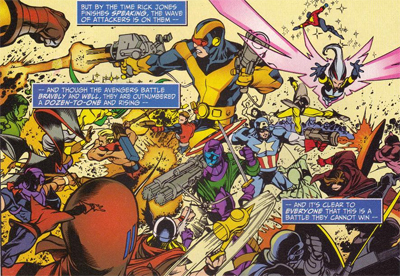
Brian Michael Bendis’ Avengers – The Age of Ultron (Review)

This March, to celebrate the release of Captain America: The Winter Soldier, we’ll be taking a look at some classic and not-so-classic Avengers comic books. Check back daily for the latest updates!

Age of Ultron is Brian Michael Bendis’ last hurrah on Marvel’s massive Avengers franchise. Bendis began writing Avengers when it was a third-tier comic book property, and he was – in a large part – responsible for turning the comic franchise into a sales juggernaut. The fact that Marvel was simultaneously working on a massive cinematic universe built around these characters – if only because they’d sold off most of the other ones – probably didn’t hurt.

So, with Bendis moving off the Avengers franchise, ceding the crown of lead Avengers writer to up-and-comer Jonathan Hickman, he wrote Age of Ultron. It was a story the author had been hinting at for quite some time, from the first arc of his relaunched adjectiveless Avengers title through to his short run on Moon Knight. Having completed a grand sweeping story arc running from Avengers Disassembled through to Siege, Age of Ultron feels like an epilogue to Bendis’ run – a post-script to the tenure of the man who changed the franchise.

It also feels, rather awkwardly, like the most self-consciously Avengers-y Avengers story ever aveng(er)ed.

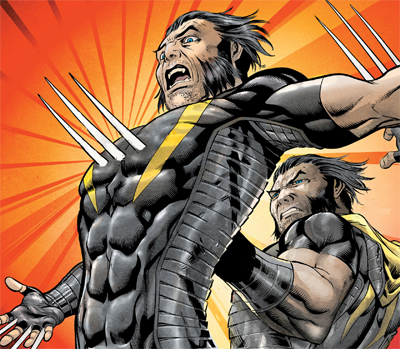
Over-exposure is killing Wolverine...

Over-exposure is killing Wolverine…

Continue reading

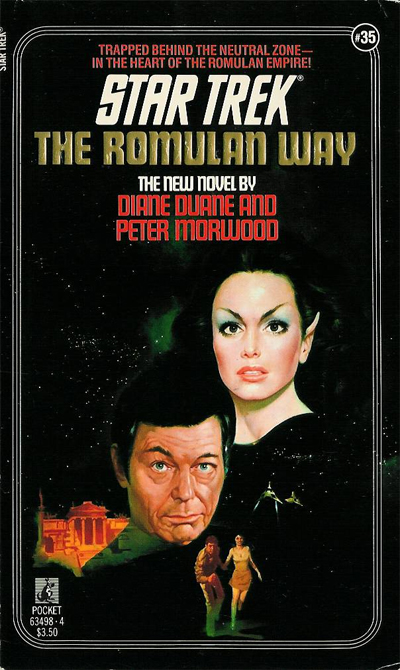
Star Trek – The Romulan Way by Diane Duane and Peter Morwood (Review)

This January and February, we’ll be finishing up our look at the second season of Star Trek: The Next Generation and moving on to the third year of the show, both recently and lovingly remastered for high definition. Check back daily for the latest review.

We’ll be supplementing our coverage of the episodes with some additional materials – mainly novels and comics and films. This is one such entry.

The Romulan Way is the second book in Diane Duane’s “Rihannsu” cycle – although the first book in the series, My Enemy, My Ally was only retroactively distinguished from standard Star Trek tie-ins. Much like My Enemy, My Ally had been roughly contemporaneous with John M. Ford’s The Final Reflection, Duane’s follow-up was published around the same time as Ford’s own sequel to his earlier work, How Much for Just the Planet? Expanding on My Enemy, My Ally, The Romulan Way sees Duane delving more thoroughly into Romulan history and culture.

The Romulan Way was published amid a sea of change at Paramount and Pocket Books in the late eighties, with shifting mandates and objectives for these tie-in books that represented a conscious effort to hem in some of the more creative tendencies of mid-eighties Star Trek novelist. To demonstrate how rapidly things were changing, both The Romulan Way and How Much for Just the Planet? were both published within three years of their predecessors. After this point, it would take Duane another thirteen years to write the third volume in her saga, and John M. Ford would never write another Star Trek tie-in again.

It’s very hard to condone any publishing philosophy that leads to results like that.

tos-theromulanway

Continue reading

Kurt Busiek’s Avengers – Avengers Forever (Review/Retrospective)

April (and a little bit of May) are “Avengers month” at the m0vie blog. In anticipation of Joss Whedon’s superhero epic, we’ll have a variety of articles and reviews published looking at various aspects of “Earth’s Mightiest Heroes.”

Read our review of The Avengers here.

In many ways, to me, Kurt Busiek’s Avengers run represents comic book nostalgia given form. I can’t help but read it as an attempt to call back to the “good old days” of mainstream comic books, with all the illogical and insane twists and an old-school approach to dialogue and characterisation. On the best of days, I’ve found his approach giddy and enjoyable – it’s hard not to get caught up in his genuine enthusiasm for the material. However, when Marvel gave Busiek a twelve-issue Avengers miniseries, it seemed inevitable that the writer wouldn’t just seek to nostalgically emulate the past, but tie it all together as well. In this respect, as it weaves through decades of Avengers continuity, Avengers Forever feels almost like continuity porn. Hardcore continuity porn.

Avengers! Avenge!

Continue reading

Kurt Busiek’s (& George Perez’s) Avengers – Avengers Assemble! Vol. 2 (Ultron Unlimited) (Review/Retrospective)

April (and a little bit of May) are “Avengers month” at the m0vie blog. In anticipation of Joss Whedon’s superhero epic, we’ll have a variety of articles and reviews published looking at various aspects of “Earth’s Mightiest Heroes.”

I want to enjoy Kurt Busiek’s Avengers run. It’s apparently one of the better Avengers runs out there. In fact, I can actually see the reasons why one would fall in love with it. It has great characters, great villains and great stories, written by a writer who adores the subject matter and an artist who is among the best in the business. And yet I can’t help but feel locked out of the series, as if this is a book intended for those who like a particular style of old comics – rather than those seeking accessible and fresh takes on classic characters coming together to fight evil. This second volume is perhaps the highlight of the run, collecting – as it does – the Ultron Unlimited storyarc, perhaps regarded as Busiek’s finest hour on the title (with only Avengers Forever and The Kang Dynasty competing, depending on who you ask).

Boy, is his face red...

Continue reading

Brad Meltzer’s Run on Justice League – The Tornado’s Path (Review/Retrospective)

This January, I’m going to take a look at some of DC’s biggest “events.” This week I’ll be taking a look at Brad Meltzer’s impact on the DC universe.

Justice League has always been a bit of a funny little book. The concept is so straight-forward that you’d imagine it would be quite difficult to muck up. After all, it’s a series about DC’s most powerful and iconic heroes teaming up to do impossibly cool stuff and to look good while doing it. DC has been doing this long enough to have an idea of what works on the title and what doesn’t. While Justice League International has its fans, it’s hard to argue that the appeal of the Justice League wasn’t encapsulated by Grant Morrison’s hugely successful nineties run. As such, putting the big characters back on the title shouldn’t seem like a big event of itself – it should be the default setting. So it always seems to me a bit strange when DC relaunch the series with a big name writer and the iconic line-up, only for editorial to inevitably screw things up down the line.

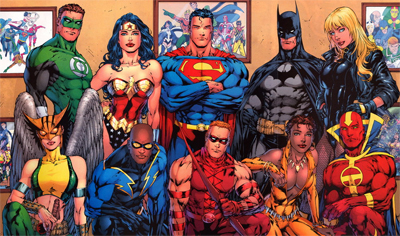
Team photo...

Continue reading

Flash: Rebirth (Review/Retrospective)

This January, I’m going to take a look at some of DC’s biggest “events.” I’ll be starting with the most recent one, Flashpoint, but – in the spirit of the character – we’re going to have a marathon run through Flash stories before we get there. Check back daily this week for more Flash-ified goodness…

From the outset, Flash: Rebirth was going to be an infinitely more complex endeavour for writer Geoff Johns than Green Lantern: Rebirth had been. Both miniseries aimed to firmly establish an older legacy character (in both cases, the iteration of the character active in the late fifties/early sixties) as the core of that particular franchise, replacing their replacements, as it were. However, Hal Jordan had been absent for about ten years, and had been hovering around the DC Universe in various guises during his absence from the role of Green Lantern. Barry Allen, on the other hand, had been gone twenty years and his appearances had been far scarcer. There had been a whole generation of fans (including the author of this miniseries) who grew up with Wally West as the Flash. Bringing Barry back was always going to be tricky, but here it becomes evident just how tricky.

A darker shade of red?

Continue reading