• Following Us

  • Categories

  • Check out the Archives


  • Awards & Nominations

Star Trek – I, Mudd (Review)

The first Star Trek pilot, The Cage, was produced in 1964. To celebrate its fiftieth anniversary, this December we are reviewing the second season of the original Star Trek show. You can check out our first season reviews here. Check back daily for the latest review.

I, Mudd is delightfully silly.

This is probably the broadest Star Trek comedy episode ever produced. It is very difficult to imagine any Star Trek ensemble outside the original cast pulling off an episode like this. While The Trouble With Tribbles is easily the show’s most iconic comedy episode (and the franchise’s, to boot), there is something rather plucky and endearing about I, Mudd. One of features of the later Star Trek spin-offs was a tendency to take themselves quite seriously. This isn’t a problem of itself, but it does make it impossible to do a show like I, Mudd.

Mudd in yer eye...

Mudd in yer eye…

As with other second-season episodes, there is a sense that the show is stretching its wings a bit. Catspaw was a clear attempt to do a horror story, and Wolf in the Fold was a slasher or occult film in Star Trek form. Episodes like Amok Time and Journey to Babel are very consciously building out the Star Trek universe. Episodes like I, Mudd and The Trouble With Tribbles demonstrate that Star Trek can do comedy.

To be fair, it is perfectly reasonably to argue that shows like I, Mudd led the show to think that Spock’s Brain was a good idea. Still, I, Mudd is just so much fun – demonstrating the sense of goofy and theatrical fun that ran through so much of classic Star Trek.
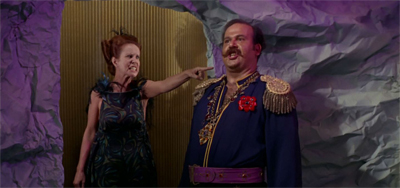
"Stella, Stella... You're putting me through hell-a!"

“Stella, Stella… You’re putting me through hell-a!”

Continue reading

Star Trek (DC Comics, 1984) #9-16 – New Frontiers (aka The Mirror Universe Saga) (Review)

The first Star Trek pilot, The Cage, was produced in 1964. To celebrate its fiftieth anniversary, this December we are reviewing the second season of the original Star Trek show. You can check out our first season reviews here. Check back daily for the latest review.

Eight issues is a long time in the world of comic books, even by the standards of modern storytelling. Committing to the same story arc for two-thirds of a calendar year is a big decision, even moreso in December 1984. Nevertheless, DC comics committed to an eight-issue Star Trek story arc in the wake of Star Trek III: The Search for Spock, on throwing Kirk and the crew into a truly epic adventure with the fate of the Federation hanging on the line. It is no wonder that The Mirror Universe Saga remains the gold standard for Star Trek comic books, reprinted and repackaged repeatedly over the years.

The Mirror Universe Saga is an epic in just about every sense of the word, spanning two universes and eight issues. Not only do writer Mike Barr and artist Tom Sutton find themselves handling the fallout from the last feature film, but they also dabble in an iconic piece of Star Trek history. The Mirror Universe Saga takes full advantage of its format to offer a spectacular and impressive adventure that would have been impossible to realise on film in 1984 – indeed, it is hard to imagine television or cinema doing justice to the scale of the adventure now.

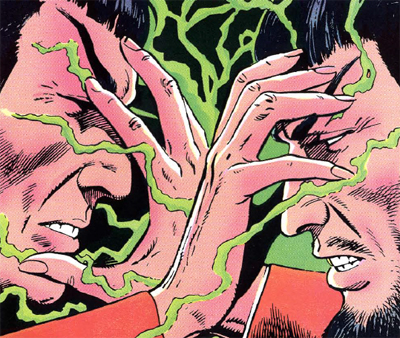
Meeting of minds...

Meeting of minds…

However, The Mirror Universe Saga succeeds on more than simply epic scale and meticulous attention to detail – although Barr and Sutton provide those with gusto. Despite everything going on around it, The Mirror Universe Saga largely works because it never loses track of the characters at the heart of the story. While the Terran Empire might be plotting an invasion in the midst of an internal revolution, the more powerful moments of The Mirror Universe Saga come from throwing the characters into contact with their alternate selves.

In 1984, it seems like The Mirror Universe Saga had figured out what would be the core ingredients for the most successful follow-ups to Mirror, Mirror. It deduced that the mirror universe could not just be playground where everything is gloriously and campily evil; it had to retain some level of emotional reality or connection. What good is a mirror if it is not reflecting anything?

Set course... for eeeevil!

Set course… for eeeevil!

Continue reading

Star Trek – Spock’s World by Diane Duane (Review)

The first Star Trek pilot, The Cage, was produced in 1964. To celebrate its fiftieth anniversary, this December we are reviewing the second season of the original Star Trek show. You can check out our first season reviews here. Check back daily for the latest review.

One of the more interesting aspect of Star Trek tie-in media during the eighties was the sense of freedom enjoyed by those working on the line.

One of the more infamous examples concerned DC’s attempts to publish a monthly comic during the release cycle of Star Trek II: The Wrath of Khan, Star Trek III: The Search for Spock and Star Trek IV: The Voyage Home. The three films tended to build off one another, forming a tight continuity, but that did not stop the comic book company from trying to build off the ending of each of the films, leading to a variety of weird continuity hijinks. Spock left to work on a Vulcan ship; Kirk took command of the Excelsior; a Klingon joined the crew.

Writers working on the tie-in novels enjoyed a similar amount of freedom. By the time that Spock’s World was published in 1989, Diane Duane had been able to firmly establish her own supporting cast of characters in her various tie-in novels. Spock’s World includes appearances from Duane regulars like K’s’t’lk and Harb Tanzer, introduced in The Wounded Sky; even Lia Burke from My Enemy, My Ally puts in an appearance. It really feels like Duane has carved out her own space within the larger Star Trek universe.

However, perhaps that freedom finds its strongest expression in the fact that Duane was able to map an entire cultural and social history unto the planet Vulcan. Spock’s World reads almost like a biography of a fictional planet – charting the history of Vulcan from the planet’s earliest days through to the twenty-third century. It is a delightfully bold and intriguing Star Trek book, one utterly unlike any other tie-in ever published.

Continue reading

Star Trek (Gold Key) #1 – The Planet of No Return! (Review)

The first Star Trek pilot, The Cage, was produced in 1964. To celebrate its fiftieth anniversary, this December we are reviewing the second season of the original Star Trek show. You can check out our first season reviews here. Check back daily for the latest review.

The Star Trek comics published by Gold Key are somewhat infamous additions to the Star Trek canon. The company began publishing comic book tie-ins in July 1967, in the gap between the first and second seasons of the original Star Trek show. They continued to publish those tie-ins until 1978, when the license passed to Marvel. These early comics have become the source of much derision over the years, with fans dismissing them as hollow cash-ins produced by people with little understanding of the franchise itself.

However, recent years have seen something of a reappraisal of these early comic books. Once IDW Publishing secured the rights to produce tie-in Star Trek comic books, they devoted considerable effort to archiving and releasing classic and little-seen material from the franchise’s history. They released the Star Trek newspaper strips in a two-volume set, before turning their attention to the classic Gold Key comic books. It is a very worthwhile attempt to provide fans with a glimpse of oft-overlooked chapters in the franchise’s history.

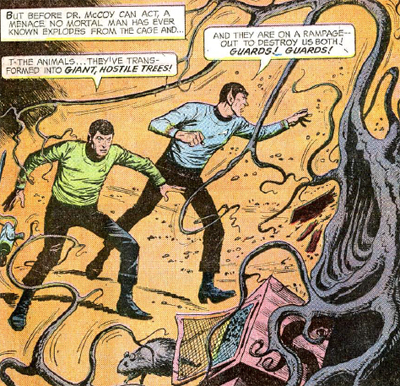
Plant life...

Plant life…

The Gold Key Star Trek comics are messy. A lot of the criticisms hold true. There are all manner of continuity errors in the production of the comic. Artist Alberto Giolitti takes quite some time to figure out what Scotty looks like, and the colourists take a bit of time to figure out what uniforms various cast members should be wearing. The writing is similarly clunky, with characters sounding a little out of sort as the basic plot details seem to stand at odds with still-relatively-small Star Trek canon had been established by the closing credit of Operation — Annihilate!

And yet, despite all these considerable flaws, these comics do make for an interesting time capsule. They don’t feel quite like Star Trek so much as an impression of what Star Trek would look described to somebody who has never seen it, filtered through the lense of fifties and sixties science-fiction comics. The early issues feel like three blind men describing an elephant, and it is glorious.

Branching out...

Branching out…

Continue reading

Star Trek: Deep Space Nine – The Lives of Dax: The Music Between the Notes (Curzon) by Steven Barnes

This September and October, we’re taking a look at the jam-packed 1994 to 1995 season of Star Trek, including Star Trek: Deep Space Nine and Star Trek: Voyager. Check back daily for the latest review.

Star Trek: Deep Space Nine struggled with the character of Dax on-and-off for the first three years. Terry Farrell found herself at the centre of interesting character-driven stories with Playing God and Facets, but the show tended to treat the Dax symbiont as a macguffin that just happened to be inside Jadzia. Episodes like Dax, Invasive Procedures and Equilibrium tended to marginalise Jadzia so that the symbiont itself could be pushed to the centre of a story driven by other members of the ensemble.

However, Dax is a character with absolutely phenomenal potential. There is something absolutely fascinating idea of a creature that has lived for centuries, and seen generations of history unfold within its lifetime.The symbiont has witnessed countless changes and pivotal moments. Dax has seen civilisations fall and alliances form; Dax has seen old enemies become true friends, and watched civilisations reach out into the cosmos.

The realities of a seven-season television show mean that Deep Space Nine never really got to explore the fact that Dax was living history. Perhaps Blood Oath and Trials and Tribble-ations come closest, using Dax as a rather logical bridge spanning almost a century of continuity. One of the joys of the Star Trek universe is how expansive and how limitless it is. Infinite diversity and all that. While even Dax cannot have seen everything, Deep Space Nine never felt like it captured the sense of Dax as living history.

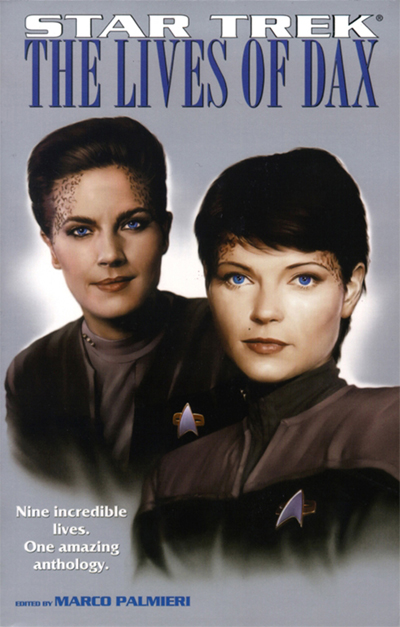
At its best, Pocket Books’ The Lives of Dax anthology captures this sense of change and movement. The books spans the width and breadth of the Star Trek franchise, as lived through the life of one single organism. It is beautiful.

ds9-thelivesofdax1 Continue reading

Scott Snyder and Greg Capullo’s Run on Batman – Zero Year: Secret City & Dark City (Review/Retrospective)

23rd July is Batman Day, celebrating the character’s 75th anniversary. To celebrate, this July we’re taking a look at some new and classic Batman (and Batman related) stories. Check back daily for the latest review.

It takes considerable bravery to craft an origin story for Batman in the wake of Frank Miller and David Mazzucchelli’s Year One.

Superhero origins are constantly being tweaked and re-written and re-worked. Superman has had a half-dozen comic book origins (in- and out-of-continuity) since Crisis on Infinite Earths rebooted the DC universe. There’s John Byrne’s Man of Steel, Kurt Busiek’s Secret Identity, Mark Waid’s Birthright, Geoff Johns’ Secret Origin, J. Michael Straczynski’s Superman: Earth One and even Grant Morrison’s Action Comics run.

It's only a pale moon...

It’s only a pale moon…

In contrast, Batman has been relatively undisturbed, with only Geoff Johns’ Batman: Earth One positing an alternate origin story for the Caped Crusader. A large part of that is down to how sacred Year One is. Written by Frank Miller and David Mazzucchelli, Year One is considered to be one of the best Batman comics ever published. It recently topped Comic Book Resources’ high-profile fan poll for the character’s seventy-fifth anniversary.

In many cases, an “if it ain’t broke…” mentality applies. Having a universally-beloved comic book story that is easily accessible as the origin story for a particular character is not a bad thing at all. You can hand Year One to anybody and they can read and enjoy it. Although undoubtedly a product of the late eighties, the comic remains relevant and compelling to this day. Indeed, we have not moved so far from the eighties that it’s hard to reconcile a Batman origin grounded in that social context.

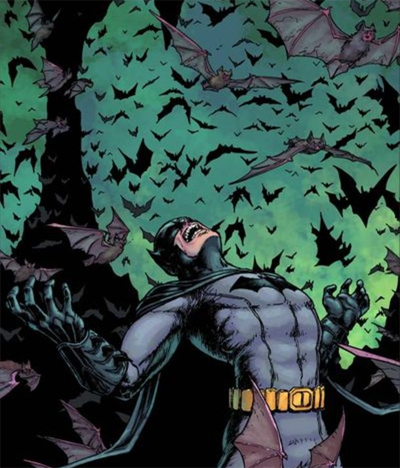
Talk about falling so far...

Talk about falling so far…

However, Scott Snyder and Greg Capullo are the creative team working on the Batman book for the character’s seventy-fifth anniversary. The duo have enjoyed a tremendous run – managing that rare intersection of critical and commercial success in mainstream comics. There are legitimate criticisms to be made, but Snyder and Capullo’s Batman work does hold up as some of the best Batman comics produced in quite some time, and one of true success stories of DC’s “new 52.”

So, if there was ever a time to go back to Batman’s origin, this was it. A well-loved creative team, a significant anniversary, a clear distance between this time and Year One. The risk associated with Zero Year is phenomenal. It is an incredible gambit. Even though the story is not in competition with Year One, comparisons are inevitable. The result is a very satisfying and exciting tribute to an iconic comic book character that doesn’t quite surpass Year One, but is clever enough to be clear that it isn’t trying to.

Getting into the swing of things...

Getting into the swing of things…

Continue reading

Grant Morrison and Chris Burnham’s Run on Batman Incorporated – Demon Star & Gotham’s Most Wanted (Review/Retrospective)

23rd July is Batman Day, celebrating the character’s 75th anniversary. To celebrate, this July we’re taking a look at some new and classic Batman (and Batman related) stories. Check back daily for the latest review.

Between September 2006 and July 2013, Grant Morrison crafted his epic Batman saga from the ashes of Infinite Crisis. Over the course of seven years, the Scottish author re-worked and re-imagined the Caped Crusader, boldly trying to condense the character’s convoluted and sprawling history into a single narrative. Morrison pulled elements from across the character’s continuity – including stories believed wiped out by continuity reboots and existing as alternatives or “what-ifs.”

To describe Grant Morrison’s Batman epic as ambitious doesn’t begin to do it justice. It is a story that pushed the character out of what had been his comfort zone since the eighties and nineties. He made Bruce Wayne a father; he killed Bruce Wayne off; he banished Batman to the dawn of time and forced him to fight his way back to the present; he made Dick Grayson into Batman; he turned Batman into a franchise so that it might fight twenty-first century crime.

Beware the Batman...

Beware the Batman…

These are all seismic shifts to the status quo, and don’t necessarily conform to what people think about when they imagine a typical Batman story. The character of Bruce Wayne and his world changed dramatically. The very first issue of Morrison’s Batman run featured Batman capturing the last of his classic villains, allowing the Caped Crusader a change to face larger and more existential threats.

It is quite telling that Morrison’s storytelling became the driving force of Batman continuity, with DC spinning books and stories off from his central premise. Scott Snyder’s first Batman epic was The Black Mirror, a story featuring Dick Grayson as Batman, as part of Morrison’s status quo. When the company relaunched Batman & Robin as part of the “new 52”, it featured Damian Wayne as Robin, another innovation introduced by Morrison.

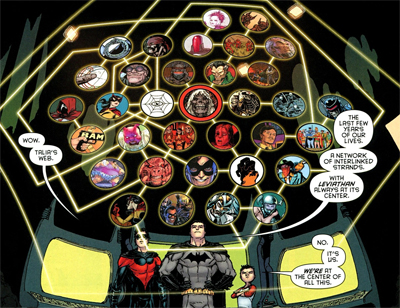
It's all connected...

It’s all connected…

Despite this sense that everything was changing, it seemed inevitable that everything would inevitably be reset. You can only change an iconic character like Batman so much, after all. If you bend Batman too far out of shape, he must inevitably snap back into his classic mould. It’s not inherently a bad thing – “Batman and Robin will never die!” to quote Batman R.I.P., and the characters endure because they revert to archetypes – but it does lend a sense of tragedy to everything.

Coming in the wake of the “new 52” reboot that represented an attempt to reset DC continuity back to its most archetypal configuration, it makes sense that Grant Morrison and Chris Burnham would write the second volume of Batman Incorporated as a tragedy. Morrison would announce his intention to step away from mainstream brand-name superhero stories in the wake of Batman Incorporated, and you can sense some of that fatigue in this story about how everything eventually gets set back to zero.

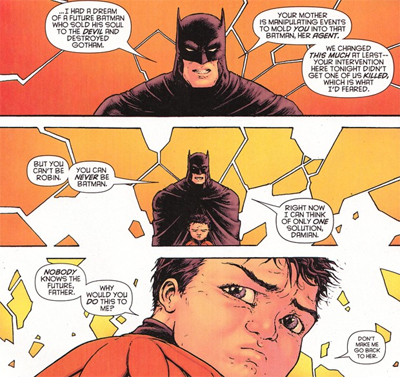
Everything falls apart...

Everything falls apart…

Continue reading

Dan Slott, Ty Templeton and Rick Burchett’s Run on The Batman Adventures (Review/Retrospective)

23rd July is Batman Day, celebrating the character’s 75th anniversary. To celebrate, this July we’re taking a look at some new and classic Batman (and Batman related) stories. Check back daily for the latest review.

More than two decades after its original broadcast, Batman: The Animated Series remains one of the most insightful and most elegant distillations of the Batman mythos. While the show was on the air, DC published a variety of tie-in comic books featuring a variety of talent. Some of these count among the best Batman stories of the nineties, and it is a shame that DC has not done more work to keep these in print.

Indeed, it is a surprise that DC has never thought to produce a suitably deluxe or high-profile collected edition of the work that Mark Miller did on the tie-in to Superman: The Animated Series. However, it is worth noting that DC did make a nice gesture by offering the first issue of The Batman Adventures as their free comic book day issue in 2003. It is much more appealing free comic book day than a collection of promotions or previews.

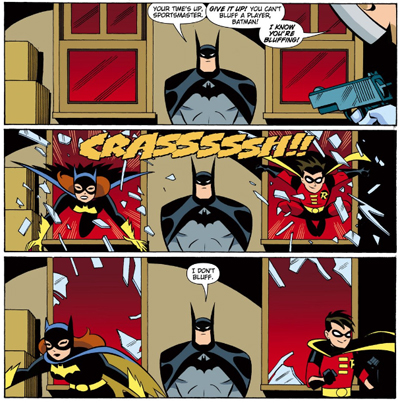
Batman. In a nutshell.

Batman. In a nutshell.

The Batman Adventures was a tie-in comic published within the animated continuity while the animated Justice League was still on the air. However, it was written after the end of The New Batman Adventures. As a result, it had a lot more freedom than the comic books that had been published in tandem with the animated series. The Batman Adventures was no longer a supplement to a television show set in Gotham, it was the only continuing glimpse at this version of Gotham.

The Batman Adventures was a wonderful inclusive comic book – it was appropriate for children, it was accessible to people with only a casual familiarity with the world of Batman. In many respects, it was the perfect “free comic book day” comic. A light, fun read with a clever take on Batman and his world. The Batman Adventures is a fantastic little book that ended far too soon – a demonstration that comics don’t need to be “adult” or “mature” in order to be smart or fun.

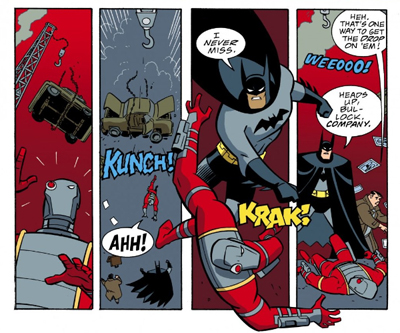
Deadshot is dead to the world...

Deadshot is dead to the world…

Continue reading

Scott Snyder & Greg Capullo’s Run on Batman – The Court of Owls, Night of the Owls & The City of Owls (Review/Retrospective)

23rd July is Batman Day, celebrating the character’s 75th anniversary. To celebrate, this July we’re taking a look at some new and classic Batman (and Batman related) stories. Check back daily for the latest review.

The “new 52” was a rather polarising experiment.

Claiming to restart their entire universe from scratch after the events of Flashpoint, DC comics claimed the initiative would make comic books more accessible to the masses. Without decades of continuity to block access, new readers would be more likely to try to get into these sorts of comics. The decision to effectively start from scratch has been controversial – arguably compounded by the fact that writers like Geoff Johns or Grant Morrison were allowed to carry their work across the continuity reboot.

Swinging into action...

Swinging into action…

The team of Scott Snyder and Greg Capullo are among the longest serving of the “new 52” creators. The pair have remained on the flagship Batman book for three years, longer than the vast majority of creators recruited to help relaunch the DC universe back in September 2011. There’s a wonderful consistency and enthusiasm to their work, and it seems like the two have a very clear vision of where they want to take Batman, one of the characters with the most complex relationship to the re-launch.

In many ways, The Court of Owls can be read as a meta-commentary on Batman’s position in the wake of Flashpoint, reflecting on the awkward relationship between the potential for novelty and the demand for familiarity.

Everything burns...

Everything burns…

Continue reading

Star Trek – Debt of Honour (Review)

This June, we’re taking a look at some classic Star Trek movie tie-ins and other interesting objects. Check back daily for the latest reviews and retrospectives.

By all accounts, Debt of Honour should be an unqualified success.

It’s a prestige graphic novel from DC comics, produced around the twenty-fifth anniversary of Star Trek and the release of Star Trek VI: The Undiscovered Country. It is written by celebrated comic book scribe Chris Claremont, fresh off his career-defining stint on Uncanny X-Men. An avowed Star Trek fan and comic book veteran, this should be in his wheel house. The art is provided by Adam Hughes, one of the most celebrated and respected artists of his time.

Talk about kicking off a comic...

Talk about kicking off a comic…

By any measure, Debt of Honour should count as some sort of hallmark for DC Comics’ Star Trek tie-ins. Unfortunately, that isn’t quite the case. A rather muddled storyline that is hopelessly devoted to Star Trek continuity while awkward interfacing with it,  Debt of Honour is just packed a little too tight. Charting a story from the earliest days of Kirk’s career to the aftermath of Star Trek IV: The Voyage Home, Claremont bites off more than he can chew.

Over the course of Debt of Honour, Claremont introduces a vague alien threat that has apparently been haunting Kirk for his entire career, a new arch-foe or love interest for Kirk, and even a supporting role for Kor. Along the way, he packs in cameos and shout-outs to various parts of Star Trek lore. He even explains why Klingons suddenly had ridges around the time of Star Trek: The Motion Picture. Ultimately, Debt of Honour is ambitious, but a little over-stuffed and quite over-cooked.

Warp speed ahead!

Warp speed ahead!

Continue reading