• Following Us

  • Categories

  • Check out the Archives


  • Awards & Nominations

Star Trek: Voyager – Year of Hell, Part I (Review)

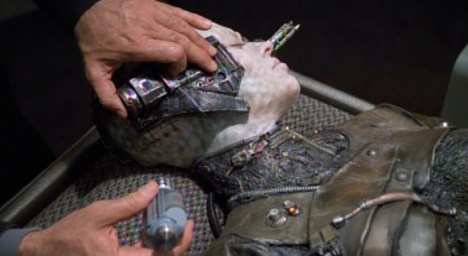
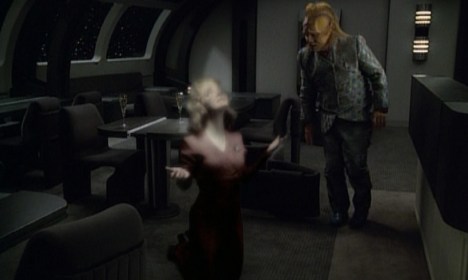
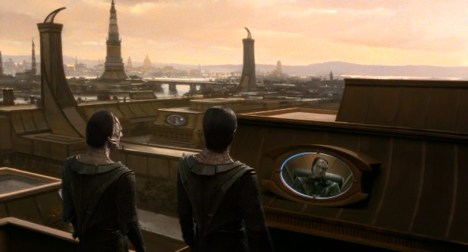
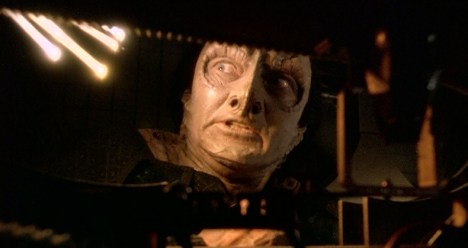
Year of Hell, Part I and Year of Hell, Part II might just be the perfect episodes of Star Trek: Voyager.

Taken together, these episodes perfectly demonstrate the raw potential and strength of the third Star Trek spin-off. They are a boldly ambitious story of a ship that finds itself in hostile territory surrounded by a hostile force with superior firepower, all while playing into the recurring themes and fascinations of the wider series. Year of Hell, Part I and Year of Hell, Part II are effectively a story that finds history itself under threat, while emphasising Brannon Braga’s interpretation of Janeway by setting her against a similarly obsessive opponent.

Things fall apart.

Things fall apart.

The result is one of the most thrilling and engaging stories of Voyager‘s seven-season run, among the most satisfying of the series’ impressive “blockbuster” two-parters. Although the show is still being broadcast in the standard nineties 4:3 aspect ratio, it feels like a widescreen story. Part of that is due to the fact that the two-parter unfolds over three quarters of an entire year, part of that is the expanded room for storytelling, part of that is the fact that history itself hangs in the balance, part of that is the fact that Voyager itself feels at stake.

Year of Hell, Part I and Year of Hell, Part II do an excellent job capturing the essence of Voyager.
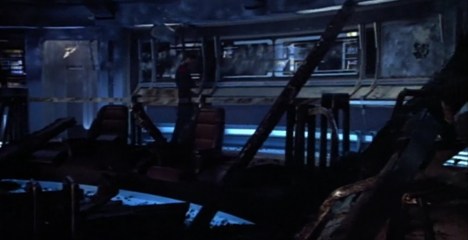
The Voyager cast Christmas party took a heavier toll than usual.

The Voyager cast Christmas party took a heavier toll than usual.

Continue reading

Star Trek: Voyager – The Gift (Review)

The Gift belongs to a very particular subgenre of Star Trek episodes.

It is an episode that fits comfortably alongside the other second stories of the other fourth seasons, alongside Family on Star Trek: The Next Generation, The Visitor on Star Trek: Deep Space Nine and Home on Star Trek: Enterprise. It is a relatively quiet and contemplative piece, more rooted in character than plot. In fact, very little of note happens during the episode, even as it is positioned at an important point in the larger run of Star Trek: Voyager following Scorpion, Part I and Scorpion, Part II.

Things come to a head.

Things come to a head.

As with FamilyThe Visitor and HomeThe Gift is a breather episode following a more epic adventure. As with Family and Home, The Gift is explicitly about working through the consequences of earlier episodes. Family allowed Jean-Luc Picard to work through the trauma of The Best of Both Worlds, Part I and The Best of Both Worlds, Part II, while Home provided an opportunity for Jonathan Archer to make sense of everything that happened between The Expanse and Zero Hour. (Let’s not worry too much about Storm Front, Part I and Storm Front, Part II.)

The Gift is an episode of contrasts, driven by the demands of the series rather than its own distinct plot. It is very heavily serialised, playing almost as the third part of Scorpion, Part I and Scorpion, Part II; much like Family played as the third part of The Best of Both Worlds, Part I and The Best of Both Worlds, Part II. However, there is something very cynical in the use of serialisation in The Gift, as the episode rather transparently exists to transition away from where the show was at the end of Scorpion, Part II towards a more sustainable status quo.

Kes of death to an established character.

Kes of death to an established character.

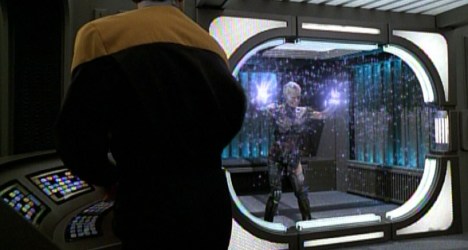
The Gift is also a tale of arrivals and departures. It is an episode about introducing Seven of Nine to the cast of Voyager, establishing her character arc and setting up her journey across the rest of the series building on her separation from the Borg Collective in Scorpion, Part II. At the same time, it is an episode about the departure of Jennifer Lien from Voyager, bidding farewell to Kes as a result of her exposure to “Fluidic Space” in Scorpion, Part II. There is something quite poetic in that set-up.

However, The Gift is just as much an episode of extremes in terms of quality. The story focusing on Janeway and Seven of Nine is rivetting and compelling, but the thread focusing on Kes plays almost as an afterthought. More than that, the episode’s final act plays as a gigantic cop out, another example of Voyager retreating from some of the bolder ideas in its core concept. The result is a curate’s egg of an episode, a reminder of Voyager‘s discarded potential.

Breakout character.

Breakout character.

Continue reading

Non-Review Review: Rogue One – A Star Wars Story

Rogue One: A Star Wars Story feels torn between two extremes.

On one extreme, it is an epic war movie about a universe that is caught in turmoil. Through the lens of science-fantasy, Rogue One can tease out all manner of interesting ideas about the conflict at the heart of the Star Wars franchise. What does an interstellar war look like in the early years of the twenty-first century? What is the view of this epic confrontation from outside the cockpit of an X-Wing or the Millennium Falcon? There are points at which Rogue One almost plays as a war film that just happens to be set within the Star Wars universe.

Too TIE-d to continuity?

Too TIE-d to continuity?

On the other extreme, Rogue One often feels like a collection of deleted scenes intended to bridge Star Wars: Episode III – Revenge of the Sith to Star Wars: Episode VI – A New Hope. The basic premise of the film involves the theft of the Death Star plans that propel the plot of A New Hope, which should be enough to connect it to the parent franchise. Instead, the film is saturated with cameos and callbacks. While it makes sense for a number of minor characters to overlap, Rogue One contorts to include two of the franchise’s biggest characters.

So Rogue One is trapped between being an exciting and exhilarating glimpse of an existing franchise from a new perspective, and feeling just a little bit too much like fan fiction. It is no surprise that the former is much more interesting than the latter.

Watered down?

Watered down?

Continue reading

Star Trek: Deep Space Nine – By Inferno’s Light (Review)

In Purgatory’s Shadow and By Inferno’s Light represent a fantastic accomplishment for Star Trek: Deep Space Nine.

The two-parter demonstrates the care and skill that went into characterisation on the show. The later Star Trek series often struggled to define their core ensembles as effectively as this series defined its secondary players. Star Trek: Voyager often reduced its characters to cogs within a plot-driven machine, capable of whatever a given plot required from them at a given moment. The same was true of Star Trek: Enterprise, which spent most of its first two years slotting cookie-cutter characters into very conventional narratives.

"I, for one, welcome our new Dominion overlords."

“I, for one, welcome our new Dominion overlords.”

In contrast to Voyager and Enterprise, the bulk of plotting on Deep Space Nine seemed to flow from the characters themselves rather than forcing the characters to conform to the demands of the plot. All the big storytelling decisions on Deep Space Nine are rooted in the agency of the characters in question, to the point that the fate of the entire Alpha Quadrant seems to hinge upon the fragility of Gul Dukat’s ego. It is a very clever (and very ahead of its time) approach to plotting a science-fiction series, just one reason that Deep Space Nine has aged so well.

As a result, In Purgatory’s Shadow and By Inferno’s Light are both rooted in what the audience already knows about the characters populating Deep Space Nine. All the decisions that are taken feel very much in character, and in keeping with what the audience knows about these individuals. This only serves to make it all the more impressive that the two-parter so radically revises the show’s status quo.

Leave a light on.

Leave a light on.

Continue reading

Star Trek: Deep Space Nine – In Purgatory’s Shadow (Review)

In Purgatory’s Shadow and By Inferno’s Light represent a fantastic accomplishment for Star Trek: Deep Space Nine.

In keeping with the television of the time, the first Star Trek show had been firmly episodic, to the point that there are arguments about the order in which episodes happened. Even in the context of the early nineties, Star Trek: The Next Generation tended to shy away from making dramatic decisions with huge consequences. The Klingon Civil War is resolved in Redemption, Part I and Redemption, Part II. The failed Romulan invasion of Vulcan in Unification, Part I and Unification, Part II is never mentioned again.

"Mister Worf, we really shouldn't have mounted this mission during Sweeps."

“Mister Worf, we really shouldn’t have mounted this mission during Sweeps.”

Deep Space Nine grew increasingly adventurous over the course of its run. The series had flirted with up-ending the status quo before, from the introduction of the Defiant and the Founders in The Search, Part I and The Search, Part II through to the dismantling of the Khitomer Accords in The Way of the Warrior. While those decisions had very long-term consequences for the show, their impact was not as dramatic and immediate as that seen here. Even the defeat of the Cardassians and Romulans in Improbable Cause and The Die is Cast took time to ripple down.

In contrast, In Purgatory’s Shadow and By Inferno’s Light change a lot of what the audience think they know about Deep Space Nine. The fifth season pivots on this two-parter, which serves to enable just about every major dramatic development between this point and the end of the series. This only serves to make it all the more impressive that the two-parter is so firmly rooted in its characters and characterisation.

Gripping drama.

Gripping drama.

Continue reading

Star Trek: Voyager – Future’s End, Part I (Review)

In a very real way, the third season of Star Trek: Voyager begins with Future’s End, Part I and Future’s End, Part II.

After all, the episode airs directly after Sacred Ground. Although mixed into the broadcast order with a bunch of episodes that had been produced during the third season, Sacred Ground was the last episode of the second season production block to be broadcast. (Basics, Part II had been the last episode to be produced.) Sacred Ground was the last episode of Voyager to be tied to producer Michael Piller, who had been working on the franchise since the start of the third season of Star Trek: The Next Generation. There is some sense of symmetry there.

Tuvok and roll.

Tuvok and roll.

Sacred Ground feels like an appropriate place to draw a line under the first two seasons of Voyager, to suggest that the earlier incarnation of the show is finished and that a new era is beginning. After all, Sacred Ground was really the last gasp of the New Age mysticism that Michael Piller had tried to infuse into Voyager through episodes like The Cloud or Tattoo. (Piller would return to that New Age fascination with Star Trek: Insurrection.) Sacred Ground even featured something of a rebirth of Captain Kathryn Janeway.

However, if Sacred Ground represents the end of the second season, what about the start of the third season? What makes Future’s End, Part I and Future’s End, Part II such an effective new beginning?

Feels like going home.

Feels like going home.

Continue reading

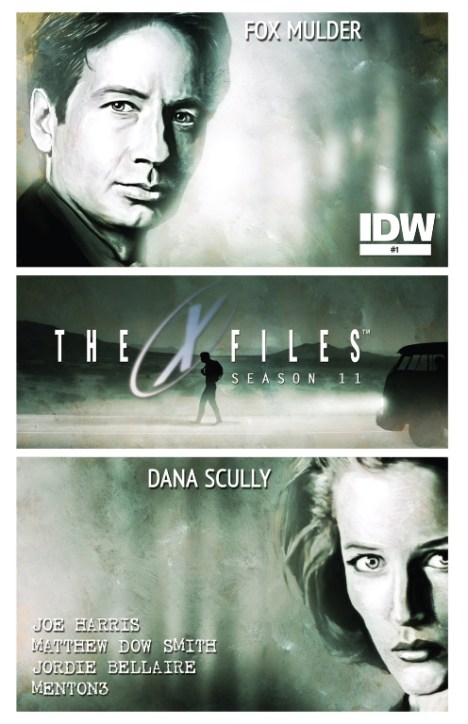
The X-Files: Season 11 (IDW) (Review)

This June, we’re going to be taking a look at the current run of The X-Files, beginning with the IDW comic book revival and perhaps taking some detours along the way. Check back daily for the latest review.

The X-Files: Season 11 is a relatively lean beast.

The X-Files: Season 10 seemed to struggle to map out a clear direction or identity for itself. This was most obvious in the context of the comic book’s mythology, as writer Joe Harris and his collaborators frequently found themselves revising and rewriting the mythology from one story to the next. All the elements introduced in Believers were reduced to a footnote in Monica & John. Although Gibson Praise made his first reappearance in the final pages of Believers, the mythology only truly galvinised around him over the course of Elders.

xfiles-endgames1

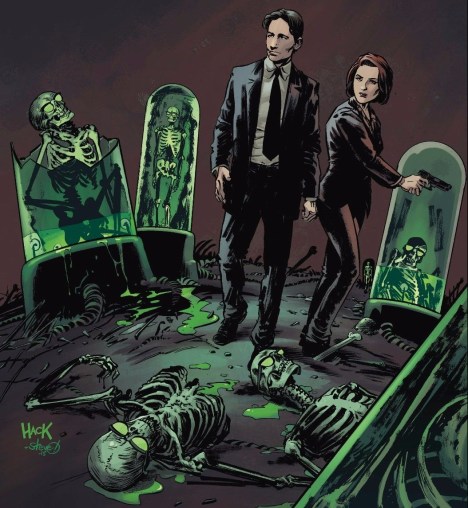
In contrast, The X-Files: Season 11 has a very clear idea of where it is going and room for a minimal amount of distractions along the way. While the art team on Season 10 changed quite frequently, the nine comic book issues that comprise Season 11 are all handled by the core team of writer Joe Harris, penciller Matthew Dow Smith and colourist Jordie Bellaire. There is a consistency and focus to the run that is striking. There is no time for exploration or improvisation. Everything serves its purpose in the context of the story being told.

This is a double-edged sword. While it does reduce the chance of an endearing standalone story like Chitter or Immaculate, it does afford the run a purity and energy that was somewhat lacking as Harris had to revise and rewrite his mythology while the revival miniseries moved closer and closer to public announcement. In some respects, Season 11 feels kind of like the version of The X-Files that some fans wanted when the revival was announced. It is an efficient attempt to resolve dangling plot threads and bring closure to the story being told.

xfiles-homeagain2

Continue reading

The X-Files: Season 11 (IDW) #6-8 – Endgames (Review)

This June, we’re going to be taking a look at the current run of The X-Files, beginning with the IDW comic book revival and perhaps taking some detours along the way. Check back daily for the latest review.

With Endgames, it all comes to an end.

The grand epic story that writer Joe Harris had built across thirty-five issues of The X-Files: Season 10 and The X-Files: Season 11 comes to a close with this three-part story. Given that the default length of a mythology-heavy story in Season 10 was five issues, Endgames cannot help but feel somewhat truncated. However, there has always been a sense that Season 11 is winding down rather than ratcheting up.

Alien nation.

Alien nation.

In some ways, Endgames suffers from being overly ambitious. Harris reintroduced the faceless rebels into his mythology with My Name is Gibson and The X-Files Christmas Special 2015, but they feel like they crowd out what is otherwise a straightforward confrontation with Mulder and Scully squaring off against Gibson Praise. It is in some ways disappointing that all of Gibson’s plans build to a handful of trucks in the desert.

And, yet, in spite of that, there is something oddly charming about Endgames. The three-parter might be a compromised twist on the ending that Joe Harris originally envisaged for his massive epic, but it is still an ending.

Full circle.

Full circle.

Continue reading

The X-Files (IDW) Christmas Special 2015 (Review)

This June, we’re going to be taking a look at the current run of The X-Files, beginning with the IDW comic book revival and perhaps taking some detours along the way. Check back daily for the latest review.

Nothing gives a better sense of how compressed The X-Files: Season 11 is than the decision to incorporate The X-Files Christmas Special 2015 into the larger arc of the season, as a bridge between Mulder’s capture at the end of Home Again, his detention in My Name is Gibson, and his adventuring with Scully in Endgames. Although it might be possible for readers to smoothly jump from the climax of My Name is Gibson into the high-stakes action of Endgames, the events of The X-Files Christmas Special 2015 smooth the transition.

Arriving late in the run of The X-Files: Season 10, The X-Files Christmas Special 2014 felt almost like an “out of continuity” adventure that found the cast sharing the holiday season together in the apartment of Walter Skinner. The festive levity provided a nice contrast to the trauma regularly inflicted upon these characters, providing a much lighter story in the spirit of the season. In contrast, The X-Files Christmas Special 2015 struggles to balance the lighter tone expected of a Christmas special with the demands of the larger arc.

Merry Christmas.

Merry Christmas.

Continue reading

The X-Files: Season 11 (IDW) #1 – Cantus (Review)

This June, we’re going to be taking a look at the current run of The X-Files, beginning with the IDW comic book revival and perhaps taking some detours along the way. Check back daily for the latest review.

The X-Files: Season 11 is a truncated season, in more than one way.

While The X-Files: Season 10 ran for twenty-five issues with two annuals, a Christmas special and three tie-in miniseries, The X-Files: Season 11 is a more modest affair. The monthly series runs for eight issues, although there is a single Christmas special thrown in for good measure. More than that, there is a very clear condensed quality to the narrative. It feels like writer Joe Harris, along with artist Matthew Dow Smith and colourist Jordie Bellaire, are racing frantically towards the finish line.

See no evil.

See no evil.

This makes a certain amount of sense. After all, The X-Files: Season 11 was not the only big news to hit the fandom in February or March 2015. The creative team had done good work reviving the nineties science-fiction franchise, but news of a fresh season of X-Files comic books was always going to pale in comparison to news that Fox had managed to bring back Chris Carter along with Gillian Anderson and David Duchovny for a six-episode miniseries to air less than one year later.

The X-Files: Season 11 was always going to exist in the shadow of the louder and showier revival. In some respects, the entire eight-issue series feels like a frantic attempt to wrap up all the dangling threads set up in that initial run. It feels very much like the publisher getting its house in orders before that classic theme music plays on prime-time once again. The X-Files: Season 11 is a somewhat modest affair. Although that modesty is somewhat endearing.

On the road again.

On the road again.

Continue reading