• Following Us

  • Categories

  • Check out the Archives


  • Awards & Nominations

New Podcast! The X-Cast – Season 5, Episode 1 (“Redux I”)

The X-Cast just kicked off its season coverage, and I’m back with Tony Black to discuss the first part of the fifth season premiere Redux I.

Redux I was famously the second-most watched episode of The X-Files, behind Leonard Betts. It’s easy to see why. Not only was the episode following on from an edge-of-the-seat cliffhanger involving the supposed suicide of the male lead on one of the buzziest shows of the decade, but it was also the launch of the season that would lead into the feature film adaptation, The X-Files: Fight the Future. As such, it was a pretty daring move on the part of Chris Carter to devote so much of the premiere to purple prose monologues playing over Mulder walking down grey corridors.

I think this is a pretty fun and interesting discussion. Redux I is always an episode that I’ve have complicated and conflicted feelings about, and the podcast was a nice opportunity to work through some of those strange emotions. Anyway, I hope there’s something worthwhile in here.

You can listen to the episode here, or click the link below.

Continue reading

New Podcast! The X-Cast – Season 3, Episode 16 (“Apocrypha”)

I’m back on The X-Cast this week, to cover the second-part of the late third-season mythology two-parter Apocrypha.

Picking up where Piper Maru left off, this conclusion finds Mulder and Scully continuing their separate investigations. Mulder is chasing down the missing tape from Anasazi, The Blessing Way and Paper Clip while Scully is dealing with the fallout from the assassination attempt on Assistant Director Walter Skinner that brings her face-to-face with the man who killed her sister. Justice, legacy and guilt are all major preoccupations, tying into the broader themes of the season as a whole.

Once again, a pleasure to substitute in for Tony Black as host of The X-Cast for an episode, and absolutely thrilled to be joined by the great Christopher Irish from The X-Files Lexicon.

The truth is in here. You can listen to the episode here, or click the link below.

Continue reading

Star Trek: Voyager – Inside Man (Review)

Inside Man is a curious episode.

It is a seventh season episode that feels very much like a first season episode. To be fair, this is perhaps par for the course with any long-running series approaching a definite ending. Both Star Trek: The Next Generation and Star Trek: Deep Space Nine got a little nostalgic in their final seasons. The Next Generation neatly bookended Encounter at Farpoint by picking up on the dangling thread of Q’s trial of humanity in All Good Things…, while Deep Space Nine revisited first season ideas like the “one hundred” in Chimera or Quark mistakenly thinking that he was replacing Zek in The Dogs of War.

“I’d counsel against that.”

Star Trek: Voyager was always going to be a little bit more nostalgic than most, given that the nature of the show involved a long journey back towards the familiar and the recognisable. The closer that Voyager got to home, the stronger the urge to look backwards. The seventh season of Voyager evokes the early seasons in a number of ways, such as the manner in which Repression tries to resurrect the Maquis conflict and even brings in a guest star last seen in Learning Curve or the surprise return of Joseph Carey as a guest star in Friendship One.

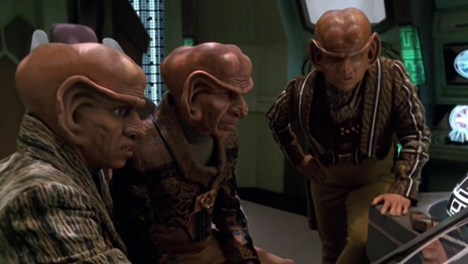
However, Inside Man has its own very strange nostalgia at its core. The episode builds on sixth season episodes like Pathfinder or Life Line, even including a number of recurring guest stars from those earlier episodes. However, its tone and its plot elements feel like they belong a much earlier script. Inside Man is an episode that treats the Ferengi as semi-serious antagonists who would murder more than a hundred people for a profit, which ignores a lot of their development on Deep Space Nine and jumps right back to their characterisation in early Next Generation episodes like The Last Outpost or Peak Performance.
“I mean, to be fair, they also couldn’t outwit the Kazon.”

However, at the core of the episode is a plot device that the series largely moved past in its second season, and one which feels strangely out of place on what amounts to the home stretch of Voyager. The plot of Inside Man revolves around a promise to get the ship and crew home ahead of schedule, the kind of promise that was frequently dangled in front of the crew in earlier episodes like Eye of the Needle, Cold Fire and False Profits. While it would be teased in later episodes like Hope and Fear or Bliss, it was never with the same intensity.

The irony with these earlier stories was that the audience understood, on some level,how unlikely it was that the ship and crew would be getting home. After all, the entire premise of Voyager was that it was a starship stranded on the far side of the galaxy, isolated from familiar support systems. To bring the ship home would represent a complete betrayal of the premise, even more than downplaying the tension with the Maquis or completely ignoring questions about which set of rules the crew would follow. If Voyager brought the ship home in a random episode in those first seasons, it would be a catastrophic admission of defeat.

Just a Reg-ular Barclay.

In Inside Man, a slight variation on the same central tension exists. Any audience member with any level of televisual literacy would understand that the ship and crew would be returning home at the end of the seventh season; this was the end of Voyager, and that ending had to involve the fulfillment of the show’s basic premise. However, given the show’s conservatism, it was highly unlikely that the crew would be getting home in such an early episode and certainly not as part of a plot involving the Ferengi. Inside Man is the most obvious sort of shell game, where there’s nothing hidden under any of the cups.

However, what’s most striking about Inside Man is that the script seems almost self-aware. The episode is glib and wry, repeatedly seeming like an extended joke being played by the savvy audience and the smirking writers on the series itself. Inside Man is based around the promise that the crew might be returning home, but is immediately established to the audience as nothing more than an empty hustle. The cruel irony (and the most wry punchline) is that the characters themselves remain in the dark even after the con is long over.
Getting into her head.

Continue reading

New Podcast! The Pensky File – Star Trek: Deep Space Nine, Season 3, Episode 20 (“Improbable Cause”)

I had great fun talking about Defiant with Wes and Clay at The Pensky Podcast.

So I was thrilled by invited back to talk over one of my favourite episodes of Star Trek: Deep Space Nine with the guys, the late third season two-parter Improbable Cause and The Die is Cast. It’s a brilliant story, in large part because (unlike a lot of Star Trek two-parters) it is very clearly two different stories that happen to neatly dove-tail into one another.

Improbable Cause is a fascinating character study of Elim Garak, following a botched attempt on his life that suggests more powerful forces at work. As Odo investigates the bombing of Garak’s shop, he gradually uncovers evidence of a much larger scheme. It was a pleasure to record, and I’ll be back next week covering the conclusion, The Die is Cast.

You can find more from The Pensky Podcast here, and listen to the podcast by clicking the link or just listening below.

Continue reading

New Podcast! The X-Cast – Season 3, Episode 2 (“Paper Clip”)

A real pleasure to re-team with Tony Black to round out our coverage of “the unopened file” on The X-Cast, following on from our discussions of Anasazi and The Blessing Way. And this time, it’s an even stronger line-up. The wonderful Chris Knowles is joins us for the discussion of the final part of the season-bridging trilogy.

As ever, a huge thrill to be a part of this. Anasazi, The Blessing Way and Paper Clip represent a landmark moment for The X-Files as a television show, and it’s been an honour to talk through those changes with Tony. However, Paper Clip is something special because it’s clear how much Chris loves this episode. There are few pleasures in life quite as satisfying as sitting down with somebody to talk about something they love.

I’ll be back on The X-Cast later in the season, to the point that I think the members of the Patreon may already have access to one of my own smaller side projects as part of the podcast. However, it was a delight to get to talk about three episodes that are so close to the core of what The X-Files is for a combined runtime of close to four hours.

The truth is in here. You can listen to the episode here, or click the link below.

Continue reading

New Podcast! The X-Cast Season 11 #39 – William, Skinner, Smoking Man & Everyone Else! (“My Struggle IV”)

Returning to The X-Cast this morning to continue my discussion of the eleventh season finale of The X-Files.

In this installment, we’re discussing the various supporting characters of My Struggle IV, from William (or Jackson) through to Monica Reyes through to creepy possibly-child-abusing car-driving guy! It’s a packed instalment, befitting a packed episode. Thrilled to be joining Tony to discuss the episode in question.

Click here, or check it out below. The final part of our discussion, talking about Chris Carter, will be landing tomorrow morning.


New Podcast! The X-Cast – Season 2, Episode 17 (“End Game”)

Just a quick link to a recent (unscheduled) guest appearance over on The X-Cast, a great X-Files podcast run by the prolific Tony Black.

Following on from last week, I had the pleasure of an extended conversation with Tony about End Game. It was a joy, given the my own fondness for the episode and its place in the large X-Files canon. It was a fun to talk through the episode, from what Mulder really wants to whether the show’s popularity drove the mythology or the mythology’s popularity drove the show to Mister X’s appreciation for the fine arts. Check it out the episode here, or click the link below.

Continue reading

The X-Files – My Struggle I (Review)

This June, we’re going to be taking a look at the current run of The X-Files, beginning with the IDW comic book revival and perhaps taking some detours along the way. Check back daily for the latest review.

This is journey that began for me – I’m sorry if I get emotional – twenty-three years ago. Things just don’t last in culture, these days. They… culture gobbles them up and they go away. It’s… it’s rare when something sticks around. Thanks for being part of the journey. The idea is that this is not the end. This is maybe a new beginning. And maybe we’ll do more of these if we do a really good job.

– Chris Carter’s opening remarks at the first production meeting on My Struggle I

The truth is still out there...

The truth is still out there…

Continue reading

The X-Files: Season 10 (IDW) #21-25 – Elders (Review)

This June, we’re going to be taking a look at the current run of The X-Files, beginning with the IDW comic book revival and perhaps taking some detours along the way. Check back daily for the latest review.

One of the more disappointing aspects of The X-Files: Season 10 and The X-Files: Season 11 is that it does very little to adapt the mythology to the twenty-first century.

The X-Files is very much a show rooted in the political and cultural context of the nineties. Everything about the show’s first seven seasons reflects the Clinton era, with the series perfectly capturing the zeitgeist in the weird lacuna between the fall of the Berlin Wall and the destruction of the World Trade Centre. At its peak, the show touched on underlying anxieties that are social, political and existential; it asked tough questions about identity in the final days of the twentieth century. As much as Friends or The Simpsons, The X-Files embodied the nineties.

The son becomes the father... And the pseudo-son...

The son becomes the father…
And the pseudo-son…

As such, any revival of The X-Files must face questions of relevance. The X-Files so perfectly captured the spirit of the nineties that removing the series from that context runs the risk of severely damaging it. What makes now such a perfect time for The X-Files? What does The X-Files have to say about contemporary culture? How will the show be tweaked for modern audiences and sensibilities? These are not trivial questions. Any X-Files revival should be more than just a nostalgic “victory lap.”

This question of relevance faced the revival miniseries, but it also faced The X-Files: Season 10. What does The X-Files mean in the modern world? Harris had broached the question in a number of different ways, perhaps most skilfully in his approach to the classic “small town horror stories” that populated the show’s nine-season run. Whereas those stories tended to touch upon themes of globalisation and the erosion of so-called eccentric spaces, Harris used stories like Chitter and Immaculate to explore a growing cultural divide in twenty-first century America.

Cuba libre...

Cuba libre…

However, The X-Files: Season 10 does not work quite as well when it comes to updating the mythology for the twenty-first century. A lot of this is down to the strong nostalgic pull of the nineties mythology. Harris employs a lot of the same elements that were in play while the show was on the air; the same characters, the same dynamics, the same story beats. There were occasional nods towards the changing geopolitical realities, such as the use of black-oil-as-oil in Pilgrims. However, the revived mythology never engaged with the twenty-first century as well as it might.

Effectively serving as the season “finale”, Elders makes the strongest play for relevance yet. It consciously references and evokes the imagery of the War on Terror in its exploration of Gibson Praise’s revived conspiracy. Unfortunately, it doesn’t quite work.

Cross to bear...

Cross to bear…

Continue reading

The X-Files: Season 10 (IDW) #11-15 – Pilgrims (Review)

This June, we’re going to be taking a look at the current run of The X-Files, beginning with the IDW comic book revival and perhaps taking some detours along the way. Check back daily for the latest review.

Pilgrims is essentially an attempt to do a mid-season mythology episode in the style of Colony and End Game or Tunguska and Terma, a big sprawling epic populated by familiar faces and impossible scale that is driven more by questions and mysteries than by answers or revelations. It is in many ways a testament to writer Joe Harris’ desire to emulate the basic structure and framework of The X-Files, right down to the manner in which he structures The X-Files: Season 10.

There are a lot of obvious markers and touches that help Pilgrims to feel like a classic mid-season mythology episode. There is an international scope, as seen in the trip to the Arctic in End Game or to Hong Kong in Piper Maru or to Russia in Terma. The first half of Pilgrims unfolds in Saudi Arabia, with Mulder and Scully dispatched to investigate what initially appears to be a terrorist attack on an oil operation but is promptly revealed to be something far more sinister.

The red and the black.

The red and the black.

Similarly, in keeping with the style and tone of many of the best mythology two-parters, the basic plot is relatively straightforward even as complications appear at the edge of the frame. In End Game, Mulder is racing to recover his lost sister as details about secret cloning experiments spill out around him. In Nisei, Mulder is trapped in a traincar with a ticking time bomb and a dangerous assassin as he digs away at the conspiracy. In Apocrypha, the black oil just wants to go home. The same is true in Pilgrims, which follows an alien trying to escape.

Even the structure of the five-issue arc recalls that of many X-Files two-parters, with a massive pivot coming between the third and fourth issues in the same way that many two-parters would switch premises at the half-way point. The Saudi Arabia plot wraps up at the end of the third issue, while Gibson Praise is introduced at the start of the fourth. The first three issues focus on the mystery of the Saudi attack, while the final two put a much greater emphasis on the traditional trappings of the X-Files mythology including the conspirators and Skyland Mountain.

Lone survivors.

Lone survivors.

It is remarkable how faithful Joe Harris is to the format of those classic X-Files mythology episodes. Of course, this is something of a double-edged sword. As with a lot of The X-Files: Season 10, the biggest weakness of Pilgrims is the fact that it all feels a little overly familiar and a little too indulgent. Krycek was one of the most popular supporting characters from the nine-season run of The X-Files, but bringing him back at the centre of a five-part epic mythology story feels like pandering and fan service. Harris is not inventing his own mythology, but resurrecting an old one.

Then again, that might seem to be the point. The black oil discovered in Pilgrims is compared to the oil resting beneath Saudia Arabia. In that respect, it is the remains of long-dead organisms compressed and decayed and converted into fuel. There is something more than a little appropriate about that.

Eye see.

Eye see.

Continue reading