• Following Us

  • Categories

  • Check out the Archives


  • Awards & Nominations

Star Trek: The Next Generation – Vendetta by Peter David (Review)

This January and February, we’ll be finishing up our look at the second season of Star Trek: The Next Generation and moving on to the third year of the show, both recently and lovingly remastered for high definition. Check back daily for the latest review.

We’ll be supplementing our coverage of the episodes with some additional materials – mainly novels and comics and films. This is one such entry.

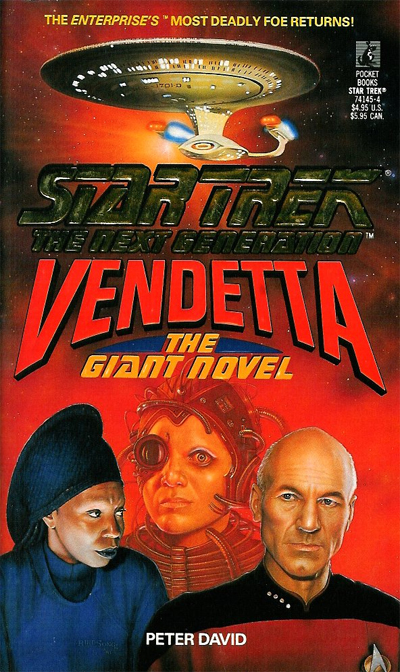
Vendetta was published in May 1991, which is an astonishingly quick turnaround for a novel building on the events of The Best of Both Worlds, which was broadcast in 1990. Vendetta is billed as “the giant novel”, in the spirit of Jean Lorrah’s Metamorphosis – the March 1990 novel building off The Measure of a Man and advertised as “the first giant novel.”

It’s offers a suitably epic premise – the Enterprise caught between the Borg and the Doomsday Machine with the fate of the universe at stake.

tng-vendetta

Continue reading

Star Trek: The Next Generation (DC Comics, 1989) #19 – The Lesson (Review)

This January and February, we’ll be finishing up our look at the second season of Star Trek: The Next Generation and moving on to the third year of the show, both recently and lovingly remastered for high definition. Check back daily for the latest review.

We’ll be supplementing our coverage of the episodes with some additional materials – mainly novels and comics and films. This is one such entry.

One of the biggest problems that the writing staff had on Star Trek: The Next Generation was the insistence that the show was episodic. Themes and characters were rarely carried from week to week. Occasionally, a plot point or character might recur, but the bulk of the show was intentionally designed to be readily accessible in just about any order imaginable. In the era of HBO and “televisual novels”, this approach seems quite quaint, but it was very much the reality of late eighties and early nineties television.

However, there were no such restrictions on comic book story telling. Far from downplaying continuity and long-term plotting, mainstream American comics pride themselves on their serialised nature. It’s quite common for characters to suddenly reappear after absences of considerable time, and for writers to make callbacks to events that occurred decades ago. Publishing twelve issues a year, typically from the same author, The Next Generation comic book did afford the opportunity for a slightly different type of storytelling.
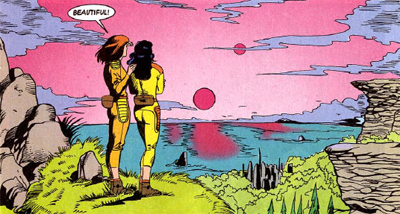
All set...

All set…

And, to be fair, that was one of the strengths of Michael Jan Friedman’s approach to The Next Generation comic book. He was fond of focusing on supporting characters, or giving page space to characterisation, or even basking in the show’s continuity in a way that wasn’t possible on television. Sure, Friedman could occasionally get a little obsessive in his continuity references, and could occasionally have difficulty tying everything into a cohesive story, but this was one way the author capitalised on the shift in the medium.

The Lesson is a single-issue story that is all the more intriguing for essentially existing as a series of character moments, with little in the way of an over-arching plot. The writing is a little clumsy and on-the-nose, with the comic earnestly offering its readers a rather ham-fisted message of the week, but it’s notable for the way that Friedman seems to bask in the freedom afforded to him by virtue of the fact that he’s writing a comic book (rather than an episode) of The Next Generation.

They've really bonded...

They’ve really bonded…

Continue reading

Star Trek: The Newspaper Strips – Beware the Omnimind! (aka Restructuring is Futile) (Review)

This January and February, we’ll be finishing up our look at the second season of Star Trek: The Next Generation and moving on to the third year of the show, both recently and lovingly remastered for high definition. Check back daily for the latest review.

We’ll be supplementing our coverage of the episodes with some additional materials – mainly novels and comics and films. This is one such entry.

As brilliant as the Borg were when they were introduced in Q Who?, they were hardly the most original of constructs. The cybernetic aliens went on to become one of the most iconic and recognisable pieces of Star Trek lore, featuring in the most popular Star Trek: The Next Generation feature film and all the subsequent spin-offs, but it’s tempting to give the Borg a bit more credit than they’re due.

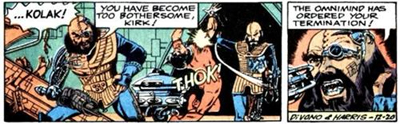
After all, cybernetic organisms were hardly cutting edge in 1989. In fact, this wasn’t even the first time that Star Trek had told this kind of story. In late 1981, the Star Trek news paper strip that had begun as a companion piece to Star Trek: The Motion Picture, featured a similar adversary for Kirk’s Enterprise.

Resistance is futile!

Resistance is futile!

Continue reading

Jason Aaron’s Run on Wolverine & The X-Men – #1-8, 17 (Review/Retrospective)

To celebrate the release of The Wolverine later in the month, we’re taking a look at some classic X-Men and Wolverine comics every Monday, Wednesday and Friday here. I’m also writing a series of reviews of the classic X-Men television show at comicbuzz every weekday, so feel free to check those out.

Superhero comic books have had a somewhat rocky relationship with the concept of “growing up” since the mid-eighties. Books like The Dark Knight Returns and Watchmen proved that it was possible to craft mature tales with incredible depth using these icons. However, it seemed like the industry learnt all the wrong lessons from the success of Frank Miller and Alan Moore. For the past couple of decades, it seems like the ideal for superhero comics is grim and nihilistic nonsense, that “maturity” is measured in blood and bodycount.

There was a sense that the comic book industry was afraid of being seen as childish or unsophisticated, which created an ironic situation where the industry’s immaturity was on show in its fixation with adult material. “When I was ten,” C.S. Lewis once mused, “I read fairy tales in secret and would have been ashamed if I had been found doing so. Now that I am fifty I read them openly. When I became a man I put away childish things, including the fear of childishness and the desire to be very grown up.”

Jason Aaron’s Wolverine and the X-Men feels like it subscribes to this philosophy. It’s an incredibly silly and  goofy piece of work, revelling in the clichés of the superhero genre, but it’s also a surprisingly sincere and intelligent one.

It's a bit of a gamble...

It’s a bit of a gamble…

Continue reading

Roy Thomas & Werner Roth’s X-Men – X-Men Omnibus, Vol. 1-2 (Review/Retrospective)

To celebrate the release of The Wolverine later in the month, we’re taking a look at some classic X-Men and Wolverine comics every Monday, Wednesday and Friday here. I’m also writing a series of reviews of the classic X-Men television show at comicbuzz every weekday, so feel free to check those out.

The X-Men were not, to put it frankly, a comic book franchise that hit the ground running. Despite the considerable talent involved in their first nineteen issues, the comic struggled to find its own niche, unsure of just how far it dared to venture from the standard superhero template, and how confined it was by the whole “mutant superhero” bit. Writer Roy Thomas was tapped to take over the book when Stan Lee left.

Thomas is one of the underrated Silver Age writers. His work on The Avengers, spanning more than a half-a-decade, is arguably more influential and definitive than Lee’s original run on the title. He is responsible for The Kree-Skrull War, which remains one of the stronger early Avengers stories. He would work on X-Men twice before the book was finally cancelled. His second run, with Neal Adams pencilling, is arguably a lot stronger than his work here, which feels a little muddled and unfocused.

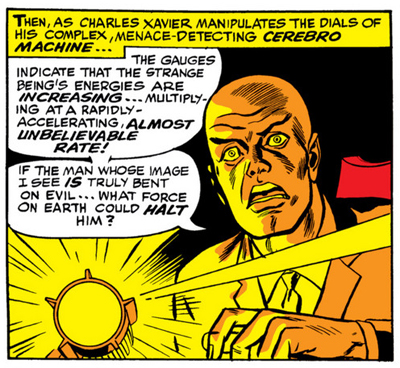
To be fair to Thomas, it’s quite clear that he recognised that the X-Men needed a shake-up and to find their own voice distinct from the initial run written by Lee and Kirby. Unfortunately, Thomas doesn’t seem entirely sure of what that voice is.

Lighten up, Charles!

Lighten up, Charles!

Continue reading

Jason Aaron’s Run on Wolverine & The X-Men – Avengers vs. X-Men (Review/Retrospective)

To celebrate the release of The Wolverine later in the month, we’re taking a look at some classic X-Men and Wolverine comics every Monday, Wednesday and Friday here. I’m also writing a series of reviews of the classic X-Men television show at comicbuzz every weekday, so feel free to check those out.

Wolverine and the X-Men is one of the best comics that is being published by Marvel at present. Along with Waid’s Daredevil and Fraction’s Hawkeye, it’s a celebration of the strange and surreal side of comics. Jason Aaron doesn’t get enough credit for his character work, but his handle on the wonderfully wacky side of the X-Men mythos makes Wolverine and the X-Men a joy to read for anybody with an open mind and a willingness to try something a bit different.

Although the Avengers vs. X-Men tie-in issues are hardly the best place to witness Aaron’s artful approach to the franchise, often feeling a little disjointed and more all-over-the-map than usual, they still contain a lot of what makes Aaron’s work with the characters so appealing.

Burn, baby, burn...

Burn, baby, burn…

Continue reading

Kieron Gillen’s Run on Uncanny X-Men – Avengers vs. X-Men (Review/Retrospective)

To celebrate the release of The Wolverine later in the month, we’re taking a look at some classic X-Men and Wolverine comics every Monday, Wednesday and Friday here. I’m also writing a series of reviews of the classic X-Men television show at comicbuzz every weekday, so feel free to check those out.

Kieron Gillen is one of the unsung heroes of modern superhero comics. Over the past few years, Gillen has come to the attention of readers for replacing or supplementing a-list talent on a-list books. He took over Thor after J. Michael Straczynski abruptly wrapped up his run on the Norse god, only to shuffle off the book when Matt Fraction took over. While Straczynzki’s run was collected in an omnibus, Gillen’s has yet to receive hardcover status. He wrote the wonderfully underrated Journey into Mystery as a supplement to Fraction’s Thor, which might hopefully get a deluxe reprinting at some point in the future.

He took over Uncanny X-Men following Fraction’s departure. He barely had time to establish his run on Marvel’s merry mutants before writer Jason Aaron up-ended the status quo with Schism, essentially restructuring Marvel’s X-Men line. Gillen remained on Uncanny X-Men in the wake of Schism, the title resetting to #1. However, less than a year into the run, Gillen’s Uncanny X-Men was caught up in Marvel’s high profile crossover of the year, Avengers vs. X-Men.

Explosive...

Explosive…

Gillen departed the book following Avengers vs. X-Men, in yet another reshuffle of Marvel’s X-Men line. (Brian Bendis promised to push the line in a new direction, writing both All-New X-Men and Uncanny X-Men.) Half of Gillen’s run on the relaunched Uncanny X-Men was tied into the gigantic Avengers vs. X-Men.

But don’t let that fool you. It’s really very, very good. In fact, it ranks as among the very best X-Men work since Joss Whedon and John Cassaday left Astonishing X-Men.

All fired up...

All fired up…

Continue reading

The Spirit Archives, Vol. 14 (Review/Retrospective)

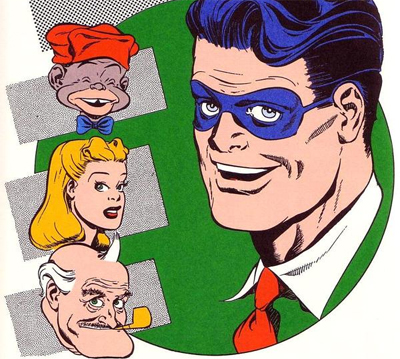
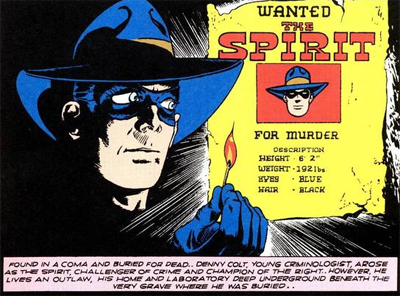
The Spirit Archives, Vol. 14 finds Will Eisner back in full swing. The Spirit is truly firing on all cylinders, after taking about a year just to get everything lined up after the creator returned from military service. The success of this volume isn’t so much that Eisner is doing anything especially new or innovative. Rather, it seems like The Spirit has made a note of the aspects of the strip that work and has decided to concentrate on those stronger elements. This six-month stretch on newspaper strips doesn’t necessarily contain a record-breaking number of stand-out stories, but there are far fewer duds that we’ve seen before. There’s still a couple of Ebony-centred stories, but they’re few and far between. The other annoying kid sidekicks are mostly demoted to black-and-white one-line “P.S.” strips at the bottom of the page, and don’t intrude on the narrative.

The Spirit Archives, Vol. 14 isn’t so much about doing things better, as doing them more consistently.

Getting into the Spirit of things…

Continue reading

The Spirit Archives, Vol. 5 (Review/Retrospective)

With The Spirit Archives, Vol. 5, we get our first real taste of what The Spirit looks like without Will Eisner. I’ve always felt like The Spirit belonged to Eisner in a way that very few iconic American comic book characters belong to a particular creator. The Spirit belonged to Eisner in the same way that The Adventures of Tintin belonged to Hergé. I am fond of Darwyn Cooke’s revival of the character, and there’s something interesting about the Kitchen Sink anthology series, but those exist mainly as curiosities or companion pieces to Eisner’s work on the character.

In many ways, this stretch of strips, published by Eisner’s staff and colleagues during his army service, feels the same sort of way. It’s more of a historical curiosity than an end to itself.

Lighten up…

Continue reading

The Spirit Archives, Vol. 3 (Review/Retrospective)

Join us the December as we take a dive into the weird and wonderful Will Eisner Spirit Archives, the DC collections of the comic strip that helped define the medium.

At this point The Spirit had survived a year. That first year had seen Eisner establish the strip, lay down many of the rules that would define the comic for the rest of its impressive twelve-year run as a regular fixture in the Sunday papers. This third volume is hardly the most essential in the twenty-six volume set, but there’s a sense of confidence in the stories the Eisner is telling and how he is telling them. The strip arguably wouldn’t hit its stride until after Eisner left for the war, and came back with a broader range of experience, but one can see the roots of that later success even in these (relatively) early adventures.

We'll always have Damascus...

We’ll always have Damascus…

Continue reading