• Following Us

  • Categories

  • Check out the Archives


  • Awards & Nominations

The X-Files (Topps) #41 – Severed (Review)

This May and June, we’re taking a trip back in time to review the fifth season of The X-Files and the second season of Millennium.

This is the end.

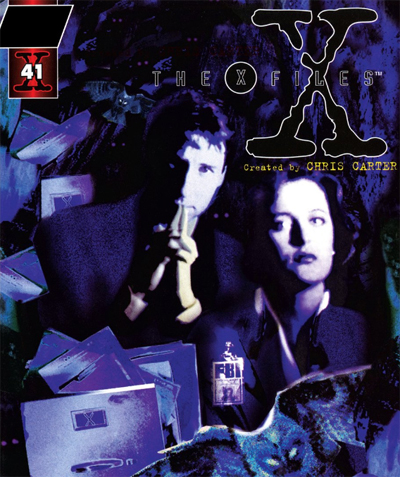
Severed is the last X-Files comic book to be published by Topps. It was released in September 1998, after the release of The X-Files: Fight the Future and before the broadcast of The Beginning. The company had actually solicited a number of X-Files comics that were never actually published – including Season One adaptations of The Jersey Devil and Ghost in the Machine. It seems quite likely that Severed was the last comic book to be published by the comic book division of Topps, who had decided to retreat from the industry following market trends.
Filed away...

Filed away…

Topps wrapped up the bulk of its publishing operations over the summer of 1998, releasing the last few tie-in comics for Xena: Warrior Princess and Hercules: The Legendary Journeys. Severed was actually delayed significantly. Devil’s Advocate had been published in June, leaving a three-month gap between the two issues. It is interesting to wonder what the delays behind publication might have been; certainly writer John Rozum and Alex Saviuk had proven themselves quite capable of managing a monthly schedule.

Whatever was happening behind the scenes, Severed is very much damp squib of an ending. It’s a bland and forgettable story, but one that is sadly par for the course in the stage of the book’s life cycle.

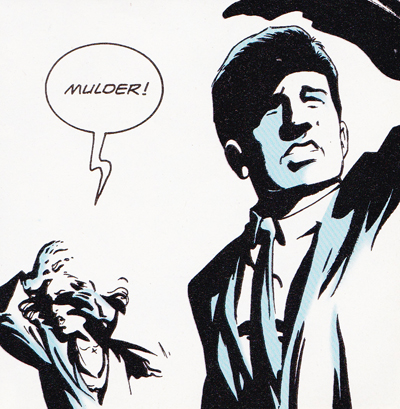
The transformed man...

The transformed man…

Continue reading

The X-Files – Kitsunegari (Review)

This May and June, we’re taking a trip back in time to review the fifth season of The X-Files and the second season of Millennium.

Kitsunegari hits on a lot of fifth season anxieties for The X-Files.

The episode is rather clearly a sequel to a beloved third season installment, featuring a returning monster of the week for the first time since Tooms brought back Victor Eugene Tooms. In this case, Kitsunegari is built around Robert Patrick Modell, the mind-controlling psychopath from Vince Gilligan’s first script as a staff writer. Given the level of Gilligan’s skill, the affection for the episode, and the charm of actor Robert Wisden, Kitsunegari really should be a “can’t miss” script for the series.

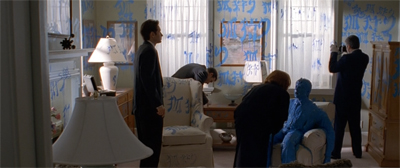
Painting the town...

Painting the town…

However, Kitsunegari proves to be a surprisingly joyless experience. The script hinges on incredibly coincidence and contrivance, everything feels a little too familiar, and even Robert Wisden seems relegated to a small supporting role. (It is telling he earns an “and” credit instead of heading the guest cast.) Kitsunegari has a host of memorable set-pieces and effective visuals, but it feels curiously hollow. It feels like a script going through the motions, rather than trying to say something new or intriguing.

Then again, there is a sense that this is the point. Kitsunegari plays beautifully as a self-aware critique of soulless sequels, of half-hearted follow-ups and cash-ins on popular monsters and villains. Kitsunegari is almost an ingenious parody of these conventions, teasing the viewer with what it might look like if The X-Files began to eat itself. It teases the audience with a trashy sequel to a classic episode, and then delivers exactly that. Kitsunegari does not just demonstrate the law of diminishing returns, it practically revels in it.

Pushing the Pusher...

Pushing the Pusher…

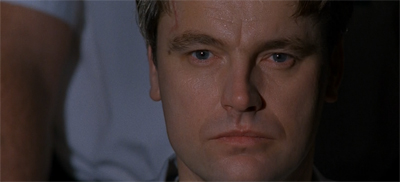
After all, Pusher was an episode about a man with complete control of his own story. Robert Patrick Modell was able to change the world using nothing more than mere words, crafting a new identity and persona for himself, casting himself in role of a criminal mastermind pursued by dogged investigators. It is no wonder that Kitsunegari portrays Modell as exhausted and strung out. Kitsunegari is essentially a story about how Modell has lost control of the narrative, how it has begun to control him. In a way, he gives voice to the same concerns that haunt The Post-Modern Prometheus.

Of course, all this postmodern self-awareness is ingenious, but it still leaves one sizable problem with Kitsunegari. Kitsunegari is so effective at mimicking a soulless sequel that is almost indistinguishable from the real thing. The result is a well-constructed and clever little episode, but one that is not particularly enjoyable or fun.

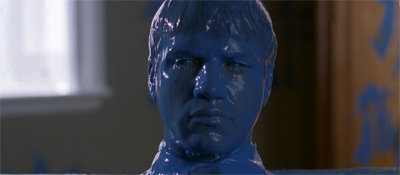
"I'm blue, dabba-dee-dabba-di."

“I’m blue, dabba-dee-dabba-di.”

Continue reading

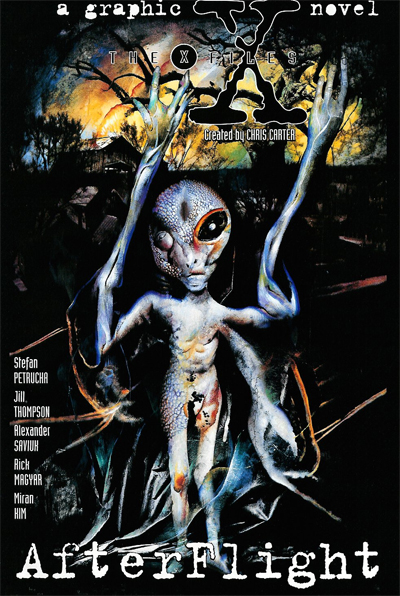
The X-Files (Topps) – Afterflight (Review)

This May and June, we’re taking a trip back in time to review the fifth season of The X-Files and the second season of Millennium.

And so we reach the end of Stefan Petrucha’s work on The X-Files.

It is quite a delayed end. Petrucha had originally written Afterflight three months before Home of the Brave, his last script for the monthly tie-in comic book. It was published fifteen months after the publication of Home of the Brave. That meant a year and a half had passed between Petrucha finished and Topps actually publishing it. The delay was rooted in disagreements with Ten Thirteen over the artwork. Still, Afterflight offers just a hint of closure to the sixteen-issue (and more) run that launched Topps’ licensed X-Files comic book line.

The truth is up there...

The truth is up there…

Afterflight is a mournful little comic, a story that takes a lot of the core themes of Petrucha’s X-Files work and distills them down to a single story. Interviewed about his work, Petrucha contended that his writing for The X-Files primarily meditated on themes of “memory, the self and what is reality.” All of these ideas are brought to the fore in Afterflight, a comic that offers a similar thematic resolution to Home of the Brave, suggesting the faintest hint of hope can be found beyond the world of men.

Afterflight is a beautiful piece of work, and a suitable conclusion to a fantastic run.

Aliens among us...

Aliens among us…

Continue reading

Daredevil – Daredevil (Review)

To celebrate the launch of Marvel’s Daredevil and the release of Avengers: Age of Ultron, we are reviewing all thirteen episodes of the first season of Marvel and Netflix’s Daredevil. Check back daily for the latest review.

In a way, the biggest problem with origin stories is that you know where they have to end up.

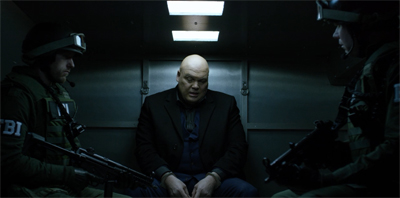
It is easy enough to predict the ending of the first season of Daredevil. Matt Murdock is the costumed superhero who dresses up as a devil to fight crime in Hell’s Kitchen. He practices law with his best friend at “Nelson and Murdock.” Wilson Fisk has embraced his identity as a supercriminal in his own right. His plans to redevelop Hell’s Kitchen are soundly defeated. Evidence is put in the hands of the authorities, allowing our heroes to be exonerated and our villains to be identified.

daredevil-daredevil10

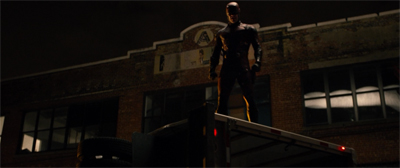
It is a very clear arc, because it has to end somewhere close to where every Daredevil story begins. Indeed, even the title of the episode alludes to that. This is the point at which Matt Murdock ceases to be “the Devil of Hell’s Kitchen” or “the Man in the Mask.” This is the point at which he formally adopts the name “Daredevil.” This is the point at which he puts on a live action version of his iconic costume. This is the point at which the show stops being a Daredevil origin story and becomes just a Daredevil story.

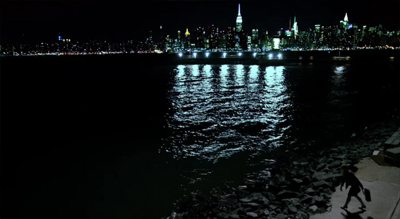
So it makes sense that Daredevil feels a little bit anticlimactic and a little bit overly familiar. The episode doesn’t fight the pull of gravity that draws it towards the inevitable status quo. Despite the shock at the end of The Ones We Leave Behind, the season finalé offers no real shock or twist or subversion. It is exactly what it claims to be. It is functional, efficient and clean. It is not a bad ending by any means. In fact, it is quite satisfying. At the same time, it does feel just a little too tidy and neat for its own good.

daredevil-daredevil14

Continue reading

Daredevil – The Ones We Leave Behind (Review)

To celebrate the launch of Marvel’s Daredevil and the release of Avengers: Age of Ultron, we are reviewing all thirteen episodes of the first season of Marvel and Netflix’s Daredevil. Check back daily for the latest review.

The Ones We Leave Behind builds off The Path of the Righteous, continuing to declutter the board a Daredevil moves closer and closer to the finalé.

The Ones We Leave Behind features the final appearances from a number of supporting players, clearing the way for Daredevil to focus on the final conflict between Matt Murdock and Wilson Fisk. In particular, The Ones We Leave Behind sees Madame Gao excusing herself from the narrative, leaving Leland Owlsley as the last standing member of Fisk’s little cabal following the deaths of Vladimir and Nobu. Gao talks to Owlsley about the necessity of removing distractions from the life of Wilson Fisk; it seems like The Ones We Leave Behind is removing its own distractions.

daredevil-theonesweleavebehind19

Of course, Madame Gao is not the only major departure to feature in The Ones We Leave Behind. The closing scene of The Ones We Leave Behind features Wilson Fisk murdering Ben Urich with his own hands. It is a rather shocking twist, particularly given how steady a fixture Ben Urich has been in the comic books since his first appearance in June 1978. Urich has played major roles in the iconic runs of writers like Frank Miller, Brian Michael Bendis and Ed Brubaker. He is a pretty core part of Daredevil‘s ensemble cast.

It is a very effective and very shocking death sequence, and one that really helps to raise the stakes for the season finalé.

daredevil-theonesweleavebehind26

Continue reading

Daredevil – The Path of the Righteous (Review)

To celebrate the launch of Marvel’s Daredevil and the release of Avengers: Age of Ultron, we are reviewing all thirteen episodes of the first season of Marvel and Netflix’s Daredevil. Check back daily for the latest review.

With The Path of the Righteous, the first season of Daredevil properly enters its end game.

After a lot of soul-searching and contemplating, Matt Murdock is spurred back to action – albeit in a somewhat limited capacity. Matt spends most of the hour searching out Melvin Potter to help design a new costume. This is perhaps the most obvious indication that the end of the season is fast approaching; Matt is beginning to transition away from the costume inspired by Frank Miller and John Romita Jr.’s The Man Without Fear and more towards something approaching his iconic comic book outfit.

daredevil-thepathoftherighteous2

At the same time, Wilson Fisk finds himself desperately losing ground. Vanessa Marianna is in a coma, poisoned during an event hosted and organised by Fisk. Karen Page and Ben Urich have found Marlene Vistain, and begun piecing together a past that Fisk worked very hard to bury. On top of that, The Path of the Righteous ends with Fisk suffering a fairly dramatic personal loss, when Karen Page repeatedly shoots James Wesley. It seems fair to suggest that the ground is shrinking from under him.

However, it is interesting that The Path of the Righteous sidelines Matt and Fisk so thoroughly. Fisk spends the entire episode in a hospital, while Matt is running errands that feel disconnected from the immediate threat. As such, The Path of the Righteous allows for some focus on the supporting cast and the wider ensemble. The biggest dramatic beat of the episode is carried by two supporting players, as Karen Page and James Wesley square off against one another.

daredevil-thepathoftherighteous

Continue reading

Daredevil – Nelson v. Murdock (Review)

To celebrate the launch of Marvel’s Daredevil and the release of Avengers: Age of Ultron, we are reviewing all thirteen episodes of the first season of Marvel and Netflix’s Daredevil. Check back daily for the latest review.

Franklin P. “Foggy” Nelson is perhaps the most constant fixture of Matt Murdock’s personal life.

The lawyer was created by Stan Lee and Bill Everett for the first issue of the comic, published in April 1964. It seems like Foggy has always been there for Matt in one form or another. “Nelson and Murdock” is the heart of Matt Murdock’s life as a lawyer, and so Foggy is generally around to deal with the fallout from whatever crisis has engulfed Matt’s life from one moment to the next. However, Foggy is notable because he is really the only member of the Daredevil cast who can be described as a “regular” character since the book’s inception.

daredevil-nelsonvmurdock2

Despite the fact that Stan Lee and Bill Everett were clearly inspired by The Amazing Spider-Man, Daredevil never developed an ensemble with quite the same depth and breadth. While casual comic book fans can list off dozens of Peter Parker’s friends and colleagues from the earliest years, Matt Murdock has always had a rougher time building up a steady and reliable supporting cast. Part of this is undoubtedly down to the book’s difficulty finding its own identity. Characters came and went as the creative team tried new directions.

Through all of that, Foggy stuck around.

daredevil-nelsonvmurdock5

Continue reading

Non-Review Review: Avengers – Age of Ultron

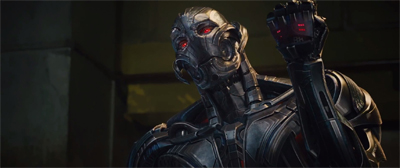
Avengers: Age of Ultron is a hot mess.

It is fun, witty and fast-moving. However, it is also disjointed, uneven and awkward. Age of Ultron is a big and bombastic summer blockbuster, but it feels like Marvel learned very little from The Avengers. Rather than simply taking what worked in the first film, it often seems like Age of Ultron doubles down on every part of its predecessor. There’s more action, there’s higher stakes, there’s bigger conflict, there’s more Tony, there’s even less of an idea what to do with Thor, there’s more continuity.

"Hey, at least I beat the Terminator prequel to cinemas, right?"

“Hey, at least I beat the Terminator prequel to cinemas, right?”

“More” seems to the be the word here. Age of Ultron is bigger than its predecessor in just about every way. The film boasts an ensemble so large that it threatens to collapse under its own weight – a fact perhaps wryly acknowledged by the genocidal robot’s evil plan at the climax. While it is nice to have more diversity in the cast – The Avengers are no longer a bunch of white guys and their token female colleague – it does seem like Age of Ultron strains and groans under all that Joss Whedon and Marvel heap upon it.

Bigger is not always better.

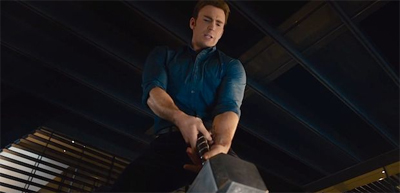
You know, "pull Thor's hammer" is probably not a family friendly party game...

You know, “pull Thor’s hammer” is probably not a family friendly party game…

Continue reading

The X-Files (Topps) #27-29 – Remote Control (Review)

This February and March, we’re taking a trip back in time to review the fourth season of The X-Files and the first season of Millennium.

In many respects, Remote Control is a very “big” story.

It is the biggest story that writer John Rozum has told to date on the comic book, one that spans three issues and seems to brush against the edge of the mythology most associated with The X-Files. Not only does Remote Control feature secret CIA experiments into psychic phenomenon, it also involves a UFO that is being transported through the United States and is hijacked by a foreign power. To top it all off, there is a super-soldier who can render himself invisible and make himself immune to bullets.

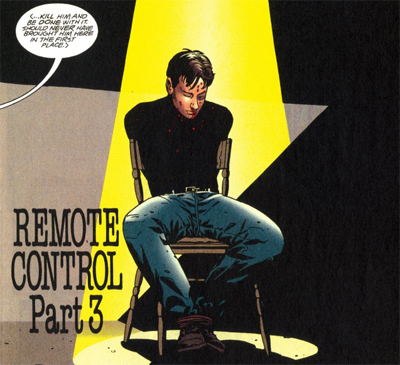
Everything is under control...

Everything is under control…

There is a very clear sense of scale to Remote Control, one that suggests this is a blockbuster adventure. This is the comic book equivalent of those mythology episodes that air during sweeps. At the same time, however, Remote Control brushes up against the limitations imposed upon the comic book by Topps and Ten Thirteen. While Remote Control offers the highest stakes that the comic book has seen since Feelings of Unreality, the script is quite clear that this is a story separate and divorced from anything happening in the show.

There are points where it feels like Remote Control goes out of its way to remind readers that this is just a tie-in comic book, and is thus secondary to the television show.

Mulder is a little tied up right now...

Mulder is a little tied up right now…

Continue reading

The Flash – Plastique (Review)

So, I’m considering reviewing this season of The Flash, because the pilot looks interesting and I’ve always had a soft spot for the Scarlet Speedster. I’m also considering taking a storyline-by-storyline trek through the 1987-2009 Flash on-going series as a companion piece. If you are interested in reading either of these, please let me know in the comments.

Plastique demonstrates that we are still in the early days of The Flash as a television show. We are still working through all the stock elements and trying to figure out what works, while also using fairly stock plot lines to help the show find its feet. Going Rogue was a massive step forwards for the show, but Plastique can’t quite maintain the forward momentum. It feels more like The Fastest Man Alive or Some Things You Can’t Outrun, episodes using a fairly episodic format with generic guest stars and familiar plots to help get things moving.

Plastique is a nice demonstration of what works and what doesn’t work about The Flash at this stage in its life-cycle. It is light and bubbly, and more than a little silly. It is very consciously a CW show, to the point where it seems to wryly winking at the audience. It is also endearingly earnest, embracing a lot of its core superhero tropes even as the characters within the narrative remain reluctant to latch on to “the Flash” as a superhero code name. The Flash is a show that is unashamed about its comic book roots; Plastique even teases the appearance of a psychic gorilla.

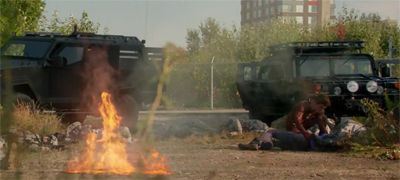
Boom!

Boom!

However, there are problems. The ensemble is uneven at best. The stand-out performers – whether part of the main cast or simply guest stars – skew older. The younger actors tend to be a bit more hit-and-miss. It is more exciting to watch actors like Jesse Martin, Clancy Brown and Tom Cavanagh interact than to spend any time with Kelly Frye or Carlos Valdes. While a lot of that is down to the quality of the casting, the writing is also to blame. The Flash is at its best when it seems to treat characters as adults, rather than young people doing young people stuff.

Plastique is a solid enough episode, but it is one that demonstrates where the strengths and weakness of the show lie. The Flash needs to start compensating and adjusting for that.

A flash of inspiration...

A flash of inspiration…

Continue reading