• Following Us

  • Categories

  • Check out the Archives


  • Awards & Nominations

Star Trek: Voyager – The Raven (Review)

Seven of Nine is something of a mixed blessing for Star Trek: Voyager.

In some respects, the character is a transparent ratings ploy designed to refocus media attention on and attract young male viewers to a television series facing major audience attrition. The series already has enough trouble serving the under-developed members of its ensemble like Chakotay, Tuvok and Kim. The arrival of Seven of Nine only compounds this issue, with the character serving as a focal point in five of the first six episodes of the fourth season. Seven of Nine is a very cynical addition to the cast, an awkward band aid applied to a patient with a chronic condition.

Enlightening.

Enlightening.

However, there is no denying that Seven of Nine works as a character. Even is early in the fourth season, Seven of Nine is more intriguing and compelling than most of the primary cast. As early as The Gift, Jeri Ryan demonstrated that she was one of the strongest members of the ensemble. Seven of Nine might be an awkward combination of the Spock and Data archetype with blatant fan service, but she already has a stronger character and a clearer arc than the vast majority of the regular cast. The production team know what they want from Seven, which is more than can be said of Chakotay, Tuvok or Kim.

Indeed, The Raven further solidifies the character’s purpose and arc in the larger context of Voyager. Indeed, The Raven very cleverly and very literalises Seven of Nine’s character arc, doing so in a way that integrates her into the larger broader themes of Voyager. With The Raven, Seven’s journey to reclaim her lost humanity is rendered as a literal homecoming. Like everybody else on the ship, Seven is ultimately trying to find her way back home.
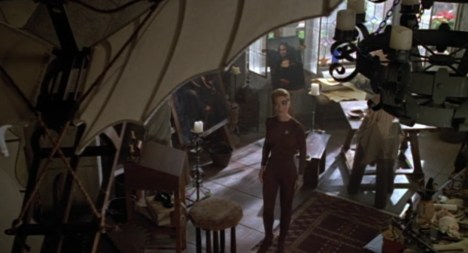
"I shall become a bat... er... a human."

“I shall become a bat… er… a human.”

Continue reading

Star Trek: Deep Space Nine – Empok Nor (Review)

Empok Nor is effectively a slasher movie.

It is Bryan Fuller’s second story credit for Star Trek: Deep Space Nine, and it shares a number of tonal and thematic similarities with his story for The Darkness and the Light. Both episodes are essentially pitched as serial killer horror movies, in which monsters from the past stalk our lead characters. These are fascinating tonal departures for the Rick Berman era of the Star Trek franchise, even if they feel like the logical extension of early horror-tinged episodes like The Man Trap or Charlie X or The Enemy Within.

The great game.

The great game.

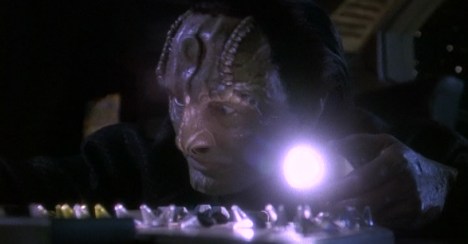
Empok Nor is not as well developed or as effective as The Darkness and the Light. It lacks the thematic and character-driven punch of that earlier episode, even suffering as a little derivative. While Kira’s efforts to reconcile her past as a terrorist with her current status quo was the driving force of The Darkness and the Light, the contrast between O’Brien as a soldier and O’Brien as an engineer feels a little underdeveloped in Empok Nor. More than that, Empok Nor suffers from casually transforming Garak into a gloating nineties serial killer.

At the same time, there is a cheeky thrill to watching the Deep Space Nine production team try their hand at a particularly trashy and visceral genre, offering jump scares and atmosphere on familiar sets with the lighting turned way down low. Empok Nor is not a standout of this most spectacular of television seasons, but it had its charms.

Sleeping beauties.

Sleeping beauties.

Continue reading

Star Trek: Deep Space Nine – The Darkness and the Light (Review)

The Darkness and the Light is the first television credit for writer Bryan Fuller.

There is no way around that. It puts a lot of emphasis on this fifth season episode, drawing a lot attention to the story. Fuller didn’t even write the script, instead pitching a story that would be developed by Ronald D. Moore. However, later in the fifth season, Fuller would pitch the story for Empok Nor. After that, he would be recruited on to the writing staff on Star Trek: Voyager. Then Fuller would begin developing his own shows. Dead Like Me. Wonderfalls. Pushing Daisies. Hannibal. American Gods. Star Trek: Discovery.

Face-off.

Face-off.

That naturally casts a shadow over his first television pitch, the premise sold to the writing staff of Star Trek: Deep Space Nine. Even watching Fuller’s idea filtered through the lens of Ronald D. Moore, there is a strong urge to read too much into this forty-five-minute piece of television. How much of it represents Bryan Fuller’s vision of Star Trek? How have its themes and ideas resonated across the rest of the writer’s work? What insight might it offer into the producer’s vision for the future of the franchise?

A lesser episode would crumple under that weight. It helps that The Darkness and the Light is an ambitious and exciting piece of television, a triumph of concept and execution that stands as one of the most distinctive and memorable episodes in the fifty-year history of the franchise.

A time to heal.

A time to heal.

Continue reading

Star Trek: Deep Space Nine – Season 2 (Review)

Star Trek: Deep Space Nine is twenty years old this year. To celebrate, I’m taking a look at the first and second seasons. Check back daily for the latest review or retrospective.

Well, that’s more like it. The second season of Star Trek: Deep Space Nine might not rank with the very best of the franchise, but it doesn’t have to. Deep Space Nine is still a young show, and Star Trek spin-offs have a long history of taking their time to find their feet. The second season of Deep Space Nine contains its fair share of classic or memorable episodes, but it’s defined by a sense that the producers are still trying to figure out what works and what doesn’t.

While the first season occasionally felt like the series was stumbling back towards safety, trying to become a lighter version of Star Trek: The Next Generation as faith in its premise wavered, the second season is a lot more confident in itself. It’s willing to play around a bit to figure out how to be the show that it wants to be. And there’s a sense, as the season winds to a close, that we’re almost there.

By the time we hit the second half of the season, it seems the show has learned to churn out inoffensive episodes that feel unique and distinctively Deep Space Nine – episodes like Playing God or Shadowplay. However, it’s in the final third that the show seems to figure out how make truly great episodes of Deep Space Nine.

ds9-playinggod22

Continue reading

Hannibal – Relevés (Review)

For a show about a serial killer and the FBI’s Behavioural Analysis Unit, Hannibal is often surprisingly deep. That’s not much of a surprise, given the quality of the staff working on it, but the show is absolutely stunning meditation on identity and personality. In a way, that’s one of the smartest things about Fuller’s first thirteen episode season, building on the foundations set by Thomas Harris to construct something that fits quite elegantly while remaining its own distinct entity.

Relevés is the penultimate episode of the first season, and the point where – having used Roti to clear away some of the clutter – the show starts tying up a lot of those loose ends. Perhaps one of the most impressive things about the episode is the amount of suspense that Bryan Fuller and his staff can wring from the set-up – despite the fact that we know how this story ends, Hannibal manages to engage us so completely in the telling that what we already know seems almost irrelevant.

Things are heating up...

Things are heating up…

Continue reading

Hannibal – Roti (Review)

Roti is the point where Hannibal really starts to gear up for its finalé. The decision to thematically name each of the first season’s episodes after a part of a meal seems oddly appropriate, as the whole season can be seen as a banquet, each of the courses painstakingly prepared to ensure a rich bouquet of flavour and a pleasing array of tastes. Each course is individual, and yet it remains part of the whole. It’s all one gigantic and enjoyable experience, just broken down into sweet digestible chunks. Each serves a clear purpose, like a chapter in a book, or a course in a meal.

Roti features the return of Abel Gideon, the show’s obvious homage to Anthony Hopkins’ portrayal of Doctor Hannibal Lecter. It also positions Will precisely where he needs to be for the first season’s rapidly-approaching climax.

A piece of the action...

A piece of the action…

Continue reading

Hannibal – Buffet Froid (Review)

Buffet Froid is the most strikingly horrific episode of Hannibal to date. Of course, the show is very much a horror story and enjoys its fair share of grotesque imagery. This is the series, after all, that gave us the makeshift angels, the do-it-yourself cello and the human totem poll. However, Buffet Froid plays most obviously on the imagery and iconography of horror. This is the episode where people have no faces and skin comes off at the slightest touch and the serial killer is waiting for you under your bed.

As you might imagine for a show with such complete control of its own atmosphere, Buffet Froid works very well indeed – providing what might be the most horrific episode of the show to date.

The doctor will see you now...

The doctor will see you now…

Continue reading

Hannibal – Fromage (Review)

With Fromage, Hannibal walks a bit of a fine line. One of the obvious conflicts in the first half of the season was between the procedural “serial killer of the week” elements and the more intriguing character-driven parts of the show. I think that, past the half-way point of the first season, the show begins to balance those two aspects much better. However, Fromage can’t help but feel a little bit contrived. It relies a rather convenient overlap between Hannibal’s world and Will Graham’s investigation.

Still, it works quite well as a continuation of the themes hinted at in Sorbet, and takes advantage of the fact that the show has completely embraced its lead character’s darker side. If Entrée and Sorbet pushed Hannibal from the periphery of the story into the spotlight, then Fromage allows him to actively drive the story. It’s the show’s first serial-killer-heavy story that is driven more by Hannibal than by Graham.

Work and play...

Work and play…

Continue reading

Hannibal – Sorbet (Review)

Hannibal took its time building up Hannibal Lecter as a serial killer. According to creator Bryan Fuller, there would have been a joke in Aperitif about Lecter’s culinary habits, but holding off on the sight of Lecter as a serial killer until the end of Entrée feels like it was a shrewd move. Not because it could ever fool the audience into forgetting that Hannibal Lecter is a murdering cannibal or anything like that. Instead, it builds up a certain amount of tension and suspense around the character, allowing us to see how those around him could have been blinded by his persona.

With a few obvious exceptions – knocking out Doctor Bloom in Potage or phoning the Hobbs household in Aperitif – we’ve mostly seen Lecter through the eyes of others. While the very premise of the show counts on the audience knowing who or what Lecter is, keeping him at a distance allowed the show a bit of breathing room in its first year. However, now that we’ve caught a glimpse of Lecter in action, Sorbet feels like its willing to pull back the layers on our eponymous epicurean.

Best served warm...

Best served warm…

Continue reading

Hannibal: Coquilles (Review)

I feel a little bad now. I spent a lot of time in Amuse-Boche and Ceuf complaining about the possibility that Hannibal might turn into a serial-killer-of-the-week procedural, at a time when the networks are over-saturated with that sort of forensic drama. However, Coquilles manages to be a pretty superlative hour of television despite feeling like a pretty conventional “catch the serial killer” story. The key is in the execution, with Coquilles serving as a rich character-driven drama that just happens to involve the hunt for a gruesome serial killer.

It also helps that the “angel maker” feels like a refugee from an early draft of a Thomas Harris novel rather than a bland psychopath of the week.

Served...

Served…

Continue reading