• Following Us

  • Categories

  • Check out the Archives


  • Awards & Nominations

Doctor Who: The Parting of the Ways (Review)

To celebrate the fiftieth anniversary of the longest-running science-fiction show in the world, I’ll be taking weekly looks at some of my own personal favourite stories and arcs, from the old and new series, with a view to encapsulating the sublime, the clever and the fiendishly odd of the BBC’s Doctor Who.

The Parting of the Ways originally aired in 2005.

Everything must come to dust. All things. Everything dies. The Time War ends.

– Rose

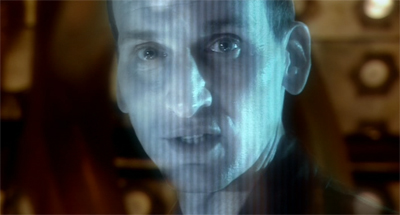
And so the first season of Russell T. Davies’ revived Doctor Who comes to a close. If you asked me, it’s the best season of the show that Davies has produced. The year contains a few clunkers, and it doesn’t contain the highest concentration of enjoyable episodes, but I think the first year has a much clearer direction and purpose than any of the years that followed. Although apparently Christopher Eccleston’s departure was only decided after the show went into production, the first season seems like it is constantly building to the death of the Doctor. The entire first season seems to build, logically and rationally, towards that moment.

He's not all there...

He’s not all there…

Continue reading

Doctor Who: Bad Wolf (Review)

To celebrate the fiftieth anniversary of the longest-running science-fiction show in the world, I’ll be taking weekly looks at some of my own personal favourite stories and arcs, from the old and new series, with a view to encapsulating the sublime, the clever and the fiendishly odd of the BBC’s Doctor Who.

Bad Wolf originally aired in 2005.

The Dalek stratagem nears completion. The fleet is almost ready. You will not intervene.

Oh, really? Why’s that, then?

We have your associate. You will obey or she will be exterminated.

No.

Explain yourself.

I said no.

What is the meaning of this negative?

It means no.

But she will be destroyed.

No! Because this is what I’m going to do. I’m going to rescue her. I’m going to save Rose Tyler from the middle of the Dalek fleet and then I’m going to save the Earth, and then, just to finish off, I’m going to wipe every last stinking Dalek out of the sky!

But you have no weapons, no defences, no plan.

Yeah. And doesn’t that scare you to death. Rose?

Yes, Doctor?

I’m coming to get you.

– the Daleks, the Doctor and Rose give the Ninth Doctor perhaps his best moment

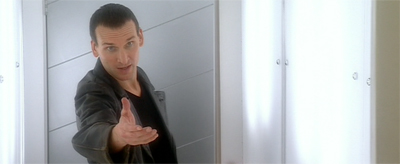
Looking back at the first season, I’d argue that it’s the most cohesive run of episodes that Russell T. Davies produced on the dhow. Now because of the whole “bad wolf” thing, as that feels a bit like a clumsy link randomly inserted. Instead, as we watch the final episode, it becomes quite clear what Davies was trying to do with his first year on the show. The patterns, the themes, the subtext, the references – it all becomes quite clear. More than any other season of Davies’ tenure, the first season is really one gigantic story – and not just because the show never leaves Earth or the finalé returns to the setting of The Long Game.

The first season is a bridge. It’s a link between the last years of the classic series into the new and revived show as written by Davies. It’s a moment to gather up the dead, tidy away the loose ends and basically manage the stage so that the show can really come into its own. One of the things I loved about Davies’ Doctor Who was how accessible it all was, but it still had all this continuity ticking away in the background.

This first season finalé feels like it isn’t only a conclusion to Christopher Eccleston’s time in the lead role, it’s also closing the last of the dangling threads from the eras of Colin Baker and Sylvester McCoy in the eighties. As soon as David Tennant steps into the lead role, it seems the show is entirely and utterly free of everything that came before. It’s a testament to Davies’ skill that we’re not even sure that he’s doing it.

Come with me if you want to live...

Come with me if you want to live…

Continue reading

Jameson Dublin International Film Festival 2013: Highlights!

The Jameson Dublin International Film Festival launched the programme for its eleventh year today. There’s some great stuff in here. There’s a variety of films, from European to American to Asian, from big budget blockbusters to intimate documentaries to more personal films. It’s a great selection of films, and festival director Grainne Humphreys should be proud. After all, if your biggest complaint is having to choose between L.A. Confidential and Bernie, then you must be doing something right.

I’ve picked out some of my own most anticipated events of the schedule below, in rough chronological order, so if you are looking for something to do on a particular day, feel free to see if there’s anything of interest. Unfortunately, some of the events overlap, so you can’t attend everything – something that’s a massive shame given some of the films on display here. With that in mind, the list is below.

JDIFF Brand 2011 (Landscape) copy

Continue reading

Doctor Who: Robot (Review)

To celebrate the fiftieth anniversary of the longest-running science-fiction show in the world, I’ll be taking weekly looks at some of my own personal favourite stories and arcs, from the old and new series, with a view to encapsulating the sublime, the clever and the fiendishly odd of the BBC’s Doctor Who.

Robot originally aired in 1974 and 1975.

There you are. Now come along, Doctor, you’re supposed to be in the sick bay.

Am I? Don’t you mean the infirmary?

No, I do not mean the infirmary. I mean the sick bay. You’re not fit yet.

Not fit? I’m the Doctor.

No, Doctor, I’m the doctor and I say that you’re not fit.

You may be a doctor, but I’m the Doctor. The definite article, you might say.

– Harry meets the Doctor

Robot feels a bit like trying to fit a round peg into a square hole, or a Tom-Baker-shaped peg into a Jon-Pertwee-shaped hole. At the time that Baker assumed the role as everybody’s favourite time-travelling phone-booth dweller, Pertwee had just finished the longest stint as the character, portraying the Doctor for five years. Of course, Baker himself would go on to break that record, playing the part for seven years, but it gives you a sense of just how big of a transition it was. As such, it’s easy to understand why outgoing producer Barry Letts felt the need to essentially cast Tom Baker in what feels distinctly like a Jon Pertwee story. As a concept, the central character aside, Robot feels like it would have fit in quite well as part of Pertwee’s last season, which is – I think – part of the problem here.

Tom Baker is a lot of things, but he’s not Jon Pertwee. As a result, Robot feels a little clunkier than it really should, as if the show is actively working against the character who should be driving it.

The Doctor will see you now...

The Doctor will see you now…

Continue reading

Doctor Who: The Eleventh Hour (Review)

To celebrate the fiftieth anniversary of the longest-running science-fiction show in the world, I’ll be taking weekly looks at some of my own personal favourite stories and arcs, from the old and new series, with a view to encapsulating the sublime, the clever and the fiendishly odd of the BBC’s Doctor Who.

The Eleventh Hour originally aired in 2010.

So, coming?

No.

You wanted to come fourteen years ago.

I grew up.

Don’t worry. I’ll soon fix that.

– the Doctor and Amy

The arrival of a new producer on Doctor Who always represents a shift in some way shape or form. The change from Barry Letts to Philip Hinchcliffe must have seemed radical, even at the time. Graham Williams following Hinchcliffe represented a similarly strange departure. The departure of Russell T. Davies, the producer who had brought Doctor Who back to television after over a decade, was always going be a pretty significant change for those watching. Steven Moffat’s first episode as producer might not seem like it’s a shocking departure from what came before, but it also quite efficiently and effectively distinguishes Moffat’s tenure from that of his direct predecessor.

While by no means as radical a shift as Spearhead from Space, there is a very clear feeling that The Eleventh Hour brings with it significant tonal and thematic changes to the tale of the Doctor.

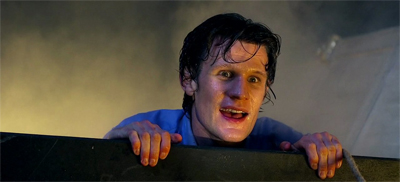
A mad man with a box...

A mad man with a box…

Continue reading

Birthing Hips Sink Ships: Dark Shadows & Improbable Feminism…

I will concede that I am fonder of Dark Shadows than most. I’ve been disappointed with a lot of Tim Burton’s recent output, but something about his revival of the seventies soap opera worked strangely well. I’ll be the first to concede that it’s pretty esoteric. After all, like Casa de mi Padre, it’s effectively one single joke stretched across a film’s runtime. However, I couldn’t help but warm to it, at least because it seemed like Burton was enjoying himself a lot more than head been with films like Alice in Wonderland. There was something quite cheeky about it, from the way that it portrayed its central character as ridiculously unheroic through to the fact that it was perhaps the year’s most subversive feminist film.

Indeed, watching the film again this weekend, it struck me just how feminist the narrative actually was, despite the somewhat superficial distractions from that.

darkshadows10

Continue reading

Doctor Who: The Daleks (Review)

To celebrate the fiftieth anniversary of the longest-running science-fiction show in the world, I’ll be taking weekly looks at some of my own personal favourite stories and arcs, from the old and new series, with a view to encapsulating the sublime, the clever and the fiendishly odd of the BBC’s Doctor Who.

The Daleks originally aired in 1963-4.

Make! no! attempt! to! capture! them! they! are! to! be! exterminated! you! understand! exterminated!

– four episodes in, the Daleks have a catchphrase

Because of the somewhat confusing naming conventions for the Hartnell era, where each individual episode had its own title, this one goes by a variety of names: The Mutants, The Dead Planet, or The Daleks. Still, if you’re reading this, you probably know the serial I’m talking about. It’s the one that introduced everyone’s favourite psychotic little pepper pots.

Taking the plunger…

Continue reading

My 12 for ’12: The Cabin in the Woods & The Virtues of Constructive Criticism

I’m counting down my top twelve films of the year between now and January, starting at #12 and heading to #1. I expect the list to be a little bit predictable, a little bit surprising, a little bit of everything. All films released in the UK and Ireland in 2012 qualify. Sound off below, and let me know if I’m on the money, or if I’m completely off the radar. And let me know your own picks or recommendations.

This is #4

The horror movie has always been a bit of an ugly stepchild when it comes to film genres. It seems, for instance, that horror movies (and directors) have to wait longer to receive recognition for the work that they’ve done. The Shining, for example, earned several Razzy nominations in the year of release, but is now regarded as one of many classics within Kubrick’s oeuvre. There are lots of reasons that the horror genre is easy enough to dismiss or ignore.

You could argue that there’s something so basic about fear that it isn’t considered as much of an artistic accomplishment to scare the audience. There are legitimate arguments to be made about the sexist connotations of various horror films. Perhaps more than any other genre, successes within the horror genre have a tendency to lead to self-cannibalisation – sequels, remakes, knock-offs – that dilute and erode any credibility that the original film had earned. The innovation of Paranormal Activity is harder to recognise after half-a-decade of found-footage imitations. The cleverness of the original Saw becomes harder to distinguish amongst a crowd of “torture porn” wannabes.

All of these are very legitimate criticisms to make about the nature of the genre as a whole, and perhaps they speak to why films within that niche are so easily dismissed. I will aggressively argue that several horror films are among the most important films ever made, but I will also concede that there is (as with everything) a lot of trash out there, and a lot of things we need to talk about. Cabin in the Woods feels like a genuine attempt to have that sort of conversation, and to raise those questions. More than that, though, it comes from a place of obvious affection for the genre and all that it represents. This isn’t a stern lecture about the inherent inferiority of a particular type of film,  but constructive criticism from a bunch of people who care deeply about the genre as a whole.

cabininthewoods8

Continue reading

Immatürity for Charity, Tonight, 9.30pm, RTÉ 2

Christmas is often the time to indulge your inner child, so Immatürity for Charity seems perfectly suited for a post-holiday comedic treat. I had the pleasure of checking out a preview of it last week, and it is deliciously juvenile. It is, as the title suggests, a decidedly low-brow comedy sketch show, the kind of thing that could easily grate if it weren’t handled with the right amount of skill and enthusiasm. Luckily, writer (and star) Domhnall Glesson and director John Butler have done an outstanding job. Not all the sketches included are absolutely pitch-perfect, but the beauty of sketch comedy is that if you don’t like what you’re watching, well… another will be along shortly.

Domhnall Gleeson - IFC

Continue reading

My 12 for ’12: Prometheus, Faith, Treachery & The Great Beyond…

I’m counting down my top twelve films of the year between now and January, starting at #12 and heading to #1. I expect the list to be a little bit predictable, a little bit surprising, a little bit of everything. All films released in the UK and Ireland in 2012 qualify. Sound off below, and let me know if I’m on the money, or if I’m completely off the radar. And let me know your own picks or recommendations.

This is #5

In the year 7510,
If God’s a-comin’, he ought to make it by then.
Maybe he’ll look around himself and say,
“Guess it’s time for the Judgement Day.” 

In the year 8510,
God’s gonna shake his mighty head.
He’ll either say “I’m pleased where man has been”,
Or tear it down and start again.

-Zager and Evans, In The Year 2525

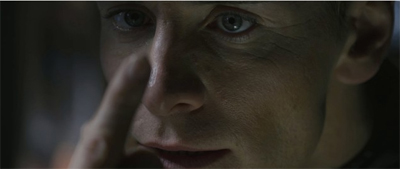
Faith is a funny thing. If you don’t have it, it’s impossible to explain. If you do have it, it needs no explanation. Ridley Scott’s Prometheus feels a little bit ham-strung by the Alien DNA” that it carries. As a prequel to the iconic film series, it’s hardly the most successful endeavour. Indeed, the film’s references to everybody’s favourite chest-bursting extra-terrestrial feel almost forced. Like the discussion about the Scientology influence on The Master, focusing on the instantly recognisable xenomorph tends to obscure the unique strengths of Prometheus as its own film.

Interestingly, the strongest connection to Alien is thematic rather than literal. Like Ridley Scott’s first science-fiction masterpiece, Prometheus postulates a cold and uncaring universe, one that is inherently alien, incomprehensible and hostile. The human condition causes us to question, but Prometheus suggests that there can be no answers – no satisfactory answers at least.

prometheus16

Continue reading