• Following Us

  • Categories

  • Check out the Archives


  • Awards & Nominations

Doctor Who: The Doctor, The Widow & The Wardrobe (Review)

To celebrate the fiftieth anniversary of the longest-running science-fiction show in the world, I’ll be taking weekly looks at some of my own personal favourite stories and arcs, from the old and new series, with a view to encapsulating the sublime, the clever and the fiendishly odd of the BBC’s Doctor Who.

The Doctor, The Widow & The Wardrobe originally aired in 2011.

I don’t understand. Is this place real, or is it fairyland?

Fairyland? Oh, grow up, Lily.

Fairyland looks completely different.

– Lilly and the Doctor get their geography straightened out

The Doctor, The Widow and the Wardrobe is, like A Christmas Carol before it, a rather wonderful idea. A Christmas Carol mashed up Doctor Who with one of the best-loved Christmas narratives of all time. The Doctor, The Widow and the Wardrobe does something similar, substituting CS Lewis for Charles Dickens. It’s a fantastic idea, given that Doctor Who is the spiritual successor of that peculiarly British thread of childhood fantasy.

The only real problem with The Doctor, The Widow and The Wardrobe is that it can’t quite stretch that good idea across an hour of television.
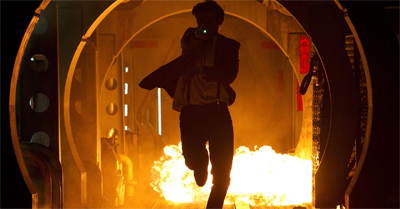
On the run again...

On the run again…

Continue reading

Doctor Who: The Christmas Invasion (Review)

To celebrate the fiftieth anniversary of the longest-running science-fiction show in the world, I’ll be taking weekly looks at some of my own personal favourite stories and arcs, from the old and new series, with a view to encapsulating the sublime, the clever and the fiendishly odd of the BBC’s Doctor Who.

The Christmas Invasion originally aired in 2005.

Oh, that’s rude. That’s the sort of man I am now, am I? Rude. Rude and not ginger.

– the Doctor

Part of what’s remarkable about The Christmas Invasion is that it’s a great big important episode. Not only is it the first Doctor Who Christmas Special, the beginning of a BBC institution, it’s also the first full-length adventure to feature David Tennant in the title role, and so it comes with a lot of expectations. Whereas most of Davies’ Christmas Specials tended to be relatively light fare – enjoyable run-arounds aimed rather squarely at the kind of people who didn’t tune into the show week-in and week-out – The Christmas Invasion is a pretty big deal.

It’s a vitally important part of Davies’ Doctor Who, and one that really lays out a general blue print for where he wants to take the series over the next few years. The fact that so much of this winds up tying back into the final story of the Davies era – The End of Time – is quite striking on re-watch.

Song for Ten(nant)...

Song for Ten(nant)…

Continue reading

Doctor Who: Survival (Review)

To celebrate the fiftieth anniversary of the longest-running science-fiction show in the world, I’ll be taking weekly looks at some of my own personal favourite stories and arcs, from the old and new series, with a view to encapsulating the sublime, the clever and the fiendishly odd of the BBC’s Doctor Who.

Survival originally aired in 1989.

Where to now, Ace?

Home.

Home?

The TARDIS.

Yes, the TARDIS. There are worlds out there where the sky is burning, where the sea’s asleep, and the rivers dream. People made of smoke, and cities made of song. Somewhere there’s danger, somewhere there’s injustice, and somewhere else the tea’s getting cold. Come on, Ace, we’ve got work to do!

– the Doctor and Ace turn off the lights on their way out

There was a long gap between Survival and Rose. It was filled with stuff. It was filled with lost of interesting and different Doctor Who stuff. There were books and audio plays and even a television movie to help fill the decade and a half when Doctor Who was not a regular feature of British television. A lot of that stuff was important, and a lot of it helped determine and shape what Doctor Who would become when it did return. It’s telling that the many members of the writing staff on the revived Doctor Who cut their teeth on novels and short stories and audio plays and specials in the wilderness years, while no writers returned from the classic show.

At the same time, however, the gap between Survival and Rose doesn’t feel as profound as it might. It’s misleading to suggest that Survival was a clear bridge towards the Russell T. Davies era, or even to hint that the revival could have emerged fully formed from this three-part closing serial. At the same time, Survival is really the closest that the classic series ever came to the spirit of the Davies era, hitting on quite a few familiar themes and ideas and settings, as if Cartmel’s vision of the future of Doctor Who was not too far from the version proposed by Davies.

Survival was the end of an era, but it also motioned towards the start of another.

Riding into the sunset...

Riding into the sunset…

Continue reading

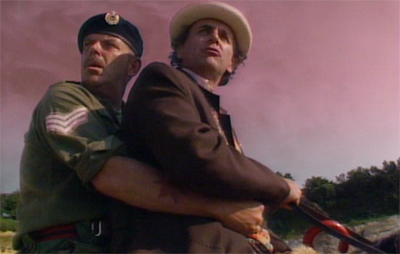
Doctor Who: The Happiness Patrol (Review)

To celebrate the fiftieth anniversary of the longest-running science-fiction show in the world, I’ll be taking weekly looks at some of my own personal favourite stories and arcs, from the old and new series, with a view to encapsulating the sublime, the clever and the fiendishly odd of the BBC’s Doctor Who.

The Happiness Patrol originally aired in 1988.

Think I’ll hang out here for a while, Doc. See if I can teach this planet the blues again.

Yes, thank you for giving them back to us, Doctor.

– Earl and Susan shouldn’t be so surprised that the Doctor is fond of blue

The Happiness Patrol is an absolutely fascinating piece of Doctor Who. On the surface, it’s another example of the series’ rapidly falling budget and the production values point towards the show’s impending cancellation. While nowhere near as dodgy as Warriors of the Deep, The Happiness Patrol looks like a very cheap piece of television, struggling to realise a futuristic colony on a tiny budget. On a purely superficial level, The Happiness Patrol is really the kind of show that Michael Grade could point to and argue that Doctor Who was a show that desperately needed to be put out of its misery.

However, if the viewer is willing to pull back the layers a bit, and to peer beneath the somewhat rough trappings of The Happiness Patrol, the adventure is really everything that eighties Doctor Who could ever want to be. There is a reason that the serial has, somewhat improbably, endured. In 2010, The Happiness Patrol became headline news in Great Britain, with national newspapers astounded by the audacity of Andrew Cartmel’s vision for the show. The following year, the Archbishop of Canterbury casually name-dropped it in an Easter Sermon.

These references aren’t derogatory. These are proof that The Happiness Patrol, despite its dodgy special effects and the limitations of its production design, is one of the most important Doctor Who adventures of the eighties.

He's perfectly sweet!

He’s perfectly sweet!

Continue reading

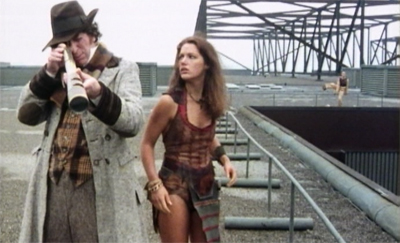
Doctor Who: The Sun Makers (Review)

To celebrate the fiftieth anniversary of the longest-running science-fiction show in the world, I’ll be taking weekly looks at some of my own personal favourite stories and arcs, from the old and new series, with a view to encapsulating the sublime, the clever and the fiendishly odd of the BBC’s Doctor Who.

The Sun Makers originally aired in 1977.

Why did you come here, then?

Because my new little chum here seemed unhappy about something.

Mandrell discovers all he needs to know about the Doctor

The Sun Makers was reportedly written as a result of a disagreement between writer Robert Holmes and the British Revenue and Customs. That’s the oft-cited background to the story, so well known that it’s even included on the notes included in the DVD release. With that summary, you’d expect The Sun Makers to be a condemnation of the tax system, and a protest at the government’s funnelling off of money from the individual to pay like pesky things like roads or schools or hospitals.

Instead, Holmes has crafted The Sun Makers as something altogether more compelling and instructive. Rather pointedly, while The Sun Maker is a story about excessive taxation, the episode casts a large interstellar corporation as the villain of the piece. The episode’s primary antagonist isn’t a state official, it’s a single-minded number-crunching accountant who operates a large corporation that has managed to turn light itself into a financial commodity. This isn’t the story about individuals fighting for the right not to pay tax, it’s people fighting for decent working and living conditions.

Indeed, it’s quite easy to read The Sun Makers as a rather socialist piece of Doctor Who, ending with the massive organisation of the working class to resist their greedy capitalist overlords. That’s quite a radical shift from the story you’d expect given the background. In that respect, it seems almost like a call-forward to the pointed subversive social commentary of the Cartmel and even Davies eras.

I see the future...

I see the future…

Continue reading

Doctor Who: The Three Doctors (Review)

To celebrate the fiftieth anniversary of the longest-running science-fiction show in the world, I’ll be taking weekly looks at some of my own personal favourite stories and arcs, from the old and new series, with a view to encapsulating the sublime, the clever and the fiendishly odd of the BBC’s Doctor Who.

The Three Doctors originally aired in 1973.

Well, Sergeant, aren’t you going to say it that it’s bigger on the inside than it is on the outside. Everybody else does.

It’s pretty obvious, isn’t it?

– the Doctor and Benton

The Three Doctors never seems entirely sure what it’s supposed to be. It knows what it has to accomplish. This was the first serial of the tenth season of Doctor Who, so it has to feature the three versions of the character to date. It also wants to radically shake-up the status quo of the series and to allow Jon Pertwee’s Doctor to take to the cosmos. Those are really the two primary objectives of The Three Doctors, and writers Bob Baker and Dave Martin accomplish them quite well.

The problem is that the story itself isn’t sure what it wants to be. Pertwee-era script editor Terrance Dicks would be a lot more confident when juggling The Five Doctors, conceding that the whole thing was a gigantic nonsensical spectacle. The Three Doctors seems almost like a regular story with the tenth anniversary grafted on to it – it’s easy enough to imagine a rough outline of this story that could work with only Jon Pertwee and without the end of his exile.

As a result, the two strongest beats in The Three Doctors feel almost like afterthoughts, grafted on to the outline of a generic and somewhat bland Doctor Who adventure.

Why does the Doctor hate himself...?

Why does the Doctor hate himself…?

Continue reading

Doctor Who: Love and Monsters (Review)

To celebrate the fiftieth anniversary of the longest-running science-fiction show in the world, I’ll be taking weekly looks at some of my own personal favourite stories and arcs, from the old and new series, with a view to encapsulating the sublime, the clever and the fiendishly odd of the BBC’s Doctor Who.

Love and Monsters originally aired in 2006.

Someone wants a word with you.

You upset my mum.

Great big absorbing creature from outer space, and you’re having a go at me?

No one upsets my mum.

– the Doctor, Rose and Elton get their priorities straight

Love and Monsters remains one of the most divisive stories of the Davies era, if not the revival in general. It’s the show’s first “Doctor-lite” episode, a production featuring as little of the lead actor in possible in order to make the season’s arduous production schedule just a little bit easier. The Christmas Invasion had added another episode to the mix, and so the idea was that Love and Monsters could be shot during the production block of The Impossible Planet and The Satan Pit in order to allow for a standard length season without increasing an already impressive workload for the leads.

As such, it’s easy to imagine that the “Doctor-lite” episodes could be throw-away adventures, episodes chopped together to meet the quota of stories for a given season – churn them out and focus the attention on to the “bigger” and “more important” adventures. Instead, the “Doctor-lite” episodes have proven to be some of the most experimental and creative episodes of the entire Davies era. While critical and fan opinion remains divided on Love and Monsters, the subsequent “Doctor-and-companion-lite” episodes – like Blink, Midnight and Turn Left – are counted among the best of their respective seasons.

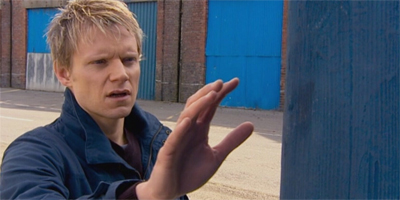
Love and Monsters is a show about Doctor Who. More specifically, it’s about Doctor Who fandom, and a romantic ode to the importance that the show can have in some people’s lives.

Reach out and touch faith...

Reach out and touch faith…

Continue reading

Doctor Who: The Greatest Show in the Galaxy (Review)

To celebrate the fiftieth anniversary of the longest-running science-fiction show in the world, I’ll be taking weekly looks at some of my own personal favourite stories and arcs, from the old and new series, with a view to encapsulating the sublime, the clever and the fiendishly odd of the BBC’s Doctor Who.

The Greatest Show in the Galaxy originally aired in 1988.

Sometimes I think it’s you that’s crazy, not Deadbeat here.

Anybody remotely interesting is mad in some way or another.

– Ace and the Doctor cut to the heart of Doctor Who

It’s very hard to believe that The Greatest Show in the Galaxy aired as the final story of the twenty-fifth season of Doctor Who. Stories like Remembrance of the Daleks and Silver Nemesis were clearly anniversary fodder, celebrating the progress of the show to this point. The Happiness Patrol was a delightfully surreal oddity that has only really been noticed by the general public in recent years, with news breaking in 2010 that Andrew Cartmel had been using Doctor Who to tell politically subversive stories. Which, I suppose, confirms just how few people were watching The Happiness Patrol in 1988.

The Greatest Show in the Galaxy is as concerned with the legacy of Doctor Who as Remembrance of the Daleks or Silver Nemesis, but it lacks the nostalgic shine. Instead, it’s a stunningly bitter piece of television that offers a pretty damning indictment of what Doctor Who had become by the late eighties, a critique of selling out and chasing ratings and living in constant fear that the gods of entertainment – the middle-class families so desperately courted and so carefully catered to – might tune out and consign the show to oblivion.

The Doctor welcomes you to The Greatest Show in the Galaxy...

The Doctor welcomes you to The Greatest Show in the Galaxy…

Continue reading

Subtitle European Film Festival, Kilkenny, 25th November – 1st December 2013

I just got this press release about the upcoming SUBTITLE European film festival being held in Kilkenny towards the end of November. I’m always a fan of European cinema, and nothing beats the ethereal atmosphere of a film festival, so I thought I’d pass it on. You can find more details about the festival and their line-up on their website here. I particularly recommend Headhunters and A Hijacking if you can get to see them.

The press release is below.

headhunters

Continue reading

Agents of S.H.I.E.L.D. – The Girl in the Flower Dress (Review)

The first few episodes of any new show are about finding the right balance, striking the right tone. You experiment a bit, you figure out what works and what doesn’t, you try a number of new things knowing that only a few will pay off. The problem with Agents of S.H.I.E.L.D. isn’t that none of the show’s experiments are coming to fruition. It’s that the show seems completely afraid to try anything new at all.

The Girl in the Flower Dress is the show’s fifth episode, but it already feels like something of a reheat, taking the best parts of The Pilot and The Asset, and synthesising them into a single familiar story.

The problem is that the best bits of The Pilot and The Asset weren’t anything to write home about.

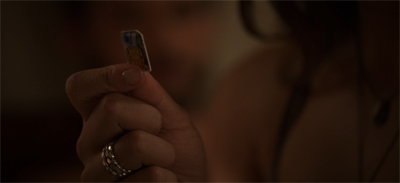
A chip off the old block...

A chip off the old block…

Continue reading