• Following Us

  • Categories

  • Check out the Archives


  • Awards & Nominations

Non-Review Review: About Time

About Time is pretty much vintage Richard Curtis. I don’t mean that in a bad way – certainly not in an entirely bad way. Curtis knows how to structure a romance, has a gift for distinguishing characters in a large ensemble, and has the capacity to employ sentimentality to calculated and devastating effect. About Time has moments of brilliance and emotional punch, framing the main character’s inexplicable ability to time travel in delightful metaphorical terms.

At the same time, Curtis has his weaknesses. Most notably, there’s the sense that his lead characters are all variations on the same character – with more cynical pundits suggesting the base model might be Curtis himself. Similarly, his ensembles are constructed efficiently as a collection of quirky characters who do quirky things quirkily, living out the most quaintly British of lives involving afternoon tea and indulging in the most stereotypical of exclamations (“just a tick…”, “oh gosh…”, etc). There’s a sense that Curtis’ world exists inside old-fashioned post cards more than in anything approaching the real world.

More than that, though, Curtis labours his point just a little bit too much, as if worried the audience might miss the whole “we’re all travelling in time” metaphor and the “secret to being happy” philosophy if it isn’t explicitly articulated in a voice-over monologue set to an upbeat pop song.

Time enough at last...

Time enough at last…

Continue reading

Star Trek: Deep Space Nine – Babel (Review)

Star Trek: Deep Space Nine is twenty years old this year. To celebrate, I’m taking a look at the first season. Check back daily for the latest review or retrospective.

With Babel, we hit the most significant flaw in the first season of Star Trek: Deep Space Nine. Put frankly, Babel is the first story that could easily have worked as an episode of the original Star Trek or of Star Trek: The Next Generation. Indeed, Michael Piller concedes in Captains’ Logs Supplemental – The Unauthorized Guide to the New Trek Voyages that Babel had a history longer than that of Deep Space Nine itself:

We had this premise for over five years at Next Generation. It was written by the same person who wrote “Hollow Pursuits” for us, and we had always been attracted to the idea that you could suddenly lose the ability to use language and communicate, and how people are able to communicate with each other.

This isn’t necessarily a bad thing, but it’s worth noting that the first season of Deep Space Nine was airing concurrently with the sixth season of The Next Generation. If people wanted to see stories that could work on The Next Generation, it made more sense to see them executed on that show by a production team with experience in these sorts of plots.

While Babel isn’t a bad episode by any means, there’s a sense that it has been cobbled together from leftovers at another table, and the result isn’t nearly as satisfying as it should be.

Chief concerns...

Chief concerns…

Continue reading

Jonathan Hickman’s Run on Ultimate Comics: Ultimates (Review/Retrospective)

To celebrate the release of Thor: The Dark World towards the end of next month, we’ll be looking at some Thor and Avenger-related comics throughout September. Check back weekly for the latest reviews and retrospectives.

There’s something to be said for keeping Marvel’s Ultimate Universe as a “do anything you want” sandbox for up-and-coming creators, a chance for writers and artists to demonstrate their ability to tell comic book stories without worrying too much about the status quo or putting everything back in something resembling the way they found it. After all, the Ultimate Universe provided a fertile starting point for creators like Mark Millar, Brian Michael Bendis and Brian K. Vaughn to demonstrate they could tell big bombastic superhero stories, with Millar and Bendis going on to radically shape  the mainstream Marvel continuity.

As such, Jonathan Hickman’s run on the awkwardly-titled Ultimate Comics: Ultimates feels like an audition. It’s very clearly a weird alternate-universe take on many of the ideas that he would carry over to his run on Avengers and New Avengers when he succeeded creator Brian Michael Bendis. Hickman’s Ultimates is bristling with big ideas, and an exciting willingness to tear down and build up without any hesitation. The only real problem is that it feels like a story sorely missing an ending.

Thor smash!

Thor smash!

Continue reading

Non-Review Review: Rush

In many ways, Rush quite resembles the last collaboration between director Ron Howard and writer Peter Morgan. Both are built around contests between two larger-than-life personalities. One is old-fashioned and conservative, averse to risk and obsessed with victory; the other is young and impetuous, arrogant and self-assured without the experience to back that up. However, while Rush lacks the screen presence of performers Michael Sheen and Frank Langella, it benefits greatly from the fact that it refuses to choose a side.

As much as Frost/Nixon might have offered a slightly more sympathetic-than-usual Nixon, it was clear that the audience was intended to root against the corrupt former president, and champion the ascension of young up-and-comer David Frost. Rush manages a more delicate balance, firmly refusing to favour one protagonist over the other. Both the reckless young go-getter and the safety-conscious number-cruncher are portrayed as sympathetic and well-developed characters.

This makes Rush that rarest of sports movies: the one where the audience is rooting for both contenders.

Not quite to Formula...

Not quite to Formula…

Continue reading

Star Trek: Deep Space Nine – A Man Alone (Review)

Star Trek: Deep Space Nine is twenty years old this year. To celebrate, I’m taking a look at the first season. Check back daily for the latest review or retrospective.

To be fair to Star Trek: Deep Space Nine, it’s clear that the show’s heart is in the right place. After all, a Star Trek television show isn’t quite the gambit that it was in 1987. The producers expect that the series will be going for quite some time. After all, the regulars signed six-year contracts, one of the reasons that the show managed to make it to its penultimate season without losing a primary cast member.

As such, a lot of the early episodes of Deep Space Nine seem prudent – they effectively amount to good housekeeping. While Star Trek: The Next Generation got its cast together and couldn’t wait to start telling bold Star Trek stories, you can see that Deep Space Nine is laying a lot of groundwork. The ensemble doesn’t gel instantly. Episodes are devoted to little more than set-up for something that will pay off over the coming year. A vast supporting cast is systematically established.

This is world-building, and it’s world-building to a purpose, even if Deep Space Nine doesn’t seem to really know what that purpose is yet. So it’s quite hard to fault these early episodes, even if they feel more like set-up for delayed pay-off.

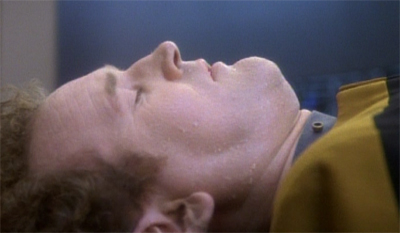
The writing's on the wall for Odo...

The writing’s on the wall for Odo…

Continue reading

Grant Morrison & Ian Gibson’s Avengers – Steed & Mrs. Peel (Review/Retrospective)

To celebrate the release of Thor: The Dark World towards the end of next month, we’ll be looking at some Thor and Avenger-related comics throughout September. Check back weekly for the latest reviews and retrospectives.

I feel a little bit cheeky describing this as “Grant Morrison’s Avengers.” After all, it’s this sort of confusion that led Disney to somewhat clumsily try to rebrand last year’s Avengers as Marvel’s Avengers Assemble in Ireland and the UK, afraid that easily-confused cinema-goers might be confused by the absence of the character my better half describes as “umbrella man”, while those more emersed in classic Britannia will recognise him as John Steed.

In fact, the comic was actually branded as Steed and Ms. Peel to avoid confusion, both in the original 1990 Eclipse miniseries and in the recent BOOM! studios reissue. That said, while legal matters prevent the release of a comic called “The Avengers”, BOOM! have hardly been shy about the original television show, with advertisements for Mark Waid’s recent revival teasing “the original Avengers” and “the original Hell Fire Club.” (Which is a little misleading itself, since the Hell Fire Club is actually a much older (real life) institution. Ah well.)

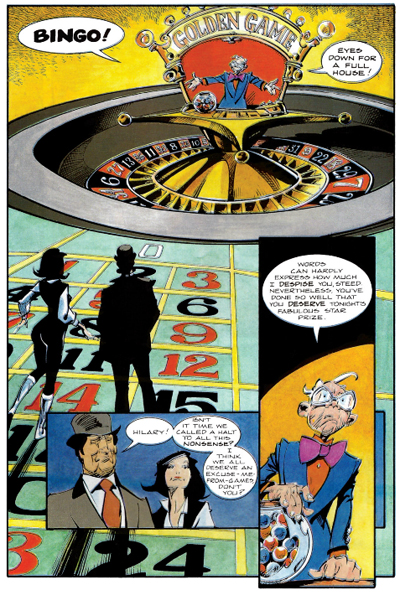
Still, Morrison and Gibson’s Steed & Mrs. Peel is a delightfully fun romp very much in the style of the original show. It is, by no means, the smartest or most essential of Morrison’s work – but it’s still clever and betrays an obvious affection for the source material.

Wheel of misfortune...

Wheel of misfortune…

Continue reading

Star Trek: Deep Space Nine – Prophecy & Change: Ha’Mara by Kevin G. Summers (Review)

Star Trek: Deep Space Nine is twenty years old this year. To celebrate, I’m taking a look at the first season. Check back daily for the latest review or retrospective.

We’ll be supplementing our coverage of the episodes with some additional materials – mainly novels and comics and films. This is one such entry.

Comparing and contrasting the anniversary short story anthologies for Star Trek: The Next Generation and Star Trek: Deep Space Nine can be highly informative. The Sky’s the Limit, released to celebrate the twentieth anniversary of The Next Generation, features fourteen stories. Most of these stories serve as prologues or epilogues to existing Next Generation episodes. Suicide Note provides closure to The Defector; Turncoats follows a character from Face of the Enemy after the camera stops rolling; Four Lights is an epilogue to Chain of Command.

In contrast, Prophecy and Change, released to celebrate the tenth anniversary of Deep Space Nine, tends to focus on short stories that fit gracefully between episodes – fleshing out connective tissue and explaining how one plot development or character decision led to another. That says quite a lot about the two shows and the way that their stories were told, with much of Prophecy and Change feeling ling deleted scenes or inserts loosely inserted between what was seen in television.

Ha’Mara is the first short story of the collection, following the introduction and the mysterious Revisited – a book-ending wrap-around written by an author who has yet to be publicly identified. Written by Kevin G. Summers, who provided Isolation Ward 4 to Strange New Worlds IV, the short story is set in the immediate aftermath of Emissary, attempting to smooth over the rough edges transitioning from the pilot to the rest of the show.

ds9-prophecyandchange

Continue reading

Star Trek: Deep Space Nine – Past Prologue (Review)

Star Trek: Deep Space Nine is twenty years old this year. To celebrate, I’m taking a look at the first season. Check back daily for the latest review or retrospective.

Past Prologue is a pretty decent second episode of Star Trek: Deep Space Nine. It does what it needs to do, serving primarily to build the world of Deep Space Nine just a little bit. After all, a story like this was inevitable with a character like Kira in the main cast, so it’s probably for the best that the show deals with it so early. It’s not a classic episode by any means, feeling as if the show was obligated to tell this particular story. Then again, I suppose that’s what the first season of any television show is for. Set up and development.

Past Prologue continues to hint at the strengths of Deep Space Nine, investing considerable effort in crafting a tangible setting for the series. However, there’s also a hint of the weaknesses of the first season to be found here. Like just about any of the Star Trek spin-offs, Deep Space Nine is going to spend its first year searching for its identity. While Past Prologue indicates the series is looking the right direction, it hasn’t quite found its footing.

Los cannon...

Los cannon…

Continue reading

Star Trek: Deep Space Nine – Emissary (Review)

Star Trek: Deep Space Nine is twenty years old this year. To celebrate, I’m taking a look at the first season. Check back daily for the latest review or retrospective.

Star Trek: Deep Space Nine is a phenomenal piece of television. It’s often a bit overlooked because of its unique setting. After all, the words Star Trek evoke space ships and new worlds – “new life forms and new civilisations.” As such, a Star Trek series about a space station feels counter-intuitive. “To boldly sit” is the hardly the most dynamic premise. And yet, despite that, there’s a very serious argument to be made that Deep Space Nine is the crowning accomplishment of television Star Trek. It’s certainly the last great attempt to boldly push the franchise forward, with Star Trek: Voyager and Star Trek: Enterprise feeling just a tad regressive and conservative in comparison.

Indeed, Deep Space Nine represents a massive narrative leap forward from the success of Star Trek: The Next Generation, which remains one of the greatest science-fiction shows ever produced. For better or worse, Emissary makes it quite clear that Deep Space Nine is not an attempt to copy its direct predecessor, even if some of the other episodes in the first season might back-pedal a bit. In fact, it’s surprising just how well the pilot for this strangest of Star Trek shows holds up, suggesting a firmer grasp of its own identity than a few of the subsequent episodes could claim.

A Commanding presence...

A Commanding presence…

Continue reading

Star Trek: Terok Nor – Day of the Vipers by James Swallow (Review)

Star Trek: Deep Space Nine is twenty years old this year. To celebrate, I’m taking a look at the first season. Check back daily for the latest review or retrospective.

We’ll be supplementing our coverage of the episodes with some additional materials – mainly novels and comics and films. This is one such entry.

Star Trek: Deep Space Nine comes with back story. A lot of back story. In fact, the opening scene of Emissary establishes the show in the context of The Best of Both Worlds, Part II, introducing a lead character whose tragic origin is rooted in an encounter that we had only fleetingly glimpse in Star Trek: The Next Generation. Due to the setting and nature of the show, history and continuity were major parts of Deep Space Nine‘s identity, and a large part of what set the show apart from its predecessors. (And successors, for that matter.)

Although the Klingons would dominate the show’s fourth season and remain a presence throughout the show’s run, and the Romulans might occasionally be glimpsed lurking in the back ground, the series largely focused on two alien races that had been introduced in The Next Generation. The Cardassians had been introduced in the show’s fourth season, in The Wounded, and the Bajorans first appeared during the fifth season in Ensign Ro.

Officially part of The Lost Era series of novels designed to flesh out the history of the shared Star Trek universe, the Terok Nor trilogy exists as a bridge into Emissary, something of an extended history lesson that contextualises the events of Deep Space Nine by providing an account of the Occupation of Bajor, an atrocity that only ended shortly before Emissary actually began.

teroknordayofthevipers1

Continue reading