• Following Us

  • Categories

  • Check out the Archives


  • Awards & Nominations

Agents of S.H.I.E.L.D – F.Z.Z.T. (Review)

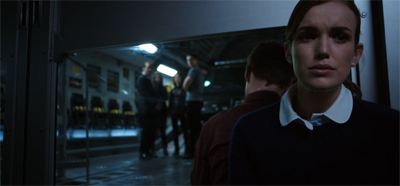
F.Z.Z.T. is a reminder that Agents of S.H.I.E.L.D. is a genre show still in its first season. That might not sound like a good thing, and F.Z.Z.T. isn’t the strongest of the mediocre crop of episodes so far, but it does indicate that there is still potential. The Girl in the Flower Dress teased the possibility that Agents of S.H.I.E.L.D. might have settled into its own incredibly unambitious niche, and any evidence to the contrary should be welcomed.

F.Z.Z.T. is boring and generic, but at least it’s boring and generic in a way that is different from most of the boring and generic episodes so far. So that’s something.

A Gemma of an idea...?

A Gemma of an idea…?

Continue reading

Doctor Who: Genesis of the Daleks (Review)

To celebrate the fiftieth anniversary of the longest-running science-fiction show in the world, I’ll be taking weekly looks at some of my own personal favourite stories and arcs, from the old and new series, with a view to encapsulating the sublime, the clever and the fiendishly odd of the BBC’s Doctor Who.

Genesis of the Daleks originally aired in 1975.

Genesis of the Daleks is a great little story, and a strong contender for the title of “best Dalek story ever.” It works because Terry Nation takes his creations “back to basics” – not only in terms of time period, but also in terms of basic principles. If the Daleks are the embodiment of total warfare, it makes perfect sense to return to the war that spawned them, giving us an insight into their creation, and the philosophy that launched these deadly xenophobes into the wider universe.

Face of evil...

Continue reading

Doctor Who: Series Four (or Thirty) (Review/Retrospective)

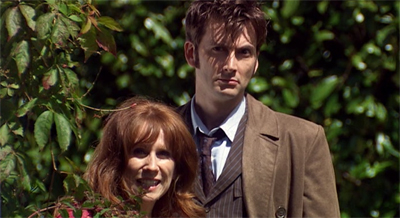
The fourth season of the revived Doctor Who is probably the most consistent of the seasons produced by Russell T. Davies. The first season had a very clear arc running through it, building to a fantastic final run of episodes; the second season had some strong individual elements, but suffered from a lot of behind-the-scenes shuffling; the third season suffered from a shoddy opening stretch, teething difficulties with the show’s first new companion lackluster finalé, despite some great ideas and wonderful experimental plotting.

While the fourth season is far from perfect, it does hang together a lot better than any of the previous three seasons. Watching from Partners in Crime through to Journey’s End, it definitely feels like Russell T. Davies had a stronger sense of where he wanted to go than he had with any of the previous three seasons. It helps that the past three seasons had been spent trying to acclimatise viewers to the workings of Doctor Who. The first season introduced the first Doctor and companion and the Daleks. The second introduced the first new Doctor and the Cybermen. The third introduced the first new companion and the Master.

doctorwho-theunicornandthewasp

So the fourth season is the first time that the show doesn’t really have too much of a mission statement. Unlike the Daleks or the Master or the Cybermen, nobody was really clamouring to see the Sontarans reinvented, let alone to reintroduce Davros. Like a lot of the foruth season, it seems like the show was really enjoying any freedom from a sense of obligation. The public knew what Doctor Who was. The rules and players had been set out, the past had been acknowledged and the show defined.

As such, the fourth season feels a lot more relaxed for everybody involved.

doctorwho-planetoftheood12

Continue reading

Doctor Who: Journey’s End (Review)

To celebrate the fiftieth anniversary of the longest-running science-fiction show in the world, I’ll be taking weekly looks at some of my own personal favourite stories and arcs, from the old and new series, with a view to encapsulating the sublime, the clever and the fiendishly odd of the BBC’s Doctor Who.

Journey’s End originally aired in 2008.

Stand witness, humans. Your strategies have failed, your weapons are useless, and… oh, the end of the universe has come.

– Davros, master of understatement

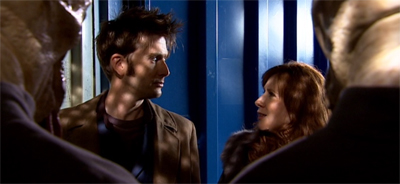
Journey’s End covers a lot of ground incredibly quickly. Even running one-and-a-half times the length of a regular episode, Journey’s End feels like it’s ready to burst at any given moment. Those who don’t like Davies’ finalés will find a lot to complain about here. The stakes are raised so high as to become almost abstract. The plot is written into a corner where it takes nothing short of a convenient deus ex machina to resolve it all. The Tenth Doctor and Rose are as annoying together as they have ever been, despite both being quite awesome apart.

However, if you’re looking at The Stolen Earth and Journey’s End as a story, you’re missing the point. The real news is that this was a crowning accomplishment for the series. Not only did The Stolen Earth and Journey’s End both pull a record high Appreciation Index of 91, Journey’s End edged out East Enders and Coronation Street to become the most-watched show on British television that week. This was the first time that Doctor Who had accomplished this since it came back.
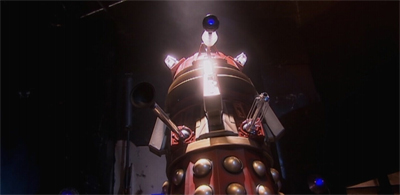
The Daleks' master plan...

The Daleks’ master plan…

The only comparable accomplishment in the history of the show is City of Death scoring the show’s highest ever ratings. And that only happened because an ITV strike made it quite difficult for anybody to watch anything else at the time. So, no matter how you cut it, Journey’s End is a phenomenal piece of event television, one that really solidifies the importance of the resurrected Doctor Who in British popular consciousness.

In a very real way, the title feels somewhat apt. The long journey of Doctor Who from a failed science-fiction show in the wilderness to a crown jewel in British television was finally over.
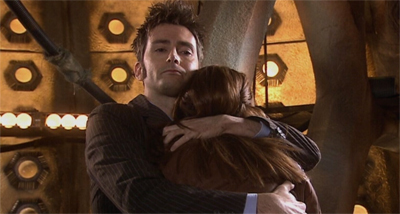
It's been a hell of a ride...

It’s been a hell of a ride…

Continue reading

Non-Review Review: Carrie (2013)

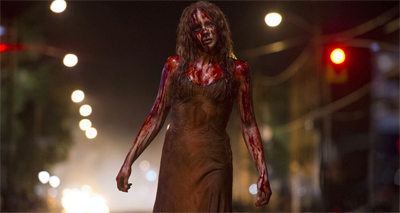
Carrie is, for the first half of its runtime, a fairly effective attempt to update Stephen King’s iconic high school horror story about religious repression and teenage issues. While Chloë Grace Moretz isn’t quite as memorable and quite as nuanced as Sissy Spacek was in Brian De Palma’s much-loved original adaptation, she gives a strong central performance. However, the film falls apart a bit as it enters the second half, turning into a large-scale action set piece that feels more like a superhero disaster movie than a psychological teen horror.

There will be blood...

There will be blood…

Continue reading

Doctor Who: The Stolen Earth (Review)

To celebrate the fiftieth anniversary of the longest-running science-fiction show in the world, I’ll be taking weekly looks at some of my own personal favourite stories and arcs, from the old and new series, with a view to encapsulating the sublime, the clever and the fiendishly odd of the BBC’s Doctor Who.

The Stolen Earth originally aired in 2008.

Someone tried to move the Earth once before. Long time ago. Can’t be.

– the Doctor reminds us that just because the Daleks are threatening doesn’t mean they aren’t completely insane

The Stolen Earth and Journey’s End are not, by any stretch of imagination, tightly-constructed episodes. They don’t represent the pinnacle of the Davies era from any technical or production standpoint. The story logic is questionable at best, and Davies’ primary concern seems to be keeping the script moving fast enough that the plot holes and illogical narrative loose ends never overwhelm the production. It is basically the most bombastic and large-scale season finalé of the Davies era. And given that it’s measured against The Parting of the WaysDoomsday and The Last of the Time Lords, that’s really saying something.

And yet, despite that, I have a strange affection for this season finalé. It’s an excuse for Davies to really bask in the success of the revitalised Doctor Who, creating a plot that draws together all manner of disparate elements into one gigantic tribute to the past four years of Doctor Who. It’s hard to hate, on those grounds alone.

An explosive finalé...

An explosive finalé…

Continue reading

Jameson Cult Film Club Presents Predator! Tuesday 19th November 2013!

Due to unprecedented demand, the Jameson Cult Film Club is returning to Dublin for a special 25th anniversary screening of the 1987 classic, PREDATOR. Continuing on from this year’s successful screenings of Die Hard, Intermission and LA Confidential, the Jameson Cult Film Club promises to transport the audience right into the world of this high suspense, sci-fi thriller at a secret Dublin location on Tuesday 19th November 2013.

Jameson Cult Film Club screening of Predator - 17.11.13

Continue reading

Non-Review Review: Parkland

There are few moments that hold as much sway over American popular consciousness as the assassination of President John Fitzgerald Kennedy. Perhaps only the moon landing or the news footage of the 9/11 attacks could compete from the last half-century of history. The assassination and its aftermath have been discussed and reconsidered countless times in the decades since those shots rang out in Dallas. There are those who continue to believe in some sinister conspiracy, while others seem to accept the probability that the nation was rocked by the actions of a single disturbed individual.

Parkland offers relatively little to the discussion, focusing on the stories unfolding around the assassination and the lives that intersect with the famous historical figures who pass through the narrative. While it’s a nice idea in practice, these sorts of historical ensemble pieces can be tricky, as Bobby demonstrated rather recently. There’s a sense that even some of these characters who find themselves caught up in events larger than themselves have become figures of interest themselves, and a scant 93 minutes isn’t enough to peel back any layers or reveal anything particularly insightful.

Sadly, the characters are not as well developed...

Sadly, the characters are not as well developed…

Continue reading

Doctor Who: Turn Left (Review)

To celebrate the fiftieth anniversary of the longest-running science-fiction show in the world, I’ll be taking weekly looks at some of my own personal favourite stories and arcs, from the old and new series, with a view to encapsulating the sublime, the clever and the fiendishly odd of the BBC’s Doctor Who.

Turn Left originally aired in 2008.

You said I was going to die, but you mean this whole world is going to blink out of existence. But that’s not dying, because a better world takes its place. The Doctor’s world. And I’m still alive. That’s right, isn’t it? I don’t die. If I change things, I don’t die. That’s that’s right, isn’t it?

– poor Donna… poor, poor Donna

The fourth season is basically one gigantic victory lap for Russell T. Davies’ Doctor Who. Davies has done the hard work of returning the show to television. He’s made the Daleks threatening. He’s rebooted the Cybermen. He’s made the Master sexy again. The fourth season is really just about enjoying the success of the show, and using that success to do crazy things like bringing back the Sontarans or Davros. Because nobody was clamouring for another Sontaran or Davros story.

That sense of celebration is probably most obvious in Turn Left, the penultimate story of the fourth season. It’s basically It’s a Wonderful Life, starring the Tenth Doctor. Or, to be more accurate, It’s a Wonderful Life for the new series of Doctor Who. It’s an excuse to celebrate a raft of continuity from The Runaway Bride through to The Sontaran Stratagem, to bring back Billie Piper and just to celebrate not only the wonder of Doctor Who, but the virtue of Davies’ approach to the series.

Everything goes up in smoke...

Everything goes up in smoke…

Continue reading

The X-Files – Season 1 (Review)

Trying to appraise the first season of any show is quite different from judging any other season. While all subsequent seasons have some measure of continuity to build off, some experience to guide the cast and crew, some familiarity to play into or away from, the first season literally starts with nothing. Even when there’s a sizeable gap between the production of the pilot and the start of work on the series proper (with over a year between the filming of The Pilot and Deep Throat), there’s still a sense we’re watching the production team settle into their roles.

All of this is a round-about way of saying that the first season of The X-Files is not a great season of television, judged on its own merits. It’s certainly not the strongest season of the show, which would go from strength-to-strength over the next three years, while also having an ambitious (if not entirely successful) fifth season. The first season of The X-Files is probably the weakest of the first five years of the show, but to express it in those terms is to miss the point.

The first season does a pretty great job laying the ground rules for the franchise, and offers a pretty solid indication of the talent involved in the show, if they can figure out what they want to do. (With quite a few episodes serving as examples of what the show doesn’t want to do.)

xfiles-deepthroat7

Continue reading