• Following Us

  • Categories

  • Check out the Archives


  • Awards & Nominations

The X-Files – Travelers (Review)

This May and June, we’re taking a trip back in time to review the fifth season of The X-Files and the second season of Millennium.

For all that the fifth season of The X-Files is building towards a major summer movie release, the production team seem surprisingly relaxed about it.

The fifth season is as experimental and as loose as the show ever got. Patient X and The Red and the Black suggested that Chris Carter didn’t even feel beholden to the continuity of The X-Files: Fight the Future, introducing new characters and concepts to the mythology that could not possibly be inserted into the film at this late stage. Similarly, the show was willing to play around with special guest writers like Stephen King and William Gibson, film an entire episode in black and white, focus on relatively minor characters, and reveal two separate secret histories of the X-files.

What do you call a baby Fox?

What do you call a baby Fox?

Of course, some of these innovations were driven by necessity or large goals. Patient X and The Red and the Black represent the beginning of the end for this stage of the mythology. Stories like Unusual Suspects and Travelers focus on characters other than Mulder or Scully because David Duchovny and Gillian Anderson were otherwise engaged. Nevertheless, there is a very relaxed vibe to the fifth season, as if the show is taking an extended moment to enjoy the peak of its popularity. As well it should.

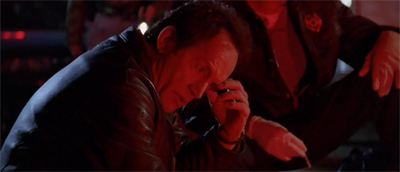
Travelers is an episode that is far from essential in many respects. It is clunky in places, indulgent in others. It feels like the production teams are just happy to root through the old costuming wardrobe and prop departments, delighted to compose over-written monologues and stock characters. Travelers is light and fun, with its indulgence and its relative lack of substance making it more enjoyable than it would otherwise be.

He'll (Garret Dilla)hunt you down...

He’ll (Garret Dilla)hunt you down…

Continue reading

Millennium – Siren (Review)

This May and June, we’re taking a trip back in time to review the fifth season of The X-Files and the second season of Millennium.

Even when the second season of Millennium doesn’t quite work, it remains a fascinating piece of television.

Siren is the last script written by Glen Morgan and James Wong before they drafted the two-part second season finalé, The Fourth Horseman and The Time is Now. The duo wrote a phenomenal stretch of the second season. They wrote six of the first eight episodes to air; Siren ends another run of four episodes credited to the duo in the middle of the season. Including the two-part finalé, the pair wrote twelve of the season’s twenty-three episodes. That is a phenomenal workload, even discounting the work of producing and re-writing the other eleven teleplays.

Where's your head at?

Where’s your head at?

Given that the duo were writing what amounts to a full-season order for some modern shows, and producing similar volume of episodes, it seems inevitable that one of their episodes would have to slip. Siren is mess. The script feels like it was stitched together from two different story ideas – each of which might have sustained its own intriguing forty-five minute episode. However, cramming both of those ideas into a single script means that neither feels as developed or as explored as it might be.

At the same time, the careful structuring of the season makes it quite what Siren is trying to do. There are a wealth of interesting ideas here that very clearly and very logically serve the larger arc of the second season. However, it often feels like this weight derives not from Siren itself, but from the outline of Siren created when all the other episodes in the season click together.

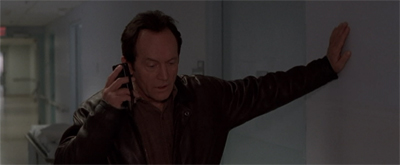
Hear him out...

Hear him out…

Continue reading

Millennium – Roosters (Review)

This May and June, we’re taking a trip back in time to review the fifth season of The X-Files and the second season of Millennium.

Then Peter remembered the word Jesus had spoken: “Before the rooster crows, you will disown me three times.” And he went outside and wept bitterly.

– Matthew 26:72

Everything is in runes...

Everything is in runes…

Continue reading

Non-Review Review: Jurassic World

Jurassic World is very self-aware.

Introducing visitors to the eponymous theme park, an audio recording assures them that the elevated train is passing through the original gates of the park. One of the techies working in the operations centre wears a “vintage” t-shirt from the original park – conceding that it might be “in poor taste.” Nostalgia is the name of the game, and the theme park basks in it. There are landmarks built to the amber that held the mosquito from the original film, and a giant bronze statue of Richard Hammond.

"Mommy's being blatantly emulated..."

“Mommy’s being blatantly emulated…”

So does the film. No opportunity for shout-out or homage is missed. When John Williams returned to work on Jurassic Park: The Lost World, he only broken out the powerful theme for very special moments – crafting a largely original score for the sequel. Not Jurassic World. It seems like every time a character does something, the theme blares. Open the gates? Theme blares! Drive through herd of dinosaurs? Theme blares! Open doors to balcony in resort room? Theme blares!

There is something relentlessly cynical about Jurassic World. The film is based around attempts at Ingen to build a designer dinosaur, one assembled from random bits of other dinosaurs. Nobody except the geneticists seem to know exactly what’s in it, but it doesn’t matter. It’s bits and pieces of what everybody’s seen before, and they’ll love it, right? The fact that Jurassic World basks in this meta-commentary hints at a sly subversive streak, but they film seems more smug than sophisticated.

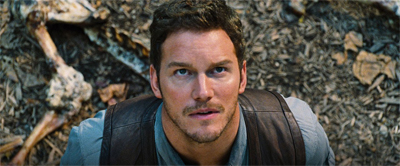
Feeding time...

Feeding time…

Continue reading

The X-Files: Season One (Topps) #6 – Space (Review)

This May and June, we’re taking a trip back in time to review the fifth season of The X-Files and the second season of Millennium.

If the jump to Ice suggested that the Season One line would only be covering the “highlights” of the first season of The X-Files, then the decision to immediately follow with an adaptation of Space puts paid to that theory.

Ice is generally regarded as one of the strongest stories of the first season. It is moody and atmospheric, tense and claustrophobic. It shines a light on the characterisation of Mulder and Scully, while also offering a particularly memorable (and unsettling) monster of the week. In contrast, Space is generally regarded as one of the weakest stories of the first season. It is clumsy and muddled, slow and dreary. The episode’s direction is bland and the special effects are woeful. On paper, it is probably the least likely choice for a Season One adaptation.

Face the future...

Face the future…

However, Space ultimately lends itself to a comic book adaptation. The story finds itself well-suited by the transition from live action footage to comic book page. there are a number of different reasons for this, but the truth is that the story is simply better suited to this format. That applies to the technical limitations imposed on film, but also to the storytelling conventions associated with comic books as opposed to live action television. It is a startling result, and arguably the biggest success of the entire Season One line.

Although it is a qualified accomplishment at best, Space is the first Season One comic that manages to surpass its source material.

Is there life on Mars?

Is there life on Mars?

Continue reading

The X-Files – The Red and the Black (Review)

This May and June, we’re taking a trip back in time to review the fifth season of The X-Files and the second season of Millennium.

“Before the exploration of space, of the moon and the planets, man hailed that the heavens were the home and province of powerful gods who controlled not just the vast firmament, but the earthly fate of man himself and that the pantheon of powerful, warring deities, was the cause and reason for the human condition, for the past and the future, and for which great monuments would be created on earth as in heaven. But in time man replaced these gods with new gods and new religions that provided no more certain or greater answers than those worshipped by his Greek or Roman or Egyptian ancestors. And while we’ve chosen now our monolithic and benevolent gods and found our certainties in science, believers all, we wait for a sign, a revelation. Our eyes turn skyward ready to accept the truly incredible to find our destiny written in the stars.”

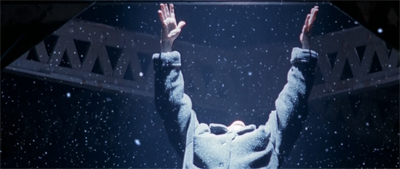
Lift me up...

Lift me up…

Continue reading

Non-Review Review: Mr. Holmes

Memory is a tricky thing, particularly as distinct from history. History often occurs as a sequence of events, a laundry list and cause and effect and happenstance. Memory is the chord that we use to tie that all together, the narrative that we weave through these isolated events. Mr. Holmes is an exploration of the gulf as it exists between the two concepts, following an ageing Sherlock Holmes as he attempts to piece together his own faded memory from facts and evidence scattered around.

Adapted from Mitch Cullin’s A Slight Trick of the Mind, writer Jeffrey Hatcher and director Bill Condon position Holmes’ famous deductive prowess as a clever metaphor. Holmes’ ability to effortless build random strands of information into cohesive theories and explanations is set against two rather unconventional targets. As his faculties begin to fail him, Holmes tries to reconstruct memory from the few details available to him. At the same time, Holmes struggles with his own difficulties understanding human nature as it exists beneath these subtle hints and clues.

Holmes for Summer...

Private investigations.

Although the publication of A Slight Trick of the Mind predates the development of Steven Moffat and Mark Gatiss’ cult adaptation Sherlock, there is considerable thematic overlap between both stories. As with the BBC series, it seems like the Sherlock Holmes of Mr. Holmes is more concerned with the mystery that is other people than with any individual case. The result is a surprisingly (and effectively) low key film that plays more as a meditation on the human condition than as a convention Sherlock Holmes mystery.

There are points where Mr. Holmes does feel a little too heavy-handed or a little too manipulative in its exploration of the eponymous character. However, Condon very clever grounds the film in a beautifully vulnerable central performance from Ian McKellen.

The long walk Holmes...

The long walk Holmes…

Continue reading

Millennium – Owls (Review)

This May and June, we’re taking a trip back in time to review the fifth season of The X-Files and the second season of Millennium.

I am like a pelican of the wilderness; I am become as an owl of the waste places.

– Psalm 102:6

Birds of prey...

Birds of prey…

Continue reading

The X-Files (Topps) – Ground Zero #1-4 (Review)

This May and June, we’re taking a trip back in time to review the fifth season of The X-Files and the second season of Millennium.

Ground Zero offers an indication of just how much success Topps was enjoying with their line of licensed X-Files comic books.

The monthly series was still being published, and Season One was on a bimonthly schedule. Both books had stable creative teams, and there was no indication that they were likely to wrap up any time soon. Of course, Topps would pull of the comic book market in late 1998, but there was no indication that they considered their X-Files line to be anything other than a complete success. As such, it made sense to expand the line. After all, the company had already used the brand to sell annuals and digests.

Eye see all...

Eye see all…

However, there was reportedly a considerable amount of friction between Topps and Ten Thirteen over the comic book line. Ten Thirteen was reportedly quite firm in what they would and would not allow to be published. Writers John Rozum and Stefan Petrucha have talked about how difficult it was to get their scripts published for the monthly series. It seems that Topps was eager to work around these restrictions. It is telling that neither Season One nor Ground Zero were original concepts; they were adaptations of ideas and stories Ten Thirteen had already approved.

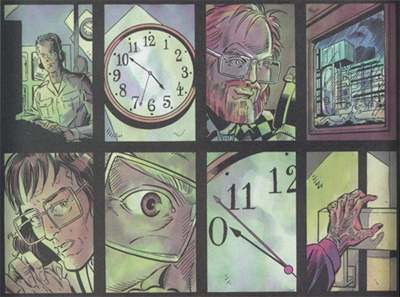
Ground Zero is written by veteran tie-in author Kevin J. Anderson. Anderson had already written a number of popular X-Files tie-in books and had provided a fill-in arc on the monthly comic book with Family Portrait. The artwork for Ground Zero is provided by Gordon Purcell, one of the best likeness artists in the business. Publishing a four-issue adaptation of a tie-in novel is the very definition of a “safe” choice to expand the line, and only illustrates some of the wasted opportunities towards the end of Topps’ stewardship of the license.

Doomsday clock...

Doomsday clock…

Continue reading

The X-Files – Patient X (Review)

This May and June, we’re taking a trip back in time to review the fifth season of The X-Files and the second season of Millennium.

This should not work.

There are lots of reasons why Patient X and The Red and the Black should simply implode under their own weight. Most obviously, they are scripts that are rather blatantly just piling more and more back story and convolution onto a framework that is already overloaded and over-stretched. They are introducing new characters at a late stage of the game. They rely on contrivance and sketchy character development. They seem to exist at odds with the script for The X-Files: Fight the Future, which had been written and shot, but was awaiting release.

Everything burns...

Everything burns…

However, despite all this, Patient X and The Red and the Black work very well together. They are the strongest story-driven mythology two-parter since Nisei and 731 at the start of the third season. There is an energy and drive to Patient X and The Red and the Black that has been largely absent from the show’s big blockbuster two-parters since Herrenvolk at the start of the fourth season. After a year-and-a-half treading water as the release date of the movie draws ever closer, it is nice to see Chris Carter cut completely loose.

Patient X and The Red and the Black form a story which doesn’t seem at all worried about what any of this means for the summer realise of Fight the Future. Parts of it become quite difficult to reconcile with the film as released. However, the two-parter is all the stronger for it.

Fog of war...

Fog of war…

Continue reading