• Following Us

  • Categories

  • Check out the Archives


  • Awards & Nominations

Star Trek: Voyager – Barge of the Dead (Review)

There is some small symmetry in Barge of the Dead.

When Bryan Fuller first pitched to Star Trek, he pitched to Star Trek: Deep Space Nine. The first idea that he sold was The Darkness and the Light, which felt like something approaching a gothic serial killer horror about a deformed killer stalking his victims using the franchise’s hyper-advanced technology. That original idea was heavily re-written by franchise veteran Ronald D. Moore, who also brought a more substantial thematic weight to the story by focusing on themes of violence and retribution.

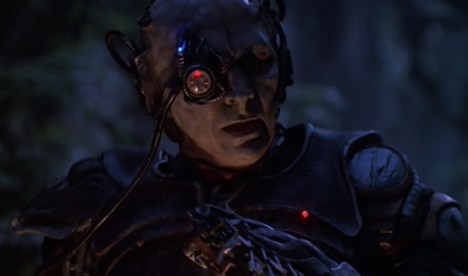
Barging in.

In contrast, Barge of the Dead is the last television story that Ronald D. Moore would pitch for the franchise, coming at the very end of his time on Star Trek: Voyager. The episode has its roots in an earlier pitch by the writer, the original idea for Soldiers of the Empire. However, Moore would depart the franchise before he could finish work on Barge of the Dead, and so the writing of the script fell to Bryan Fuller. Much like Moore had subtly shifted the emphasis of The Darkness and the Light to his own thematic interests, Fuller embraces his own sensibilities in reworking Barge of the Dead.

Moore had re-written Fuller’s last story, and Fuller would re-write Moore’s last story. There is some sense of poetry in this.
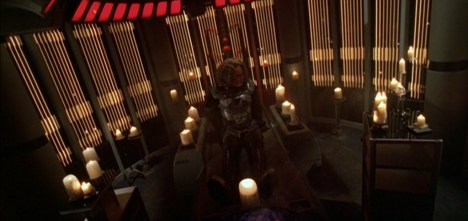
Tom’s idea of a romantic evening certainly needed some work.

Continue reading

Star Trek: Voyager – Survival Instinct (Review)

Survival Instinct marks the beginning and the end of Ronald D. Moore’s involvement with Star Trek: Voyager.

Moore had been one of the most influential writers on Star Trek: The Next Generation and Star Trek: Deep Space Nine. Moore had famously been drafted into the Star Trek franchise with no outside experience; The Bonding was based upon a speculative script that he wrote, and he had been invited to join the staff when The Defector proved that he was not a one-script wonder. Moore had inspired producer Michael Piller to open the franchise to speculative scripts, a decision which led to the recruitment of writers like Bryan Fuller and Rene Echevarria.

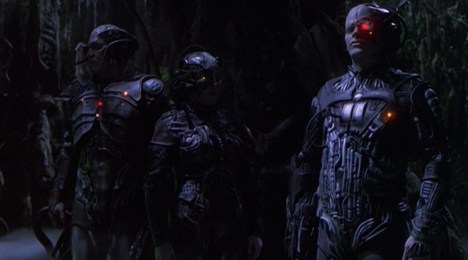
Drone warfare.

Moore had consistently pushed the envelope in terms of what Star Trek could be. Several of Moore’s scripts feel like trailblazers, expanding the storytelling language of an established science-fiction franchise; the Klingon-centric script for Sins of the Father, the quieter character drama of Family, the epic scale of Redemption, Part I and Redemption, Part II. Paired with Ira Steven Behr on Deep Space Nine, Moore really pushed the boundaries of what Star Trek could be; Soldiers of the Empire looked at life on a Klingon ship, In the Pale Moonlight stretched (and maybe broke) Star Trek morality.

All of the other writers on Deep Space Nine chose to bow out gracefully with What You Leave Behind, to part ways with the franchise having provided their own unique take on the Star Trek mythos. However, Moore was convinced to migrate across from Deep Space Nine to Voyager. There are any number of reasons why Moore might have chosen to stay when writers like Behr and Echevarria chose to take their exit; Moore was the longest continuous-serving writer on the Star Trek franchise to that point. In terms of second-generation Star Trek, only Rick Berman could have claimed to have a deeper impression.

Armed and dangerous.

Moore arrived on the sixth season of Voyager and immediately looked to make his mark. Like Brannon Braga, Moore had always been an extremely productive Star Trek writer. He was typically credited on six or seven scripts in a season of The Next Generation and Voyager, while also scripting Star Trek: Generations and Star Trek: First Contact. Although not credited on the script, Moore was actively involved in the back-and-forth over the script to Equinox, Part II. He scripted the second episode, Survival Instinct. He was working on the story to third, Barge of the Dead.

And then the unthinkable happened. Like so much of Voyager, Moore’s arrival proved to be something of a false dawn. In early July 1999, Ronald D. Moore left Star Trek. This was within a month of the broadcast of What You Leave Behind, and nearly three months before the premier of the sixth season of Voyager. Even before Moore and Braga elaborated upon the particulars of what had happened, it was clear that something had gone disastrously wrong.

What We Left Behind.

Continue reading

Star Trek: Voyager – Equinox, Part II (Review)

Equinox, Part II works worse than it should.

Equinox, Part II is undercut by three key factors. The most obvious is the premise itself. Equinox, Part I and Equinox, Part II tell a story that is baked into the DNA of Star Trek: Voyager, but there is a sense that the production lacks the will to tell that story. Secondly, Equinox, Part I and Equinox, Part II struggle with consistent characterisation and clear narrative arcs. The third factor is a sense of inevitability, with Equinox, Part I and Equinox, Part II feeling like they reveal nothing insightful about Voyager before concluding, and that the show will no lasting impact.

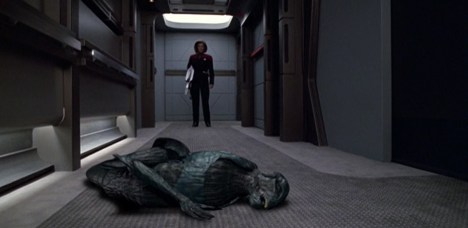
Fish out of fluidic space.

These three factors squander a lot of raw potential. Equinox, Part II is telling a story that feels essential to Voyager, a story that the franchise arguably should have been telling immediately after Caretaker. This season premiere represents the chance for Voyager to have a full and frank discussion with itself, particularly in the context of its sixth season. Star Trek: Deep Space Nine had concluded at the end of its seventh season. For the first time in its run, Voyager was the only Star Trek series on television. This was the perfect opportunity for introspection.

Equinox, Part II is an episode that fails to deliver upon a fantastic opportunity.

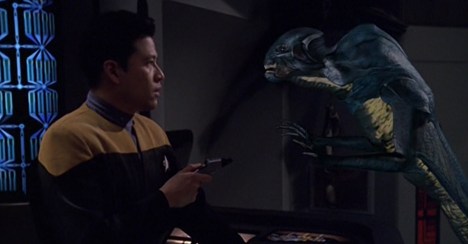
“What are you looking at?”

Continue reading

New Podcast! Primitive Culture #19 – Star Trek: Voyager, History and Nostalgia

Over the Christmas Break, I had the pleasure of sitting down with the wonderful Duncan Barrett and talking about Star Trek: Voyager. Duncan is a historian, and I’ve had the pleasure of quoting some of his work on the blog in the past. He hosts Primitive Culture, with Tony Black and Clara Cook, a show wherein the hosts discuss certain historical-related items of interest in the Star Trek canon.

Duncan was in Ireland for part of the break, and so we took the opportunity to have a sit down to talk about the unique approach that Voyager had to the ideas of history and nostalgia within the Star Trek canon, how it viewed both the past and the future. We particularly focused on episodes like Distant Origin and Living Witness, along with a broad discussion of particular themes. It was a fun discussion, and you can listen to it below or directly via Primitive Culture‘s homepage on trek.fm.

Star Trek: Voyager – Season 5 (Review)

It is hard to discern a central arc or purpose to the fifth season of Star Trek: Voyager.

There are certainly recurring preoccupations and ideas simmering through the twenty-six episodes of the fifth season, reflecting the interests of the creative team. Indeed, many of these themes culminate in Equinox, Part I, the fifth season finale. However, there is never a sense that any of these ideas are being assembled in service of anything, never a sense of what exactly the production team want to say about these themes or where they want to go with these concepts.

The fifth season of Voyager feels rather listless. This may be due to a combination of factors. Most obviously, the fourth season of Voyager was arguably the show’s best season, one marked by a sense of purpose and forward momentum. Thanks to the introduction of Seven of Nine and the miniature arc focusing on the Hirogen, along with the clever bookending of Scorpion, Part II with Hope and Fear, there was a sense that the fourth season of Voyager had ended in a different place than it began.

The big issue with the fifth season of Voyager is that it feels like the series is running in place.

Continue reading

Star Trek: Voyager – Equinox, Part I (Review)

Equinox, Part I works better than it should.

Equinox, Part I is sustained by three important factors. The most obvious is the premise itself. Equinox, Part I and Equinox, Part II tell a story that is baked into the DNA of Star Trek: Voyager, and it is surprising that it took the production team five years to tell it. Secondly, Equinox, Part I and Equinox, Part II have the luxury of a fantastic supporting cast with John Savage and Titus Welliver playing the two most senior officers on the eponymous ship. The third factor is a sense of momentum, with Equinox, Part I and Equinox, Part II moving at a tremendous pace.

A Captain’s Ransom.

These three factors compensate for a lot of potential flaws. Equinox, Part I is an episode of television that spends forty-five minutes consciously building towards its cliffhanger. There is nothing wrong with this approach. Many of the best Star Trek cliffhangers, especially season finales, are structured as relentless build-up. The Best of Both Worlds, Part I builds to Picard’s assimilation and Riker’s command. Call to Arms builds to the Dominion retaking the station and war being declared. Equinox, Part I builds to the reveal of what Rudolph Ransom did.

Equinox, Part I is an episode that works as sheer and unrelenting build-up.

Too many captains.

Continue reading

Star Trek: Voyager – Relativity (Review)

Relativity is perhaps the most Star Trek: Voyager episode that ever Star Trek: Voyaged.

Of course, there are better episodes of Voyager. Of course, there are episodes of Voyager that more effectively showcase the cast and the premise. Of course, there are episodes of Voyager that do a lot of things that Relativity does, only better. However, there is a sense the episode’s crushing mediocrity is a large part of what makes it so indicative of the show as a whole. Those other stronger episodes stand out from the crowd, and rank among some of the best episodes that Voyager ever produced. In contrast, Relativity is just kinda… there.

Ship of the line.

Relativity clearly belongs to the familiar Voyager subgenre of “timey wimey” action adventures that include epics like Future’s End, Part I and Future’s End, Part II, Year of Hell, Part I and Year of Hell, Part II and Timeless. In fact, the subgenre could be extended to include The Killing Game, Part I and The Killing Game, Part II, even if no literal time travel takes place. Relativity also borrows from the “let’s blow Voyager up!” school of plotting that includes Deadlock and Course: Oblivion. The episode also leans on the “reset” button that has been in integral part of Voyager dating back to Time and Again.

There is a sense that Relativity is a heady cocktail of Voyager storytelling tropes, a reiteration of many stock storytelling elements that have been employed in a variety of important and notable episodes earlier in the run. However, these episodes count among the finest example of Voyager‘s blockbuster storytelling. Relativity is most notable for taking all of these bombastic larger-than-life elements and finding a way to integrate them into a rather lifeless and stale piece of television. In this sense, Relativity is a quintessential Voyager episode.

Keeping those balls in the air.

Continue reading

Star Trek: Voyager – 11:59 (Review)

The thing about experiments is that they don’t always work, but that doesn’t mean they should never be attempted.

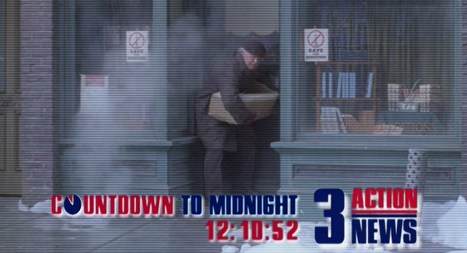
Much like Someone to Watch Over Me, 11:59 represents a new departure for Star Trek: Voyager. It is an episode unlike any other episode in the run of series, unfolding primarily on early twenty-first (or, as one character wryly points out, maybe late twentieth) century Earth. As with Someone to Watch Over Me, there is a sense that 11:59‘s closest spiritual companion is an episode of Star Trek: Deep Space Nine. There are any number of superficial similarities between 11:59 and Far Beyond the Stars, another time-travel-to-close-to-modern-day-Earth-episode-without-the-time-travel.

Countdown.

Sadly, the experiment does not quite work out. Someone to Watch Over Me is one of the most charming episodes in the seven-season run of Voyager, while 11:59 is more than a little dull. Far Beyond the Stars is one of the most powerful and evocative episodes of Star Trek ever produced, while 11:59 is a competent piece of television that is almost immediately dated. For all that 11:59 represents a bold departure for Voyager, there is a sense that the episode has very little to actually say. It exists, but it never seems to exist for a particular reason. 11:59 is a frustrating piece of television.

However, none of this matters too much. Voyager has been such a safe and conservative show that any creative risk feels worthwhile, that any departure from the established template feels worth of celebration on those terms alone. 11:59 is an unsuccessful experiment, but it is an experiment nonetheless. For a series as risk-adverse as Voyager, that is remarkable.

“Time’s up.”

Continue reading

Star Trek: Voyager – Someone to Watch Over Me (Review)

Someone to Watch Over Me is a decidedly atypical episode of Star Trek: Voyager.

The episode’s subplot, focusing on Neelix and a disorderly alien ambassador, harks back to the old diplomacy subplots of Star Trek and Star Trek: The Next Generation, when the crews would be asked to ferry ambassadors around only for terrible things to happen. There are any number of examples of that story template across the two earliest incarnations of the show; Journey to BabelElaan of Troyius, Is There in Truth No Beauty?Lonely Among UsLoud as a Whisper, SarekThe PriceMan of the PeopleData’s DayViolationsLiaisons.

The EMH rose to the occasion.

To be fair, Voyager has done a couple of these episodes before. There are a number of episodes in which the ship acts as a diplomatic courier shipping aliens from one destination to another or welcoming on board representatives of an alien culture; the subplot of Innocence comes to mind, as does the set-up of Remember. However, by and large, these diplomacy-driven subplots are a lot less frequent on Voyager than they were on the original Star Trek or The Next Generation. As such, the Neelix subplot feels very much like a throwback.

However, the primary plot of Someone to Watch Over Me feels very much like an episode of Star Trek: Deep Space Nine, an intimate romantic character study about an attraction between two individuals. Someone to Watch Over Me is very much an archetypal love story, one without the flavour of adventure or stakes defines other Star Trek romances like Captain’s Holiday or Counterpoint or Gravity. This is a low-stakes interpersonal attraction, very much in the style of Looking for Par’Mach In All the Wrong Places, His Way or Chrysalis.

A snap decision.

In fact, the basic plot of Someone to Watch Over Me is so archetypal that it can be traced back to number of classical inspirations. This is nothing new. The Star Trek franchise has long borrowed inspiration from various classics; Favourite Son and Bliss owe a great deal to The Odyssey and Moby Dick, for example. However, the choice of influences on Someone to Watch Over Me feels more like Deep Space Nine than Voyager; it draws from Pygmalion and its various adaptations, along with the early eighties comedy My Favourite Year.

The result is a decidedly strange blend of classic Star Trek storytelling that feels fresh and exciting in the context of Voyager. In many ways, Juggernaut was a showcase of Voyager‘s preference for blockbuster plot-driven storytelling. However, Someone to Watch Over Me is something much more compelling and intriguing. Someone to Watch Over Me is a character-driven episode of Voyager, and a very impressive and engaging one at that.

Putting the “ass” in ambassador.

Continue reading

Star Trek: Voyager – Juggernaut (Review)

Juggernaut is not a great episode of television.

The episode has any number of key problems. Most obviously, the episode illustrates how little the character of B’Elanna Torres has actually grown since Parallax, without even pausing to acknowledge everything that has happened in between in episodes like Extreme Risk. More than that, the episode’s core themes are undermined by an incredibly cynical conclusion that might work in the context of a larger character arc, but which doesn’t work when rooted in the series’ episodic approach to storytelling.

Calm under pressure.

However, in spite of all these fundamental flaws that hobble Juggernaut as a piece of television narrative, there is quite a lot to like here. This is very pointed a big “action” story told in blockbuster mode, evoking episodes like Timeless. It is all about broad strokes, ticking clocks and epic stakes. Juggernaut is fundamentally a runaway train story crossed with The Phantom of the Opera, which is almost perfectly within the show’s comfort zone. More than that, Juggernaut actually figures out how to do something vaguely interesting with the Malon before they disappear.

Juggernaut is a highly enjoyable episode of Star Trek: Voyager.

Here there be monsters…

Continue reading