• Following Us

  • Categories

  • Check out the Archives


  • Awards & Nominations

Star Trek: Voyager – The Killing Game, Part I (Review)

In some ways, The Killing Game, Part I and The Killing Game, Part II feel like a perfect companion piece to Year of Hell, Part I and Year of Hell, Part II.

As with Future’s End, Part I and Future’s End, Part II during the third season, these two two-part episodes are very much larger-than-life archetypal Star Trek storytelling. While Future’s End, Part I and Future’s End, Part II riffed on Star Trek IV: The Voyager Home, and Year of Hell, Part I and Year of Hell, Part II borrowed liberally from Star Trek II: The Wrath of Khan, The Killing Game, Part I and The Killing Game, Part II draw from a broader pool of franchise iconography for a Star Trek: Voyager spectacular.
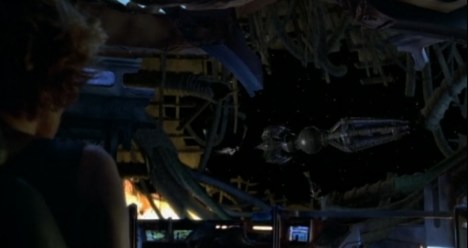
A cut above.

As with Future’s End, Part I and Future’s End, Part II or Year of Hell, Part I and Year of Hell, Part II, The Killing Game, Part I and The Killing Game, Part II are very much concerned with themes of memory and history. Much like Henry Starling or Annorax, the Hirogen are presented as villains waging a war upon history. They have no history or culture, usurping that of the crew and distorting it to serve their own whims and desires. Of course, The Killing Game, Part I and The Killing Game, Part II features no literal time travel, merely holographic.

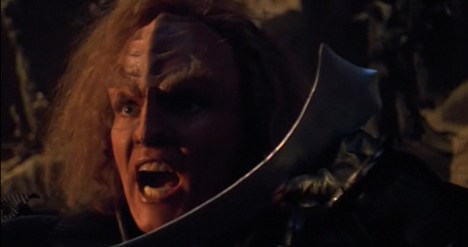
However, The Killing Game, Part I and The Killing Game, Part II is more than just archetypal Voyager. These preoccupations with memory and history are wrapped up in a whole host of broad and iconic Star Trek idea. Although the two-parter features a number of different plot threads, including the recreation of a classic Klingon conflict, the bulk of the action unfolds in a holographic simulation of the Second World War. Once again, the Star Trek franchise returns to that conflict as a formative and defining moment.

For the world is hollow and I have touched the sky.

Indeed, the two-parter even makes a point to weave the franchise’s core humanism into its sprawling epic pseudo-historical conflict. As much as The Killing Game, Part I and The Killing Game, Part II are driven by spectacle, writers Brannon Braga and Joe Menosky are careful to integrate classic Star Trek themes into the episode. While the story begins with the Voyager crew defeated and subjugated by the Hirogen, it ends with a peaceful settlement. Janeway grants the Hirogen a chance to save their people. Coexistence seems possible.

As such, The Killing Game, Part I and The Killing Game, Part II feels like an intentionally broad smorgasbord of Star Trek themes and iconography. It feels very much like the culmination of the journey that Voyager has been on since the start of the third season, with the production team aspiring to produce a show that might not have its own distinct texture or identity but which retains an archetypal “Star-Trek-ian” quality.
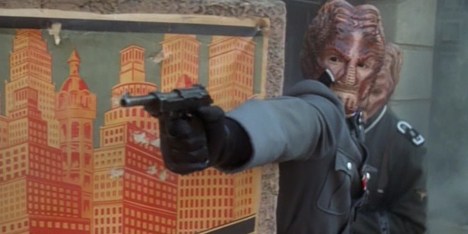
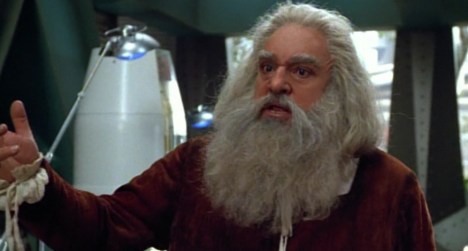
Evil alien space Nazis!

Continue reading

Star Trek: Voyager – Retrospect (Review)

Star Trek: Voyager is a very nineties show. Sometimes that is endearing. Sometimes it is not.

Retrospect is an episode that made a great deal more sense in the context of the nineties. It was still troublesome and reactionary, structuring its central allegory in a way that was deeply problematic. However, Retrospect made a certain amount of sense when considered in light of the McMartin Preschool scandal and the satanic panic driven by regression hypnosis in the early part of the decade. Retrospect is very clearly an attempt to turn that talking point into a twenty-fourth century allegory about witch hunts and persecution.

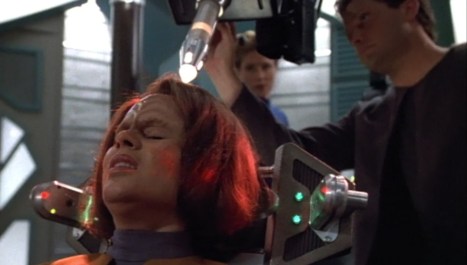
Assimilate this…

However, there are a number of poor choices made over the course of the episode. The most obvious is build the episode around the character of Seven of Nine. There are any number of reasons why this would be written as a Seven of Nine episode, given that she is the breakout character of the fourth season. However, episodes like The Gift and The Raven have made a conscious effort to portray Seven of Nine as an abuse surviving living with genuine trauma. To put her at the centre of an episode about false allegations of abuse feels ill-judged.

Similarly, the emphasis on the subject of these accusations and his ruined life feels more than a little tone-deaf, even in the context the nineties satanic panic. Retrospect is not an episode about Seven of Nine processing abuse or even coping with distorted memories. It is ultimately the story about how the falsified accusations of abuse (from a character who is a verified abuse victim) can serve to destroy the lives of innocent men. Indeed, the emphasis on the EMH as a proxy for Seven of Nine downplays her own agency in this plot.

Memory Beta.

These aspects are troubling even in the context of an episode about the dangers of using hypnotherapy as the basis of these charges. However, the scandal has slipped from public consciousness in the years since Retrospect was initially broadcast. When the audience hears about women false accusations against men, it evokes the long-standing myth that men are frequent victims of falsified reports about sexual assault that ruin lives. This was creepy and uncomfortable subtext was obvious at time of broadcast, but has only become more pronounced in the years since.

Retrospect would have been a very clumsy and ill-judged allegory in the context of the mid-to-late-nineties. Decades removed from that original context, it seems almost reprehensible.

Blinding flash of the obvious.

Continue reading

Star Trek: Voyager – Prey (Review)

Prey is a fantastic piece of television, and stands as one of the best standalone episodes of the fourth season of Star Trek: Voyager.

It is an episode built around a very simple premise, pitting two of Voyager‘s more memorable alien creations against one another and throwing a nice character arc into the midst of this epic conflict. Prey is an exciting thriller built around the established characteristics of both the Hirogen and Species 8472, using two very distinctive cultures to tell a compelling and engaging story with the regular cast thrown into the fray. “Lone Hirogen hunter pursues lost member of Species 8472” is a great hook for an episode.

Here come the big guns.

However, Prey goes even further than that. The basic plot is intriguing on its own terms, but Prey cleverly grounds the story in what we know about these characters and their dynamic. As much as Voyager is caught in the crossfire of this horrific situation, the crew are also forced to make tough decisions. How will Janeway react to a wounded member of a hostile (and nigh-invulnerable) species? How will Seven of Nine respond when asked to save the life of a creature that participated in a brutal war with the Borg Collective?

This is intriguing stuff, largely anchored in what the audience already knows of the characters and delivered with top-notch production values and a great sense of pacing. Prey is an episode that plays to all the strengths of the fourth season, from the appeal of the Hirogen and Species 8472 through to the chemistry between Kate Mulgrew and Jeri Ryan.

There’ll be hull to pay.

Continue reading

Star Trek: Voyager – Hunters (Review)

Hunters is a weird episode of Star Trek:Voyager, perhaps most notable for the manner in which it flirts with serialisation.

More than any other episode of the fourth season, with the possible exception of The Gift, this mid-season episode seems to exist primarily in relation to the episodes around it. The script is very consciously a sequel to Message in a Bottle, with the crew discovering the ancient network of space stations is a two-way radio back to the Alpha Quadrant. It also introduces the Hirogen, an alien species that will recur in Prey, The Killing Game, Part I and The Killing Game, Part II. The story also sets up a narrative thread that will pay off in Hope and Fear, the season finale.

“Prey, tell.”

More than that, Hunters is an episode that is very consciously engaged with dangling threads of continuity. It resolves the relationship between Janeway and Mark that has haunted the lead character since Caretaker, offers Tom Paris some hint of reconciliation with the father who seemed so disappointed in Persistence of Vision, and even resolves the Maquis plot thread by tying back to Blaze of Glory. This is an episode that exists as something of a storytelling nexus point, a variety of intersecting threads all tied together as part of a single narrative.

Voyager had largely eschewed any attempt at long-form storytelling, perhaps in response to the trauma of the troublesome Kazon arc in the second season that led to ill-judged misfires like Alliances and Investigations. However, those early attempts at serialisation were heavily plot-driven, a series of stories building towards a number predetermined plot points. In contrast, the serialisation suggested by Hunters is looser; a collection of character beats, some earlier details that had largely been forgotten, some elements that might be useful in the future.

The farthest woman from home.

That said, Hunters seems just as cautious about long-form storytelling as The Gift was. As much as Hunters revives old story lines and character beats, it also makes a conscious effort to close many of them. Hunters makes it very clear that this level of serialisation will not be the default for the series going forward. The episode tidies away more loose threads than it unravels. The relationship between Kathryn Janeway and Mark Johnson is brought back purely so it can be ended. The Maquis are mentioned only to confirm they have been destroyed.

Still, there is something oddly intriguing about Hunters, a mostly quiet episode that exists primarily as both prelude and coda rather than a narrative in its own right. It is a quieter, stranger Voyager episode, even while introducing a race of giant space!hunters.

Gripping stuff.

Continue reading

Star Trek: Voyager – Message in a Bottle (Review)

Message in a Bottle is an intriguing episode, although not necessarily for the most obvious of reasons.

Working with Andy Dick can be tough.

Working with Andy Dick can be tough.

Message in a Bottle is notable for its stunt casting, featuring controversial comedian Andy Dick as the Emergency Medical Hologram, Mark II. Given his background and his interests, Andy Dick is a very strange choice for a Star Trek guest role. Then again, it takes all sorts; Star Trek: Deep Space Nine cast Iggy Pop in The Magnificent Ferengi and Star Trek: Voyager finds room for the Rock in Tsunkatse. However, the last time the franchise attempted to cast a famous comedian, Star Trek: The Next Generation ended up with The Outrageous Okona.

Understand, Andy Dick tends to be the focal point for discussion around Message in a Bottle. However, the episode is notable for other reasons. In a weird way, Message in a Bottle kicks off a very loose serialised arc that plays through the next handful of episodes. It introduces the communications grid that plays a major role in Hunters, and features the first glimpse of the Hirogen. The Hirogen go on to play a major role in episodes like Prey, The Killing Game, Part I and The Killing Game, Part II.

"What the hell are YOU doing in my Star Trek show?"

“What the hell are YOU doing in my Star Trek show?”

Message in a Bottle also comes at the half-way point in Voyager‘s run, speaking in terms of structure rather than episode count. Message in a Bottle is positioned mid-way through the middle season of Voyager‘s seven year run. Although the count is skewed somewhat by the series’ abridged first season, it feels like the last point at which Voyager is closer to its beginning than to its end. As such, there is something strangely appropriate in the fact that Message in a Bottle allows Voyager to reconnect with Starfleet and the Alpha Quadrant.

This is perhaps the point where the end of the journey “seems a little closer.”

"This never would have happened if they'd just gone with the Bashir model!"

“This never would have happened if they’d just gone with the Bashir model!”

Continue reading

Star Trek: Voyager – Waking Moments (Review)

Waking Moments feels very much like a first or second season episode of Star Trek: Voyager that somehow entered production in the middle of the fourth season.

A lot of this is down to the simple texture of the episode. Waking Moments centres around a decidedly “weird” alien species, a touch that recalls the early mysteries of Delta Quadrant life suggested by episodes like Phage, The Cloud, Heroes and Demons, Cathexis and even Emanations. These are aliens that do not conform to standard Star Trek logic, stalking their prey through dreams rather than with advanced technology. In fact, the emphasis on dreams in Waking Moments harks back to the vague New Age sentiment of Michael Piller’s time on Voyager.

No, Chakotay. Hunters and Prey are next week.

No, Chakotay. Hunters and Prey are next week.

In fact, Waking Moments returns to a very New Age cliché version of Chakotay. Following on directly from Mortal Coil, Chakotay is once again repeating “ah-koo-chee-moya” and talking about “vision quests.” He mentions his father as a connection to his Native American heritage for the first time since Basics, Part I, and even evoked Tattoo in discussing his rejection of shared activities in his youth. Waking Moments feels like an episode that was originally written while Michael Piller was overseeing the show, but has finally made it to air.

Of course, Waking Moments feels rather retrograde in other ways. It is a very clumsy ensemble piece that treats tired old plot twists as innovative and exciting, moving along at a leaden pace without any sense of what makes this story interesting or compelling in its own right. Waking Moments is a surprisingly tiring piece of television.

An artist's impression of the audience watching Waking Moments.

An artist’s impression of the audience watching Waking Moments.

Continue reading

Star Trek: Voyager – Mortal Coil (Review)

In its own weird way, Mortal Coil effectively amounts to a Star Trek: Voyager Christmas Special.

It unfolds in the lead up to the Talaxian festival of Prixin, which Neelix describes as “the Talaxian celebration of family. We observe it every year on Voyager.” Bringing friends and family together on an annual basis with ritualised food preparation and salutations, it serves as analogous to Thanksgiving or Christmas. Indeed, this sort of thinly-disguised Christmas celebration is a science-fiction stable. Perhaps “Life Day” from Star Wars Holiday Special is the most obvious example. To solidify this Yuletide sensibility, Mortal Coil aired the week before Christmas.

Choking on his Borgophobia.

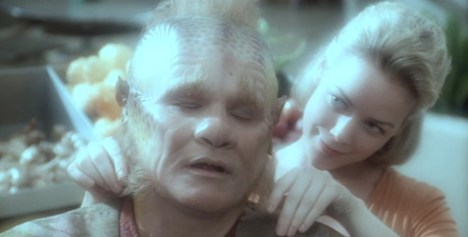
They just keep killing Neelix.

There is something decidedly wry about the one and only Star Trek Christmas Special. (And no, the Christmas Party in Dagger of the Mind doesn’t really count.) This is after all an episode in which a regular character loses his faith in the existence of an afterlife and attempts to commit suicide in a transporter room. It is a strange choice for a seasonal story. In some ways, it feels very much like a Bryan Fuller script, a subversion of the traditional Christmas narrative. After all, Fuller has talked about Hannibal as an exploration of heterosexual male friendship. Just one with murder and cannibalism thrown in.

Mortal Coil is a fascinating episode, albeit one that feels decidedly clumsy in its execution. The episode hesitates and wavers on what it wants to say, offering a wishy-washy conclusion to a very powerful premise. Still, Mortal Coil is intriguing for its oddness.

I met a man who wasn't there.

I met a man who wasn’t there.

Continue reading

Star Trek: Voyager – Concerning Flight (Review)

Concerning Flight is a lovely, whimsical little episode.

Of course, the actual plot of the episode is complete nonsense. During a raid by alien pirates, a bunch of advanced technology is stolen from Voyager. Among that advanced technology is the EMH’s mobile admitted, the holodeck database, and the primary computer core. Somehow, the pirate prince responsible for this raid has the wherewithal to download a character from the holodeck database into the mobile emitter and employ him as an inventor. Conveniently enough, the hologram is Leonardo da Vinci and the arrangement resembles medieval patronage.

da Vinci's demons.

da Vinci’s demons.

It is all very ridiculous, relying on insane contrivance and random leaps in logic. At any given moment, the audience might be inclined to ask exactly what chain of decisions have led the characters to this exact point, right down to the sheer coincidence of having Leonardo da Vinci’s prototyple glider resting on a hilltop on the escape route that Janeway and da Vinci take in the final act. All of these criticisms are valid, and all of them are perfectly reasonable. Concerning Flight does not require suspension of disbelief, it requires a suspension bridge of disbelief.

However, the episode largely earns that trust. There is an incredible charm to this very simple and straightforward (if awkwardly contrived) story, a surprising warmth and engagement to the tale of the ultimate renaissance man confronted with the ultimate new world. Concerning Flight is a fun episode that places a lot of faith in the interplay between Kate Mulgrew and John Rhys-Davies. It is a choice that pays dividends.

O brave new world, That has such people in 't!

O brave new world,
That has such people in ‘t!

Continue reading

Star Trek: Voyager – Random Thoughts (Review)

Random Thoughts is another example of Star Trek: Voyager as generic issue-driven Star Trek.

Random Thoughts is a fairly standard political-commentary-as-science-fiction-allegory plot, with the crew encountering a race of telepaths who have built a utopian society through the careful regulation of thoughts. When Torres is implicated in a very rare violent crime, the crew find themselves embroiled within mystery to determine the origin of the violent thought and the means of its transmission. Along the way, there is a hefty dose of commentary on a broad range of themes.

Scrambling the subversives.

Scrambling the subversives.

In theory, Random Thoughts is very much of a piece with Nemesis or Scientific Method, other fourth season episodes less interested in character and more driven by commentary. However, Random Thoughts is a good deal more muddled. The allegory at the centre of the story is a mess, in part because the script is so intentionally vague. Are these violent thoughts a metaphor for violence in media? Are they a commentary on heat speech? Are they an analogy for drug addiction? What about non-heteronormative sexuality?

Random Thoughts never seems to decide on one central metaphor, and so casts an exceptionally broad net. The problem is that these issues are radically different from one another, and the all-encompassing nature of the central analogy robs the episode of any nuance or sophistication. An episode advocating for the legalisation of drug use is radically different from an episode against the criminalisation of heat speech. It is very difficult to work out exactly what Random Thoughts is saying, let alone what it wants to say.

Whisked away.

Whisked away.

This muddled storytelling plays out in other ways. Random Thoughts is a mess episode, in terms of storytelling and structure. The plot wanders in various different directions, shifting focus from one member of the ensemble to another; for a story about Torres’ emotions, Torres is afforded very little agency. The narrative also diverts along pointless tangents, with obvious filler scenes like Paris and Chakotay discussing a rescue that never happens or Seven of Nine stopping by the Ready Room to discuss the moral of the episode.

There is something distractingly unfocused about Random Thoughts.

Secure in his convictions.

Secure in his convictions.

Continue reading

Star Trek: Voyager – Year of Hell, Part II (Review)

Year of Hell, Part I and Year of Hell, Part II might just be the most representative episodes of Star Trek: Voyager.

Taken together, these episodes perfectly embody the restrictions placed upon the third Star Trek spin-off. They are a boldly ambitious story of a ship that finds itself in hostile territory surrounded by a hostile force with superior firepower, all while playing into the recurring themes and fascinations of the wider series. However, they are also a two-parter that wraps up with an incredibly convenient resolution that handily resets the status quo in a manner that allows the ship (and the series) to avoid any lasting consequences from this blockbuster story.

The hole in things.

The hole in things.

The result is one of the most thrilling and engaging stories of Voyager‘s seven-season run, among the most satisfying of the series’ impressive “blockbuster” two-parters. However, its sense of scale and scope exists very much in contrast to the episodes around it, a truly epic story that leaves no lasting mark. An audience member skipping from Scientific Method to Random Thoughts would be completely oblivious of the episode. For an episode of such weight, great care is taken to ensure that its passage causes no disturbance.

Year of Hell, Part I and Year of Hell, Part II do an excellent job capturing the essence of Voyager.

Annorax-ed with guilt.

Annorax-ed with guilt.

Continue reading