• Following Us

  • Categories

  • Check out the Archives


  • Awards & Nominations

Star Trek – Catspaw (Review)

The first Star Trek pilot, The Cage, was produced in 1964. To celebrate its fiftieth anniversary, this December we are reviewing the second season of the original Star Trek show. You can check out our first season reviews here. Check back daily for the latest review.

Catspaw was the first episode to enter production for that second season of Star Trek. However, it was not the first to air. Amok Time served as the season opener. Instead, Catspaw was produced as something of a rarity – a Star Trek holiday special. Produced in May, it was eventually broadcast during the last week of October. Given the subject matter and trappings of the episode, that seems highly appropriate.

We are, after all, looking at what amounts to a Star Trek Halloween Special.

Bones joins the cast...

Bones joins the cast…

Continue reading

Star Trek (Gold Key) #1 – The Planet of No Return! (Review)

The first Star Trek pilot, The Cage, was produced in 1964. To celebrate its fiftieth anniversary, this December we are reviewing the second season of the original Star Trek show. You can check out our first season reviews here. Check back daily for the latest review.

The Star Trek comics published by Gold Key are somewhat infamous additions to the Star Trek canon. The company began publishing comic book tie-ins in July 1967, in the gap between the first and second seasons of the original Star Trek show. They continued to publish those tie-ins until 1978, when the license passed to Marvel. These early comics have become the source of much derision over the years, with fans dismissing them as hollow cash-ins produced by people with little understanding of the franchise itself.

However, recent years have seen something of a reappraisal of these early comic books. Once IDW Publishing secured the rights to produce tie-in Star Trek comic books, they devoted considerable effort to archiving and releasing classic and little-seen material from the franchise’s history. They released the Star Trek newspaper strips in a two-volume set, before turning their attention to the classic Gold Key comic books. It is a very worthwhile attempt to provide fans with a glimpse of oft-overlooked chapters in the franchise’s history.

Plant life...

Plant life…

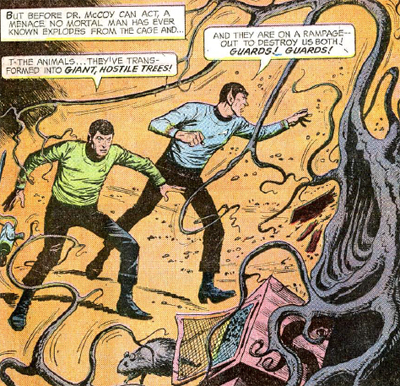
The Gold Key Star Trek comics are messy. A lot of the criticisms hold true. There are all manner of continuity errors in the production of the comic. Artist Alberto Giolitti takes quite some time to figure out what Scotty looks like, and the colourists take a bit of time to figure out what uniforms various cast members should be wearing. The writing is similarly clunky, with characters sounding a little out of sort as the basic plot details seem to stand at odds with still-relatively-small Star Trek canon had been established by the closing credit of Operation — Annihilate!

And yet, despite all these considerable flaws, these comics do make for an interesting time capsule. They don’t feel quite like Star Trek so much as an impression of what Star Trek would look described to somebody who has never seen it, filtered through the lense of fifties and sixties science-fiction comics. The early issues feel like three blind men describing an elephant, and it is glorious.

Branching out...

Branching out…

Continue reading

Win! A Copy of David Gerrold’s World of Star Trek!

As you may have picked up, we are big fans of Star Trek here at the m0vie blog, and we are big fans of David Gerrold as well. Mr. Gerrold has recent released a number of his classic novels in eBook format, including The World of Star Trek. Originally published in 1973 and updated in 1984, the book offered a behind-the-scenes glimpse of the franchise and is an invaluable glimpse behind the curtain. A full list of Mr. Gerrold’s eBooks are available via his official site, or by clicking the image below.

We have an excerpt from the classic below and Mr. Gerrold has kindly volunteered to host a give away here. For your chance to win a copy – and four of David Gerrold’s eBooks of your choosing – simply leave a comment below. Simply leave a comment on the article stating you would like to be entered in the draw and we’ll pick a name from a hat. Enjoy!

World of Star Trek_giveaway

Continue reading

Star Trek – Debt of Honour (Review)

This June, we’re taking a look at some classic Star Trek movie tie-ins and other interesting objects. Check back daily for the latest reviews and retrospectives.

By all accounts, Debt of Honour should be an unqualified success.

It’s a prestige graphic novel from DC comics, produced around the twenty-fifth anniversary of Star Trek and the release of Star Trek VI: The Undiscovered Country. It is written by celebrated comic book scribe Chris Claremont, fresh off his career-defining stint on Uncanny X-Men. An avowed Star Trek fan and comic book veteran, this should be in his wheel house. The art is provided by Adam Hughes, one of the most celebrated and respected artists of his time.

Talk about kicking off a comic...

Talk about kicking off a comic…

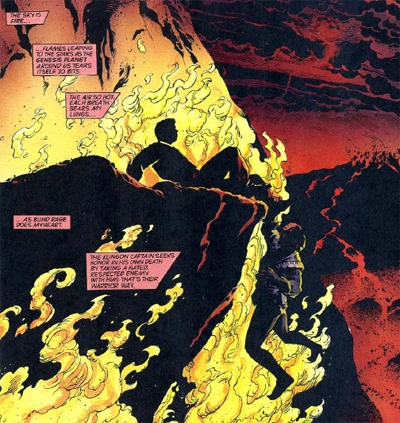
By any measure, Debt of Honour should count as some sort of hallmark for DC Comics’ Star Trek tie-ins. Unfortunately, that isn’t quite the case. A rather muddled storyline that is hopelessly devoted to Star Trek continuity while awkward interfacing with it,  Debt of Honour is just packed a little too tight. Charting a story from the earliest days of Kirk’s career to the aftermath of Star Trek IV: The Voyage Home, Claremont bites off more than he can chew.

Over the course of Debt of Honour, Claremont introduces a vague alien threat that has apparently been haunting Kirk for his entire career, a new arch-foe or love interest for Kirk, and even a supporting role for Kor. Along the way, he packs in cameos and shout-outs to various parts of Star Trek lore. He even explains why Klingons suddenly had ridges around the time of Star Trek: The Motion Picture. Ultimately, Debt of Honour is ambitious, but a little over-stuffed and quite over-cooked.

Warp speed ahead!

Warp speed ahead!

Continue reading

Star Trek – The 25th Anniversary (Review)

This June, we’re taking a look at some classic Star Trek movie tie-ins. Check back daily for the latest reviews and retrospectives.

Star Trek VI: The Undiscovered Country was released quite close to the twenty-fifth anniversary of Star Trek. With Star Trek: The Next Generation at the height of its popularity, the franchise was able to mark the occasion with a variety of celebrations. There were comic books and prose books celebrating the occasion. Both Spock and Scotty appeared on The Next Generation around the time of the anniversary.

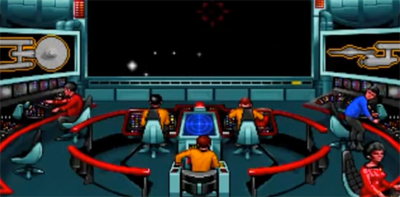
Perhaps the most obvious example was the release of Star Trek: The 25th Anniversary by Interplay. While it was not the first video game to be based on the Star Trek franchise, it was the first high profile release. It set the tone for commercial Star Trek video games, remaining one of the best-selling Star Trek video games ever produced. It paved the way for everything from Bridge Commander to A Final Unity to Elite Force.

Ship shape...

Ship shape…

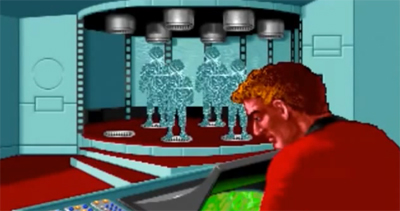
Released across multiple platforms and featuring seven episodic adventures structured like episodes of the classic television show, The 25th Anniversary set a dramatic and effective precedent for Star Trek video gaming. The CD-ROM edition of the game took things even further, featuring voice recordings of the show’s primary cast to help lend a sense of continuity and credibility to events. The 25th Anniversary is littered with easter eggs and in-jokes, and it’s constructed with the utmost love and affection.

However, perhaps what is most interesting about The 25th Anniversary is the way that it plays into all these established Star Trek clichés and tropes, but with a rather sophisticated outlook. It’s a wonderful example of how the original Star Trek show never stopped reinventing itself, only really reaching a truly idealised form long after it had been off the air.

Beam me up, Kyle!

Beam me up, Kyle!

Continue reading

Star Trek (DC Comics, 1989) #35-40 – Tests of Courage/The Tabukan Syndrome (Review)

This June, we’re taking a look at some classic Star Trek movie tie-ins and other interesting objects. Check back daily for the latest reviews and retrospectives.

Captain Hikaru Sulu occupies a very special place in Star Trek lore. Given the amount of spin-off material that Sulu’s command of the Excelsior has generated, Sulu often seems like the Star Trek spin-off that never quite materialised. The idea of Sulu commanding the Excelsior has inspired novels and comics and audio books, and was even featured in Flashback, one of the episodes produced to celebrate the thirtieth anniversary of the franchise.

While Sulu’s command of the Excelsior is open-ended, it is interesting to consider the various origin stories that might apply. As with Khan Noonien Singh, there are multiple tie-in stories that cover the same ground. Published in late 2007, the novel Forged in Fire, for example, offers one account of Sulu taking command of the Excelsior – assuming command from Captain Styles during a high-pressure diplomatic crisis. However, this was not the first time that the story had been told.

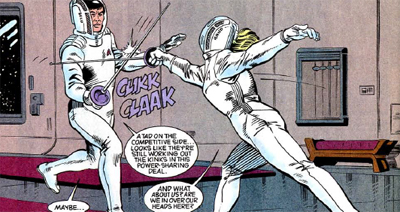
Crossing swords...

Crossing swords…

A year following the release of Star Trek VI: The Undiscovered Country, author Howard Weinstein wrote Tests of Courage. A six-issue arc set during the earliest days of Sulu’s command, Weinstein had originally hoped to collaborate with George Takei on the comic. Unfortunately, the two could not work out their schedules, forcing Weinstein to write the comic without Takei’s input. However, Takei did provide a glowing and enthusiastic foreword for the collected edition of the comic published two years later.

Tests of Courage is a fantastic piece of work, a suitably epic Star Trek comic that tells a suitably epic story – one with breadth and scope and drama and conflict that demonstrates just what a wonderful storyteller Howard Weinstein is.

Ships of the line...

Ships of the line…

Continue reading

Star Trek – The Fearful Summons by Denny Martin Flinn (Review)

This June, we’re taking a look at some classic Star Trek movie tie-ins. Check back daily for the latest reviews and retrospectives.

One of the great things about a franchise as expansive and as well-documented as Star Trek is that no idea is even completely lost to history. The franchise is sprawling enough that episodes and films inevitably end up lost to history. Scripts are written and re-written, with ideas changing dramatically from original conception through to the final released version. Even Star Trek: Phase II is well accounted for, affording fans a glimpse at how things might have gone for the franchise.

It’s interesting to imagine the possibilities that exist at given moment for the franchise – how radical things might be now had a particular event gone a different direction. Imagine Bryan Fuller and Bryan Singer bringing Star Trek back to television with Angela Bassett in the big chair. Or Spock on the grassy knoll. Or Oscar nominee Geneviève Bujold as Janeway. Or a first season of Star Trek: Enterprise set primarily on Earth during the development of the warp five drive.

So much of the franchise is discussed and analysed that ideas like this tend to bubble through. Occasionally, the franchise allows an echo of what might have been to break through. Star Trek: The Next Generation adapted two aborted scripts from Star Trek: Phase II into The Child and Devil’s Due. Harlan Ellison’s original script for The City on the Edge of Forever is being adapted into a comic book. That is to say nothing of writers like D.C. Fontana and David Gerrold working with fan productions.

However, Denny Martin Flinn’s novel, The Fearful Summons, is a particularly interesting glimpse at what might have been. It’s essentially a novel based around his original idea for Star Trek VI: The Undiscovered Country. It’s a rather bizarre and occasionally awkward glimpse at what might have been for the franchise.

tos-thefearfulsummons

Continue reading

Star Trek VI: The Undiscovered Country (DC Comics, 1992) (Review)

This June, we’re taking a look at some classic Star Trek movie tie-ins and other interesting objects. Check back daily for the latest reviews and retrospectives.

In many respects, adapting a Star Trek feature film into comic book form is very much an editorial function. With so little space available, particularly as compared to a feature film or novel, the assignment is more about whittling the script down to something that can be covered in fifty-five pages of a comic book. While those adapting the features films into novels frequently have to expand and flesh out the material to make it fit within the allocated page count and account for plot hole and logic error, the comic book adaptations just have to keep everything ticking over.

So Peter David and Gorden Purcell’s adaptation of Star Trek VI: The Undiscovered Country plays quite well as a condensed version of the narrative, covering the requisite story beats in the available space.

In space, everybody can hear you scream...

In space, everybody can hear you scream…

Continue reading

Star Trek VI: The Undiscovered Country by J.M. Dillard (Review)

This June, we’re taking a look at some classic Star Trek movie tie-ins. Check back daily for the latest reviews and retrospectives.

Reading her novelisation of Star Trek VI: The Undiscovered Country, it’s hard to shake the feeling that author J.M. Dillard really does not like this film.

It’s a very peculiar sensation, to read an adaptation clearly written by somebody who could not care less for the source material. It is not unique, of course. Diane Carey’s adaptation of Broken Bow is downright scathing in its attitude towards Star Trek: Enterprise. It just seems rather strange that J.M. Dillard’s early adaptation of Star Trek V: The Final Frontier seems a lot fonder of its source material.

st-theundiscoveredcountry-dillard

Continue reading

Star Trek (DC Comics, 1989) #1-12 – The Trial of James T. Kirk! (Review)

This June, we’re taking a look at some classic Star Trek movie tie-ins and other interesting objects. Check back daily for the latest reviews and retrospectives.

The late eighties and early nineties saw a change in the world of Star Trek tie-ins. During the eighties, tie-in writers had typically been afforded a great deal of freedom in telling their stories – allowed to explore the fringes of the Star Trek universe with little regard to how things matched up. The period saw a number of truly spectacular Star Trek tie-ins that count among the best work ever released with the Star Trek brand on it – John Ford’s The Final Reflection or Diane Duane’s My Enemy, My Ally.

However, with the release of Star Trek V: The Final Frontier and the broadcast of the third season of Star Trek: The Next Generation, there was a shift in how the franchise approached tie-in novels and comic books. Gene Roddenberry had arguably lost control of his creation, with the Harve Bennett and Nicholas Meyer taking control of the feature films while Rick Berman and Michael Piller were the driving creative forces on the television show.

Crossing swords...

Crossing swords…

As such, the tie-ins became a place where Roddenberry and his “people” – including Richard Arnold and Susan Sackett – could make their influence most heavily felt. So, in the late eighties and early nineties, a conscious effort was made to re-tool the novels and the comic book tie-ins, with Richard Arnold maintaining a much tighter grip on the reigns. DC’s first volume of Star Trek comics was cancelled after fifty-six issues, and another volume was launched to coincide with the launch of the Next Generation comic.

Writer Peter David had closed out the first volume of the Star Trek comic, and was drafted in as the writer of the new on-going series. However, he almost immediately came into conflict with Richard Arnold. Pages of the first issue had to be hastily re-drawn when Richard Arnold vetoed the use of a supporting character from Star Trek: The Animated Seriesafter the comic had been drawn. In many respects, this set the tone for the comic, which was victim to all sorts of weird editorial mandates.
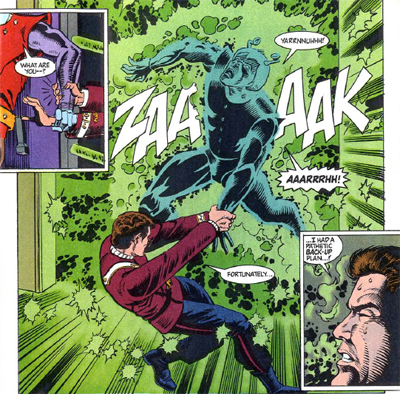
The Andorian Incident...

The Andorian Incident…

While writer Michael Jan Friedman remained the writer on the on-going Next Generation comic for most of its run – only occasionally getting another writer to fill in – Peter David departed the Star Trek comic before the end of the book’s second year on the stand. This is especially frustrating when one considers the pedigree of Peter David. An accomplished novelist and comic book writer, David had a wealth of experience in the medium that was being maliciously squandered by Arnold.

It’s a shame, because the opening twelve issues of DC’s second volume of Star Trek make for a delightful read and a fitting substitute for a live-action Star Trek television show unfolding between the movies.
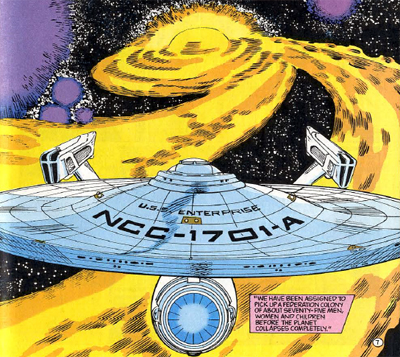
Warp speed ahead...

Warp speed ahead…

Continue reading