• Following Us

  • Categories

  • Check out the Archives


  • Awards & Nominations

Star Trek V: The Final Frontier (DC Comics, 1989) (Review)

This June, we’re taking a look at some classic Star Trek movie tie-ins and other interesting objects. Check back daily for the latest reviews and retrospectives.

In many respects, the late eighties represented a changing of the guard when it came to Star Trek. The feature films had been relatively serialised. The events of Star Trek II: The Wrath of Khan led into the events of Star Trek III: The Search for Spock, which itself led directly into the events of Star Trek IV: The Voyage Home. At the same time, the expanded universe was generally left free to its own devices. Novelists and writers were given the freedom to do whatever they wanted.

In the late eighties, things changed. Directed by William Shatner, Star Trek V: The Final Frontier stood quite clearly apart from the events of the last three Star Trek films. At the same time, the franchise had found its way back to weekly television in the form of Star Trek: The Next Generation. Whereas comic books and novels had served to fill a gap when there was a scarcity of “official” Star Trek material, they were now very clearly of secondary importance to the “real” (or simply “live action”) versions of Star Trek.
Oh your God...

Oh your God…

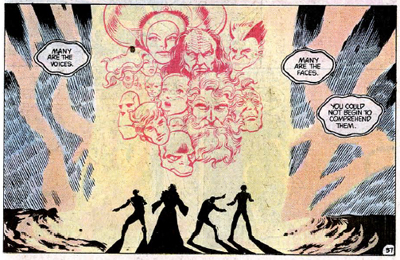
There was a rather seismic shift in the nature and tone of tie-ins and adaptations. Rather notably, the creators who had adapted the last couple of films into prose and comic book form did not return to translate The Final Frontier across different media. Vonda McIntyre had written the novelisations of the last three Star Trek films, but was replaced by J.M. Dillard. Mike W. Barr and Tom Sutton had produced the comic book adaptations of the last two Star Trek films, but were replaced by Peter David and James W. Fry. Both Dillard and David would find themselves tasked with adaptation of Star Trek VI: The Undiscovered Country.

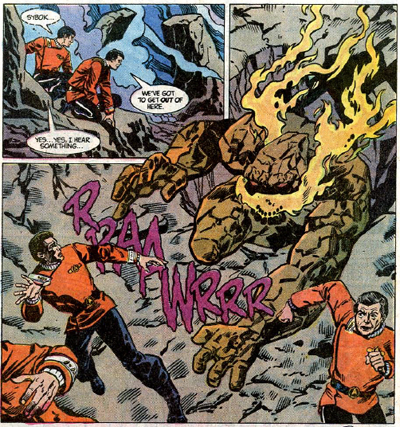
Peter David and James W. Fry’s adaptation of The Final Frontier is clearly intended as a launchpad for their new on-going Star Trek series that would debut only a few months later. Indeed, the final page of The Final Frontier includes an advertisement for that new series. In many respects, this adaptation of The Final Frontier seems to serve as a pilot for a new comic book series, a starting point for a bold new beginning to DC’s Star Trek line. Opening with the The Final Frontier, you might be forgiven for assuming it was doomed from the outset.
Here there be rock monsters...

Here there be rock monsters…

Continue reading

Star Trek V: The Final Frontier by J.M. Dillard (Review)

This June, we’re taking a look at some classic Star Trek movie tie-ins. Check back daily for the latest reviews and retrospectives.

In many respects, J.M. Dillard is a safe pair of hands.

Star Trek V: The Final Frontier was released at a point where Star Trek was shifting. Star Trek: The Next Generation had returned the franchise to prime time television after an absence of almost two decades and Star Trek IV: The Voyage Home had been an unqualified box office success. Gene Roddenberry was welcome back at Paramount after parting ways following the release of Star Trek: The Motion Picture, even if the production of Star Trek: The Next Generation was already slipping through his fingers.

There was a much tighter editorial approach to tie-ins and to spin-offs. Whereas the writers of the early Pocket Books novels and DC comics had been given considerable freedom, that freedom was being reigned in around the release of Star Trek V: The Final Frontier. The monthly comics series was launched with any elements not matching the “on message” approach to the franchise scrubbed out. All the original characters were gone. All the references to Star Trek: The Animated Series were gone.

The shift at Pocket Books was also palpable. Authors were suddenly getting asked to do ridiculous re-writes, or simply having their own material re-written at will. Margaret Wander Bonanno’s much-mangled Music of the Spheres is perhaps the most infamous example, going through several different ghost writers before finally being released as Probe, a book that Bonanno has relentlessly disavowed. Publishing Star Trek tie-ins was more like making sausages than it ever had been before.

So, in this context, it makes sense that author Vonda N. McIntyre would not return to do the novelisation of The Final Frontier. Her adaptations of Star Trek II: The Wrath of Khan, Star Trek III: The Search for Spock and Star Trek IV: The Voyage Home were clever and thoughtful stories that built freely off the source material, finding room for asides and tangents that were not possible on film. Her novelisation of The Search for Spock hits the movie’s opening scene almost a third of the way into the book.

As such, McIntyre’s unique style was unlikely to be a comfortable fit for this new tie-in environment. J.M. Dillard, on the other hand, would be.

st-finalfrontier Continue reading

Star Trek IV: The Voyage Home (DC Comics, 1986) (Review)

This June, we’re taking a look at some classic Star Trek movie tie-ins and other interesting objects. Check back daily for the latest reviews and retrospectives.

The comic book adaptation of Star Trek IV: The Voyage Home does a surprisingly good job of translating the comedy adventure into comic book form. Relying the creative team of Mike W. Barr and artist Tom Sutton to produce a one-shot comic book adaptation of the feature film, DC Comics have reached a point where they are able to consistently and reliably churn out comic books based around the Star Trek franchise.

Indeed, one might imagine that the somewhat lighter tone of The Voyage Home would pose a challenge for the duo, eschewing the grand space opera of Star Trek III: The Search for Spock in favour of something more firmly rooted in modern sensibilities. However, Barr and Sutton do a wonderful job adapting the screenplay into a charming comic, even if it does seem to be aimed more squarely at hardcore Star Trek fans than casual viewers.

Standing tall...

Standing tall…

Continue reading

Star Trek IV: The Voyage Home by Vonda N. McIntyre (Review)

This June, we’re taking a look at some classic Star Trek movie tie-ins. Check back daily for the latest reviews and retrospectives.

Comedy doesn’t always translate well between different media. That’s not to suggest that comedy works better in one medium as compared to others, merely to contend that certain forms of comedy don’t translate perfectly between different media. It works any number of ways. Something that is funny in sound and vision is not necessarily hilarious in prose. Gags relying on delivery might play better with a seasoned performer than in the mind’s eye of a reader. Witty prose doesn’t always lend itself to narration or articulation on film.

Much of Star Trek IV: The Voyager Home plays as broad farce, following a bunch of time-travelers from the future (and refugees from television land) as they try to interact with the real world. The movie does have some wonderful character moments – notably Spock’s character arc that beautifully brings him a full circle and Kirk’s relationship with Spock – but it also plays the Star Trek ensemble in a highly caricatured manner, more as archetypes than fully-realised three-dimensional characters.

This is grand. After all, these are fictional characters rather than real people. After all stories are more than just excerpts from the biographies of fictional characters. While it’s nice to have consistent characterisation, suggesting that you can’t have Kirk and Spock acting in an exaggerated fashion for the sake of comedy is a very narrow and restrictive view of what Star Trek is or should be.

The Voyage Home gets the big character beats right – Spock’s insistence that the crew rescue Chekov, Kirk convincing Gillian to trust him, Spock “guessing” – that we can excuse the crew’s lack of awareness about a time period they have visited before and the general flippancy of the movie itself. The novelisation, however, is another matter. Vonda N. McIntyre clearly cares a great deal about the characters. That was one of the strengths of her work on the novelisations of the last two films. Here, however, McIntyre struggles to balance that with the tone of the story.

startrekiv Continue reading

Star Trek: The Klingon Dictionary (Review)

This June, we’re taking a look at some classic Star Trek movie tie-ins and other interesting objects. Check back daily for the latest reviews and retrospectives.

Something absolutely fascinating happened around the release of Star Trek III: The Search for Spock.

It seemed like the entire Star Trek universe suddenly got wider and broader. While alien races and cultures had always been a part of the franchise, they seemed to exist as little more than mirrors of human society – a prism through which we might view the modern world. While episodes like Amok Time and The Day of the Dove teased the idea of elaborate and truly alien civilisations, in most cases the show wasn’t committed to building a universe so much as telling an engaging story on its own terms.

This is, of course, a valid approach. Producing a weekly television show, it makes sense to focus on entertaining an audience with each and every episode. A fully-formed universe is a little pointless if nobody is actually watching it. However, around the release of The Search for Spock, something changed. All of a sudden, the cultures occupying the shared Star Trek universe seemed to take on a life of their own – they began to develop into more than just mirrors or reflections.

This is apparent in The Search for Spock itself, albeit obliquely. Kruge is not the most well-defined of adversaries, but he has a point. He is worried about what the Genesis Device means from outside the context of the Federation. He’s reacting to cultural imperialism, rejecting the right of the Federation to remake worlds in their own image. The Klingon Empire suddenly existed as more than just a convenient foe when the episode needed some stock communists, but an adversary with legitimate concerns and perspectives.

This change was mirrored outside The Search for Spock as well. Directly before the publication of Vonda N. McIntyre’s novelisation of The Search for Spock, Pocket Books released John M. Ford’s The Final Reflection. The novel was an in-depth look at Klingon culture, one that went on to influence Ronald D. Moore’s development of Klingon culture on Star Trek: The Next Generation. The novel published following McIntyre’s novelisation of The Search for Spock was Diane Duane’s My Enemy, My Ally, an exploration of the Romulans.

Perhaps the most interesting example of this trend and development can be seen with the publication of the Klingon dictionary, as written by linguist Marc Okrand, based on his work for The Search for Spock. All of a sudden, Klingons were developed enough that they needed their own language.

klingondictionary

Continue reading

Star Trek III: The Search for Spock (DC Comics, 1984) (Review)

This June, we’re taking a look at some classic Star Trek movie tie-ins. Check back daily for the latest reviews and retrospectives.

In 1984, DC secured the license to print Star Trek comics. They retained the license into the nineties, allowing the publisher to release their own comic book adaptations of each of the four remaining classic Star Trek movies. They even got to publish an adaptation of Star Trek: Generations before the rights transferred to Marvel. Mike W. Barr and Tom Sutton got to produce 64-page adaptations of Star Trek III: The Search for Spock and Star Trek IV: The Voyage Home, lending some consistency to the last two instalments in the trilogy that began with Star Trek II: The Wrath of Khan.

While its impressive visuals and relaxed pacing meant that Star Trek: The Motion Picture leant itself to a comic book adaptation, The Search for Spock is not quite as nice a fit for the medium. The movie’s plot is quite complicated, with lots of things going on at different times with different characters in different locations. One of the joys of the film is the way that it tries to turn Star Trek into an ensemble piece in Spock’s absence, with each of the main characters getting a moment in the sun during the Enterprise jailbreak. The comic simply doesn’t have the space to do this, and the result is an adaptation feels a little compressed.

At the same time, though, writer Mike W. Barr does get to showcase his love of the franchise, and his deft technical skill.

Let's see what's out there...

Let’s see what’s out there…

Continue reading

Star Trek III: The Search for Spock by Vonda N. McIntyre (Review)

This June, we’re taking a look at some classic Star Trek movie tie-ins. Check back daily for the latest reviews and retrospectives.

Star Trek II: The Wrath of Khan, Star Trek III: The Search for Spock and Star Trek IV: The Voyage Home form a loose trilogy following the death and resurrection of the franchise’s most iconic character. The events of each leads into the next, and there’s a very clear pattern of cause and effect that brings you from Saavik’s Kobayashi Maru test through to Kirk’s assignment to the Enterprise-A. The start of each of the three films picks up from the end of the last one. It brings the characters involved on a full arc.

However, despite this, there is a bit of a disconnect between the feature films – perhaps inevitable for three movies conceived separately one-after-another. The Wrath of Khan is a story about how Kirk is perhaps broken, too old and too reckless to keep doing the stuff that he does; The Search for Spock shrugs that off by having Kirk joyride on the Enterprise. The Wrath of Khan introduces a next generation of characters in the form of Kirk’s son David Marcus and Spock’s protégé Saavik; The Search for Spock kills David and The Voyage Home dismisses Saavik.

While The Search for Spock might begin with the Enterprise limping back to Earth following the confrontation with Khan, it seems to gloss over every part of The Wrath of Khan that isn’t directly related to the death of Spock. Genesis is carried over as Spock’s final resting place, but Khan isn’t mentioned, nor is the Reliant; Carol Marcus doesn’t appear; the deaths of the cadets on the cruise and the staff of Regula I are somewhat glossed over.

The most interesting aspect of Vonda McIntyre’s adaptation of The Search for Spock is the way that it makes a point to carry over elements from The Wrath of Khan into the story. Indeed, McIntyre is almost a third of the way into the book before reaching the actual plot. The result is an interesting novel that feels more like a sequel to The Wrath of Khan than a direct rebuttal, as the film had been.

startrekiii Continue reading

Star Trek II: The Wrath of Khan (IDW, 2009) #1-3 (Review)

This June, we’re taking a look at some classic Star Trek movie tie-ins and other interesting objects. Check back daily for the latest reviews and retrospectives.

Due to bad timing, the Star Trek comic book license was between publishers when Star Trek II: The Wrath of Khan was released into cinemas in 1982. As the license transitioned between Marvel and DC, the movie adaptation got lost in the shuffle. As a result, the film was the only classic Star Trek film without a contemporary comic book adaptation. It remained that way for over a quarter of a century.

However, on the release of JJ Abrams’ rebooted Star Trek, current license holder IDW decided to release an omnibus of the classic movie adaptations as a tie-in. In doing so, they discovered a Wrath-of-Khan-sized hole in the collection, and so set about filling it with a three-issue miniseries that could be included in the omnibus for completeness’ sake.

Stationary orbit...

Stationary orbit…

Continue reading

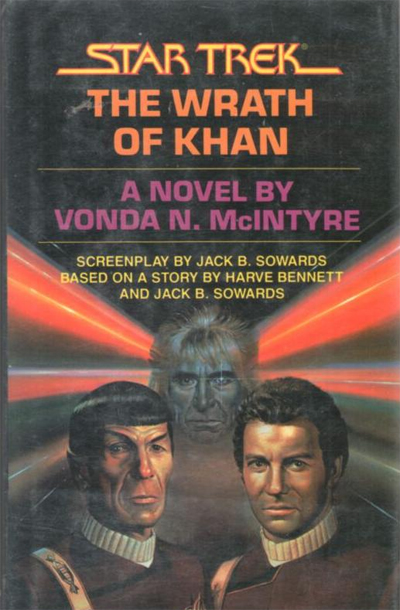
Star Trek II: The Wrath of Khan by Vonda N. McIntyre (Review)

This June, we’re taking a look at some classic Star Trek movie tie-ins and other interesting objects. Check back daily for the latest reviews and retrospectives.

Gene Roddenberry novelised Star Trek: The Motion Picture. While there’s some lingering discussion about whether Roddenberry actually wrote the novelisation, the book reads like the work of a screenwriter turning his hand to prose. It’s more of a manifesto than a novel – an excuse for Roddenberry to expand on his utopian vision for the franchise.

In contrast, Vonda N. McIntyre was hired to write the novelisation of Star Trek II: The Wrath of Khan. Unlike Roddenberry, McIntyre was an experienced and professional novelist. She had been writing since the mid-seventies, and had a wealth of experience in both media tie-ins and her own original work. In fact, McIntyre wrote The Entropy Effect, the book published directly after the publication of The Motion Picture, and only the second Star Trek book published by Pocket Books.

All of this is a very round-about way of explaining that The Wrath of Khan is very much an adaptation in a way that The Motion Picture simply was not.

st-twk-novel

Continue reading

Star Trek – Untold Voyages (Review)

This June, we’re taking a look at some classic Star Trek movie tie-ins and other interesting objects. Check back daily for the latest reviews and retrospectives.

There’s something of a continuity lacuna that exists between Star Trek: The Motion Picture and Star Trek II: The Wrath of Khan. Although the movies were released three years apart, more time appears to have passed for the characters themselves. Some of the changes are quite startling. After fighting so hard to get the Enterprise back in The Motion Picture, Kirk has retired to Earth once again at the start of The Wrath of Khan. After putting the Enterprise back in action in The Motion Picture, it has been converted into a cadet cruiser in The Wrath of Khan.

A lot of stuff has happened, and the gap is relatively under-explored by tie-in material. In contrast, the gap between The Turnabout Intruder (or The Counter-Clock Incident) and The Motion Picture is filled with all sorts of material designed to offer the show the type of closure that it never got on television. The same is true of the gap between The Cage and Where No Man Has Gone Before, with books and comics eager to offer accounts of Pike’s time in command and the transition to Captain James Tiberius Kirk.

Star Trek: Untold Voyages is a five-issue Marvel Comics series published in 1998 designed to bridge The Motion Picture and The Wrath of Khan. Although it wallows a bit in continuity and references, writer Glenn Greenberg uses the series to make some very clever and introspective points about Star Trek as a franchise – in effect, cleverly transitioning from Gene Roddenberry’s “future humans are the best” attitude toward Nicholas Meyer’s more reflective and introspective take on the characters and their world.

Shining star...

Shining star…

Continue reading