• Following Us

  • Categories

  • Check out the Archives


  • Awards & Nominations

Star Trek: Enterprise – Civilisation (Review)

Next year, Star Trek is fifty years old. We have some special stuff planned for that, but – in the meantime – we’re reviewing all of Star Trek: Enterprise this year as something of a prequel to that anniversary. This January, we’re doing the first season. Check back daily for the latest review.

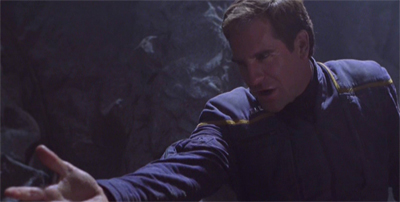
After Breaking the Ice hinted at what Star Trek: Enterprise might become, Civilisation is an episode that nudges the show right back into its comfort zone. It’s an episode of Star Trek that feels like it could have been produced for Star Trek: The Next Generation or Star Trek: Voyager, with only a minimum amount of change to the script. However, what is strangest about Civilisation is the way that it feels like a rather direct throwback to the very classic Star Trek show, serving as a tale about our hot-blooded captain fighting evil imperialist adversaries and seducing sexy alien space babes.

Of course, there’s a sense that this sense of regression is exactly what the show is aspiring towards. After all, Archer was advertised as “Captain Kirk’s childhood hero”, and it makes sense for the show to play with the classic Star Trek tropes that are regarded so affectionately by popular culture. Unfortunately, Civilisation lacks the spark and wit necessary to make such a pulpy homage work, instead feeling too much like a dull retread.

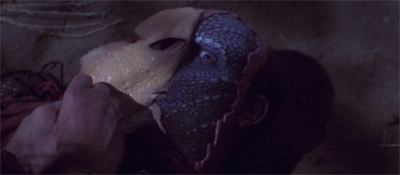
David Ickes was right!

David Icke was right!

Continue reading

Star Trek: Enterprise – Breaking the Ice (Review)

Next year, Star Trek is fifty years old. We have some special stuff planned for that, but – in the meantime – we’re reviewing all of Star Trek: Enterprise this year as something of a prequel to that anniversary. This January, we’re doing the first season. Check back daily for the latest review.

Breaking the Ice is the first episode of the first season of Star Trek: Enterprise not to reserve a “story by” credit for Rick Berman and Brannon Braga. (Although – in the To Boldly Go documentary – Braga has suggested that at least some of the episode came from his own ideas.)

It is instead credited solely to the writing team of Maria & Andre Jacquemetton. A husband-and-wife writing team, the duo have a long history of writing for television. Before they worked on Enterprise, their credits included Baywatch Nights. However, they are probably more notable for the work that they did after Enterprise, working as executive producers and writers on Mad Men. The duo have won WGA awards for their contributions to Mad Men and been nominated for Emmys.
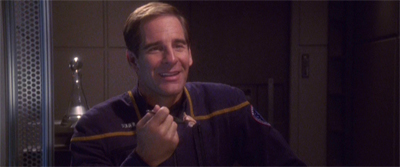
Guess who's coming to dinner...

Guess who’s coming to dinner…

It is very easy to take the pedigree of the writers on Star Trek for granted. After all, Ronald D. Moore went from a Star Trek: The Next Generation fan with a spec script to the showrunner on the rebooted Battlestar Galactica. Bryan Fuller went from a workhorse on the Star Trek: Voyager staff to a television auteur with work on Dead Like Me, Pushing Up Daisies and Hannibal. Brannon Braga has been prolific since his departure from the franchise, while Ira Steven Behr and René Echevarria have worked consistently in genre television.

It is tempting to claim that Enterprise was something of a formative experience for the Jacquemettons, but that would be disingenuous. Despite writing the show’s first script without a credit to Berman and Braga, the duo were not around long enough to make an impression on the show. They departed at the end of the first season, along with most of the writing staff. Indeed, the most significant influence that Enterprise had on their career was probably the fact that they used to discuss the idea for Mad Men with creator Matt Weiner while they were working on this show.
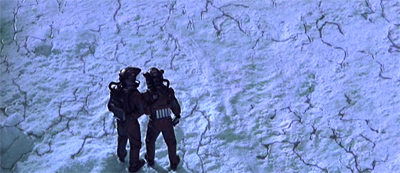
They're cracking up out there...

They’re cracking up out there…

Still, while hardly a demonstration that Jacquemettons were a creative force to be reckoned with, Breaking the Ice is a solid little episode. It ranks as the strongest episode of Enterprise since the pilot. In many respects, it recalls the Prime Factors/State of Flux duology from the first season of Voyager. It is a flawed episode that has no shortage of ambition, offering a taste of what could make its show unique in the Star Trek pantheon.

It is an episode that celebrates everything that makes Enterprise unique as compared to the other Star Trek shows, taking a great deal of pleasure in things that the audience had come to take for granted in the franchise. It’s a quiet character piece, where what little plot exists is pushed very much to the background, and which offers a much more nuanced view of human/Vulcan relations than Strange New World or The Andorian Incident.

Those Vulcans are cold so-and-sos...

Those Vulcans are cold so-and-sos…

Continue reading

Star Trek: Enterprise – The Andorian Incident (Review)

Next year, Star Trek is fifty years old. We have some special stuff planned for that, but – in the meantime – we’re reviewing all of Star Trek: Enterprise this year as something of a prequel to that anniversary. This January, we’re doing the first season. Check back daily for the latest review.

The Andorian Incident is a strange little episode. On the surface, it’s a fairly standard and competently-executed hostage thriller. However, that only scratches the surface. The Andorian Incident is an episode that promises so much more, teasing the potential of Star Trek: Enterprise to evolve into perhaps the most “Star Trek-y of Star Trek shows”, exploring the foundation of the United Federation of Planets and how mankind really found its place in the wider cosmos, building a intergalactic confederation build on peace and tolerance.

The Andorian Incident seems more like a statement of intent from the show, which is a crucial part of any first season.

A bolt from the blue...

A bolt from the blue…

Continue reading

Star Trek: Enterprise – Terra Nova (Review)

Next year, Star Trek is fifty years old. We have some special stuff planned for that, but – in the meantime – we’re reviewing all of Star Trek: Enterprise this year as something of a prequel to that anniversary. This January, we’re doing the first season. Check back daily for the latest review.

Terra Nova is a rather unfortunate fifth episode for Star Trek: Enterprise. The show is in its first season, so there are bound to be mistakes and missteps along the way. However, Unexpected and Terra Nova provide a one-two punch of unfortunate back-to-back episodes, shows that aren’t just the result of an uncertain creative time stumbling while trying to find their groove. Like Unexpected directly before it, Terra Nova is an episode that is toxic from the ground up.

It is, in short, precisely the kind of story that you don’t want to tell about mankind’s first adventures into the cosmos. While the episode very much evokes the mood and style of classic Star Trek, it also inherits all the franchise’s worst colonial impulses. This is an episode that belongs alongside the more ill-judged entries in the first season of Star Trek: The Next Generation, like The Last Outpost or Lonely Among Us.

He's got faith, faith of the heart...

He’s got faith, faith of the heart…

Terra Nova takes a fascinating starting point – something very intrinsically tied to the premise of Enterprise – and twists it into a show about our human protagonists dealing with silly off-world people. Those silly off-world people happen to be humans, who need to be reminded of their humanity, in such a way that our protagonists can feel proud and superior about how advanced and sophisticated they are. Those silly humans who have “gone native” could really learn a lot from our super-advanced heroes.

Terra Nova feels like an episode that sets Star Trek back fourteen years, proof that some of the worst aspects of Roddenberry’s vision of the franchise have endured surprisingly well.

On yer bike, Reed...

On yer bike, Reed…

Continue reading

Star Trek – Assignment: Earth (IDW, 2008) (Review)

The first Star Trek pilot, The Cage, was produced in 1964. To celebrate its fiftieth anniversary, this December we are reviewing the second season of the original Star Trek show. You can check out our first season reviews here. Check back daily for the latest review.

John Byrne’s five-issue Assignment: Earth miniseries is fascinating, because it is perhaps the closest that fans will ever come to getting an actual series spinning out of the episode Assignment: Earth. Of course, the second season finalé had been planned as a backdoor pilot for a new television show, but it never quite materialised. Understandably, Gary Seven tends to appear in spin-off material as a guest star or supporting player. Assignment: Earth focuses on the adventures of Supervisor 194 on his own terms.

Coupled with Byrne’s decidedly old-school done-in-one storytelling structure, Assignment: Earth manages to tell four separate stories featuring Gary Seven and Roberta Lincoln doing what they do in the late sixties and into the seventies. A series of unique and episodic adventures delivered on a regular, Assignment: Earth comes quite close to capturing the feel of a television show. Taking the television episode as his starting point, John Byrne manages to pitch a series of adventures that feel like they might hint at the direction the show could have gone.

Sensors detect a spin-off!

Sensors detect a spin-off!

While the Assignment: Earth miniseries is ultimately disposable and largely forgettable, it is an interesting experiment. By their nature, prose novels like The Eugenics Wars can only focus on a single plot starring the character. Using his fairly compressed approach to comic book storytelling, Byrne can tell five different stories in rapid succession, each with a clear beginning, middle and end. While these stories are inevitably written from the vantage point of 2008, they still feel like they might offer a glimpse at what the show might have looked like.

In many respects, Byrne is hampered by his source material. While the writer and artist has a bit of fun with the concept, a lot of Assignment: Earth ultimately feels a little dry and a little heavy-handed. Despite all the nods towards relevance and social commentary, Assignment: Earth lacks the spirit of adventure and excitement that a television show like this would need in the longer term.

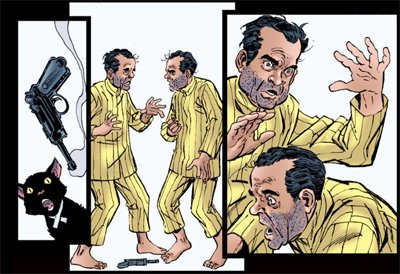
"You'll have fifty percent less Nixon to kick around!"

“You’ll have fifty percent less Nixon to kick around!”

Continue reading

Star Trek: Enterprise – Unexpected (Review)

Next year, Star Trek is fifty years old. We have some special stuff planned for that, but – in the meantime – we’re reviewing all of Star Trek: Enterprise this year as something of a prequel to that anniversary. This January, we’re doing the first season. Check back daily for the latest review.

So, male pregnancy, eh?

Talk about a nipple slip...

Talk about a nipple slip…

Continue reading

Star Trek (DC Comics, 1989) #49-50 – The Peacekeepers (Review)

The first Star Trek pilot, The Cage, was produced in 1964. To celebrate its fiftieth anniversary, this December we are reviewing the second season of the original Star Trek show. You can check out our first season reviews here. Check back daily for the latest review.

There is something quite disconcerting about Gary Seven.

Abducted from Earth at a young age by a race of mysterious aliens, Gary Seven was then returned to Earth in order to ensure that human history unfolds as expected. The unstated assumption is that “as expected” is a euphemism for “according to the wishes of his mysterious employers.” Using his advanced technology, Gary Seven manipulates the world around him. His technology allows him to cloud the minds of his enemies, and to materialise wherever he might wish. He tinkers with nuclear weapons, keeping his existence – and his objectives – a secret from the local people.

Everything comes apart...

Everything comes apart…

It is interesting to wonder how Assignment: Earth might have developed had it successfully spun off from Star Trek. After all, a pilot does not exist to completely define a new television show; it exists to set up a framework through which interesting stories might be told. Would a weekly television show built around Gary Seven have explored these big questions? Or would it have been content to exist as an imitation of Mission: Impossible? As with ever road not taken, it is absolutely impossible to be sure where it might lead.

Still, Howard Weinstein’s The Peacekeepers teases out some of these interesting questions and queries. Even if it never really offers any answers, there is a lot to chew over.

A spectre...

A spectre…

Continue reading

Star Trek – Season 2 (Review)

The first Star Trek pilot, The Cage, was produced in 1964. To celebrate its fiftieth anniversary, this December we are reviewing the second season of the original Star Trek show. You can check out our first season reviews here. Check back daily for the latest review.

The first season of Star Trek was quite remarkable. The cult television show opened with a reasonably solid run of episodes that gradually built momentum over the course of the season. The first season seemed to build towards a crescendo, climaxing with a run of episodes including all-time classics like A Taste of Armageddon, Space Seed, The Devil in the Dark, Errand of Mercy and The City on the Edge of Forever. Sure, Operation — Annihilate! ended the first season on a whimper rather than a bang, but the quality of the show only seemed to improve as the season went along.

In contrast, the second season was a bit more uneven. It probably contains as many truly classic hours of television, but the quality is a lot more variable on an episode-to-episode basis. The Apple leads in to Mirror, Mirror, which leads into The Deadly Years. Metamorphosis leads into Friday’s Child. The Immunity Syndrome and A Piece of the Action follow The Gamesters of Triskelion and Obsession. Watching the season blind is a roller-coaster, with episodes varying radically in quality from one week to the next. Some of the franchise’s best and worst episodes sit back-to-back here.

tos-returntotomorrow25

The second season of Star Trek can be incredibly hard to get a handle on. It is, in many respects, the season that defined a lot of what the franchise could and would become. Episodes like Amok Time and Journey to Babel really built up a universe around the Enterprise and her crew, expanding on late first season episodes like Arena or Errand of Mercy. The show also demonstrated incredible range, with the occult sensibilities of Catspaw and Wolf in the Fold existing alongside the broad comedy of I, Mudd and The Trouble With Tribbles.

However, the season also demonstrated some of the worst tendencies of sixties Star Trek. Episodes like Friday’s Child, A Private Little War and The Omega Glory engaged in precisely the sort of sabre-rattling jingoism against which Balance of Terror and Errand of Mercy had cautioned. The Changeling, By Any Other Name and Return to Tomorrow felt like generic science-fiction retreads. The show brutally (and casually) massacred red shirts in episodes like The Changeling, The Apple and Obsession.

tos-theapple

This variable quality is a feature of episodic television. After all, different writers working on different stories featuring the same characters will inevitably produce a wide variety of results. Some writers “get” the show more than others, and some scripts are subject to more work and attention than others. Such is the nature of the industry, particularly when the production team is cranking out more two dozen hours of television in a year – under intense pressure, both in terms of time and money.

Nevertheless, it is quite difficult to distill the second season of Star Trek into a cohesive or singular whole. It is diverse and multifaceted, capable of being almost anything from one episode (or, perhaps, one moment) to the next. Perhaps that is the greatest legacy of this second season; demonstrating that there is very little Star Trek cannot be.

tos-thetroublewithtribbles2

Continue reading

Star Trek – Assignment: Earth (Review)

The first Star Trek pilot, The Cage, was produced in 1964. To celebrate its fiftieth anniversary, this December we are reviewing the second season of the original Star Trek show. You can check out our first season reviews here. Check back daily for the latest review.

Assignment: Earth was almost the last episode of Star Trek ever produced.

It was also possibly (although nowhere near “almost”) the pilot for a spin-off television show.

Seventh heaven?

Seventh heaven?

At the last minute, following a very high-profile fan campaign, Star Trek was renewed for a third season.

Fans would have to wait decades to see an actual Star Trek finalé that reduced the main cast to guest stars.

"Wait, who just hijacked my show?"

“Wait, who just hijacked my show?”

Continue reading

Star Trek: Enterprise – Strange New World (Review)

Next year, Star Trek is fifty years old. We have some special stuff planned for that, but – in the meantime – we’re reviewing all of Star Trek: Enterprise this year as something of a prequel to that anniversary. This January, we’re doing the first season. Check back daily for the latest review.

Strange New World is the first episode of Star Trek: Enterprise to come from a writing team other than Brannon Braga and Rick Berman. Berman and Braga would dominate the writing credits for the first season. Even when the final teleplay was credited to another writer or writing team, there was often a “story by” credit given to Berman and Braga. Braga himself has conceded that he essentially re-wrote all of the episodes of the first season.

Still, Strange New World is credited to the writing team of Mike Sussman and Phyllis Strong. Both had worked on Star Trek: Voyager before migrated to Star Trek: Enterprise along with André Bormanis. Sussman had pitched the story for Meld and worked on a number of solo stories and scripts before teaming with Strong on the seventh and final season of the show. The two would remain a writing team for the first two seasons of Star Trek: Enterprise, hitting their stride with some of the strongest episodes of the troubled second season.

Picture perfect...

Picture perfect…

Strange New World is an interesting début for the pair. On the hand, it is a story that celebrates the unique place of Star Trek: Enterprise in the Star Trek pantheon. It’s a story about how great it must be to set foot on an alien planet, and how wondrous it must be to breath air from outside our atmosphere. With its emphasis on shuttlepods and primitive transporters, it does remain relatively true to the prequel premise of Enterprise.

On the other hand, Strange New World is a very familiar Star Trek template. Indeed, it’s a very familiar first season template. It’s the episode where the crew of the ship are exposed to some strange outside force that makes them all act out of character. It’s something of a Star Trek standard. The original Star Trek had The Naked Time and Star Trek: The Next Generation had The Naked Now, while Star Trek: Deep Space Nine had both Babel and Dramatis Personae. In many ways, Strange New World feels like a familiar old story.

Strange yellow daisy fields forever...

Strange yellow daisy fields forever…

Continue reading