












The September and October, we’re taking a look at the jam-packed 1994 to 1995 season of Star Trek, including Star Trek: Deep Space Nine and Star Trek: Voyager. Check back daily for the latest review.
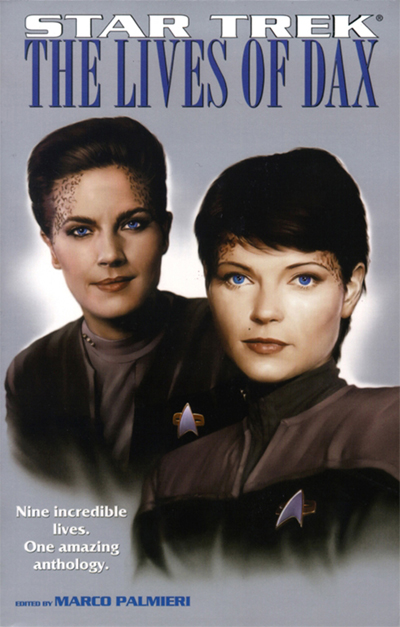
Joran Dax was a much more interesting character in Equilibrium than he became in later appearances. In shows like Facets and Field of Fire, Joran went from being a socially dysfunctional individual who murdered his supervisor to a serial killer with an in-depth understanding of the psyche of a killer. The shift is understandable. After all, “killer” is much more eye-catching with word “serial” placed in front of it.
Unfortunately, it has a tendency to diminish the character. Serial killers are a dime-a-dozen in pulp fiction. Although they had been a fixture of the American popular consciousness for quite some time, the critical and commercial success of The Silence of the Lambs had turned serial killers into a cottage industry within popular culture. Films and television shows about people hunting serial killers became fixtures of the pop culture landscape, to the point where it all got exhausting.
The story of Joran Dax as presented in Equilibrium is tragic and more than a little compelling. In that story, Joran was a damaged individual who was not ready to merge with another mind. The process shattered his psyche completely, breaking his tenuous hold on reality. As a result of poor screening and a quirk of fate, the thing he had wanted for the most of his life pushed him over the edge. He lashed out, killing the person who had initially rejected him from the initiation programme.
It is a story that makes Joran seem like a creature to be pitied. Indeed, Equilibrium ends with Jadzia embracing Joran – as if accepting that his actions were not entirely his fault. Unfortunately, Allegro Ouroboros in D Minor rather heavily re-writes this back story, in favour turning Joran into a serial killer. Reading Allegro Ouroboros in D Minor, Joran comes off as even more of a Hannibal Lecter knock-off than he did during Avery Brooks’ scenery chewing in Facets. Which is saying something.
Filed under: Deep Space Nine | Leave a comment »






 the m0vie blog
Star Trek: Deep Space Nine – Equilibrium (Review)
The September and October, we’re taking a look at the jam-packed 1994 to 1995 season of Star Trek, including Star Trek: Deep Space Nine and Star Trek: Voyager. Check back daily for the latest review.
Equilibrium is another troubled Dax episode. Dax is probably the hardest character on the Star Trek: Deep Space Nine cast to write for, if only because of the character’s central premise. “Well-adjusted functionally immortal alien slug inside a young woman’s body” is a nice character description, but it’s hard to ground a character-driven story in that. It’s tempting just to turn the Dax symbiote into a convenient macguffin that can drive various plots.
To date, Playing God is really the only Dax-centred episode of Deep Space Nine that has placed the emphasis on Jadzia rather than the slug inside here. (Although Blood Oath did at least try to deal with how a current Trill host deals with obligations incurred by past lives.) In Dax, the symbiote was a gateway to a pretty conventional and generic murder mystery story. In Invasive Procedures, the symbiote was something particularly valuable to be stolen and exploited.
The biggest problem with Equilibrium is that – like Dax and Invasive Procedures before it – the episode uses the Dax symbiote as a springboard to a story that is more driven by Sisko and Bashir than it is by Jadzia Dax. While Equilibrium does have a great hook and some biting social commentary, Dax feels more like a plot point than a character in her own right.
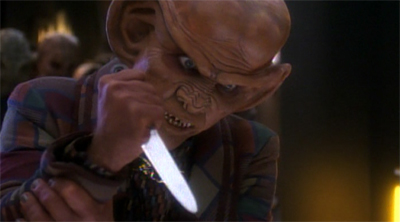
Shocking behaviour…
Continue reading →
Filed under: Deep Space Nine | Tagged: 1994, 1995, america, Anger, bitterness, class, Dax, deep space nine, ds9, ennui, equilibrium, reflection, René Echevarria, ron moore, social commentary, Trill | 5 Comments »