• Following Us

  • Categories

  • Check out the Archives


  • Awards & Nominations

Star Trek: Deep Space Nine – His Way (Review)

His Way doesn’t so much straddle the line between sweet and creepy as play hopscotch across it.

There is a lot to like about His Way. There is a palpable enthusiasm to the episode, a charm and energy that excuses the indulgence. After all, His Way uses the holosuite to create facsimile of sixties Las Vegas populated by a self-aware crooner who spends a solid chunk of the episode hitting swing band classics. It is a ridiculous set-up, yet one entirely in keeping with the interests of Star Trek: Deep Space Nine.

Suited to the task…

Deep Space Nine never felt like it belonged in the nineties. It felt a much stronger connection to Star Trek than to Star Trek: The Next Generation, as evidenced by episodes like Crossover and Blood Oath. It built entire episodes around a classic Hollywood aesthetic, from the broad noir pastiche of Necessary Evil to the more specific plot references of Profit and Loss or Meridian. This is a television show that made repeated and extended references to Julian Bashir’s affection for James Bond in episodes like Our Man Bashir or A Simple Investigation.

There is a genuine warmth and affection that shines through His Way, something at radiates through the episode from Jay Chattaway’s lounge-tinged ambient soundtrack through to James Darren’s giddy performance. There is a sense that everybody involved in the episode is having such a good time that it would be churlish to begrudge them this small diversion. After all, Deep Space Nine is much closer to the end than to the beginning, and the production team have accomplished so much that they deserve an indulgence.
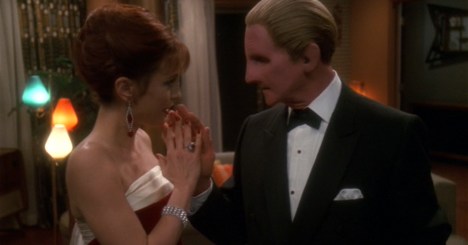
The hands-on approach.

At the same time, His Way has not aged particularly well. It is the episode that eventually gets Odo and Kira together, but it suffers from the problem affecting many of the episodes leading into the relationship. His Way is told almost exclusively from Odo’s perspective, reducing Kira to an object of fascination or desire. His Way invests a lot of energy in the idea that Odo can “win” Kira, but it never affords Kira any agency. This was okay in Crossfire, an episode explicitly about how unhealthy Odo’s unrequited and unexpressed obsession was. It works less well in His Way.

His Way plays almost like an episode about a pick-up artist, about that creepy subculture in which insecure and nerdy men effectively try to trick women into sleeping with them through a complicated series of performance pieces and psychological warfare. Rene Auberjonois and James Darren make a charming enough duo that the episode doesn’t tank outright, but His Way still feels decidedly creepy in its approach to the question of courtship.

Vic’s story is life.

Continue reading

Doctor Who – Knock, Knock (Review)

“That’s what they’re called, Driads?”

“That’s what I’m calling them, yes.”

“You’ve gone crazy.”

“Well, I can’t just call them lice, can I?”

Performance is a bit wooden.

Knock Knock is a solid, if unexceptional, episode of Doctor Who. It occasionally feels more like a grab bag of idea welded together, more than a single cohesive story.

Knock Knock is essentially three very different episodes sutured together in a decidedly haphazard fashion. Knock Knock is, in quick succession: an episode focusing on Bill’s life outside the TARDIS, an old-school haunted house adventure, an intense familial psychodrama with a powerhouse guest performance. There is a strong sense that Knock Knock would work better if it chose to be any two of those three episodes, but that it simply cannot hold itself together trying to satisfy all three masters.

Dial it back, there.

Continue reading

Star Trek: Voyager – Unforgettable (Review)

Unforgettable has perhaps the most ironic title in the Star Trek canon.

The episode is very generic in nature, very much in keeping with the style of Star Trek: Voyager. It is a love story centring on the character Chakotay, although he seems to have been selected as the focus of the episode by chance. There is nothing about Unforgettable that would not work as well as an episode built around Harry Kim or Neelix or even Tuvok. It is an episode with an alien of the week, with a strange society that leads to a dilemma that can be neatly resolved within the forty-five minutes allotted to the episode, leaving no lasting mark on the series.

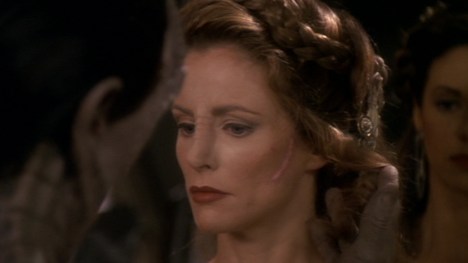
Forget me not…

Unforgettable has any number of interesting ideas. The Ramuran are an interesting high concept, an alien race with the power to erase themselves from the memories of those they encounter. That should be an interesting story hook, particularly given Voyager‘s recurring fascination with memory and identity. This is also an episode built around a guest appearance from cult icon Virginia Madsen. Madsen is a fantastic guest star for Voyager, an actor who really deserves a meaty and memorable role, like Andy Dick was afforded with Message in a Bottle.

Unfortunately, none of these ideas coalesce. Unforgettable is a bland romantic episode that moves a glacial pace towards an inevitable outcome, either unable or unwilling to exploit either its clever concept or its top-tier guest star to tell a memorable story. Unforgettable is ultimately anything but.

Memories are made of these.

Continue reading

Star Trek: Deep Space Nine – In the Pale Moonlight (Review)

I can live with it.

I can live with it.

– Captain Benjamin Lafayette Sisko, Stardate 51721.3

In the Pale Moonlight is a masterpiece.

There is simple no way around it. It works beautifully as a morality play, as a thriller, as a character study. It has a powerful script, a set of brilliant performances, a memorable set-up and pay-off. In the Pale Moonlight is a fantastic piece of television production, something that immediately distinguishes itself from the episodes around it. Like The City on the Edge of Forever or The Inner Light, there is just something fundamentally different about In the Pale Moonlight from the establishing shots.

In many ways, In the Pale Moonlight is the flip side of the coin to Far Beyond the Stars. Both are spectacular episodes of television, and stand as some of the best entries in the franchise canon. However, there are clear differences. While Far Beyond the Stars would not work with any other lead character or actor, it is an episode that is arguably quintessentially Star Trek; it is a powerful allegory about racism and the power of an optimistic future. In contrast, In the Pale Moonlight is specifically Star Trek: Deep Space Nine.

In the Pale Moonlight is an episode of Deep Space Nine that simply could not exist in any other Star Trek show. This could never have been an episode of Star Trek: The Next Generation or Star Trek: Voyager. The episodes that edge closest to this – like The Pegasus or The Omega Directive – lack the same commitment to the premise. Star Trek: Enterprise arguably came closest with the script for Damage, but even that lacked the powerhouse focus of In the Pale Moonlight.

As the title implies, In the Pale Moonlight is a story about what it takes to dance with devil. It is told against the epic backdrop of the Dominion War, against the scale and spectacle of the sixth season of Deep Space Nine, but the real drama of In the Pale Moonlight unfolds in one man’s confession. This is the story in which the Romulans join the war effort, but it is not a story about the Romulans joining the war effort. It is a story about how Captain Benjamin Sisko sets a price for his own self-respect and his own self-regard.

In the Pale Moonlight is that most personal of dramas, the story of a man who bargains away his soul for a far cheaper price than he expects.

Continue reading

Star Trek: Voyager – The Omega Directive (Review)

The Omega Directive plays like Star Trek: Voyager is trying to push itself.

It is an episode which finds Janeway acting secretively and unilaterally, casually brushing aside the Prime Directive in service of some hidden agenda. This is a very big deal. On the original Star Trek, it frequently seemed like the Prime Directive was something for Kirk to outwit. However, since Star Trek: The Next Generation, the franchise has taken the rule to have a lot more moral weight. Even more precisely, since Caretaker, Janeway has emphasised that it is not her place to intervene directly in the affairs of alien civilisations.

The be-all and end-all.

So there sound be something very shocking about Janeway keeping secrets from her crew and forsaking the moral principle that had been the cornerstone of her first few years in command. Given how conventional Voyager has been, how carefully the show has pitched itself as the most archetypal of Star Trek shows, this should be a pretty big deal. What would get Janeway to consciously (and even enthusiastically) cross those lines? How far would she go? What else is she concealing from the people around her? It should be a powerhouse episode of television.

However, The Omega Directive falls flat. Part of the problem is timing, with The Omega Directive sandwiched between Inquisition and In the Pale Moonlight in terms of the overall franchise chronology. Star Trek: Deep Space Nine had been transgressing and subverting franchise norms for years at this point. The Omega Directive feels like something relatively small-scale, juxtaposed against the activities of Section 31 or Sisko’s complicity in murder. The Omega Directive thinks that it is playing in the same league, but it is not even the same sport.

An explosive new development.

More than that, there is a clumsiness to The Omega Directive. The episode touches on a number of interesting ideas, but the story’s thematic weight is quite consciously removed from the core premise. The Omega Directive works best as a weird episode touching on Borg spirituality, and on the question of the Collective’s motivations, but the episode invests so much energy in the black-ops norm-shattering framing device that these elements do not feel like satisfying pay-off. The core themes of The Omega Directive feel like they belong in another episode.

The Omega Directive is a wasted opportunity, its underwhelming subversive trappings distracting from what might have been a compelling meditation on faith and belief.

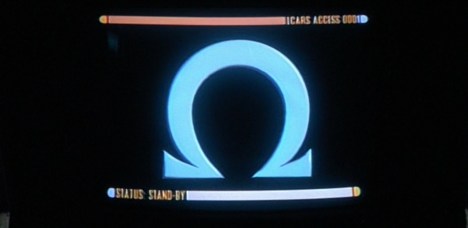
That healthy blue glow.

Continue reading

Doctor Who: Thin Ice (Review)

“How is that a screwdriver?”

“In a very broad sense.”

“Well, how is it sonic?”

“It makes a noise.”

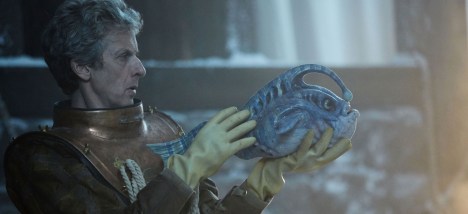
Pilot fish.

Thin Ice is a fairly solid historical adventure, one that takes a fairly conventional Doctor Who template and puts a slightly self-aware spin on it.

As with The Pilot and Smile, there is a decidedly nostalgic quality to Thin Ice. As with the two prior episodes, Thin Ice feels like a conscious throwback to the structure of the Davies era. Moffat’s final season as showrunner has opened with the classic present-future-past triptych that recalls Rose, The End of the World and The Unquiet Dead, or The Christmas Invasion, New Earth and Tooth and Claw or Smith and JonesThe Shakespeare Code and Gridlock. This is a very familiar and comforting pattern.

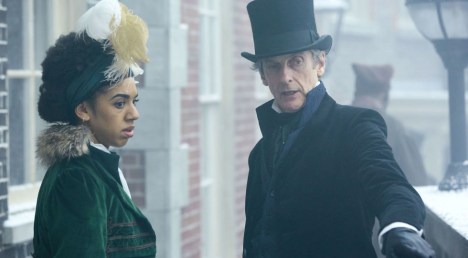
Hat’s off to him.

As with Smile before it, Thin Ice is built upon a stock plot. A series of mysterious disappearances lead the Doctor and his companion to one inescapable conclusion: there is a monster menacing Regency England. Thin Ice feels very much like the kind of episode that Mark Gatiss has been known to write, an affectionate historical depiction of an iconic chapter in British history like The Unquiet Dead, The Idiot’s Lantern or The Crimson Horror. Indeed, Thin Ice looks lavish, complete with all the costume drama trappings that one might expect.

However, much like Smile, there is a slight twist on the tale. Whereas Smile attempted to subvert the classic “machines gone awry” plot with a clumsy last-minute twist, Thin Ice instead makes a point to weave its commentary and theme through the familiar structure of the episode. Thin Ice might be a very conventional historical monster story, but it engages with themes of race and class that are often under-explored in these stories.

The time travelers who came in from the cold…

Continue reading

Star Trek: Deep Space Nine – Inquisition (Review)

Inquisition is a superb piece of television, and a highlight of the sixth season of Star Trek: Deep Space Nine.

It is a very clever extrapolation of various themes and ideas that have been bubbling across the length and breadth of the series, particularly concerns about what happens when incredible power is concentrated in institutions that find themselves under threat. One of the underlying assumptions of the Star Trek universe is that mankind is somehow different than any other sentient life form, somehow more enlightened and more idealistic than the other major powers that make up the broader shared universe.

Luthless.

Deep Space Nine has always been wary of this assumption, in part because it is frequently made with no real exploration of what specifically makes mankind more evolved and more compassionate than the Romulans or the Klingons. More than that, Deep Space Nine has been openly suspicious of that idea because of the moral complacency involved. If Star Trek assumes that mankind is so special and so unique that it has evolved past all of its darker impulses, the franchise has a massive blindspot that could be readily exploited.

This is nothing new. Although the first season of Star Trek: The Next Generation leaned heavily into the idea of mankind as a hyper-evolved species with much to teach the wider cosmos, that series really came of age when it followed this train of thought to its logical conclusion in The Measure of a Man. A society that deems itself beyond moral reproach is capable of anything, because it lacks the introspection to really consider the moral weight of its actions. Even in peacetime, the Federation was only a single court case away from re-instituting slavery.

Imperialist leather.

Inquisition is very much a logical extension of this idea. Beyond the sprawling epic six-episode opening arc, the sixth season of Deep Space Nine arguably works best when it sits outside the Dominion War and explores the impact that the conflict has beyond the space battles. Statistical Probabilities ponders the war in numerical terms. Honour Among Thieves inquires about life in the underground and at the margins. In the Pale Moonlight touches on the backroom politics and the moral compromises. Inquisition looks at how the Federation itself has been changed by the war.

Like Homefront and Paradise Lost, Inquisition has aged well. Less than half a decade after the episode originally aired, the United States would be trying “enemy combatants” in secretive military tribunals, detaining suspected terrorists without trial in secretive holding facilities, and engaging in “enhanced interrogation” including sleep deprivation to make subjects more pliable. Although the production team could have no idea at the time, the image of a dark-skinned man being paraded in irons is a lot more evocative two decades after the fact.

“Not quite the parade that I had in mind.”

Continue reading

Star Trek: Voyager – Vis á Vis (Review)

Well, it was nice while it lasted.

The fourth season of Star Trek: Voyager had a nice little strand of continuity running through the fourth season, from the discovery of the relay stations and first contact with the Hirogen in Message in a Bottle through to the reaching of an accord with the Hirogen in The Killing Game, Part II. That six-episode run had demonstrated a remarkable attention to detail on the part of the production team. Even the relatively stand-alone episode Retrospect alluded to the ending of Prey and the threat of the Hirogen lingering from Hunters.

Ch-ch-changes…

However, Vis á Vis represents a return to business as usual for the series. It is a light stand-alone episode that completely eschews any sense of continuity or character development. Credited to production assistant Robert J. Doherty, Vis á Vis feels like a weird throwback to the middle of the second season, a retrograde character-driven episode rooted in a version of Tom Paris that has not existed since Investigations at the absolute latest. The result is a weird body-swapping episode where the regular cast member seems out of character to begin with.

Vis á Vis is an outdated Voyager episode, even beyond the lame body-swap premise.

Grease is not the word.

Continue reading

Star Trek: Deep Space Nine – Wrongs Darker Than Death or Night (Review)

Wrongs Darker Than Death or Night once again brushes up against the limits of Star Trek: Deep Space Nine.

Wrongs Darker Than Death or Night is essentially two episodes wrapped up in one. Most basically, it is a character-driven melodrama that focuses on Kira and her relationship to her mother. Dark secrets are unearthed, and betrayals are revealed. Kira finds that she is much closer to Dukat than she once believed, and finds her own moral certainty tested as she confronts the reality of who her mother was and the compromises that she had to navigate in the context of the Cardassian Occupation. It is a bold and provocative episode, daring and unsettling.

Everybody has scars.

However, Wrongs Darker Than Death or Night is also trying to be an exploration of the kind of moral compromises necessary against the backdrop of the Cardassian Occupation, about the toll that such a horrific event inflicts upon a population. It is a tale of sexual slavery and brutality, about manipulation and abuse. It is a tale about power and violence, and how those aspects of an enemy occupation do not always manifest in brute force. This is story about the scars that such horrors leave. This is a clumsy episode, revealing the firm limits that exist within Deep Space Nine.

Wrongs Darker Than Death or Night does not work as well as it should, suggesting that there are some stories that Deep Space Nine simply cannot tell.

Screening her calls.

Continue reading

Doctor Who: Smile (Review)

Smile is a retro future thriller updated for the twenty-first century. It is 2001: A Space Odyssey and Logan’s Run by way of Ex Machina or The Girl With All the Gifts.

On the surface, Smile is the story of a rogue computer program seeking to enslave or destroy mankind. Popular culture is littered with that particular nightmare, a sentient AI that embarks upon patricide; Skynet from The Terminator, Alpha 60 in Alphaville. Indeed, Doctor Who has a rich history of playing with the trope; the sentient computer in The Keys of Marinus, B.O.S.S. from The Green Death, WOTON from The War Machines, P7E from Underworld. It is a classic science-fiction trope, and Smile plays with the idea of help robots becoming self-aware and murderous.

Bad bots.

Indeed, even the aesthetic of the episode consciously evokes those retro stories. Smile was filmed in Valencia’s City of Arts and Sciences, a beautiful architectural marvel defined by its smooth white surfaces and peaceful atmosphere. It feels very sterile and very clean, its minimalism evoking the set designs of those classic films and its relative lack of colour harking back to the time when Doctor Who was broadcast in black-and-white. For most of its runtime, Smile feels like a very old-fashioned piece of science-fiction.

However, around the halfway point, a shift takes place. All of a sudden, the smooth whites of the city give way to the grim industrial earth tones of the rocket. The episode seems to jump forward to gritty late seventies and early eighties science-fiction, the “used future” of Star Wars and Alien. As the episode continues, it pushes even further. Ultimately, it becomes a sly subversion of the archetypal “robot rebellion” story, instead exploring the implications of that narrative. The Vardi are transformed from renegade robots to freed slaves. It is a clever twist, albeit somewhat rushed.

Character arcs.

Continue reading