• Following Us

  • Categories

  • Check out the Archives


  • Awards & Nominations

Star Trek: Voyager – Night (Review)

Star Trek: Voyager typically bridged its seasons with epic two-parters, a sprawling single narrative told over two forty-five minute episodes separated by the three-month summer hiatus. In fact, it was somewhat striking when the production team chose to end the fourth season with Hope and Fear, a standalone episode with a very definite conclusion. However, it becomes even more ironic once the fifth season opens with Night. Rather than one story split over two episodes, Night feels like two narratives compressed into a single chunk of television.

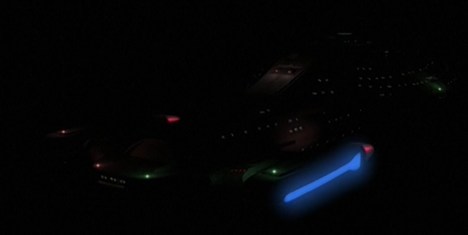
Of these two narratives, one is definitely more interesting than the other. The first half of Night essentially focuses on the ship and crew as they venture through an empty (and starless) section of space known as “the Void.” No light can get in. Nothing seems to live in there. There are no anomalies to investigate. “Anything to report?” Tuvok asks Kim. Kim responds, “Not even a stray electron.” It is so dull that even Tom classifies the detection of “a sudden increase in theta radiation” as “excitement.”
Starless, starless night.

This is an interesting approach to storytelling, particularly for a show so focused on plot. More than any other series in the franchise, Voyager runs on plot beats. Stories tend to progress from one revelation and escalation to the next, affording little room for character development or exploration. As such, the first half of Night seems like a very ambitious piece of work, an introspective character-driven drama where there are no plot beats to distract from character. It is a very brave and compelling set-up.

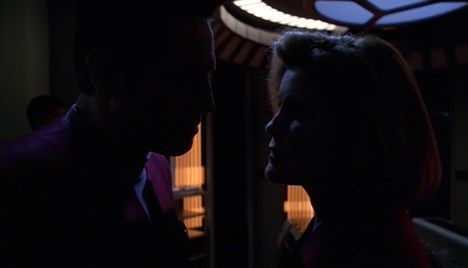
Of course, Night somewhat fumbles the ball in this first half. The thread is never explored as thoroughly as it might be, the character never allowed to properly express themselves. There is far too much emphasis on the holodeck, and the ship’s ability to simulate comforts and illusions even in this most depressing of surroundings. However, compared to the way that Voyager usually tells stories, the first half of Night is refreshing. Ironically, it is genuinely exciting, because it feels like the writers are pushing outside their comfort zone.
A darker side of Janeway.

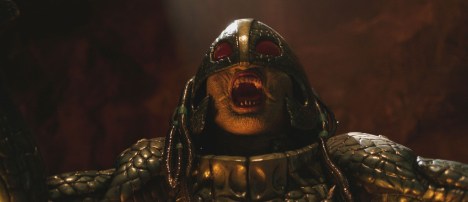
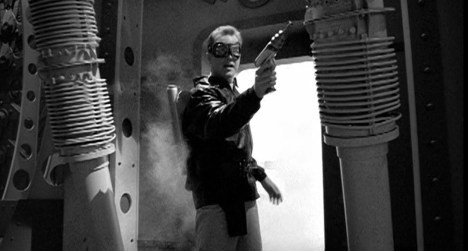
Unfortunately, it cannot last. Night can only resist the comfort of plot for so long. Eighteen minutes into the hour, the second plot kicks into gear. It is a much more conventional Voyager episode, particularly for these later seasons. There is a broadly drawn piece of social commentary that ties into the both Voyager‘s New Age sensibilities and its attitude towards the Delta Quadrant as a whole. There are new aliens introduced, that will become recurring foils. It is all very standard, and all very rushed. The second half of Night makes up for those missed plot beats.

The result is an episode that is deeply frustrating, a game of two halves were each horribly undercuts the other.
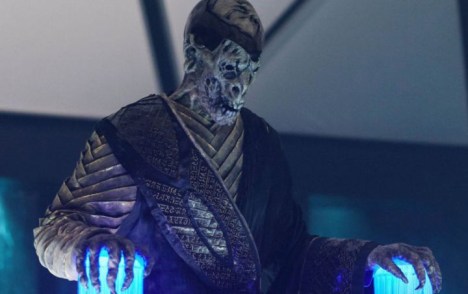
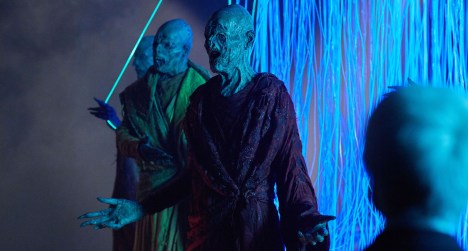
A black-and-white issue.

Continue reading

Doctor Who: Empress of Mars (Review)

Empress of Mars might be the last script that Mark Gatiss writes for Doctor Who for a long time.

Chris Chibnell has expressed an interest in putting together an American-style “writers’ room” upon taking over the series. It is entirely possible that Gatiss might continue to write for the show, to the point that he has expressed optimism at the possibility. Nevertheless, it seems likely that Chibnell would have a different dynamic with Gatiss than the other showrunners; Gatiss was the first writer to write for the revival other than Russell T. Davies, and co-created Sherlock with Steven Moffat.

Forget a Hard Brexit or a Soft Brexit.
Mars wants a Cold Brexit.

Gatiss has been a fixture of Doctor Who, dating back even beyond the start of the revival. Like Davies and Moffat, Gatiss wrote extensively for the property during the interregnum between Survival and Rose. Since the series returned to television screens, Gatiss has been a regular contributor. He has written for eight of the ten television seasons to air since the show was revived in 2005. He has written for every season overseen by Steven Moffat, making him unique among the stable of  Doctor Who recurring writers. As such, Empress of Mars represents the end of an era.

Empress of Mars might just be the best script that Mark Gatiss has ever written for Doctor Who.

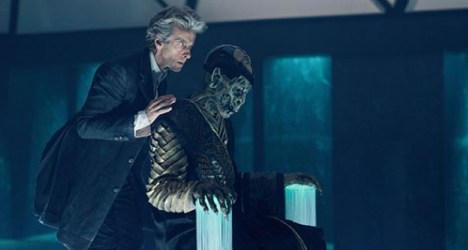
For Queen and Planet.

Continue reading

Star Trek: Deep Space Nine – Shadows and Symbols (Review)

Image in the Sand and Shadows and Symbols continue to reframe the theology of Star Trek: Deep Space Nine in terms of Christian iconography.

To be fair, it makes sense that Christian imagery and metaphor should so heavily influence film and television. The United States is the world’s largest exporter of entertainment, and so it makes sense that its preoccupations should filter through into the art that it creates. After all, certain plot and story threads on Star Trek: Voyager (including the Kazon, and the treatment of immigrants and refugees in Displaced and Day of Honour) are very clearly anchored in a number of racial anxieties unique to California during the nineties.

The writing’s on the wall.

However, there was something very interesting in the way that Deep Space Nine had introduced and developed its theology. The early seasons of Deep Space Nine were heavily influenced by more eastern religions, like Buddhism. They were also more ambiguous in their portrayal of the wormhole aliens, suggesting that the enigmatic creatures could be both aliens and gods, depending on one’s perspective. Even then, there was a recurring suggestion in episodes like Emissary and Prophet Motive that the wormhole aliens did not conform to human morality.

As Deep Space Nine approaches the end of its run, it simplifies its approach to religion. The Prophets become a lot less ambiguous, and the spiritual framework becomes a lot more conventional. This process really began in earnest with The Assignment and was solidified in The Reckoning, but it becomes a lot more concrete in Image in the Sand and Shadows and Symbols.

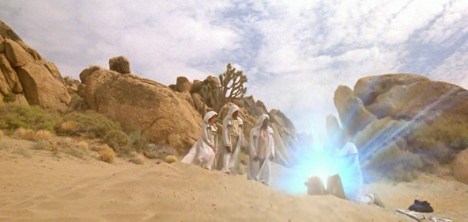
Let there be light.
And it was good.

Continue reading

Star Trek: Deep Space Nine – Image in the Sand (Review)

There is an endearing sense of symmetry to the seventh season premiere of Star Trek: Deep Space Nine.

The writers who worked on the show have been quite candid about their creative process. In particular, most of the production team would acknowledge that the show was heavily improvised rather than planned in advance. While the creators had a sense of the direction in which they wanted to move, they did not have a clear destination in mind until quite late in the journey. This was quite obvious looking at a number of the strange narrative detours that the arc took, most notably Gul Dukat’s time as a space pirate between Return to Grace and By Inferno’s Light.

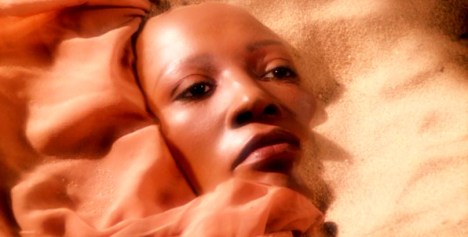
A Time to Sands.

At the same time, as the seventh season began, it seemed like the writers working on Deep Space Nine had a much stronger idea of how they wanted the series to come to a close. Image in the Sand and Shadows and Symbols feel like a very clever structural choice for the seventh season premiere. They exist at once as echoes of the arc that opened the sixth season and as preludes to the story that would conclude the seventh. They exist as bookends to these two chapters of the larger series, feeling almost like the exact midpoint of a larger story.

Positioned approximately half-way between the epic six-episode arc that opened the sixth season and the sprawling ten-episode narrative that would draw down the curtain at the end of the seventh season, Image in the Sand and Shadows and Symbols feel like a much smaller affair. However, they are still well-observed and well-written, covering a lot of thematic and narrative ground in a way that contextualises what come before and sets up what will follow.

“Play it again, Sisko.”

Continue reading

Star Trek: Deep Space Nine – Season 6 (Review)

The sixth season of Star Trek: Deep Space Nine seems to brush up against the limits of what the show could do.

To be fair, Deep Space Nine spent most of its fourth and fifth seasons smashing through the arbitrary boundaries imposed upon what a Star Trek show could and could not do. Overseen by executive producer Ira Steven Behr, the writing staff very consciously and very vigourously pushed past the limitations imposed by the so-called “Roddenberry Box” and the style of television overseen by franchise leader Rick Berman. The storytelling became more complex, serialisation crept in, the music became more noticeable, conflict became more evident.

This all built to a climax in the second half of the fifth season, a series of interlinked stories that stretched from In Purgatory’s Shadow and By Inferno’s Light through to Call to Arms. Diplomatic tensions rose, character arcs became clear. Then, at the very end of the season, the unthinkable happened. The Federation went to war with the Dominion. More than that, the Federation started a war with Dominion. It was a bold creative choice, one that chipped away at so many of the assumptions underlying the utopian future of Star Trek.

The sixth season faces a number of serious problems. Most obviously, the fourth and fifth seasons had pushed so far that there was only so much ground left to cover. The sixth season explored that ground thoroughly. There is an argument to be made that the arc that opens with Call to Arms and continues through the first six episodes of the sixth season ranks as the single most ambitious stretch of the Rick Berman era. Episodes like Far Beyond the Stars, Inquisition and In the Pale Moonlight pushed the franchise well outside its comfort zone.

At the same time, there was a clear sense that the production team was butting up against the limits of the form, that they had pushed Deep Space Nine almost as far as it was possible to push a nineties Star Trek show, and so the season lacked the same sense of forward momentum as the fourth and fifth seasons had. Many creative decisions in the sixth season feel like the result of creative compromise, whether the sense that the writers had told all the big stories that they wanted to tell or because they had to bow in some way to the conventions of television storytelling.

The result is a frustrating season of television. The sixth season of Deep Space Nine features some of the best Star Trek episodes in the fifty-year history of the franchise. However, it also contains a lot of thwarted ambitions. For every barrier that the sixth season smashes through, it brushes up against another. It is a reminder of just how far Deep Space Nine had pushed the franchise during its run. In some ways, it felt like the sixth season of Deep Space Nine was not so much brushing up against the limits of Star Trek as against the limits of nineties television.

Continue reading

Doctor Who: The Lie of the Land (Review)

The Lie of the Land is a much more conventional episode than Extremis or The Pyramid at the End of the World.

Part of that is undoubtedly down to the fact that it actually has to resolve a massive three-part “event” story, instead of iterating through the invasion of the monks and pushing off the ending to the next episode. While Extremis and The Pyramid at the End of the World could be experimental and playful in their form and structure, The Lie of the Land is very much a standard meat-and-potatoes episode that has to tidy up the pieces so that Mark Gatiss might have a clean slate for Empress of Mars.

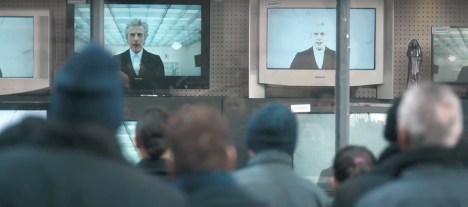
Terror vision.

However, even outside of the three-part structure and the experimental nature of the preceding episodes, The Lie of the Land feels like a curiously old-fashioned and straightforward adventure. It is a very conventional “contemporary Earth invasion” story. It is a template that feels very firmly rooted in the history of Doctor Who, but one that feels relatively out of place in the context of the Moffat era as a whole. After all, the last time that the Doctor squared down an alien invasion as the primary plot of an episode, it was the unconventional Power of Three.

The Lie of the Land is the kind of story that was far more common during the Davies era. It is very much of a piece with stories like Aliens of London, World War III, Rise of the Cybermen, The Age of Steel, Doomsday, The Sontaran Stratagem, The Poison Sky, The Stolen Earth and Journey’s End. Indeed, the basic plot of the episode owes a lot to The Last of the Time Lords. It is perhaps telling that The Lie of the Land is credited to writer Toby Whithouse, who is (along with Mark Gatiss) one of the primary holdover writers from the Davies era as a whole.

Old hat.

The Lie of the Land is competently executed, more interested in maintaining forward momentum and hitting big emotional beats than it is with big ideas. Tellingly, the episode adds very little to the mythology or definition of the monks beyond what was suggested in Extremis and The Pyramid at the End of the World. After those two episodes worked hard to make the Monks unique, The Lie of the Land turns them into generic Orwellian bad guys who manipulate history in a fairly simplistic manner.

The Lie of the Land is essentially a broad strokes run-around. While there’s definitely a time and a place for that, and while it certainly makes sense after two bolder and more provocative episodes, there is something faintly disappointing in this.

Information is power.

Continue reading

Star Trek: Deep Space Nine – Tears of the Prophets (Review)

Tears of the Prophets has a number of very good ideas.

The character arc driving the episode is very good, particularly in the context of a finale leading into the final season of the show. Star Trek: Deep Space Nine has always been a show more interested in character arcs and long-form storytelling than the other Star Trek shows, so “Benjamin Sisko experiences a loss so great that he resigns his commission” is an organic story beat. It feels like a story that the writers on this show can tell, and a story that fits very comfortably within the grand mythic framework that the writers are trying to construct.

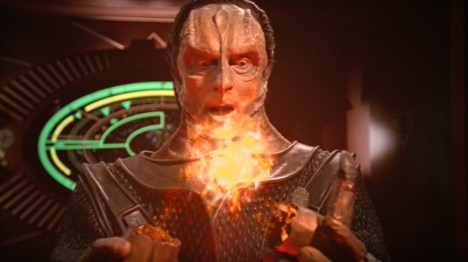
All fired up.

Deep Space Nine has earned a lot of goodwill in this regard, demonstrating a willingness to let stories play out over extended periods and to follow stories through to their natural conclusion. Sisko leaving the station at the end of Tears of the Prophets is not the same as Picard being assimilated at the end of The Best of Both Worlds, Part I or Worf leaving the Enterprise at the end of Redemption, Part I. Any savvy audience member knows that Sisko will return to his post, probably sooner rather than later, but they also trust the show to treat it as more than just a striking cliffhanger.

Unfortunately, Tears of the Prophets is compromised by a number of very poor ideas. Some of those ideas did not originate with the writing staff, their hands forced by outside factors. Ira Steven Behr’s original plans for Tears of the Prophets did not include the death of Jadzia Dax, but the writers had to incorporate that plot element rather late in the cycle. Of course, this does not excuse some of the poor decisions made in how the writers chose to handle that unforeseen plot element, although that was also a result of a number of outside factors.

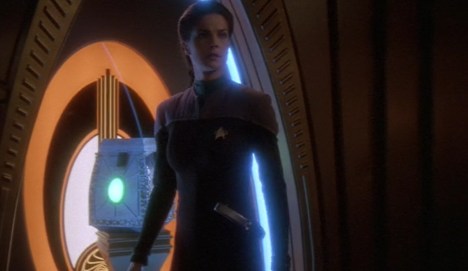
So Jad to zia you.

However, Tears of the Prophets also leans into some of the more frustrating creative decisions of the sixth season as a whole. The script doubles down on some of the least satisfying elements of Deep Space Nine‘s long-form storytelling, even combining several of these frustrating beats into a central narrative strand of the season finale. Tears of the Prophets combines the generic cartoon villainy of Gul Dukat as suggested at the climax of Waltz and the teaser to Wrongs Darker Than Death or Night with the stock mysticism of the Pah-Wraiths from The Reckoning for a heady ill-judged cocktail.

The result is a somewhat uneven episode, a story with a very strong central character arc that plays to the strengths of the show, but with several supporting elements that indulge the series’ worst impulses.

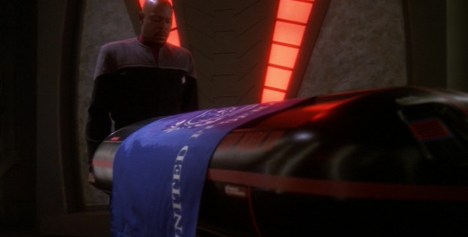
Funeral for a friend.

Continue reading

Star Trek: Deep Space Nine – The Sound of Her Voice (Review)

The Sound of Her Voice is a very sweet and thoughtful little episode.

In many ways, it is the perfect penultimate episode of the sixth season of Star Trek: Deep Space Nine. It is a reminder of just how much the series has changed over the past few seasons, but also a demonstration of the things that make the show different from Star Trek: The Next Generation or Star Trek: Voyager. It is an episode that is anchored in the sort of careful character development and rich atmosphere that sets the series apart from the other Star Trek series. It is difficult to imagine this episode working as well with any other cast.

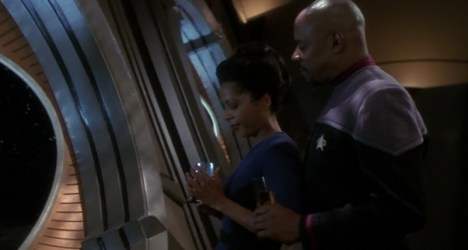
Absent friends.

However, The Sound of Her Voice is more than just a clever character-driven ensemble piece. It is a very reflective piece of television. Like Ronald D. Moore’s previous script for the sixth season, Valiant, his work on The Sound of Her Voice feels very introspective. Over the course of the episode, the characters find themselves in contact with a voice from the past. In a very direct way, The Sound of Her Voice puts the characters from Deep Space Nine in conversation with the franchise’s history.

There is a lot of maturity and consideration in The Sound of Her Voice, which feels appropriate as the sixth season draws to a close.

The window of opportunity is closing.

Continue reading

Star Trek: Deep Space Nine – Time’s Orphan (Review)

In some ways, Time’s Orphan provides a companion piece to Profit and Lace.

A recurring theme of the sixth season of Star Trek: Deep Space Nine has been the suggestion that the series has reached the limits of what is possible within the context of a nineties Star Trek series, that it has really done just about everything that it is possible for a mid-nineties genre television show to do within the confines of Gene Roddenberry’s universe. After the fourth and fifth seasons crashed through boundaries, the sixth discovers new limits on the horizon.

This will not end well.

In some ways, Profit and Lace marks the end of the line for Deep Space Nine‘s Ferengi-centric episodes. It suggests that the production team have done just about everything that they can do within that framework, and that the ideas remaining are somewhat underwhelming. Time’s Orphan does something similar with the annual (or even biannual) “O’Brien must suffer!” stories. The production team have inflicted almost every horror imaginable on Chief Miles Edward O’Brien, and Time’s Orphan represents just about the last idea left.

Time’s Orphan is nowhere near as bad as Profit and Lace, although it taps into the same core problem. The writers on Deep Space Nine have taken a given story thread about as far as they can take it, which means that there is very little left to do within an established framework. Time’s Orphan manages a few moments of genuine emotion, but it also feels strained and tired. Time has caught up with the production team.

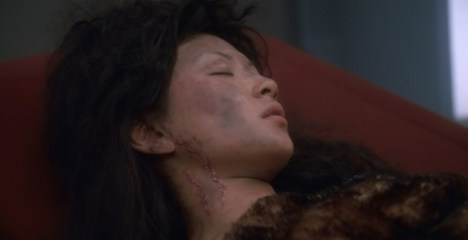
Scarred to death.

Continue reading

Doctor Who: The Pyramid at the End of the World (Review)

The Pyramid at the End of the World is very much a Peter Harness script.

Much like Kill the Moon, The Zygon Invasion and The Zygon Inversion, the climax of the episode boils down to a set of characters in a contained set making an impossible moral choice in the abstract. Harness very much writes Doctor Who in the grand tradition of science-fiction allegory, the use of the show’s absurd framework to ask broad philosophical questions about the human condition in general and this political moment in particular. Harness is writing Doctor Who in the great political tradition of The Happiness Patrol.

Without a thread of doubt.

Harness is a writer with his finger on the proverbial pulse. The Zygon Invasion and The Zygon Inversion were essentially metaphorical explorations of radicalisation and immigration, touching on two of the hot-button political issues of the season. The Pyramid at the End of the World essentially updates the root metaphor for the current climate. The Pyramid at the End of the World is essentially a story about what it takes for people to make truly unconscionable choices. At what point does an ordinary decent person consent to be governed by a monster?

This is very much in tune with the popular consciousness in 2016 and 2017. After all, the British public voted for Brexit largely in support of xenophobic platform that borrowed imagery from Nazi Germany. The American public elected a leader who believed that most Mexicans were rapists and that all women wanted him to sexually assault them. At what point do these objectively horrific ideas seem palatable to the average person? The Pyramid at the End of the World reaches the same answer as Harness’ other Doctor Who scripts: when people are very afraid.

“Why didn’t you tell me you’d had fibre installed?”

Continue reading