• Following Us

  • Categories

  • Check out the Archives


  • Awards & Nominations

Star Trek – In the Name of Honour by Dayton Ward (Review)

This August, to celebrate the upcoming release of Star Trek: Into Darkness on DVD and blu ray, we’re taking a look at the Star Trek movies featuring the original cast. Movie reviews are every Tuesday and Thursday.

We’ll be supplementing our coverage of the movies with tie-ins around (and related to) the films. We’ll be doing one of these every week day. This is one such article.

The Klingons changed rather dramatically, between the classic Star Trek and Star Trek: The Next Generation. Part of the changes were physical – most obviously, advances in make-up allowed Klingon characters to be shown with their now-iconic forehead ridges. However, there was another interesting change. Somewhere between The Turnabout Intruder and Encounter at Farpoint, the Klingons went from generic communist stand-ins to a fully-formed alien culture with a wealth of ritual and tradition.

To a large extent, this shift took place during the movie era. Klingons wound up being the focus of Star Trek III: The Search for Spock, and were a significant presence in each of the films that followed. Star Trek V: The Final Frontier, produced at the same time as the first season of Star Trek: The Next Generation, suggested that it wasn’t necessary for the Federation and the Klingon Empires to be mortal enemies. The final movie featuring the original cast, Star Trek VI: The Undiscovered Country, tied up Kirk’s adventures with the promise of galactic peace.

Still, it’s hard to reconcile the differences in characterisation between the Klingons seen in the classic Star Trek television show and those from the later spin-offs. With In the Name of Honour, Dayton Ward tries to explore this radical shift and also to bridge The Final Frontier and The Undiscovered Country. He does the former much better than the latter.

startrek-inthenameofhonour

Continue reading

Star Trek – Dwellers in the Crucible by Margaret Wander Bonanno (Review)

This August, to celebrate the upcoming release of Star Trek: Into Darkness on DVD and blu ray, we’re taking a look at the Star Trek movies featuring the original cast. Movie reviews are every Tuesday and Thursday.

We’ll be supplementing our coverage of the movies with tie-ins around (and related to) the films. We’ll be doing one of these every week day. This is one such article.

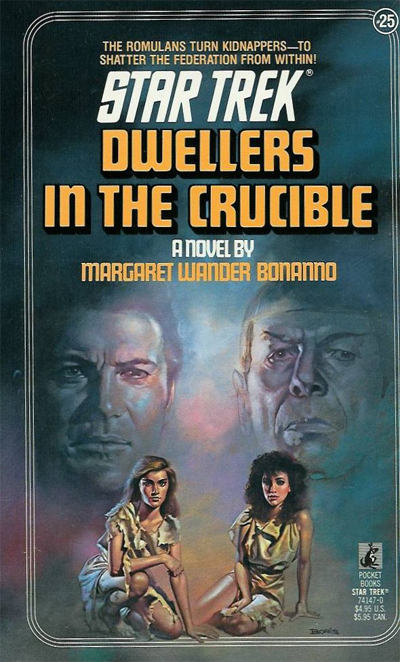
The state of Star Trek tie-ins in 1985 was radically different than it is today. While the film series was at height of its popularity, generating a great deal of attention for the franchise, authors working on the associated tie-in novels were granted a great deal of freedom. Books from this era tend to be a great deal looser, adapting a sort of “devil may care” attitude towards the type of restrictions one might impose on a Star Trek story. Novels could be dedicated to new characters or to existing aliens, or offer radical twists on the show’s rich mythology. It was almost free-style Star Trek, with authors afforded the freedom to tell the stories that they wanted to tell, no matter how difficult it might be to fit that within the confines of “Star Trek.”

Dwellers in the Crucible captures a lot of the spirit of this era quite well. It’s Margaret Wander Bonanno’s first Star Trek tie-in book, but it’s also her strangest. It’s a rather high-concept piece of trashy “women in prison” fiction that dares to ask a question that nobody in their right mind had ever broached before: what if Kirk and Spock were lesbians?

st-dwellersinthecrucible

Continue reading

Hannibal – Fromage (Review)

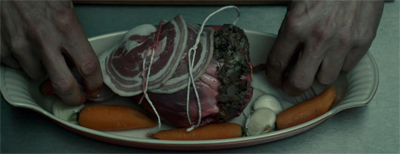
With Fromage, Hannibal walks a bit of a fine line. One of the obvious conflicts in the first half of the season was between the procedural “serial killer of the week” elements and the more intriguing character-driven parts of the show. I think that, past the half-way point of the first season, the show begins to balance those two aspects much better. However, Fromage can’t help but feel a little bit contrived. It relies a rather convenient overlap between Hannibal’s world and Will Graham’s investigation.

Still, it works quite well as a continuation of the themes hinted at in Sorbet, and takes advantage of the fact that the show has completely embraced its lead character’s darker side. If Entrée and Sorbet pushed Hannibal from the periphery of the story into the spotlight, then Fromage allows him to actively drive the story. It’s the show’s first serial-killer-heavy story that is driven more by Hannibal than by Graham.

Work and play...

Work and play…

Continue reading

Star Trek – The Ashes of Eden by William Shatner et al (DC Comics) (Review)

This August, to celebrate the upcoming release of Star Trek: Into Darkness on DVD and blu ray, we’re taking a look at the Star Trek movies featuring the original cast. Movie reviews are every Tuesday and Thursday.

We’ll be supplementing our coverage of the movies with tie-ins around (and related to) the films. We’ll be doing one of these every week day. This is one such article.

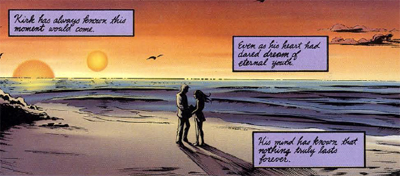
The Ashes of Eden is effectively professionally published Star Trek fan fiction, written by William Shatner. The actor gets some assistance from veteran Star Trek writers Judith and Garfield Reeves-Stevens, but it’s clear that Shatner is the driving force behind The Ashes of Eden. Indeed, an astute reader will spot quite a few thematic overlaps with Shatner’s much-maligned directorial effort, only without the rest of the cast around to temper his efforts to make this a story about Kirk and Kirk alone.

Still, The Ashes of Eden isn’t as bad as it might be. After all, just because something is fan fiction – professionally published or otherwise – says nothing of its quality. The story is probably best read as an exploration between Shatner and his alter ego, but it holds together quite well, providing a much more solid (if still far from perfect) exploration of the themes hinted at in Shatner’s Star Trek V: The Final Frontier.

The dusk of an era...

The dusk of an era…

Continue reading

Hannibal – Sorbet (Review)

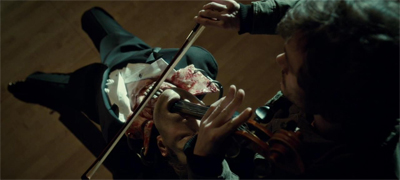
Hannibal took its time building up Hannibal Lecter as a serial killer. According to creator Bryan Fuller, there would have been a joke in Aperitif about Lecter’s culinary habits, but holding off on the sight of Lecter as a serial killer until the end of Entrée feels like it was a shrewd move. Not because it could ever fool the audience into forgetting that Hannibal Lecter is a murdering cannibal or anything like that. Instead, it builds up a certain amount of tension and suspense around the character, allowing us to see how those around him could have been blinded by his persona.

With a few obvious exceptions – knocking out Doctor Bloom in Potage or phoning the Hobbs household in Aperitif – we’ve mostly seen Lecter through the eyes of others. While the very premise of the show counts on the audience knowing who or what Lecter is, keeping him at a distance allowed the show a bit of breathing room in its first year. However, now that we’ve caught a glimpse of Lecter in action, Sorbet feels like its willing to pull back the layers on our eponymous epicurean.

Best served warm...

Best served warm…

Continue reading

Star Trek – Music of the Spheres by Margaret Wander Bonanno (Review)

This August, to celebrate the upcoming release of Star Trek: Into Darkness on DVD and blu ray, we’re taking a look at the Star Trek movies featuring the original cast. Movie reviews are every Tuesday and Thursday.

We’ll be supplementing our coverage of the movies with tie-ins around (and related to) the films. We’ll be doing one of these every week day. This is one such article.

Music of the Spheres is something of a legend in Star Trek circles. It’s not quite a ghost story, spoken of in hushed whispers. Indeed, author Margaret Wander Bonanno has made the manuscript available to interested fans via her website, and has used it to raise money for a variety of worth causes. She’s documented the difficult story of how her original novel warped in Probe in a wonderfully wry and insightful essay, offering a glimpse at the inner workings of Pocket Book and Paramount towards the end of the eighties.

It’s a rare peek behind the curtain, with Music of the Spheres serving as a compelling vehicle to explore just what was going on inside Star Trek licensing in the late eighties and early nineties.

startrek-voyagehome8

Continue reading

Star Trek – Unspoken Truth by Margaret Wander Bonanno (Review)

This August, to celebrate the upcoming release of Star Trek: Into Darkness on DVD and blu ray, we’re taking a look at the Star Trek movies featuring the original cast. Movie reviews are every Tuesday and Thursday.

We’ll be supplementing our coverage of the movies with tie-ins around (and related to) the films. We’ll be doing one of these every week day. This is one such article.

Saavik is an interesting character, for several reasons. Most obviously, there’s the behind the scenes manoeuvrings involving the new character. Everything from her origin to the recasting of the role between Star Trek II: The Wrath of Khan and Star Trek III: The Search for Spock. There’s the inclusion of a short scene in Star Trek IV: The Voyage Home, and the fact that the last time we see Saavik, she’s watching the reunited cast of the original Star Trek continue their galactic adventures.

There’s her complete absence from Star Trek V: The Final Frontier and then the weird pseudo-return of the character in Star Trek VI: The Undiscovered Country, where the role that would become Valeris was originally considered for Saavik, before being cast with Kim Cattrall, an actress who had originally been considered to play Saavik. It’s interesting to consider the conceptual history of the character, given what she was supposed to represent upon her introduction in The Wrath of Khan.

Margaret Wander Bonanno does an excellent job exploring Saavik’s life in the wake of her decision to remain on Vulcan in The Voyage Home, with Unspoken Truth doing an excellent job playing with the character in the grand scheme of the shared Star Trek universe.

startrek-unspokentruth

Continue reading

Hannibal – Entrée (Review)

It’s nice that we got this far into the season before Entrée was necessary. It’s the kind of episode that a show like Hannibal was always going to have to produce relatively early on, allowing it to air the laundry, so to speak, and to overtly and clearly distinguish itself from a popular predecessor. In this case, it’s The Silence of the Lambs.

Although we haven’t met Clarice Starling yet, although the credit at the start of each episode cites Red Dragon as the show’s inspiration, it’s hard to escape the shadow of one of the most popular horror films ever made. Many argue that The Silence of the Lambs was the first film to win the Best Picture Oscar. Even today, it remains a cultural touchstone, and there’s an incredibly large number of people who are only familiar with the character of Hannibal Lecter through that story and – in particular – through the film adaptation.

Hannibal hasn’t been shy about referencing The Silence of the Lambs, nor should it be. Crawford’s office from the start of Aperitif seems arranged in homage to the film, while the arrangement of two of the victims in Coquilles couldn’t help but evoke Hannibal’s dramatic escape from his cell at the film’s climax. Still, that doesn’t change the fact that Entrée exists mainly to allow the show to indulge and engage in the imagery and iconography of the film, so that Hannibal can truly distinguish itself.

"Oh, goodie..."

“Oh, goodie…”

Continue reading

Star Trek Special #1 (1994) – The Needs of the One (Review)

This August, to celebrate the upcoming release of Star Trek: Into Darkness on DVD and blu ray, we’re taking a look at the Star Trek movies featuring the original cast. Movie reviews are every Tuesday and Thursday.

We’ll be supplementing our coverage of the movies with tie-ins around (and related to) the films. We’ll be doing one of these every week day. This is one such article.

In many ways, the Star Trek movies feature more character development and exploration for the cast than the entire three seasons of the television show. Star Trek III: The Search for Spock and Star Trek IV: The Voyage Home are true ensemble pieces, but there’s also more of a sense that this is a family rather than a bunch of people who just hang out together. I’d argue that the cast of Star Trek: The Next Generation remain the tightest ensemble that the franchise has ever produced, but the first six movies portray the crew of the original Enterprise as a bunch of people who have been to hell and back together.

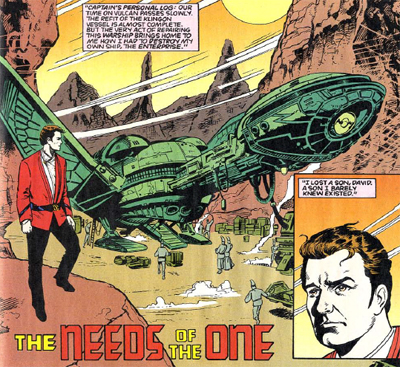
Michael Collins’ The Needs of the One represents a bit of an interlude between The Search for Spock and The Voyage Home, taking place during the crew’s three month “Vulcan exile.” While Collins’ script suffers from its inability to decide whether it’s a Spock-centric character drama or a day-in-the-life of the renegade crew, it’s a fascinating story situated in a lacuna of the movies’ chronology. It cements the idea that Spock has been radically altered over the course of the film series, and that his character arc spans the first four films.

Indeed, Collins’ opening sequence tying together his failure to achieve Kolinahr in Star Trek: The Motion Picture with his decision to once again rejoin the crew in The Voyage Home.

When all Kirk asked for was a tall ship, he probably should have been more specific...

When all Kirk asked for was a tall ship, he probably should have been more specific…

Continue reading

Star Trek (DC Comics, 1984) #28 – The Last Word (Review)

This August, to celebrate the upcoming release of Star Trek: Into Darkness on DVD and blu ray, we’re taking a look at the Star Trek movies featuring the original cast. Movie reviews are every Tuesday and Thursday.

We’ll be supplementing our coverage of the movies with tie-ins around (and related to) the films. We’ll be doing one of these every week day. This is one such article.

Star Trek II: The Wrath of Khan, Star Trek III: The Search for Spock and Star Trek IV: The Voyage Home form a trilogy that tells a single story, covering Spock’s death and resurrection, the loss of the Enterprise and the construction of its replacement and Kirk’s journey from washed-up old commander to saviour of the planet Earth. Although the three films weren’t planned as a single story, they worked out surprisingly well as a Star Trek epic told across three films and four years.

Four years is a remarkable turn-around for three franchise films, let alone three well-received franchise films. However, it’s worth conceding that the storyline had a fairly significant impact on the tie-in media. Books could be published set in the existing gaps in chronology, but DC’s plan for their first volume of Star Trek comics was to feature stories set in the contemporary film universe. Since that universe was in the middle of its own story, and the comic publishers had no idea how it would play out, the results are interesting.

Lighten up...

Lighten up…

Continue reading