• Following Us

  • Categories

  • Check out the Archives


  • Awards & Nominations

New Escapist Video! “Candyman – Review”

I’m thrilled to be launching movie reviews on The Escapist. Over the coming weeks and months, I will be joining a set of contributors in adding these reviews to the channel. For the moment, I’m honoured to contribute a three-minute film review of Candyman, which is released theatrically in Europe and the United States this weekend.

“Let It Go, Indiana”: “Indiana Jones and the Last Crusade”, and the Necessity of Growing Up…

This August, the podcast that I co-host, The 250, is doing a season looking at all four Indiana Jones films as part of our “Indiana Summer.” This week, we’re looking at Indiana Jones and the Last Crusade, and I had some thoughts on the film.

The clue is in the title. Indiana Jones and the Last Crusade was clearly intended to be the last movie in the Indiana Jones series, the title character’s last adventure.

By the time it came to release Indiana Jones and the Last Crusade, both Lucas and Spielberg were clearly drawing down the shutters on the franchise. “Three is a nice number,” Lucas remarked. Contemporary reviews noted that the film was positioned as the “last romp” with the daring adventurer. Shortly after the film’s release, Harrison Ford donated the character’s iconic bullwhip to the Institute of Archeology at University College London. Spielberg would later reflect, “I thought the curtain was lowering on the series, which is why I had all the characters literally ride off into the sunset at the end.”
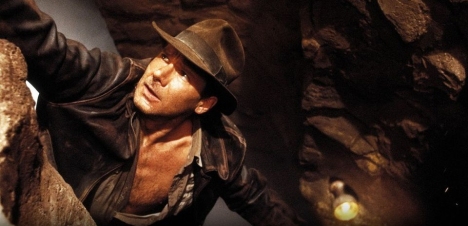
Hang in there.

There is a sense that the reaction to Indiana Jones and the Temple of Doom might have been a key factor here. After all, the basic premise of Raiders of the Lost Ark wasn’t something that demanded a neat three-movies-and-done structure, particularly when the second movie had actually be a prequel rather than a sequel and adopted a completely different style than its predecessor. As much as it drew from the same kinds of adventure serials that George Lucas and Steven Spielberg had loved as children, this franchise was not Star Wars. It didn’t set out to adopt the mythic triptych structure.

Indeed, contemporary critics made a point to read Indiana Jones and the Last Crusade as something of an apology for Indiana Jones and the Temple of Doom. Opening his review, Randy Lewis joked that Pauline Kael was “probably the only person on the planet” who preferred Indiana Jones and the Temple of Doom to Raiders of the Lost Ark. Early reports talked about Indiana Jones and the Last Crusade as something of a rebound after Indiana Jones and the Temple of Doom had “turned off many critics.”
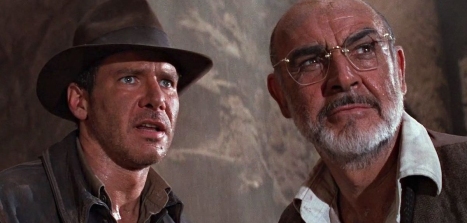
Bring Your Dad to Work Day was going great.

Certainly, it’s notable that the five year gap between Indiana Jones and the Last Crusade and Indiana Jones and the Temple of Doom was appreciably longer than the three year gap between Indiana Jones and the Temple of Doom and Raiders of the Lost Ark. It seems that there was enthusiasm to make the movie. More than that, while Spielberg had made Indiana Jones and the Temple of Doom following the critical and commercial success of E.T., he only returned to the franchise with Indiana Jones and the Last Crusade after the critical and commercial disappointment of Empire of the Sun.

This perhaps explains the conservative nature of Indiana Jones and the Last Crusade. If there is a criticism to be leveled at the film, it is that Indiana Jones and the Last Crusade feels like a retreat back to the comforts of Raiders of the Lost Ark as much as it feels like anything new. Indiana Jones and the Temple of Doom was bold and novel, but Indiana Jones and the Last Crusade is safe and familiar. Once again, there are Nazis. Once again, there is Sallah and there is Brody. Once again, there’s an erudite man selling out to work with the Nazis. Once again, there is a Judeo-Christian artifact with unlimited power.
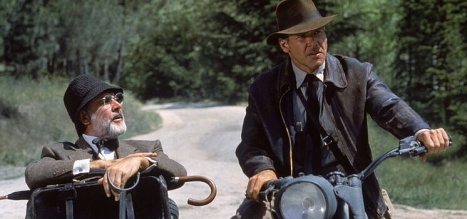
Everybody eventually finds themselves at a crossroads in their lives.

Indiana Jones and the Last Crusade is a very conventional and very straightforward sequel, at times even feeling like something of a remake of the first installment. In that way, it recalls Star Wars: Episode VI – Return of the Jedi, which was similarly predicated on reacting against a darker and weirder middle entry in a trilogy by instead serving the audience nostalgia for an original film that they loved. It’s vaguely disheartening, and it perhaps explains the sense of closure at work here. It often feels like Lucas and Spielberg are trying to end the series with a reminder of a widely-accepted past triumph.

It’s notable that Indiana Jones and the Last Crusade arrived in a summer dominated by the sorts of blockbusters and sequels that movies like Jaws and Star Wars had enabled, and which Raiders of the Lost Ark had helped to codify. It seemed somewhat appropriate that Indiana Jones and the Last Crusade arrived the same summer as movies like Lethal Weapon IIGhostbusters II, Star Trek V: The Final Frontier, License to Kill, Karate Kid III and Batman. In many ways, Indiana Jones and the Last Crusade was positioned as a victory lap for Spielberg and Lucas, a standard-bearer in a blockbuster era that they both helped create.
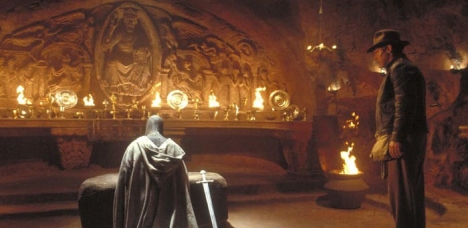
Eternal life or not, you should probably thoroughly disinfect any cup you find here before drinking from it.

Still, what distinguishes Indiana Jones and the Last Crusade from those other films is its not of finality. Indiana Jones and the Last Crusade is not a movie that begs for a sequel. In fact, with due respect to Indiana Jones and the Kingdom of the Crystal Skull, the movies seems structurally designed to all but rule out any substantial subsequent adventures. This is probably one reason, along with casting concerns, why the franchise’s next major film or television project was The Young Indiana Jones Chronicles. Allowing for occasionally appearances from an older Indiana Jones, the only way forwards was backwards.

There’s an endearing and surprising grace to Indiana Jones and the Last Crusade, a sense of the franchise making peace with itself and deciding to call it a day. There’s an interesting maturity in this, which feels arguably of a piece with where Steven Spielberg was at this point in his career.
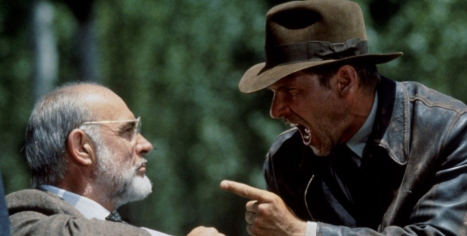
The original Getting Even With Dad

Continue reading

New Escapist Column! On Why the Mandarin from “Iron Man 3” Remains One of the Best Marvel Villains…

I published a new In the Frame piece at The Escapist this evening. With the release of Shang-Chi and the Legend of the Ten Rings next week, it seemed like a good opportunity to take a look back at Iron Man 3, and that movie’s attempt to update the Mandarin for the twenty-first century.

Long treated as Tony Stark’s arch-nemesis, the Mandarin is a complicated character with a very troubled history. The character is built around yellow peril stereotypes, and is easily recognisable as a classic Fu Manchu archetype. Part of what made Iron Man 3 so compelling and so interesting was the way in which the film wasn’t just built around the Mandarin as a character, but instead explored and interrogated the concept. It was a film about how pop culture, film and television, creates images of foreign enemies in service of the politic demands of the moment. Iron Man 3 explores that idea brilliantly.

You can read the piece here, or click the picture below.

New Escapist Video! “Reminiscence – Review”

I’m thrilled to be launching movie reviews on The Escapist. Over the coming weeks and months, I will be joining a set of contributors in adding these reviews to the channel. For the moment, I’m honoured to contribute a three-minute film review of Reminiscence, which is released theatrically in Europe and the United States this weekend and is now streaming on HBO Max.

New Escapist Video! “The Witcher: Nightmare of the Wolf – Review”

I’m thrilled to be launching movie reviews on The Escapist. Over the coming weeks and months, I will be joining a set of contributors in adding these reviews to the channel. For the moment, I’m honoured to contribute a three-minute film review of The Witcher: Nightmare of the Wolf, which is releasing on Netflix tomorrow.

New Escapist Video! On What Makes “The Suicide Squad” the Year’s Best Blockbuster…

So, as I have mentioned before, I am doing some film critic work at The Escapist. Part of that includes long-form video criticism, such as this piece which is now available to watch at The Escapist, editted by the wonderful Matt Laughlin, looking at what makes The Suicide Squad the best blockbuster of the year to date.

“Anything Goes!” The Curious, Qualified Appeal of “Indiana Jones and the Temple of Doom”…

This August, the podcast that I co-host, The 250, is doing a season looking at all four Indiana Jones films as part of our “Indiana Summer.” This week, we’re looking at Indiana Jones and the Temple of Doom, and I had some thoughts on the film.

Indiana Jones and the Temple of Doom occupies an interesting space in the cultural consciousness.

Released as a sequel to Raiders of the Lost Ark, the film was generally considered something of a disappointment. Despite a higher profile and a higher budget, the film grossed slightly less than its direct predecessor. The reviews were generally unkind. People Magazine decried the movie as “an astonishing violation of the trust people have in Spielberg and Lucas’ essentially good-natured approach to movies intended primarily for kids.”

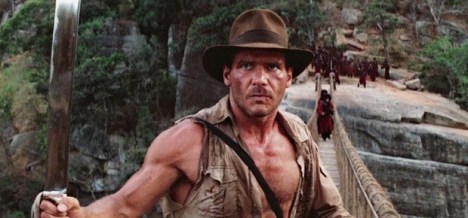
A bridge too far?

Many of those involved with the film seem to have accepted this criticism and taken it to heart. Kate Capshaw quipped that Indiana Jones and the Temple of Doom only really endured because it was packaged as part of trilogy re-releases, joking, “Thank goodness it’s a three-pack, or we wouldn’t have made the cut.” Spielberg was already apologising for the movie in the pre-release publicity for Indiana Jones and the Last Crusade, admitting, “I wasn’t happy with the second film at all.”

To be clear, there are a lot of valid criticisms of Indiana Jones and the Temple of Doom. It would almost be a cheat to concede that the film “has not aged well”, as that would imply that its portrayal of the Indian subcontinent was not horribly dated on its initial release in the mid-eighties. However, accepting and allowing for these very real problems, there is still something interesting and engaging about Indiana Jones and the Temple of Doom. It’s not a movie that is appealing in spite of its darkness, but one that is appealing precisely because of it.

Fortune and glory.

Indiana Jones and the Temple of Doom is a messy and brutal movie. It’s angry and it’s unpleasant. However, it is interesting for precisely that reason. It stood out in the context of Steven Spielberg’s career at the time because Spielberg had cultivated an image of himself as a wholesome and wondrous filmmaker. Indiana Jones and the Temple of Doom marks the first real challenge to that image, perhaps paving the way for the director’s later forays into darkness and cynicism with movies like The Lost World: Jurassic Park, A.I. Artificial Intelligence, Minority Report, War of the Worlds, Munich and more.

Indiana Jones and the Temple of Doom feels like the work of Steven Spielberg at his most unguarded, cutting completely loose and working through a lot of stuff. It’s a very candid and very explicit film, lacking a lot of the polish and the cleanliness of Spielberg’s other major works from around this time. That’s what makes it such a fascinating artifact.

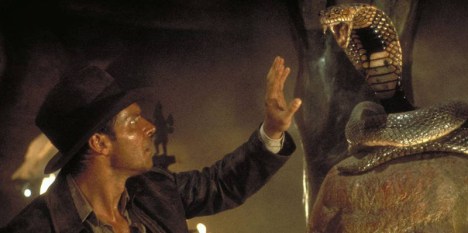
“Why did it have to be snakes?”

Continue reading

New Escapist Video! On How “The Suicide Squad” Uses Idris Elba…

So, as I have mentioned before, I am launching a new video series as a companion piece to In the Frame at The Escapist. The video will typically launch with every second Monday’s article, and be released on the magazine’s YouTube channel the following week. This is kinda cool, because we’re helping relaunch the magazine’s film content – so if you can throw a subscription our way, it would mean a lot.

With the release of The Suicide Squad last week, it seemed like a good opportunity to take a look at one of the things that the film did very well. In particular, the movie used its lead actor to great effect. The Suicide Squad is a movie that understands Idris Elba’s movie star persona and understands how it enhances the general mood of the film around it.

New Escapist Column! On How “The Suicide Squad” Uses Idris Elba…

I published a new In the Frame piece at The Escapist this evening. With the release of The Suicide Squad, it seemed like a good opportunity to take a look at one of the keys to the film’s success. James Gunn understands how to use Idris Elba as a leading man.

Movie stardom is a fascinating concept. So much of what makes a particular person a movie star is ineffable. It is hard to quantify or gauge. It can also be difficult to harness with intent and purpose. This is particularly true in an era where Hollywood seems to be moving away from movie stars, and films like Jungle Cruise seem to struggle against their leads’ screen personas. However, part of what makes The Suicide Squad so effective is that it understands exactly what makes Idris Elba so compelling as a screen presence, and finds a way to play into that to the movie’s benefit.

You can read the piece here, or click the picture below.

New Escapist Column! On the Return of the Hollywood Epic…

I published a new In the Frame piece at The Escapist this evening. With the release of The Green Knight, and the upcoming releases of movies like Dune and The Last Duel, it seems like the old-fashioned Hollywood epic might be making a comeback.

This is interesting, as the genre has long been a Hollywood staple. Most people obviously think of the big biblical epics from the middle of the twentieth-century – Ben-Hur, The Ten Commandments, Quo Vadis? However, there was an interesting revival at the turn of the millennium with the release of Gladiator and the Lord of the Rings trilogy, but Hollywood failed to really reignite the genre. However, that failure has not been for lack of trying.

You can read the piece here, or click the picture below.