• Following Us

  • Categories

  • Check out the Archives


  • Awards & Nominations

Non-Review Review: The Drop

It is suggested that hell is other people. Perhaps not so much. Perhaps hell is the absence of other people. Towards the end of The Drop, a character ruminates on the idea of eternal damnation – suggesting that hell is nothing but eternal emptiness, a cosmic echo chamber where the damned are left with nothing but their own sense of isolation. Maybe that is what damnation is, nothing but an individual’s own loathing and self-doubt reflected back them, amplified through the darkness.

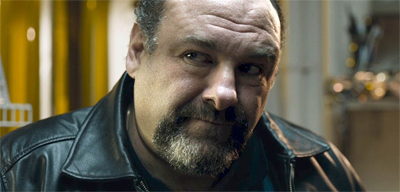
The Drop is a tense and claustrophobic thriller. The bulk of the action unfolds around the small world as Bob knows it. Bob is a simple man. He works at a small dive, “Cousin Marv’s Place.” When asked tough questions, he simply answers, “I just tend bar.” As Bob explains, the dive bar occasionally serves as a “drop” for all the money laundered through local crime. Bob doesn’t know where it comes from or where it goes. He is only aware of it when it comes into his care and when it leaves.

It's a dog's life...

It’s a dog’s life…

The Drop is a story about isolation and loneliness. Characters reflect on their place in the world, trying to make sense of what unfolds around them. Most are unknowable to each other, mysteries and enigmas. Asked a personal question, Bob replies, “That’s my business.” When his friend Nadia asks why Bob never inquired about her own very obvious scars, Bob simply answers, “I figure that’s your business.” The world as Bob knows it is a small place. Maybe it’s constantly getting smaller.

Adapted by Dennis Lehane from his own short story Animal Rescue, The Drop wallows in its own sense of lost direction and impending doom. Michaël R. Roskam’s direction never rushes the story or the actors, allowing the film time to take in the emptiness and hollowness in this small world that briefly intersects with something much bigger and more unpleasant. Perhaps a little too stately and relaxed in places, The Drop is nevertheless an atmospheric delight.
Just Cous...

Just Cous…

Continue reading

Non-Review Review: The Babadook

Monsters are real.

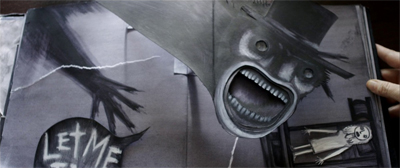
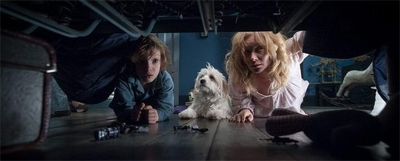
We all have our own monsters that we keep with us over our lives. “You can’t get rid of the Babadook,” a mysterious storybook threatens early in the runtime of The Babadook. Young Samuel tries to warn his mother Amelia about the monster lurking in the dark spaces – under the bed, in the closet, in the corner of his eye. He offers one rather sage bit of advice when it comes to such creatures. “You have to let it in.”

thebabadook1

Writer and director Jennifer Kent has crafted a superlative creature feature with The Babadook, acknowledging the metaphorical nature of monsters. These strange nightmares tend to stand in as expressions of guilt or anxiety. They give expression to thoughts and fear we could never properly articulate. The Babadook teases its audience with questions about the reality of the eponymous creature.

Is the strange “Mr. Babadook” something that truly exists, or is it something Samuel (and maybe Amelia) have created to cope with a horrific trauma?

thebabadook2 Continue reading

Non-Review Review: Friday the 13th, Part II

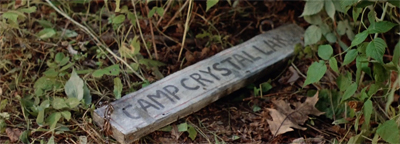
There is something almost endearing about how direct the Friday the 13th film series is, how comfortable it is in its skin.

There are arguments to be made that the original Halloween and Nightmare on Elm Street are genuine cinematic classics, that are frequently underrated because they were followed by decades of sequels, knock-offs, reboots and remakes. Although they rapidly devolved into franchise zombies, Halloween really jump-started a cinematic genre, and Nightmare on Elm Street was slyly post-modern.

Somebody didn't read the signs...

Somebody didn’t read the signs…

In contrast, the Friday the 13th films have no such pretension. Instead, the Friday the 3th films exist as pure and uncompromising slasher schlock. Hack and slash and slice and dice. The Friday the 13th film series is powered not by central themes or ideas, but by a simply desire to churn out movies in which attractive and generic characters get brutally slaughtered. It is a ruthlessly efficient model; there were eight Friday the 13th films released between 1980 and 1989.

It’s hard not to admire the ingenuity at work here – the Friday the 13th films are relentless, refusing to let little things like logic or resolutions get in the way of the next sequel. Friday the 13th, Part II starts the franchise machine properly rolling, by rather efficiently getting around the fact that the first film’s serial killer had been fairly cleanly dispatched. It’s time to meet Jason Voorhees.

If you go down to the woods today...

If you go down to the woods today…

Continue reading

Non-Review Review: Fury

Fury is an apocalyptic glimpse of warfare.

Unfolding in the last days of the Second World War, as Allied forces pour into Germany from all sides, there’s a sense that this is the end. This is the abyss. As the introductory text explained, Hitler had declared a doctrine of “total war” against these invading forces. Every man woman and child was to be mobilised against the advancing armies, in the hope that it might somehow slow down the Allied war machine. If you throw enough people at it, you might do some damage – even if it is just clogging the gears.

He will strike down with Fury-ous anger...

He will strike down with Fury-ous anger…

A movie about a tank crew enduring these last few days, Fury gets considerable mileage out of that image – of human flesh falling before the unstoppable and inevitable machine. At a couple of points in the movie, characters die with their faces quite literally down in the mud. At other points, bodies are crushed beneath the tracks of the eponymous vehicle. Towards the climax, we encounter a body so thoroughly squashed beneath the weight of the Allied advanced that it seems like an empty uniform.

Fury is at its best when it captures the sheer unrelenting terror and horror of the advancing war machine – the nihilism of fighting a war that has already been decided, and the bleak inevitability of large-scale slaughter.

Fog of war...

Fog of war…

Continue reading

Non-Review Review: Book of Life

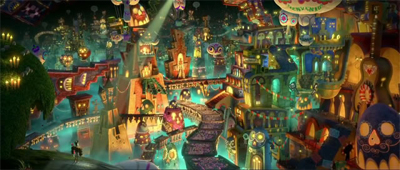
Book of Life bristles with energy – almost too much energy at times.

Book of Life is a sumptuous feast for the eyes, dynamic and beautiful, elegantly crafted and lovingly staged. It is packed with eye-popping visuals and an electric energy. In many ways, these help to compensate for a script that is simultaneously under-plotted and hyperactive. The basic plot arc of Book of Life – and the trajectory of all the featured characters – can be mapped from the opening scenes, while the movie is over-stuffed with pop culture references and snappy asides.

Book of Life is exhausting and exhilarating in equal measure, almost perfectly calibrated for its ninety-minute runtime. The result is a stylish and suave animated film that pops out of the screen, even if it doesn’t lodge in the memory. There’s little here that hasn’t been done before, but rarely has it been done so stylishly.

bookofthedead3 Continue reading

Non-Review Review: Nightcrawler

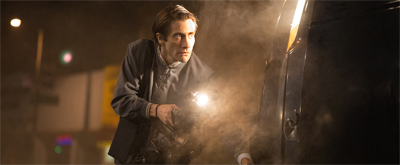
Nightcrawler features a tour de force performance from Jake Gyllenhaal.

Gyllenhaal plays Louie (“call me Lou”) Bloom, a wandering and lost soul who stalks late-night Los Angeles in search of a lucrative pay-day. He is just trying to get his foot on the ladder any way that an entrepreneurial young gentleman can – he’s introduced stealing construction supplies and scrap metal so he can sell them on, seguing effortlessly into a well-rehearsed job pitch applying for an unpaid internship.

nightcrawler

Bloom seems like a man who has watched people from a distance for years, almost through a filter. Gyllenhaal injects a haunting eccentricity into the character, his wide eyes and practised stillness almost edging Bloom into the uncanny valley. Though he seems to always know just what to say, there’s something distinctly inhuman about Lou Bloom. He watches people, but from the outside. He has got a pretty passable impersonation of a human being down, but there’s just something missing.

Nightcrawler is a fascinating, harrow and occasional wry look at desperation and ruthlessness – and the heady cocktail they make when blended together.

nightcrawler1

Continue reading

Non-Review Review: The Best of Me

As with a lot of Nicholas Sparks adaptations, there’s something inherently reductive about The Best of Me. The film would suggest that characters are either inherently good or inherently bad, with several members of the cast existing as nothing more than roadblocks serving to keep the film’s central couple apart. The Best of Me is not set in the real world; it makes no allowance for the nuanced complexities of human emotions and relationships.

Instead, The Best of Me unfolds in a weird parallel world, a world where all human interactions and feelings are clear-cut and simple. It is easy to see the appeal of this world. It is a realm of romantic fantasy, where probability and chance are simply the tools of dramatic irony; where obvious twists are not only expected, they are obligatory. The Best of Me introduces its male lead, Dawson, reading Stephen Hawking as lazy shorthand for how smart he is. He can’t be that smart, or he’d understand this world doesn’t follow anything as bland as physics.

thebestofme5

Throughout The Best of Me, characters ruminate on the machinations of fate and destiny. We are told that mankind has always looked to the stars to guide them. However, this metaphysical musing is not so much a thematic statement as preemptive justification for a contrived (and entirely predictable) final act. The Best of Me is very much a twist in search of a movie. It is a tire-and-tested twist, at that.

However, the characters in The Best of Me don’t seem to realise that there is a difference between fate and hackneyed writing.

thebestofme4

Continue reading

Non-Review Review: Annabelle

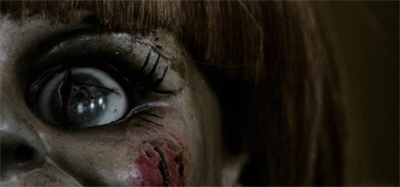
Annabelle certainly looks pretty. Not the doll, of course. The doll looks like the children’s toy version of Jack Nicholson. There is something immediately and effectively intense about the figure at the centre of this horror spin-off, to the point where it’s hard to imagine anybody wanting the toy in their home in the first place. To paraphrase Stephen King’s criticism of Jack Nicholson in The Shining, it is not a question of if this doll will start killing people, but when.

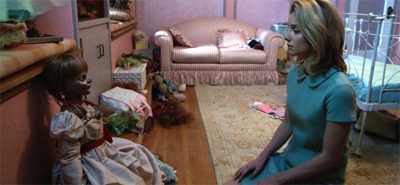
However, the production design on Annabelle is quite striking. It very much a period horror film in the way that The Conjuring was a period horror film. This time, we are visiting the sixties rather than the seventies. There are lots of bright colours and stylish clothes, and the film works hard to capture the mood and aesthetic of the era – or, at the very least, the era as we remember it. Annabelle feels like a horror film effectively riding the waves of sixties nostalgia that has rocked popular culture in recent years.

Well, it'll never be a collector's item now...

Well, it’ll never be a collector’s item now…

Sadly, Annabelle is not pretty enough to distract from its rather fundamental problems. Its script has some good ideas, but no real idea what to do with them. So, instead, it falls back on a kitchen sink approach to modern horror. The script for Annabelle is a collection of sequences and stock elements copied wholesale from recent films like Insideous or Sinister or The Conjuring. While those films did not necessarily have fresh scares, they were blowing the dust off some very classic horror movie tropes.

Here, it feels almost like reheated leftovers.

A doll's house...

A doll’s house…

Continue reading

Non-Review Review: The Imitation Game

The Imitation Game is a solid and effective bio-pic elevated by a sharp script from Graham Moore, tight direction from Morten Tyldum and a superb central performance from Benedict Cumberbatch. There are points where the film seems to over-simplify its protagonist, trying to reduce his fascination with computers to a series of Freudian quirks, but the movie is held together by witty dialogue and a mesmerising turn from its lead actor.

theimitationgame

Continue reading

Non-Review Review: The Maze Runner

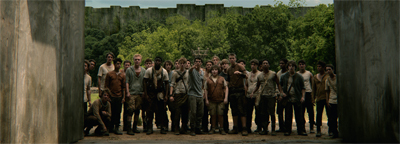
The Maze Runner is a perfectly solid piece of young adult action adventure. It excels primarily as a piece of old-school science fiction, the kind layered with blunt social commentary and barely-veiled allegorical themes. The Maze Runner constructs a fascinating metaphorical maze for our heroes to explore. It works less well when it comes to making the audience care about the characters navigating it.

It's alive inside...

It’s alive inside…

Continue reading