• Following Us

  • Categories

  • Check out the Archives


  • Awards & Nominations

Non-Review Review: xXx iIi – The Return of Xander Cage

Perhaps the most endearing aspect of xXx iIi: The Return of Xander Cage is how absurd the movie feels, on just about every level.

xXx iIi is the third in a trilogy of films that launched in 2002. xXx is highly unlikely to rank as anybody’s favourite Vin Diesel film, sitting somewhere below The Fast and the Furious and Pitch Black on the “viable Vin Diesel movie franchises” scale. The movie was very much part of that turn-of-the-millennium attempt to craft an American answer to the highly successful James Bond franchise, and as such had arguably been rendered redundant by The Bourne Identity two months before it was released.
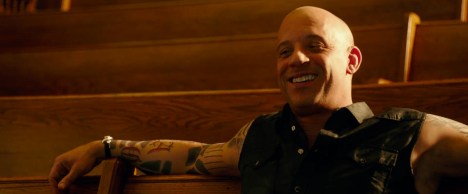
Quite Cagey on the matter.

Quite Cagey on the matter.

In fact, xXx was such an underwhelming Vin Diesel vehicle that the performer did not return for the sequel three years later. In xXx II: State of the Union, the extreme sports daredevil was replaced by a veteran marine played by Ice Cube. As such, it seems strange that the third film in the trilogy should be released fifteen years after the original and more than a decade following the only sequel starring a substitute lead. It is very hard to argue that the world was crying out for a xXx sequel promising the return of a low-tier Vin Diesel persona.

In its best moments, xXx iIi actively embraces that absurdity and swivels into the insanity. There are points at which xXx iIi ultimately collapses under its own ridiculousness, as it struggles to fill the gaps between admirably over the top set pieces with terrible dialogue delivered by a fairly weak cast. However, there are also moments when xXx iIi works much better than it should, if only because it recognises the absurdity of its own existence and just runs with it.

It's good to be back.

It’s good to be back.

Continue reading

Non-Review Review: Live by Night

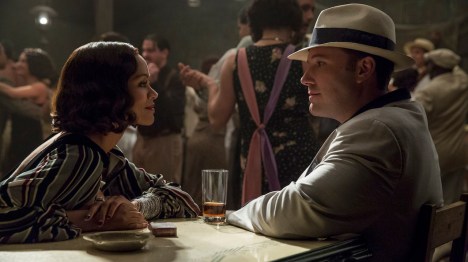
Live by Night is a film with big ideas. Writer, director, producer and star Ben Affleck is very clearly attempting to use the classic gangster film as a commentary upon the American Dream. This is hardly a novel idea, but it still resonates as powerfully as it did during the pulp era of the thirties and forties. Working from a novel by Dennis Lehane, Affleck crafts a story about violence and power that is clearly intended to resonate with modern audiences looking to understand fundamental aspects of the American identity.

And there are moments when Live by Night really works. Affleck is a solid writer and a performer who can skilfully channel that old-school Hollywood charm, but he has proven himself a very impressive director. Live by Night is occasionally a beautiful film, as the camera pans across the wilderness of the Florida everglades or spins around a room during a tense dialogue scene or even just captures the lead character on the shore with the reflection of the sky framed so perfectly that it seems like he is standing upon the edge of heaven itself.

Speaking easy.

Speaking easy.

However, these moments are assembled in a haphazard fashion around a disjointed plot. Live by Night plays like a stream of consciousness attempting to delve into the symbolic heart of the United States, tossing out crazy ideas like a turf war between Prohibition gangsters and the Ku Klux Klan or arbitrarily drawing long-absent characters back into the narrative with little foreshadowing. Live by Night seems to navigate by night, prone to storytelling detours and narrative cul de sacs that undercut (rather than enrich) its thematic intent.

Live by Night is built like an epic, but its script lacks the discipline and structure to justify an impressive running time. Affleck is a strong enough director that the film never collapses, even as it stumbles. There is a sense that the writer and director is having a great deal of fun playing with a very archetypal set of iconography and themes, and that fun is occasionally contagious. However, Live by Night never truly comes alive in the way that it promises.

Sea changes.

Sea changes.

Continue reading

Non-Review Review: Manchester by the Sea

What is most effective and affecting about Manchester by the Sea is what is not said.

It seems a strange thing to note of an Oscar-caliber drama, but one of the most striking aspect of Kenneth Lonergan’s Manchester by Sea is the sound design. Sound carries repeatedly in the film. A recurring motif of Manchester by the Sea is the thinness of the walls, as characters eavesdrop on one another and overhear conversations in adjoining rooms and spaces. However, it is more than that. When the characters retreat into silence, the world almost seems to swallow them whole.

"If Colin Farrell thinks he's stealing my Best Actor trophy, he's got another thing coming."

“If Colin Farrell thinks he’s stealing my Best Actor trophy, he’s got another thing coming.”

As one character discusses funeral arrangements on the phone, other characters prepare breakfast around him; the sound of the bowl hitting the table, of the rice crackling in the milk, of the chair scraping off the ground, of the spoon hitting teeth. Attending the funeral, the eulogies are drowned out by the dull recurring buzz of a mobile phone on vibrate. When another character walks by a graveyard, he picks up a stick so that he might strum it against a fence to generate some ambient noise.

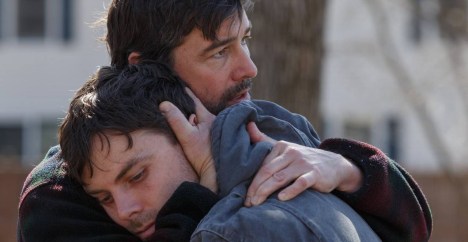
Sound designer Jacob Ribocoff does amazing work in bringing the environment to life around the film’s central characters. Manchester by the Sea is light on dialogue, with Casey Affleck conveying an incredible array of emotions through a carefully restrained performance. Affleck’s performance is not perfect, but one that exists in harmony with the sounds around him. Manchester by the Sea is not just a film that breaths. It is a film that sings in its own unique way.

Brother's keeper.

Brother’s keeper.

Continue reading

Non-Review Review: Assassin’s Creed

“What the f%$k is going on?” asks Michael Fassbender about halfway through the film.

It is not the first time that Cal Lynch has asked this question. Earlier on, the character wondered out loud “what’s happening?” after waking up following his state-sanctioned execution and being hooked up to a gigantic robotic claw that yanking him into the air mid-sentence. The audience is probably asking the same questions as Assassin’s Creed bounces across time and space with mountains of exposition (occasionally helpfully subtitled) about rival societies conspiring to find an artefact that can harness (and eliminate) mankind’s free will.

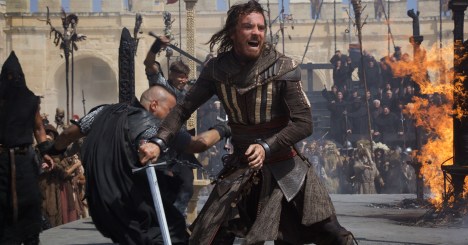
The Fass and the Furious.

The Fass and the Furious.

To be fair, incoherence is not the real problem with this disjointed video game adaptation. In fact, there is a certain weird charm to watching the amazing cast and the game director react to the crazed concepts that they have been dealt. For the first hour or so, the sheer weirdness of the film proves compelling, drawing in audience members willing to resist the tonal whiplash and laboured exposition as the film rockets along. What ultimately kills Assassin’s Creed is not its lack of sense, but the stubborn insistence that it must make sense.

Assassin’s Creed would be a stronger film were it willing to revel in its incoherence instead of trying to impose order upon it. The gonzo plotting and zany high concepts give the film a strange texture, but the problems do not really kick in until Assassin’s Creed starts awkwardly and painfully trying to construct a rational framework around this bizarre cavalcade. The result is to wed a visually hyper-kinetic and tonally unruly film to an incredibly tired generic plot that winds transforming the film into a plodding mess.

He's so hot right now.

He’s so hot right now.

Continue reading

Non-Review Review: Passengers

Passengers is a super creepy tale of male entitlement.

The movie has an intriguing science-fiction premise. On a sleeper ship intended to ferry passengers to the colony world of Homestead II, a freak accident awakens James Preston. The only problem is that Preston awoke far too early. Preston awoke approximately thirty years into a one-hundred-and-twenty-year voyage. The engineer is now destined to spend the rest of his life as the only waking inhabitant of a gigantic city ship, living and dying completely alone. It is a horrifying thought.

"We need a little space."

“We need a little space.”

There are suggestions of a powerful science-fiction epic to be found in the film. Jim finds his every physical need has been anticipated. He can live a life of material luxury. He will never want for food or space or activity. He effectively has a gigantic space craft all to himself. And therein lies the rub. Feeling almost like a sadistic episode of The Twilight Zone, Jim grapples with the question of what he will or will not do in order to end his loneliness. In his desperation, Jim makes a horrifying (if entirely understandable) decision.

The biggest problem with Passengers is that it strains too hard to make that decision palatable instead of terrifying. It is a super creepy tale of male entitlement that brushes aside any of this issues in favour of a much more conventional action romance.

Peace in a pod.

Peace in a pod.

Note: Very minor spoilers for Passengers follow. If you know the cast list, you can probably deduce where the movie is going from the opening ten minutes.

Continue reading

Non-Review Review: Why Him?

Why Him? is perhaps a little over-stretched.

Why Him? is built around a very stock comedy template. A hard-working old-fashioned father finds himself at odds with his daughter’s new boyfriend, leading to a clash of competing masculine egos. The most innovative aspect of Why Him? is the decision to filter this standard comedy plot through two more filters. Why Him? is simultaneously a raunchy R-rated comedy full of profanity and bodily-function jokes. It is also framed as a Christmas comedy, as much as a comedy set in and around Los Angeles can seem like a Christmas comedy.

Guess who's coming to (Christmas) dinner.

Guess who’s coming to (Christmas) dinner.

These are hardly the boldest of innovations. Why Him? is a paper-thin comedy that is somehow stretched out to run over one hour and fifty minutes. There are any number of gags that work and a solid cast that never rises to exceptional, but the fact is that all of these elements overstay their welcome by at least a good twenty minutes. It is telling that one of the biggest issues with Why Him? is repetition, where the movie attempts to spin out slight jokes that prompt a knowing smile into running gags that exhaust all good will.

Ironically enough, given the title, Why Him? never makes a compelling case for its own scale and length.

Fists of fury.

Fists of fury.

Continue reading

Non-Review Review: Silence

Faith is a curious thing.

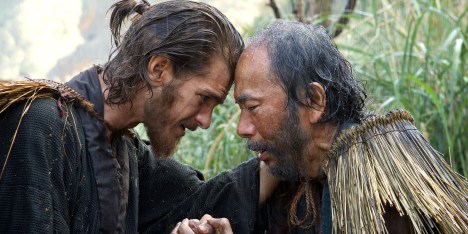
It is a fascinating concept, even (and perhaps especially) for those who lack it or wrestle with it. Pure and untempered faith in the face of a turbulent (and occasionally hostile) world is intriguing. It is something that many long to understand, even if it eludes them. Silence is very much a meditation (or an extended monologue) on the nature of religious belief playing out as a set of conversations and moral dilemmas. Characters wrestle with doubt and uncertainty, and particularly about what their faith means to them.

Easy pray.

Easy pray.

Silence is not a masterpiece or an epic. It is not one of Martin Scorsese’s major works, despite the energy and conviction with which he invests it. It is the weakest film from the director in a very long time, although that sounds very much like praising with faint criticism. Silence is a little too invested in its own dialogue with itself, as delivered through a series of monologues and occasionally through conversation between characters. Silence looks beautiful, but it often feels a little bit like a stunning visual companion to a book on tape.

And yet, in spite of all of this, there is an endearing earnestness to the film. Silence feels like the product of a long and considered reflection on the nature of faith and its place in the world. It never lacks for ambition or vision, playing as a two-and-a-half hour parable about suffering and transcendence. Silence is more interesting than successful, but that is largely because it is so very interesting.

Gotta have faith.

Gotta have faith.

Continue reading

Non-Review Review: Rogue One – A Star Wars Story

Rogue One: A Star Wars Story feels torn between two extremes.

On one extreme, it is an epic war movie about a universe that is caught in turmoil. Through the lens of science-fantasy, Rogue One can tease out all manner of interesting ideas about the conflict at the heart of the Star Wars franchise. What does an interstellar war look like in the early years of the twenty-first century? What is the view of this epic confrontation from outside the cockpit of an X-Wing or the Millennium Falcon? There are points at which Rogue One almost plays as a war film that just happens to be set within the Star Wars universe.

Too TIE-d to continuity?

Too TIE-d to continuity?

On the other extreme, Rogue One often feels like a collection of deleted scenes intended to bridge Star Wars: Episode III – Revenge of the Sith to Star Wars: Episode VI – A New Hope. The basic premise of the film involves the theft of the Death Star plans that propel the plot of A New Hope, which should be enough to connect it to the parent franchise. Instead, the film is saturated with cameos and callbacks. While it makes sense for a number of minor characters to overlap, Rogue One contorts to include two of the franchise’s biggest characters.

So Rogue One is trapped between being an exciting and exhilarating glimpse of an existing franchise from a new perspective, and feeling just a little bit too much like fan fiction. It is no surprise that the former is much more interesting than the latter.

Watered down?

Watered down?

Continue reading

Non-Review Review: Jackie

…  there was a spot, for one brief, shining moment, that was known as Camelot.

Towards the end of Jackie, the title character ruminates on her deceased husband. As a boy, he loved history. He especially loved the tales of Camelot. It does not matter that Camelot never existed, a figment of the collective imagination conjured into being through generations of myth and legend. People wanted to believe in Camelot, and so they invested it with a texture that seemed to manifest itself. Camelot was a story, but it was a story that was in many ways more appealing than the truth.

More like the Pastel House.

More like the Pastel House.

Jackie is a story about mythmaking. Arch and playful, self-aware and self-critical, Jackie tightens its focus on Jackie Onassis Kennedy to the days immediately following the death of her beloved husband. Using the iconic Time magazine interview as a framing device, Jackie follows its protagonist as she sets about building a legacy and a legend around John F. Kennedy. The lines between history and mythology blur, Jackie cleverly contrasting the title character’s restoration of the White House with her construction of her husband’s legend.

There are points at which Jackie seems a little too manner and a little too stage-managed, a little too perfect and a little too rehearsed. There are points at which Natalie Portman slips from being Jackie Onassis Kennedy playing the widow to a beloved legend to being Natalie Portman playing Jackie Onassis Kennedy playing the widow to a beloved legend. This sort of sly recursion is very much in fitting with the tone of the film, but it does occasionally feel a little too cold and a little too distant.

Mirrored in controversy.

Mirrored in controversy.

Continue reading

Non-Review Review: Office Christmas Party

Office Christmas Party is a mess. Far from a carefully orchestrated festive frivolity, it feels more like it was quickly cobbled together from whatever happened to be lying around the staff canteen.

Office Christmas Party plays like a seasonal-themed pot luck; a combination of weird flavours that might work well in other contexts or on their own, only to clash awkwardly when thrown together. There is a mix-tape quality to the film, as is probably to be expected in a movie with a cast this expansive. However, Office Christmas Party never finds a centre around which it might arrange this particular tale. Instead, it feels like a half-hearted collection of mad-libs that have been shamelessly borrowed from other and better films.

No escape Claus...

No escape Claus…

Continue reading