• Following Us

  • Categories

  • Check out the Archives


  • Awards & Nominations

Non-Review Review: Without Name

This film was seen as part of the Audi Dublin International Film Festival 2017.

Without Name is a stunningly confident theatrical debut from director Lorcan Finnegan.

In theory, Without Name belongs that long-standing environmental horror genre, the fear that nature exists in opposition to mankind and that human beings are ultimately a hostile species not welcome in their surroundings. There are all manner of variations in that classic horror set-up, but it bubbles through any number of classic horror films, from The Shining to Jaws to The Birds. There is a recurring fear that the world is not a welcoming place for mankind, and that the wilderness might one day rebel against mankind’s desire to tame it.
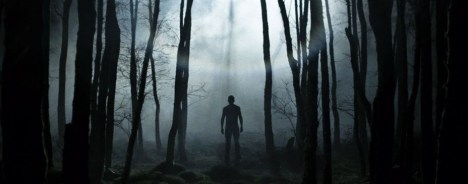
If you go down to the woods today...

If you go down to the woods today…

Without Name takes that familiar premise and puts a uniquely Irish spin on it, distinguishing its own set of anxieties from those felt by the European Settlers in the United States or even those disconnected from their pagan roots in the United Kingdom. Without Name draws heavily upon the Western European pagan spirituality that informs films like The Wicker Man or A Field in England, but weds it to unique Irish anxieties about property and ownership that reflect both long-standing uncertainties and modern fears.

The result is a delightfully weird little environmental horror that feels very much of its time and place, a credit to its first-time director.
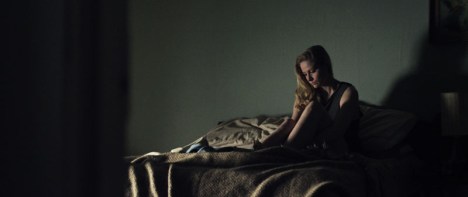
Sleep well...

Sleep well…

Continue reading

Non-Review Review: The Happiest Day in the Life of Olli Mäki (Hymyilevä mies)

This film was seen as part of the Audi Dublin International Film Festival 2017.

The Happiest Day in the Life of Olli Mäki plays almost like a mumblecore Raging Bull.

To be fair, that is a very facile description. Almost every boxing film stands in the shadow of Martin Scorsese’s 1980 biography of Jake LaMotta, but The Happiest Day in the Life of Olli Mäki invites those comparisons by filming its period-specific based-on-a-true-story boxing fable in black and white. It is hard not to think of Raging Bull in that context, and it is incredibly daring for The Happiest Day in the Life of Olli Mäki to actively invite the comparison.

Skipping to the point.

Skipping to the point.

However, in explicitly evoking that classic boxing movie, writers Juho Kuosmanen and Mikko Myllylahti are able to do something genuinely interesting. Taking all the iconography and expectations of the boxing movie genre, Kuosmanen and Myllylahti are able to tell a story that skews its perspective slightly. Channelling Raging Bull only underscores this subtle shift, with The Happiest Day in the Life of Olli Mäki not so much asking for a comparison as a contrast.

The Happiest Day in the Life of Olli Mäki is charming in the way that it embraces the clichés and expectations of the boxing movie only to subvert with a more naturalistic (and optimistic) love story about a boxer who largely eschews the conventions of the biography films that such sportsmen tend to inhabit.

On the ropes.

On the ropes.

Continue reading

Non-Review Review: Lady Macbeth

This film was seen as part of the Audi Dublin International Film Festival 2017.

Lady Macbeth is a very beautiful, and very arch film. Perhaps a little too arch.

Writer Alice Birch and director William Oldroyd’s Lady Macbeth is a very loose adaptation of Lady Macbeth of the Mtsensk District by Nikolai Leskov, adapting the Russian novel to British surroundings. Ari Wegner’s cinematography is stunning, capturing the beauty of these new surroundings and meticulously framing the characters. Oldroyd films Lady Macbeth at a Kubrickian remove, keeping the camera still and often facing his characters head-on in a way that makes it seem like the cast are staring out of the film at the audience watching.

Thinly-veiled contempt.

Thinly-veiled contempt.

Birch’s script has an incredibly dark sense of humour, a wry grimace juxtaposed against the horrors that its characters inflict upon one another and the sense of bleakness that pervades the film. Indeed, the film balances on a knife-edge in terms of tone, shifting skilfully between moods from one scene to the next. At one moment, Lady Macbeth is a thoughtful character study, at another a cheeky feminist critique, then a pitch black comedy. Lady Macbeth is an impressive work in any technical sense.

However, there is a pervading coldness to the film, one reinforced by the intensity upon which the camera focuses upon characters who keep themselves at a remove. For all the polished sheen of Lady Macbeth, its characters remain heavily internalised and take their time expressing themselves through action. The result is a film that moves far too slowly, keeping its characters both opaque and inert for far too much of the runtime. Lady Macbeth is a very pretty film, but one that mistakes silence for profundity.

Return of the Mac(beth).

Return of the Mac(beth).

Continue reading

Non-Review Review: Maudie

This film was seen as part of the Audi Dublin International Film Festival 2017.

“Show me the way you see the world,” urges one buyer of Maud Lewis approximately half-way through Maudie, capturing the ageless appeal of just about any artistic vision. There is something exciting and unique about the opportunity to examine the world from a unique vantage point, to perceive time and space from the perspective of somebody else.

That is particularly true of Maud Lewis, the Canadian folk artist who captured the international imagination through the forties and into the fifties. Lewis had a very unique perspective on the world, capturing her surroundings and even people in crude two-dimensional terms with a surprising amount of depth. The little incongruous details of these seemingly simplistic paintings turned Lewis into a cultural icon, whose influence and legacy perseveres to this day.

maudie

Wedded to convenience.

The biggest problem with Maudie is that the film completely lacks any sense of original or distinctive vision, any real effort to see the world as it must have appeared to Maud Lewis. As much as the film and the surrounding characters might laud Maud for her distinct approach to painting, Maudie is a much more conventional tale. Maudie hits just about every biography cliché in the book, without offering any keen insight or shrewd observation. It lacks those small well-observed nuances that really brought Lewis’ work to life.

A superb central performance from Sally Hawkins cannot elevate a film that is so eager to engage in twee unreconstructed nostalgia.

Painting a pretty picture.

Painting a pretty picture.

Continue reading

Non-Review Review: Fences

Fences is a superb play, with a great cast, that makes for a reasonably solid film.

Fences was adapted by playwright August Wilson from his 1983 Pulitzer-Prize-winning stage play. Although Wilson passed away in 2005, the resulting film is very faithful to that stage-bound sensitivity. Perhaps out of respect for the writer, or out of respect for the story’s origin on the stage, director Denzel Washington never really pushes Fences beyond its source material. Fences has a superb A-list cast, but it never quite feels like a feature film adaptation.

Living life to the Maxson.

Living life to the Maxson.

Instead, Fences feels like it is trapped somewhere in the limbo between stage and screen, feeling like one of those adaptations from the earliest days of television when the medium never knew exactly where it fell between those two pillars. Fences retains a tight cast and a very fixed location, much like the stage play. It retains monologues and confrontations that play out over extended scenes that recall theatre rather than taking advantage of cinema’s ability to let time lapse.

To be fair, the cast superb and the source material is impressive. It is easy to understand why Washington adopted such a reverent and respectful approach to the cinematic adaptation. However, Fences never feels like anything more than the sum of its very impressive parts. In fact, it might feel like a little less.

Mending fences.

Tightly-knit family unit.

Continue reading

Non-Review Review: The Founder

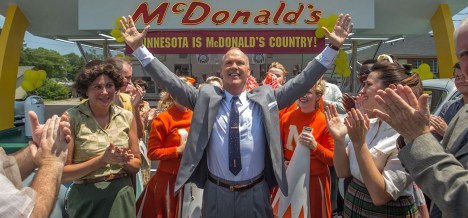
The Founder is a reasonably solid drama, anchored in a strong central performance and a timely narrative.

In form, The Founder plays like a very old fashioned piece of prestige cinema. It is a grand and sweeping character-driving historical drama that spans a seven-year period from Dick and Mac McDonald’s first encounter with Ray Kroc to his eventual purchase of the family and business name. Unlike many contemporary historical dramas, there is no tight focus on a singular significant historical event. The Founder does not attempt to illuminate its central character through intense scrutiny of one big moment. Instead, it tries to tell the whole story.

Foundation myth.

Foundation myth.

The Founder hits all of the expected beats from a film like this. Although it is obvious rooted in a true story, the movie tracing an arc as smooth as that iconic golden “m.” This not necessarily a bad thing. The Founder knows what it is doing, and it sets out about doing it in an efficient manner. In its own strange way, this feels appropriate. The Founder is as precisely constructed as the “swift service” engine that Ray Kroc elevates from a local quirk to a national franchise. The Founder never falters too badly, never meanders unforgivably.

More than that, The Founder has the luxury of a fantastic central performance from Michael Keaton as the huckster salesman who attaches himself to a small family business and manoeuvres himself to the head of an international empire.

He only wants his cut.

He only wants his cut.

Continue reading

Non-Review Review: 20th Century Women

20th Century Women is more affective than effective.

Mike Mills’ late seventies drama is far too quirky for its own good, often feeling more like a dramatised video essay than a narrative film. Mills provides a rake of social context for his story, from samples of Lodger to references to The Man Who Fell to Earth. He plays an extended section of President Jimmy Carter’s “Crisis of Conscience” address to the nation and even inserts some footage from Koyaanisqati. Characters monologue (and even dialogue) over careful compositions as the camera tracks across footage.

Making a splash.

Making a splash.

Everything in 20th Century Women feels overstated. It is not enough to have characters quote extended passages from contemporary literature and poetry, Mills makes sure to cite his sources up on screen. The result is that 20th Century Women feels more like an annotated thesis statement than an engaging story. Mills keeps the camera at a distance from his characters, constantly moving through scenes instead of allowing them to develop organically. Everything is quirky and arch.

The result is that 20th Century Women suffocates its most interesting elements; its characters, its cast, its engagement with American masculinity and femininity on the cusp of Reaganism. This is a movie that strives so hard for authenticity that it only exposes its artifice.

Fanning the flame.

Fanning the flame.

Continue reading

Non-Review Review: The LEGO Batman Movie

“I have aged phenomenally,” Bruce Wayne confesses about half-an-hour into The LEGO Batman Movie.

He is not wrong. The LEGO Batman Movie is in many ways an overt celebration of the legacy of the Caped Crusader, the pop culture icon who remains one of the most recognisable figures in the world. Repeatedly over the course of the film, character reference Batman’s rich history, from the Joker’s confession that they have known each other for “seventy-eight years” or Alfred’s reference to “that weird [phase] in 1966” or even Barbara Gordon’s slideshow presentation that goes back to the cover of Detective Comics #27 and the forties film serial.

Holding it all together...

Holding it all together…

The framework of The LEGO Batman Movie allows the characters and the script to comment upon the Batman mythology. The script is crammed with references from the length and breadth of the character’s publication history, from “Bat shark repellent!” to particular costume styles to minor villains to musical cues to fourth-wall-breaking references to other media that has inspired various interpretations of the Caped Crusader. This allows The LEGO Batman Movie to be explicitly about Batman in a way that few Batman stories can be.

As such, The LEGO Batman Movie offers a very broad summary of the Batman mythology and characters, surveying decades of printed and screen material to reduce Batman to his most simply and essential qualities. The LEGO Batman Movie offers a very compelling portrait of Batman as a man so traumatised by loss that he never allowed himself to grow up, while somehow subconsciously cultivating a family around himself. For all the character’s lauded darkness, The LEGO Batman Movie celebrates the hope at the heart of that mythology.

Welcome to his man-cave.

Welcome to his man-cave.

Continue reading

Non-Review Review: Denial

Denial is a vitally important story, albeit one told in a rather unimpressive manner.

Denial documents the libel case that David Irving took against Deborah Lipstadt upon the publication of her book Denying the Holocaust. In that book, Lipstadt accused Irving of being a Holocaust denier. Irving took offense at this, and attempted to sue her in the British courts. Under British law, the onus was placed on Lipstadt to prove that she was correct in her assessment. Essentially, the court case put the Holocaust itself on trial and served to interrogate the idea of objective truth in a postmodern age.

Suits you, sir.

Suits you, sir.

Obviously, Denial feels a lot more relevant now than it would have two years ago. In fact, it feels more relevant now than it did two months ago. Or two weeks. This is big weighty subject matter, dealing with an important issue in a very sensitive and delicate manner. It is in many the perfect focus for a prestige awards-season film. However, the problem is that film itself feels rather flat. Denial often feels like a made-for-television movie, clumsy and forced. It is a film aware of its own importance, but lacking its identity.

Denial feels very much like a missed opportunity.

Lecture notes.

Lecture notes.

Continue reading

Non-Review Review: T2 Trainspotting

“Nostalgia,” Sick Boy scoffs. “You’re a tourist in your own childhood.”

It is no surprise that Trainspotting 2 is saturated with nostalgia. It is, after all, a long-delayed sequel to a beloved nineties classic, a prestige picture counterpart to Jurassic World or Independence Day: Resurgence. Despite its fine pedigree, Trainspotting 2 is subject to the same basic questions. Is this really necessary? Does the original require a sequel? Can this film be judged on its own terms? Why now? Is there anything more to the film than cynical nostalgia?

An impressive pool of talent.

An impressive pool of talent.

After all, one can never go home again. Any true sequel to Trainspotting would not be a film directed by Danny Boyle, featuring these characters or carrying this branding. Part of the appeal of Trainspotting was its gritty youthful aesthetic, the product of a young film-maker and a young cast with everything to prove against all odds. This is fundamentally at odds with approaching the original as a venerate relic and building a worshipful sequel around it. That is the central tension of Trainspotting 2.

This is also a key strength of Trainspotting 2. At its strongest, Trainspotting 2 is more a movie about the trap of nostalgia and the dangers of its sweet allure than a sequel to the adventures of four heroin addicts in nineties Edinburgh. Still, Trainspotting 2 is trapped in the gravity of its younger and angrier self. Trainspotting was a young man’s film, all manic energy and desperation and iconoclasm. Trainspotting 2 is a middle-aged man’s film, affectionate and soft in the middle. Its desperation is quieter and less endearing.

Projecting?

Projecting?

Continue reading