• Following Us

  • Categories

  • Check out the Archives


  • Awards & Nominations

Non-Review Review: Game Night

Game Night is a delightfully strange creation, the kind of film that feels willfully esoteric.

Game Night a comedy built around an extended whole plot reference to a largely forgotten-by-all-but-hardcore-devotees mid-tier nineties David Fincher movie. Despite amassing something of a cult following, and despite the fact that it has aged relatively well as an example of Fincher’s craft, The Game is largely seen as a curiousity in Fincher’s filmography. It lacks the gravity and cultural weight afforded to the Fincher films that impacted the zeitgeist and resonated with critics; se7en, Fight ClubZodiac, The Social Network.

A cheesy premise.

As such, it is strange to see a comedy built as an extended homage to The Game. Not that there is anything wrong with The Game. As with any Fincher film, it is a very well-constructed film and one that is satisfying on its own terms, even if it never elevates itself in the same way as the best of the director’s work. It seems like a strange choice for a loving spoof twenty years after the fact. Perhaps Game Night can be contextualised as one of the more bizarre and specific expressions of the nineties nostalgia otherwise referenced in films like Jurassic World or Independence Day: Resurgence.

However, what is especially striking about Game Night is its commitment to this singular extended reference. This is not a film recycling the basic concept of The Game, it is a film defined and shaped by The Game. While it is very clearly nested inside the framework of a contemporary studio comedy, Game Night proves endearingly invested in its inspiration. Game Night is very… well… game.

Getting on board with the premise.

Continue reading

Non-Review Review: Ni juge, ni soumise (So Help Me God)

This film was seen as part of the Audi Dublin International Film Festival 2018.

So Help Me God is a very strange film, in that it is very difficult to imagine how exactly this documentary got made.

Anne Gruwez is a judge working in Brussels. As part of her role in the criminal justice system, she not only supervises on-going investigations, but also hear minor cases on something approaching a one-on-one basis. So Help Me God follows roughly a year in the life of Gruwez, splitting its attention between her on-going stewardship of a cold case murder investigation and the more routine cases that she hears on a daily basis. What emerges is a fascinating and compelling examination of the Belgian legal system.

So Help Me God has an amazing amount of access to the workings of the criminal investigations overseen by and the criminal cases heard by Anne Gruwez. No faces are blurred, no voices are disguised. There is no artificial barrier created between the audience and the subjects, no attempt to disguise identities. In many ways, So Help Me God feels very much like a particularly eccentric workplace documentary, with little sense of any red tape or restrictions upon the production team. It is a testament to directors Yves Hinant and Jean Libon that they were able to construct such a candid film.

So Help Me God is fascinating and engaging viewing, even if there is a sense of something decidedly less quirky and amusing resting somewhere beneath its polished and charming exterior.

Continue reading

Non-Review Review: Journeyman

This film was seen as part of the Audi Dublin International Film Festival 2018.

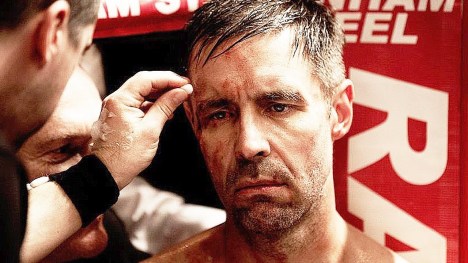
Journeyman is a very traditional and formulaic film in some regards.

The plot and arc of the film are very familiar. Matty Burton is a veteran boxer, and World Middleweight Champion. During a bout defending his title against aggressive young challenger Andre Bryte, Matty suffers a catastrophic setback, and is left picking up his pieces and struggling to put his life back together. Along the way, the trauma has serious and profound consequences for the people around him, including his wife and his best friends. Journeyman hits most of the beats that the audience expects from a story like this, occasionally feeling formulaic and predictable.

However, Journeyman is a reminder that these are not fatal flaws in a feature film. After all, a formula becomes predictable for a reason; that familiarity comes from repeated exposure to it, and the repeated application of a narrative formula is a testament to its durability and reliability. Journeyman is in someways a blending of the typical boxing movie with the typical recovery movie, but also a demonstration of just how effective all of these conventions can be when applied with proper skill and energy.

Journeyman is a very conventional film, but it is also a deeply satisfying one.

Continue reading

Non-Review Review: Hannah

This film was seen as part of the Audi Dublin International Film Festival 2018.

Hannah is a quiet, meandering movie elevated by a powerhouse central performance from Charlotte Rampling.

The second feature film by Andrea Pallaoro, Hannah unfolds primarily in silence – or in the absence of talking. There is dialogue, but it often seems incidental to the story being told. Much of the film consists of extended wordless passages, focusing on the eponymous character as she moves through the world. Dialogue is often perfunctory and functional, seldom exposition driving a scene. A lot of the sound in the film is ambient; a train approaching and then pulling into a platform, a cloth cleaning a gigantic glass door, water trickling from taps and faucets.

As the title implies, Hannah is essentially a character study. Charlotte Rampling plays the eponymous character, the film following her through her routine. Gradually, the film sketches out her world, first in broad pencil strokes and then in fine detail. Rampling anchors the film, conveying so much through her eyes and her expression, providing a strong emotional core to the film buried beneath an emotionally reserved exterior. Rampling’s performance is crushing and heartbreaking, and all the more powerful for its low-key nature.

However, Hannah is perhaps too low-key. Barring a bunch of clumsy symbolism, there are points at which the film feels like it might easily lapse into a coma without anybody noticing.

Continue reading

Non-Review Review: Le Fidèle (The Racer and the Jailbird)

This film was seen as part of the Audi Dublin International Film Festival 2018.

The Racer and the Jailbird is certainly a very strange film, and not in a particularly interesting way.

Running two hours and ten minutes, The Racer and the Jailbird is essentially two very different films stitched together. Michaël R. Roskam‘s third feature-length film is a curious hybrid, a passable eighty-minute Heat knock-off followed by an interminable European Lifetime Movie-of-the-Week. How stereotypical European, you ask? So European that it features a completely earnest reading of the line, “I am not pregnant with new life, but with death.” it is kind of brilliant, in its own ways. Many writers spend their lives in search of prose that purple.

To be fair, there is something interesting in the premise of The Racer and the Jailbird, and in its eventual narrative substitution. There is something be said for setting up a premise and then swerving dramatically to upset an audience’s expectations, to catch them off-guard by establishing a familiar set of genre elements and then twisting sharply in an unexpected direction. However, these sharp turns demand a very precise set of skills, including complete mastery of tone and narrative.

The Racer and the Jailbird lacks that control, and so misses the turn, spinning out of control and flipping dramatically before ending up as a mangled heap by the side of the road.

Continue reading

Non-Review Review: Unsane

This film was seen as part of the Audi Dublin International Film Festival 2018.

Unsane is off the wall.

The movie simply should not work, by just about any conceivable measure. Unsane is at once a conspiracy thriller criticism of the hypercapitalist impulses of the American healthcare system and a self-aware trashy nineties psychothriller about a young professional woman who may or may not be dealing with a stalker, all shot on an iPhone. It is One Flew Over the Cuckoo’s Nest meets Single White Female meets Tangerine. It is astounding that the film works as well as it does, that Unsane remains compelling and engaging even as it careens off the tracks.

A large part of this is down to a fantastic central performance by Claire Foy, who holds the thematically loopy and surreal adventure together through sheer force of will. Unsane subjects its protagonist to a cavalcade of horrors and twists, any one of which blatantly absurd upon even the most cursory of examinations. However, Foy anchors the film in a compelling and engaging central performance to manages to keep the audience both off-balance and sympathetic at the same time. It is a deft (and impressive) balancing act.

Similarly, writer and director Steven Soderbergh also deserves a great deal of credit for keeping Unsane from completely unspooling. For all the chaos and absurdity of the film, for all the tonal shifts and weird contrivances, for all the trashy genre tropes and gonzo plotting, it never feels like Unsane escapes its director. Soderbergh walks a fine line, producing a film that veers wildly and unpredictably, while also seeming to know exactly what it is doing. The result is bizarre, but engaging. It might be too much to describe Unsane as good, but it is good fun.

Continue reading

Non-Review Review: The Meeting

This film was seen as part of the Audi Dublin International Film Festival 2018.

The Meeting is a fascinating story, told terribly.

The real-life events that inspired The Meeting are genuinely moving. Nine years after she was sexually assaulted walking home from the bus, Ailbhe Griffith convenes a meeting with the man who raped her. In a small room, Ailbhe Griffith and Martin Swan engage in a dialogue about those events, about how that evening shaped both of their lives, and about the scars that linger. It took remarkable courage for Griffith to put herself in that room, and she is clearly a thoughtful and fascinating subject. There is a great movie to be made of this story.

Unfortunately, The Meeting is not that great movie. There are various reasons why The Meeting doesn’t work. Some of those reasons are justifiable and understandable, fair creative choices that simply don’t pay off in a satisfying manner and serve to undercut the narrative being constructed. However, some of those reasons are unjustifiable decisions that could never have worked even in abstract theory and which serve to turn The Meeting into a spectacularly ill-judged piece of cinema.

The eponymous meeting might have been a genuinely moving and affecting experience, but The Meeting is nothing short of a disaster.

Continue reading

Non-Review Review: Annihilation

Annihilation is a science-fiction smorgasbord.

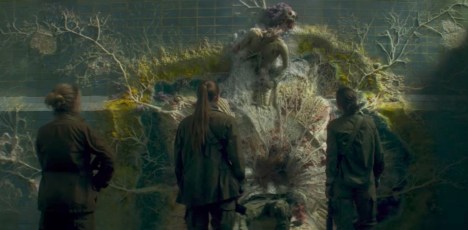
Early in the film, a group of scientists determine that the are of land which they have been sent to investigate has taken strange properties. Local plants and animals seem to have mutated and warped under the influence of some strange beings. Impossible hybrids stalk the landscape, exotic combinations of recognisable forms in order to create something uncanny and unsettling. In its own way, Annihilation feels self-aware.

The mouth of madness.

Alex Garland’s latest film is very much a hybrid itself, a synthesis of iconic science fiction elements, fused together to create something novel and exciting. Audience members will recognise a strand of DNA here, a stronger marker there. Even its harshest critic must concede that Annihilation has a broad palette; a dash of Stalker, a shade of Alien, a hint of Arrival, the slightest trace of Solaris, a nod towards The Thing, some 2001: A Space Odyssey for flavour. All these elements thrown together and mixed to create something eccentric and something intriguing.

Annihilation is a brainy high-energy imaginative science-fiction mixtape, and one both enticed and horrified by the idea that this is essentially the future culture.

“He was always throwing himself into his work.”

Continue reading

Non-Review Review: Filmworker

This film was seen as part of the Audi Dublin International Film Festival 2018.

What must it be like to surrender a life in service of somebody else pursuing their dreams? It is a challenging and provocative question; very few people are willing to risk everything to chase their own dreams, so what level of devotion must be required to do that in service of somebody else’s aspirations?

This is the central question of Filmworker, the documentary charting the life and times of Leon Vitali, who essentially surrendered his life to director Stanley Kubrick, to help the director fulfill his creative vision and realise his dreams on celluloid. The opening voiceover, lifted from Matthew Modine’s diaries working on Full Metal Jacket, likens Leon Vitali to a moth drawn to Stanley Kubrick’s flame. It’s an apt metaphor, one that plays through Filmworker.

For years, Leon Vitali was Stanley Kubrick’s right-hand man, the film offering varying labels; some call him an “assistant”, others a “factotum”, while Leon’s own official classification of his job for paperwork and applications was “filmworker.” Whatever title might have been applied to Leon, the man did everything did everything. The jack-of-all-trades coached actors, he oversaw casting, he restored negatives, he documented decisions, he engaged with distribution. He was essential to the operating of Kubrick’s creative machine, yet he remains mostly anonymous.

Filmworker engages with this relationship, with the sacrificing of an individual’s autonomy to enable another’s creative vision. The film is refreshing frank in some respects about the demands of such a life, of the temperamental impositions made by such artists of these devotees. The film captures the romance of working with genius, but also the toll that it exacts.

Continue reading

Non-Review Review: Red Sparrow

This film was seen as part of the Audi Dublin International Film Festival 2018.

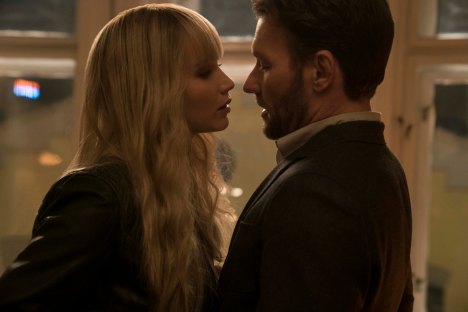
Red Sparrow puts a tacky (and tame) erotic sheen on a tepid (and tawdry) espionage story.

Red Sparrow has an interesting premise, both in terms of history and in terms of genre. It is a spy film structured around one of the more unsettling and uncomfortable aspects of the Cold War, the use of espionage agents to harvest information through sexual means. It is also a premise that could serve as a fascinating deconstruction of the tropes that audiences have come to expect of such films, a timely exploration of how issues of consent apply in the sorts of deception-laden love scenes that populate the genre. Red Sparrow could be James Bond as a sexual horror story.

However, Red Sparrow is far too tame to deliver on either premise. The film is too devoted to the conventional structure and dynamics of an espionage thriller to upset the audience in the way that any meaningful exploration of this history of sexual exploitation would, and is too comfortable with the rhythms and beats of the genre to offer a searing deconstruction of how its characters frequently leverage sex as just another weapon.

As a result, Red Sparrow is a meandering and uneven example of the espionage, trapped between two stools. The film is not sordid enough to excel as a visceral thriller in its own right, and not committed enough to offer a sobering examination of its themes.

Continue reading