• Following Us

  • Categories

  • Check out the Archives


  • Awards & Nominations

Non-Review Review: The Highwaymen

The Highwaymen is an uneven and clumsy piece of work.

In many ways, The Highwaymen positions itself as a logical extension of the modern deconstructive western, the tales of men on the edge of the frontier grappling with the challenges of modernity. Sometimes, those stories are set in the old west as it faces massive social shifts; The Sisters Brothers is a recent, effective example. Sometimes, these stories unfold in a more contemporary setting featuring characters still processing how the world has moved past them; Hell or High Water may be the best of the recent examples. The Highwaymen positions itself somewhere on the spectrum between the two; an early scene has the Governor of Texas offering an elevator pitch for the entire film, “It’s 1934, Lee, and you wanna put cowboys on Bonnie and Clyde?”

This is the basic premise of The Highwaymen, and it is a good one. It is two different American archetypes thrown into stark opposition with one another, a story that pits two of the last cowboys in the old west against a newer and hungrier breed of American outlaw. The Highwaymen is the story of the two Texas Rangers drafted out of retirement to hunt down Bonnie and Clyde. Forget Monsters vs. Aliens or Cowboys and Aliens or Alien vs. Predator, this is a pop cultural match-up for the ages. It is cowboys versus gangsters. (It might be more accurate to describe Bonnie Parker and Clyde Barrow as “public enemies”, but “cowboys versus public enemies” is not quite so evocative.)

With all of this in mind, it is disappointing that The Highwaymen feels so hollow.

Continue reading

Non-Review Review: Triple Frontier

Triple Frontier feels very much like a J.C. Chandor grab bag. And that’s no bad thing of itself.

The film runs on a variety of different concepts and ideas that run through Chandor’s other films. On a purely plotting level, the idea of a story about five guys trapped alone in the wilderness trying to survive on hostile terrain evokes the survival drama of All is Lost, albeit with more men carrying more weapons. The thematic underpinnings of the story, particularly its preoccupations with the dangers of greed and the consequences of unchecked avarice, resonate with Chandor’s earlier work like Margin Call or A Most Violent Year. There is a sense in which Triple Frontier feels of a piece with the body of work that Chandor is building for himself.

Even more broadly, Triple Frontier feels like the kind of older sort of film that rarely gets made in the current studio system; an ensemble cast dropped into a fairly standard premise, anchored in the recognisability of the actors rather than the familiarity of the intellectual property. Triple Frontier is a film build around the closest thing that modern Hollywood has to star wattage. The film reunites Chandor with Oscar Isaac, who anchored A Most Violent Year and the secondary lead role is given over to Ben Affleck, who is arguably one of the rare remaining movie stars. There is no small irony in the fact that Triple Frontier should end up on Netflix, despite being the sort of mid-budget, actor-driven, basic-concept action thriller that studios used to churn out on a regular basis.

Triple Frontier is perhaps Chandor’s weakest film. It lacks the raw urgency of Margin Call, the desperate intimacy of All is Lost and the claustrophobic anxiety of A Most Violent Year. However, it is still a well-constructed survival parable driven by a likable cast and confident director with a clear affection for an older style of Hollywood film-making.

Continue reading

Non-Review Review: Captain Marvel

The biggest problem with Captain Marvel is one of spoiler culture.

“Spoiler culture” is a fascinating cultural phenomenon, and one that is interesting as a facet of cultural consumption that arose parallel with the internet. It is perhaps a logical extension of the manner in which information flows these days. Information travels instantly and in all directions, quickly consumed and quick disseminated. In the nineties, it was easy (or easier) to avoid spoilers to films like The Usual Suspects or The Sixth Sense. After all, there was no Twitter or Facebook to share information. If somebody had already seen the film, they had to be physically talking to somebody else to discuss it, and it was posisble to establish the ground rules for the flows of information before the conversation progressed.

In an era where simply being on the internet exposes a person to torrents of information, the advent of “spoiler culture” seems logical and rational. People want to be surprised. People don’t want to know the finer points of a story before witnessing it first hand. People do not want the easter eggs given out or the finer details dissected. This is an understandable response. Having an experience described is no match for actually having that experience first-hand. So a culture has grown up online about preserving surprise and controlling the flow of information. This is fine. This is healthy. This is good. Mostly “spoiler culture” is just common courtesy and common sense. A reviewer should not reveal anything to a reader that they themselves would not want to know.

As with any philosophy, there is a tendency to take things too far. Sometimes “spoiler culture” descends into self-parody. Reviewers were famously told not to reveal any information about the plot of Blade Runner 2049, which ironically made it very hard to sell the movie to a potential audience. Some more extreme adherents felt betrayed when Sony released a trailer for Spider-Man: Far From Home before Avengers: Endgame, as if the fact that Sony was making another Spider-Man movie would give away the resolution to the cliffhanger from Avengers: Infinity War. Naturally, Infinity War came with its own massive spoiler-warning from the studio, with reviewers told that “Thanos demands [their] silence.” This despite the fact the ending was lifted directly from a comic.

Captain Marvel embodies the worst impulses of “spoiler culture” because it confuses a logical and organic narrative development for a big twist. There is a reveal that comes around the half-way mark of the two-hour film which fundamentally changes the nature of the story being told. It plays against the story that had been set up to that point, and is positioned as a game-changer. It is a “twist.” It is a “big” moment. It is the kind of development for which Thanos would demand silence. Except it’s not really. It is not an actual twist. It is a plot point. It is a story beat. It is a part of the story that makes a great deal of sense in the context of the story as it is being told. However, Captain Marvel decides to play this game-changing story beat as a revelation.

There are a couple of big issues here. Most obviously, the actual narrative development is quite literally the only way that Captain Marvel could go without becoming something completely and irredeemably monstrous, so it is entirely predictable. (The twist is only a surprise to audience members who genuinely believe that Marvel’s first female-led superhero movie is likely to play out as extreme white nationalist propaganda.) More than that, though, it creates a larger problem with the flow of the story. The decision to play this story beat as a twist means the film has to conceal its hand for the first hour and fifteen minutes. This means that Captain Marvel is almost half-way over before any member of the cast gets any real character development.

Continue reading

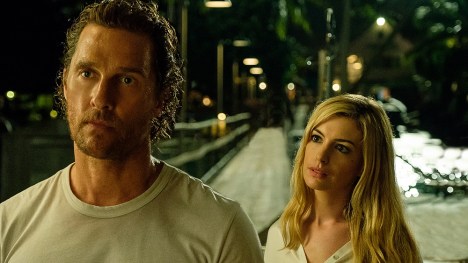
Non-Review Review: Serenity (2019)

Serenity is the story of a grizzled middle aged man and a tuna fish. A tuna fish named “Justice.”

There are many, many problems with Serenity. Indeed, fixing the most obvious problems with Serenity would just reveal a whole new set of problems. It is all recursive. Serenity does not work in either broad stroke or finer detail. It is flawed from the foundation through to the finishing touches. The basic concept of the movie is spectacularly ill-judged, but this impulse towards poor-decision-making branches out to smaller and more intimate moments of dialogue. It is hard to think of a major cinematic release that has been this obviously and fundamentally broken since Book of Henry. Indeed, like Book of Henry, there is a sense that Serenity might possibly live on as a cult bad movie, the kind of film so committed and thoroughly wrong that it becomes a source of pleasure.

The most obvious thing to criticise about Serenity is the central twist, because that is the hinge upon which the movie turns and central point from which so many bad decisions flow. It is big and glaring, flashing like a beacon. Indeed, one of the characters in the film who identifies himself as “the Rules” might describe it as a lighthouse. However, the central twist often feels like a distraction. There have been successful movies that have pulled off bigger twists than Serenity, and which have worked. There are beloved movies that are built around nominally insane plotting developments, but which have managed to walk that finest of lines; The Sixth Sense, Memento, The Usual Suspects.

The issue with Serenity is not so much its admittedly endearingly insane central revelation. The issue is absolutely everything else, including what it does with that major plot twist.

Continue reading

Non-Review Review: Mard Ko Dard Nahi Hota (“The Man Who Feels No Pain”)

This film was seen as part of the Virgin Media Dublin International Film Festival 2019. Given the high volumes of films being shown and the number of reviews to be written, these may end up being a bit shorter than usual reviews.

The Man Who Feels No Pain is the best film at this year’s Virgin Media Dublin International Film Festival.

Written and directed by Vasan Bala, The Man Who Feels No Pain is a delightfully self-aware Hindu action comedy which focuses on a young man who – as the title suggests – was born without any capacity to feel pain. Surya has lived a sheltered life, raised by an over-protective father and an over-eager grandfather. Surya’s life has been shaped and defined by the steady stream of popular culture that his grandfather has fed him, in lieu of access to the outside world. Surya’s moral compass is shaped and defined by comic books and eighties action movies, instilling in the boy a very firm sense of right and wrong and giving him a moral certainty about how best to respond to injustice.

When Surya is thrown out into the world as a twenty-year-old adult, there is a serious question as to whether Surya or the world is ready for the experience. The Man Who Feels No Pain is many, many things. Most immediately and superficially, from its opening scenes, it is a loving and knowing parody of eighties action movies and the superhero cinema that they spawned. It works incredibly well on these terms, managing to expertly balance the demands of both the action sequences and the comedic beats. However, the most endearing and engaging aspect of The Man Who Feels No Pain is the way in which it blends this celebration of contemporary pop culture into a broader exploration of growing up.

At its core, The Man Who Feels No Pain is an exploration of that old C.S. Lewis adage that growing up means putting away childish things; including the fear of being seen as childish.

Continue reading

Non-Review Review: Greta

This film was seen as part of the Virgin Media Dublin International Film Festival 2019. Given the high volumes of films being shown and the number of reviews to be written, these may end up being a bit shorter than usual reviews.

Greta is a pure and pulpy delight.

In some ways, Greta could be seen as a follow-up to director Neil Jordan’s previous film, the under-appreciated Byzantium. Like Byzantium, Greta is also a tale of monstrous motherhood and of a young woman struggling with a prolonged and extended childhood. Indeed, both Byzantium and Greta are very much genre pieces. This is in keeping with Neil Jordan’s sensibilities as a filmmaker. It is dismissive of these stories to suggest that Jordan “elevates” them, but he has a very strong understanding of the mechanics of how stories like these work. He always has, going back to stories like The Company of Wolves or Interview with a Vampire. (Even other “genre” work, such as crime films like Mona Lisa or The Crying Game.)

Both Greta and Byzantium are monster stories, even if Greta is anchored by a much more modern sort of monster than Byzantium.  Whereas Byzantium explored this mother-daughter push-and-pull through the lens of the classic vampire story, Greta draws inspiration from a different sources. There are obvious classic gothic influences at work in this psychological horror – Edgar Allan Poe looms large over one of the film’s big reveals, to pick one example. However, Jordan is most obviously and most consciously evoking the popular trashy psychological horror genre of the late eighties and nineties, the dozens of the films that were legitimised by the success of Silence of the Lambs; films like The Cell or Kiss the Girls or The Hand That Rocks the Cradle.

Indeed, the easiest and most efficient way to describe Greta might be “Postnatal Attraction” meets “Single Hungarian Female.”

Continue reading

Non-Review Review: Ash is Purest White

This film was seen as part of the Virgin Media Dublin International Film Festival 2019. Given the high volumes of films being shown and the number of reviews to be written, these may end up being a bit shorter than usual reviews.

There’s something strangely hypnotic in Zhangke Jia’s Ash is Purest White.

The film is a (quasi-) love story stretched across seventeen years and told in a set of three vignettes as the lives of the lead characters intersect in a rapidly-changing China. There’s an epic sweep to Zhangke Jia’s otherwise intimate narrative, a tale of two characters whose circumstances are constantly changing but who very clearly exist in orbit of one another. At one point, Qiao describes herself as a “prisoner of the universe”, and there seems to be some truth in that. No matter what happens, no matter how far she travels, a rubber band always seems to snap back. Indeed, Ash is Purest White has a compelling symmetry to it, the first and final third reflecting one another and suggesting that no matter how hard the characters might push, they’ll end up back where they started.

There is an endearing dreamlike quality to Ash is Purest White, a sense of mood that runs through the film’s two hours and seventeen minutes. At one point in the middle section of the film, a supporting character monologues at length about the idea of unidentified flying objects reported in the skies above the region. It’s a strange intersection for what began as a crime-inflected love story about gang violence, but even stranger for how Ash is Purest White commits to this strange metaphysical tangent. Shortly after this conversation, Qiao has her own experience of mysteries wonder in the haunted skies over the region. a strangely moving and almost spiritual sequence.

Ash is Purest White is full of these sorts of images and moments, beats that capture the weirdness and eccentricity of life, and the strange beauty to be found in the smallest of pleasures.

Continue reading

Non-Review Review: Ben is Back

This film was seen as part of the Virgin Media Dublin International Film Festival 2019. Given the high volumes of films being shown and the number of reviews to be written, these may end up being a bit shorter than usual reviews.

Ben is Back finds itself in a strange place in terms of weirdness.

At is core, Ben is Back is essentially the Key and Peele vehicle Keanu reimagined as an earnest prestige picture for the era of Beautiful Boy. It is an inherently absurd premise, an exploration of drug addiction that takes the form of an epic odyssey to rescue a beloved family pet. The incongruous pairing of a recovering addict with his suburban mother on this most unlikely Christmas adventure adds an extra layer of strangeness to the whole proceedings. There’s something very exciting about all of these elements thrown together, feeling incredibly unconventional.

Hug life.

Unfortunately, Ben is Back feels gun shy. It never commits to the inherent ridiculousness of using a trashy thriller template to tell a more intimate story about a pressing contemporary issue. Instead, Ben is Back compromises itself. It tries to have the best of both worlds. It tries to strike a balance between being a dogsploitation journey in to the heart of darkness with a more grounded and mundane portrait of a family struggling with the trauma that addiction has inflicted upon them. The two tones might work separately, but they jar as Ben is Back alternates between them.

This is a shame, as there’s a lot of potential in Ben is Back, and a few moments when it seems like it might actually deliver upon it.

Ben around the world, and I can’t find my baby.

Continue reading

Non-Review Review: Vox Lux

This film was seen as part of the Virgin Media Dublin International Film Festival 2019. Given the high volumes of films being shown and the number of reviews to be written, these may end up being a bit shorter than usual reviews.

Vox Lux very brazenly and very openly positions itself as the evil twin of A Star is Born.

Both Vox Lux and A Star is Born are meditations on the idea of fame in contemporary America, particular the effect that it has upon an individual. Effectively the third (or fourth) retelling of a classic Hollywood fairy tale, A Star is Born offers a much more optimistic perspective on how deeply fame is anchored in the American popular consciousness, a story about an individual being seen and elevated because of their unique gifts. Vox Lux is a decidedly more cynical take on that same story, a darker meditation on the corrupting power and toxic cult of fame.

All the glitters…

These are old ideas. Popular culture has grappled with fame and stardom for decades, the push-and-pull around the siren call of celebrity both lauded and dissected over and over and over again. Neither A Star is Born nor Vox Lux have anything especially innovative or insightful to say about the notion of celebrity, nothing that hasn’t been explored or deconstructed or interrogated countless times. Much is made of the idea popstar Celeste as a new voice for the twenty-first century in Vox Lux, but it’s never clear that the film has anything new to say.

That’s not an issue. There is power in reiterating familiar ideas. Vox Lux tells a familiar tale with a strong est of performances and confident narrative style. Perhaps this is enough, in its own wry way. Perhaps Vox Lux is arguing that the bold new voices of the twenty-first century are just repackaging and reheating old ideas with a new energy and new commitment. It might just be the movie’s darkest joke.

Life of Lux-ury.

Continue reading

Non-Review Review: Angelo

This film was seen as part of the Virgin Media Dublin International Film Festival 2019. Given the high volumes of films being shown and the number of reviews to be written, these may end up being a bit shorter than usual reviews.

Angelo is perhaps as good as “what if Barry Lyndon, but with slavery from a European filmmaker?” could hope to be.

The basic premise of Angelo owes a lot to Stanley Kubrick’s Barry Lyndon, a period piece that largely eschews many of the conventional trappings of period productions to offer a more philosophical meditation on man’s relationship with the larger world. Both Angelo and Barry Lyndon are stories about people trying to navigate the complicated networks of human relationships in an unstable world, their own pursuit of stability and self-actualisation subject to arbitrary forces that exist outside of their control. Both are stark moral fables that border of nihilistic, shot in a much a colder manner than most of their period movie contemporaries, eschewing a lot of the warmth and romance traditionally associated with the genre.

Of course, Barry Lyndon was the story of a peasant Irishman who found himself fleeing to the European continent and trying to make a living for himself, whose star would rise and fall along the way. In contrast, Angelo is inspired by the true-life story of Angelo Soliman. Writers Alexander Brom and Markus Schleinzer take obvious liberties with the basic story of the black man who integrated himself in some of the most exclusive circles of nineteenth century European royalty only to discover how fickle such associations could be. This creates an inherent tension within Angelo. This is a film that opens with Angelo’s abduction from Nigeria, and which returns time and again to his status as a slave. However, it does so without really grappling with that reality.

Angelo threads the line about as delicately as possible, focusing more on its abstract thematic preoccupations and philosophical musings than any concrete details. However, there is a sense of cynicism about the film, a sense that the movie is utterly uninterested in the particulars of Angelo Soliman’s life or the finer details of what life as an actual slave (and later a freed slave) would be like in the nineteenth century. Instead, Angelo avoids these smaller questions by asking bigger and bold questions about the very nature of human existence as a whole.

Continue reading