• Following Us

  • Categories

  • Check out the Archives


  • Awards & Nominations

Ultimate Galactus Trilogy (Review/Retrospective)

After spending the tail end of last year looking at the tangled inter-continuity crossovers at Marvel, I thought I’d spend January looking at some of the looser “out of continuity” tales at the major companies.

What does a continuity-lite crossover look like? I mean, a relatively self-contained comic book event that isn’t based upon years and years of events? Marvel famously launched their Ultimate line a decade ago to offer a chance to “reimagine” their classic stories – the Avengers became The Ultimates, and monthly issues of Ultimate Spider-Man, Ultimate X-Men and Ultimate Fantastic Four were available on the stands. The goal was to offer tales that would allow new readers to jump on board without having to worry about the weight of half-a-century (or more) worth of back story for the characters. Despite some minor crossover between the books – Mark Millar writing the Ultimates into his Ultimate X-Men run or Ultimate Spider-Man occasionally paying a short visit to the Baxter building – the line largely steered clear of the sort of bombastic big events that Marvel seems to love churning out month-on-month. So, what does an actual “big crossover event” look like when written for these characters? A bit like the Ultimate Galactus Trilogy, I suppose.

He's got the world in the palm of his hand...

Continue reading

Flashpoint

After spending the tail end of last year looking at the tangled inter-continuity crossovers at Marvel, I thought I’d spend January looking at some of the looser “out of continuity” tales at the major companies.

Flashpoint is the first big event of Geoff Johns’ relaunched run on The Flash. If Flash: Rebirth was intended to echo Green Lantern: Rebirth, fan anticipation and speculation suggest that his Flashpoint – a five-part miniseries – will serve as a counterpart to Sinestro Corps War on his Green Lantern run. However, the title Flashpoint has connotations for the character – it was the title of a relatively recent story featuring the character, one of DC Comic’s Elseworlds. I figured, with the big event coming it up, it might be worth a bit of a retroactive review of the title which perhaps inspired the event.

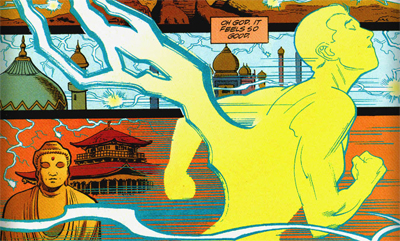
He moves like lightening...

Continue reading

Marvel 1602 (Review)

After spending the tail end of last year looking at the tangled inter-continuity crossovers at Marvel, I thought I’d spend January looking at some of the looser “out of continuity” tales at the major companies.

Although DC invented the term “elseworlds” to describe alternative continuities featuring familiar characters in unfamiliar settings, it was really Marvel who ran with it. Even discounting the Ultimate line, Marvel has produced any number of alternative continuity worlds within the past decade or so – not stories or chapters, but worlds. Tales spin-off in so many different directions that these stories become viable alternative versions of the Marvel Universe, just with a variation upon a theme. Marvel Noir offers us the Marvel Universe as seen through a smokey glass-half-empty lens, with tales of Daredevil, X-Men and Spider-Man changed to fit in this strange new setting. Writer Neil Gaiman, however, crafted an especially interesting alternative to mainstream Marvel with 1602. It pretty much does exactly what it says on the tin, transposing the modern day Marvel Universe to 1602.

Take these broken wings...

Continue reading

A Tale of the Batman: Gotham By Gaslight (& Master of the Future)

After spending the tail end of last year looking at the tangled inter-continuity crossovers at Marvel, I thought I’d spend January looking at some of the looser “out of continuity” tales at the major companies.

Gotham By Gaslight is an out-of-continuity tale which imagines Batman as the protector of a Victorian-era Gotham City, pitting the detective against none other than Jack the Ripper. It’s an entertaining little story which has a bit of fun with its premise, while managing to concisely boil the Dark Knight’s characteristics down to their core components. It’s an efficient tale which works quite well on its own merits, but has subsequently been overtaken by the hype surrounding it.

Making headlines...

Continue reading

Marvel Crossover Continuity

In August, I decided it would be… interesting to take a look at the event-driven storylines that Marvel was producing between 2005 and 2010. So, for sixteen weeks (and more, if you consider the occasional bonus back-up feature), I reviewed one of the many “events” Marvel produced during the period. I’ve grouped the particular strands of continuity together below for easy of browsing (also providing the original date of publication). I hoped that exploring this particular aspect of the medium might grant me some insight into why big events like this continually upset on-going stories being told by writers in individual characters’ books. It was an interesting experiment, even if I doubt I’ll be engaging with the core of the Marvel Universe so thoroughly any time soon.

Note: It is incomplete. I had planned to follow The Avengers through to Siege, but it looks like my reviewing schedule caught up with them – for the same reason I haven’t got around to The Thanos Imperitive yet. I will return to this thread in the future.

Avengers-Based Continuity
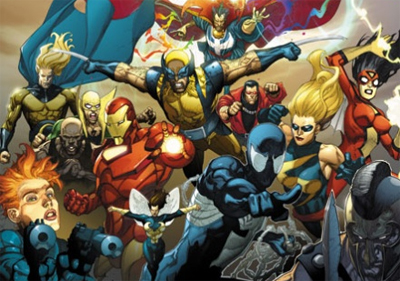
It was a good decade for The Avengers as a franchise, with Marvel consciously pushing the franchise to the forefront – not just in comics but in other media as well. If the nineties and early naughties belonged to the X-Men (with X-Men: The Animated Series on the airwaves, Bryan Singer’s X-Men in cinemas and crossovers like Age of Apocalypse in comic books), this was very clear attempt to take that back. Brian Michael Bendis was tasked with turning the Avengers into Marvel’s prime franchise and succeeded – most of the “big” comic book events of the decade revolved around them. That said it was certainly a controversial restructuring of the book, with a line-up crafted to feature more popular characters like Spider-Man and Wolverine instead of more obscure characters like Quicksilver or the Scarlet Witch.

The Avengers branched out into other media too. Iron Man demonstrated that Marvel’s “big three” could hold viewer interest in cinemas, and promised a series of crossovers on the big screen that would see The Avengers assemble under the direction of Joss Whedon. As a brand, Marvel made sure these characters were everywhere.

The stories featuring these characters over the decade form something of a larger meta-story which seems to reflect on the superhero genre as a whole. Although Bendis’ New Avengers opens with a supervillain breakout, the characters spent more time fighting each other than bad guys (Civil War, World War Hulk). When they did fight bad guys, they were more often than not corrupted mirrors of themselves, be it the Skrulls who had managed to so perfectly imitate heroes despite being villains (Secret Invasion) or government-sanctioned psychotic “Dark Avengers” (Siege). It was a story about how difficult it was to be a hero in the last few years – in the wake of the “dark age” of comic books – and a deconstruction of the effectiveness of a group of individuals like this to actually make a difference. You could even argue that this was a grim reflection of real world political and social uncertainty – particularly mistrust of authority (it’s telling how much time these heroes spend going “rogue”). Of course, this is open to interpretation, and many fans were less than pleased with the execution of this particular tale.

“Cosmic Marvel” Continuity

Marvel’s Cosmic Universe got a much-needed revitalisation this decade, offering perhaps a better-plotted and more straightforward avenue for Marvel’s crossover events. Although Jim Shooter had done great work with many of these characters in the nineties (with Infinity Gauntlet and so forth), they had mostly remained in relative obscurity before the relaunch.

The distinguishing aspect of these stories is the way that they are structured. Rather than a big event coinciding with countless tie-ins across countless books, most of these stories would open with a single prologue issue which would branch into a handful of miniseries running for a set number of issues, before dovetailing into a main series. This meant that every issue remotely connected with a series could be collected in a hardcover. Admittedly the titles become more entangled in continuity as they went on (with War of Kings tying in directly to Ed Brubaker’s The Rise & Fall of the Shi’ar Empire story arc in Uncanny X-Men), but by and large these series served to avoid pointless tie-ins and an exceptionally convoluted continuity (everything you needed was included in the books themselves).

They’re the best crossovers that you weren’t reading.

X-Men Continuity

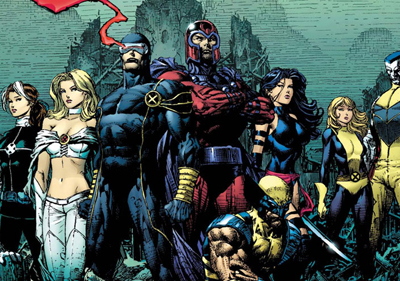
The last decade has been an interesting one for the X-Men, as both the books and the characters have found themselves looking for purpose. Grant Morrison’s New X-Men posited a world where mutants would be the dominant species with a few generations and proposed to move the “mutants as oppressed minority” metaphor firmly into the twenty-first century, where the worries weren’t (at least for the most part) about government-sponsored genocide or legal rights, but cultural and social questions about the way that mutants and humanity live together. This was clearly a step too far, as Marvel decided to essentially wipe out the mutant population, feeling there were too many mutants in the Marvel Universe. This was done with three words from a psychotic Scarlet Witch rather than a more subtle approach (like simply reducing the number of mutants featured in various books).

Suddenly the X-Men found themselves facing extinction, and this became a driving narrative force for the book. It was as if the line was actively rebelling against the editorial mandate forced upon them. Instead of granting narrative clarity, the edict had instead complicated things. It also forced the X-Men away from their widely-loved position as a civil rights metaphor and towards a more straight forward “find the cure” narrative. It also served to isolate the franchise from the rest of the Marvel Universe (except for Wolverine, of course, who is everywhere) – the X-Men were always busy doing their thing and trying not to die out rather than assisting with Civil War or Secret Invasion. The solution to this narrative thread is entirely predictable, but it does offer a clear structure to the X-Men stories from the period.

It’s interesting to note that while all the major Avengers titles from this period (New/Mighty/Dark Avengers) have been consistantly collected, the X-Men books have not been. Ed Brubaker’s run is quite difficult to collect in one consistent format, as is Matt Fraction’s – and both are writing for what should be “the flagship book” of the X-Men publishing line, Uncanny X-Men. This makes it considerably harder to follow than the Avengers franchise, for example.

X-Men: Second Coming (Review/Retrospective)

This is the sixteenth in a series of comic book reviews that will look at the direction of Marvel’s shared universe (particularly their “Avengers” franchise) over the past five or so years, as they’ve been attempting to position the property at the heart of their fictional universe. With The Avengers planned for a cinematic release in 2012, I thought I’d bring myself up to speed by taking a look at Marvel’s tangled web of continuity.

Second Coming is the culmination of about five years of X-Men plots. In fairness, the finale was pretty obvious from the moment that the Scarlet Witch rather infamously muttered “no more mutants” at the climax of the muddled House of M. When mutants were rendered an “endangered species” we always knew the saga would come down to one gigantic confrontation between mutants and the humans who would seek to exterminate them – while at the same time lifting the weight of extinction from the shoulders of the mutant franchise. Reflecting on the events within the Marvel universe, Cyclops comments, “Osborn is gone. The Avengers are back. And the X-Men… we can stand for something again.” And perhaps that’s the best thing to come out of all of this – the return to the status quo. If that sounds disappointing, it probably is.

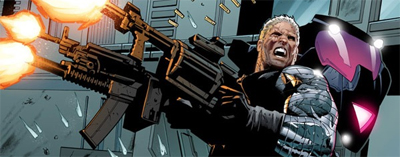
Cable's gunning for the record for most kills by a one-armed mutant ever...

Continue reading

Realm of Kings (Review/Retrospective)

This is the fifteenth in a series of comic book reviews that will look at the direction of Marvel’s shared universe (particularly their “Avengers” franchise) over the past five or so years, as they’ve been attempting to position the property at the heart of their fictional universe. With The Avengers planned for a cinematic release in 2012, I thought I’d bring myself up to speed by taking a look at Marvel’s tangled web of continuity.

Realm of Kings is a strange little chapter in the cosmic saga that Dan Abnett and Andy Lanning have been drafting. It seems to exist not really as a story in its own terms (although it does contain some interesting narratives) but rather as a bridge between War of Kings and The Thanos Imperative. It’s essentially the story of an attempt to find stability in a radically warped universe, one turned upside down by recent events. It feels somewhat smaller in scope than the other events that the pair have produced, not that there’s anything wrong with that. In fact, it’s nice to see a series exploring the consequences and aftermath of what has occurred, rather than simply pushing on right into the next big thing. While Realm of Kings does focus on “the Fault” opened at the climax of War of Kings that will become a galactic threat in The Thanos Imperative, the three miniseries are at their best when they explore the consequences of the political instability that the intergalactic war has produced.

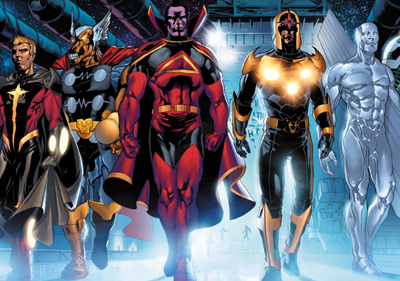
That's gonna be Thor tomorrow...

Continue reading

Batman: Dark Victory

This post is part of the DCAU fortnight, a series of articles looking at the Warner Brothers animations featuring DC’s iconic selection of characters. I’ll be looking at movies and episodes and even some of the related comic books. We’re winding down now, having worked our way through the nine animated features, so I’m just going to look at a few odds-and-ends, some of the more interesting or important episodes that the DC animated universe has produced. Earlier today we looked at the Emmy-winning Robin’s Reckoning, so I thought we might take a look at the comic book origin of Robin that it inspired.

“And while the Maronis and the Falcones have often been bitter rivals, they all now share a common enemy,” Batman narrates at one point in the sequel to The Long Halloween“Extinction.” Dark Victory is the story of the death of “the gangster element of Gotham City” as the organised crime families attempt one last struggle against the emerging freaks. It closes the book on the story threads that Frank Miller introduced in his revision of Batman’s origin in Year One, which continued through Loeb and Sale’s The Long Halloween (which itself provided the basis of Christopher Nolan’s The Dark Knight). The book serves as an origin story for Dick Grayson, and thus offers a nice bookend for the early years of Bruce’s crimefighting career.

Face the facts...

Continue reading

Absolute All-Star Superman (Review/Retrospective)

This post is part of the DCAU fortnight, a series of articles looking at the Warner Brothers animations featuring DC’s iconic selection of characters. I’ll be looking at movies and episodes and even some of the related comic books. With All-Star Superman confirmed as the next animated DC feature, I thought I’d take a look at Grant Morrison’s original comic book story. In case you haven’t noticed, it seems the DCAU guys are big Morrison fans.

Doomed Planet.

Desperate Scientists.

Last Hope.

Kindly Couple.

Superman.

– Grant Morrison reduces perhaps the most iconic origin story down to fewer words than this synopsis, …Faster… (Chapter 1)

I have to admit, nothing quite psyches me like holding a Grant Morrison book in my hand – save maybe holding an Alan Moore book in my hand. Sure, I might not love what he’s writing and it might not necessarily be the most complete narrative experience that could have been provided, but I always want to read it again after I’m done – even if I hated it. As a writer, Morrison can crank out crazy-yet-clever concepts like nobody’s business, finding a way to put a new slant on an old piece of mythology or making a change seem like a logical extension of what came before. All-Star Superman is perhaps his most widely respected work, an attempt to boil the iconic Man of Steel down into twelve easy-to-disgest chunks, for new and old fans alike. It’s a stunning piece of comic book literature and perhaps the closest experience one could have to holding the quintessential elements of Superman in your hands.

Last sun of Krypton…

Continue reading

Matt Fraction’s Run on Uncanny X-Men – Nation X (Review/Retrospective)

I am doing a weekly look at Marvel’s complicated crossover chronology, following various key crossovers to see if they might give me a better idea of what I’m missing by avoiding mainstream comic book continuity. While – with The Avengers due for release in 2012 – I am focusing on the stories told featuring those characters over the past five years, I also have time for the X-Men. While this isn’t strictly speaking a crossover, it is a series of issues which connect Utopia to Second Coming, so I figured it was worth a look.

Utopia ended with a heck of a plot twist. Cyclops decided that his merry band of mutants have had enough of being looked down upon in New York and , more recently, San Francisco, so he decides to build himself an island from the remains of Magneto’s “Asteroid M” just off the San Francisco Bay. Announcing the new nation of “Utopia”, he declares the island a haven for mutants. Nation X provides a hardcover collection of the issues from Matt Fraction’s Uncanny X-Men which bridge the gap between Utopia and Second Coming, as well as the four-issue Nation X anthology miniseries. And, while it’s a decidedly uneven reading experience, I have to admit that some of Fraction’s portrayal of the mutant team is a little bit interesting – even if most is slightly boring and deeply convoluted.

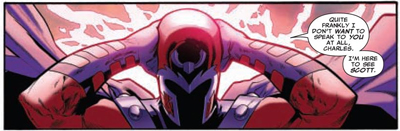
Magneto has a magnetic personality...

Note: This collection opens with Dark Reign tie-in X-Men: The List written by Matt Fraction and following an attempted assassination attempt on Namor by Norman Osborn. Accordingly, I think I should open this review with a link to Abhay’s quite excellent article on the issue, which – among some more serious points – suggests that Namor is starring in his own private version of You Don’t Mess With The Zohan. Seriously, check it out.

Continue reading