• Following Us

  • Categories

  • Check out the Archives


  • Awards & Nominations

Star Trek: The Newspaper Strips – Beware the Omnimind! (aka Restructuring is Futile) (Review)

This January and February, we’ll be finishing up our look at the second season of Star Trek: The Next Generation and moving on to the third year of the show, both recently and lovingly remastered for high definition. Check back daily for the latest review.

We’ll be supplementing our coverage of the episodes with some additional materials – mainly novels and comics and films. This is one such entry.

As brilliant as the Borg were when they were introduced in Q Who?, they were hardly the most original of constructs. The cybernetic aliens went on to become one of the most iconic and recognisable pieces of Star Trek lore, featuring in the most popular Star Trek: The Next Generation feature film and all the subsequent spin-offs, but it’s tempting to give the Borg a bit more credit than they’re due.

After all, cybernetic organisms were hardly cutting edge in 1989. In fact, this wasn’t even the first time that Star Trek had told this kind of story. In late 1981, the Star Trek news paper strip that had begun as a companion piece to Star Trek: The Motion Picture, featured a similar adversary for Kirk’s Enterprise.
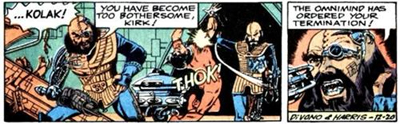
Resistance is futile!

Resistance is futile!

Continue reading

Star Trek: The Next Generation/Doctor Who – Assimilation² (Review)

This January and February, we’ll be finishing up our look at the second season of Star Trek: The Next Generation and moving on to the third year of the show, both recently and lovingly remastered for high definition. Check back daily for the latest review.

We’ll be supplementing our coverage of the episodes with some additional materials – mainly novels and comics and films. This is one such entry.

It’s amazing that Assimilation² represents the first official crossover between Star Trek and Doctor Who. After all, the nineties saw a trilogy of comics and novels in which Star Trek crossed over with Marvel’s X-Men. At the same time, though, the miniseries’ combination does seem a little odd. Pairing the Cybermen and the Borg is a bit of a no-brainer, but the Eleventh Doctor feels like a bit of a strange fit on board Picard’s Enterprise.

The Ninth or Tenth would arguably offer more of a contrast with Picard’s restrained and dignified command style. The Tenth Doctor and Donna arriving on the luxury Enterprise practically writes itself. (“Now that’s what I call a spaceship. You’ve got a box, they’ve got a Stella Liner.”) Picard and the Eleventh Doctor feels like a particularly bland pairing, if only because there’s no way they’d try each other’s patience. The Eleventh Doctor would probably work better in the context of Sisko’s Deep Space Nine or either Kirk’s Enterprise.

Still, although Assimilation² never quite takes full advantage of its central hook, it’s a diverting enough mish-mash of two science-fiction staples.

Cue Who?

Cue Who?

Continue reading

Star Trek: The Next Generation (DC) Annual #2 – Thin Ice (Review)

This January and February, we’ll be finishing up our look at the second season of Star Trek: The Next Generation and moving on to the third year of the show, both recently and lovingly remastered for high definition. Check back daily for the latest review.

We’ll be supplementing our coverage of the episodes with some additional materials – mainly novels and comics and films. This is one such entry.

Riker is a character caught between a rock and a hard place. According to the series bible, Riker was imagined as one of the “dual lead characters” for the show and clearly envisioned as an impulsive and brilliant Kirk to Picard’s more rational and stoic Spock. However, it didn’t quite work out that way, for a number of reasons. For one thing, the writing on the early years of Star Trek: The Next Generation tended to be a bit more sterile and bland, so Riker was never really allowed to step too far out of Picard’s shadow.

Instead, we got lots of characters talking about how ambitious Riker was, without seeing it for ourselves. It’s implied that Riker’s career led him to separate from Troi, something Peter David ran with in Imzadi. Everybody is constantly telling everybody else how Riker desperately wants to be a starship commander. And yet, when it come to the actual characterisation of Riker on the show, none of this shines through.

Due to the constraints imposed on the early years, interpersonal conflict was impossible in early Next Generation scripts, putting Riker in a paradoxical position as a character. We’re repeatedly told how ambitious and career-orientated he is, but none of that shines through.

Dead space...

Dead space…

Continue reading

Star Trek: The Next Generation (DC Comics, 1988) (Review)

This January and February, we’ll be finishing up our look at the second season of Star Trek: The Next Generation and moving on to the third year of the show, both recently and lovingly remastered for high definition. Check back daily for the latest review.

We’ll be supplementing our coverage of the episodes with some additional materials – mainly novels and comics and films. This is one such entry. This is actually supplementary to the first season of the Next Generation, specifically the episode Encounter at Farpoint.

When Malibu comics launched their Star Trek: Deep Space Nine comic in 1993, the first season of the show had concluded. Due to licensing issues, Marvel Comics published the first Star Trek: Voyager tie-in comic in late 1996, after the show’s second season had concluded. The notoriously dodgy Gold Key Star Trek comics did run alongside the classic television show, but at least waited until 1967 to begin getting the details horribly wrong.

So publishing a tie-in to Star Trek: The Next Generation in early 1988 was an ambitious move by DC comics. By that point, the show’s first season was an ambitious prospect. The six issue miniseries was launched as part of a big publicity push at the start of The Next Generation, with editor Robert Greenberger explaining in the afterword to the first issue that Paramount had approached them “sometime early this year” to write the series.

This means that the comic was being written before Encounter at Farpoint was even finished. In the letters section in the second issue, Greenberger concedes, “As I write this, it’s mid-September and Star Trek: The Next Generation has yet to debut anywhere in America.” It’s no wonder that Michael Carlin’s series wound up so inconsistent and so decidedly strange. While it’s an interesting demonstration of just how firmly Paramount were pushing their new show, it’s hardly a triumph of tie-ins.

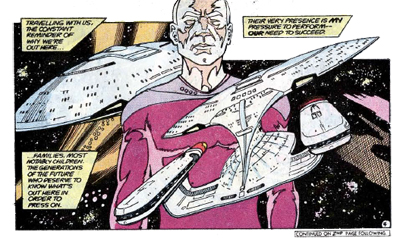
These are the voyages...

These are the voyages…

Continue reading

Star Trek: Deep Space Nine (Marvel Comics) #3-4 – The Cancer Within (Review)

This January and February, we’ll be finishing up our look at the second season of Star Trek: The Next Generation and moving on to the third year of the show, both recently and lovingly remastered for high definition. Check back daily for the latest review.

We’ll be supplementing our coverage of the episodes with some additional materials – mainly novels and comics and films. This is one such entry.

Poor Doctor Pulaski. She seems to have just disappeared from the canon. First season casualty Tasha Yar seemed to haunt to the show, returning for Yesterday’s Enterprise while her daughter become a recurring foe from The Mind’s Eye onwards. Even Wesley popped back every once in a while following his departure from the series. Pulaski, on the other hand, remains something of a phantom.

Barring an audible reference to her made in the background during the Star Trek: Voyager finalé Endgame, she disappears from the franchise without so much as a peep at the end of Shades of Grey.  She isn’t even referenced by name in the first episode of the third season to air (Evolution) or the first produced (The Ensigns of Command). While Beverly Crusher’s return is used as a plot point for Wesley, we only get the most fleeting of references to Pulaski in Who Watches the Watchers?

While this can easily be explained by the complex relationship that Diana Muldaur seems to have with Star Trek: The Next Generation. She has suggested the atmosphere on set was decidedly unfriendly, so the fact that Pulaski doesn’t return should not be that much of a surprise. What is interesting is the general apathy that the expanded universe seems to have for Pulaski. While even guest characters seem to get their own back stories and development in novels and comics, Pulaski is treated as a decidedly minor character in the Star Trek canon, reduced to guest spots and small appearances.

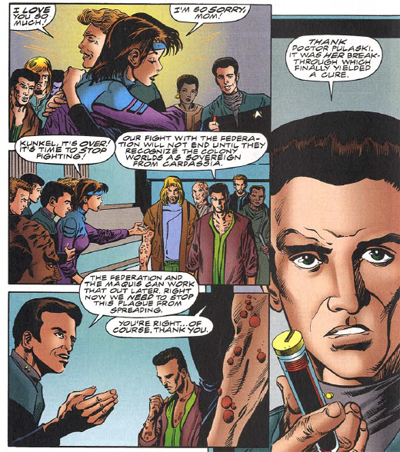
I like my family reunions generic and bland...

I like my family reunions generic and bland…

Continue reading

Star Trek: Mirror, Mirror #1 – Fragile Glass (Review)

Star Trek: Deep Space Nine is twenty years old this year. To celebrate, I’m taking a look at the first and second season. Check back daily for the latest review or retrospective.

We’ll be supplementing our coverage of the episodes with some additional materials – mainly novels and comics and films. This is one such entry.

One of the benefits and the curses of tie-in material is the ability to connect the dots – to tie together two parts of continuity separated by time and space, filling in the blanks in some character or plot arc. Often, this feels extraneous at best. In order for the televised stories to work, there must be enough information conveyed effectively to the audience so they can make their own leaps. Trying to plug imaginary and unnecessary holes is seldom satisfying.

On the other hand, there are occasionally gaps that are worth exploring. These are gaps that have been explained on the show, but which are still large enough that creators can fit their own interesting stories between them. The divide between Mirror, Mirror and Crossover is one such gap, as we go from the original Star Trek‘s version of the mirror universe to the very different iteration seen on Star Trek: Deep Space Nine.

Tom DeFalco’s Fragile Glass attempts to sketch in some of the details around this gap. While it’s not entirely satisfying as either a missing link or a story in its own right, it does offer some nice pulpy fun and gets considerable mileage out of the “Spock vs. Kirk” premise.

I am not Spock...

I am not Spock…

Continue reading

Star Trek: Deep Space Nine – The Maquis: Soldier of Peace (Review)

Star Trek: Deep Space Nine is twenty years old this year. To celebrate, I’m taking a look at the first and second seasons. Check back daily for the latest review or retrospective.

We’ll be supplementing our coverage of the episodes with some additional materials – mainly novels and comics and films. This is one such entry.

The Maquis: Soldier of Peace is a rather interesting little miniseries, produced while Malibu comics held the rights to Star Trek: Deep Space Nine spin-off comics in the early nineties. Malibu owned the rights to the earliest comics, publishing just over thirty issues of the main Deep Space Nine title between August 1993 and December 1995. Due to Paramount’s desire to exploit the license as much as possible, Malibu only had access to the Deep Space Nine rights, and not to Star Trek: The Next Generation or the original Star Trek.

Malibu would eventually be bought by Marvel, allowing the company to briefly publish Star Trek comics related to all on-going series. However, the company managed to generate an impressive amount of content in the time that it held the rights. Cynics would suggest that company was trying to cash in on the comics boom of the nineties, trying all manner of gimmicks, including one-shots and even a “celebrity” prestige series featuring stories written by Mark Lenard or Aron Eisenberg.

As such, these comics offer an interesting snapshot of where Deep Space Nine was at this point in its history.

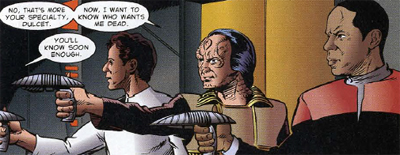
The three amigos...

The three amigos…

Continue reading

Charles & Daniel Knauf’s Run on Iron Man – Civil War (Review/Retrospective)

To celebrate the release of Thor: The Dark World towards the end of next month, we’ll be looking at some Thor and Avenger-related comics throughout September. Check back weekly for the latest reviews and retrospectives.

You really have to feel sorry for the father-son team of Charles and Daniel Knauf for their work on Iron Man. Picking up the book after the fantastic introductory Extremis arc by Warren Ellis and Adi Granov, the duo quickly found the character’s direction swept up in the maelstrom of Marvel’s event-driven larger universe. Mark Millar’s mammoth superhero crossover Civil War did its best to turn Tony Stark into a supervillain, a fascist in a suit of armour presiding over internment without trial, cloning of gods and the use of psychopathic villains to hunt down his former friends.

The duo do their best to try to deal with the obvious problems that this approach generates for an on-going Iron Man book, managing a fairly concise two-issue tie-in that tries its best to offer a defense for the characterisation of Tony Stark during the crossover.

On top of the world...

On top of the world…

Continue reading

Stan Lee & Jack Kirby’s Thor – The Might Thor Omnibus, Vol. 1 (Review/Retrospective)

To celebrate the release of Thor: The Dark World towards the end of next month, we’ll be looking at some Thor and Avenger-related comics throughout September. Check back weekly for the latest reviews and retrospectives.

I am a massive fan of The Mighty Thor. There’s just something so clever and playful about the idea of a classic Norse deity reimagined as a Marvel superhero, a self-aware take on the whole “modern myth” approach to American comic book storytelling that it’s hard not to love. Indeed, I would rank portions of Lee and Kirby’s work on Thor among the best of their output from the Silver Age, a truly epic large-scale epic fantasy narrative that isn’t anchored or tethered to any limitations beyond the imaginations of those working on it.

While The Fantastic Four is a lot more consistent and a lot more important in the grand scheme of comic book history, Thor is a bit rockier. It took Lee and Kirby a considerable amount of time to find their creative voice on Thor – a difficulty compounded by the fact that heavy work loads on other Marvel often forced the duo to delegate the early issues of the book to other writers and artists. As a result, this mammoth tome of Thor serves more as a learning curve, building towards a point where the duo will have figured out quite how to tell compelling and exciting stories featuring the God of Thunders.

Taking the hammer for a spin...

Taking the hammer for a spin…

Continue reading

West Coast Avengers Omnibus, Vol. 1 (Review/Retrospective)

To celebrate the release of Thor: The Dark World towards the end of next month, we’ll be looking at some Thor and Avenger-related comics throughout September. Check back weekly for the latest reviews and retrospectives.

I’ve never been especially fond of the classic Avengers. The group has always seemed particularly insular and self-centred for a comic book superhero team, with so much emphasis on their by-laws and regulations, their posh fifth avenue mansion and the strange sense of pride that second-tier characters like Hawkeye seem to place on their own importance within the Avengers franchise. There have been great runs, and there have been comics that I have enjoyed a great deal, but I will concede that I am not a fan of the Silver and Bronze Age Avengers aesthetic.

West Coast Avengers is a clear attempt to develop the franchise, to give Marvel a second high-profile Avengers book. Launched in 1984 and running for a decade, the book followed the establishment of a second superhero team branded on the classic Avengers model. Of course, part of me suspects that this was all just a plan to get Hawkeye out of the mansion (“you and Mockingbird can relocate quickly… and the sooner you do — the sooner our west coast team is operational — the better!” Vision insists).

There are moments of wry self-awareness in West Coast Avengers, but far too much of it reads far too earnestly.

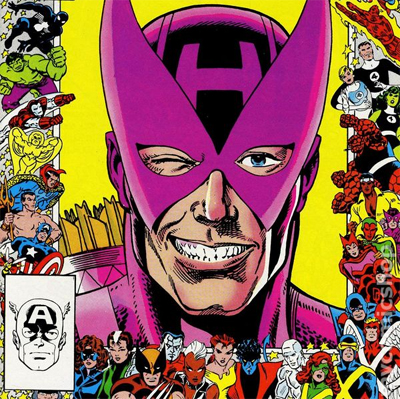
And yet somehow this guy has appeared in two of the biggest superhero blockbusters of the past five years...

And yet somehow this guy has appeared in two of the biggest superhero blockbusters of the past five years…

Continue reading