• Following Us

  • Categories

  • Check out the Archives


  • Awards & Nominations

Greg Rucka and Marco Checchetto (and Carmine Di Giandomenico’s) Punisher – War Zone (Review)

This March, to celebrate the release of Captain America: The Winter Soldier, we’ll be taking a look at some classic and not-so-classic Avengers comic books. Check back daily for the latest updates!

Despite the continuity of character, plot and creator, it’s striking how distinct Punisher: War Zone feels from the sixteen-issue solo series leading into it. After Marvel cancelled Greg Rucka and Marco Checchetto’s Punisher series, the company green-lit a five-issue miniseries to allow the duo to wrap up the various plot threads and themes that ran through their earlier work. It is nice to see the pair given a chance to bring closure to their story, to tidy away loose ends on their take on Frank Castle.

At the same time, Punisher: War Zone feels very much like its own thing. The plot is powered by the arrest of Rachel Cole-Alves, Frank Castle’s accomplice who accidentally murdered a police officer during a botched raid. At the end of the series, the New York City Police Department had taken Cole into custody while Castle escaped into the night. In a way, the story could just has effectively ended there – the Punisher disappearing back into the woodwork, the characters all squared away.

While Punisher: War Zone does resolve the Cole-Alves subplot, it feels like it is primarily an accuse to pit Frank Castle against the Avengers. It’s a rather demented comic book idea – allowing a guy with lots of guns to face off against “Earth’s mightiest heroes” – but it plays into the larger themes of Rucka’s run about what tolerance of Castle says about the people who share this world with him.
Seeing red...

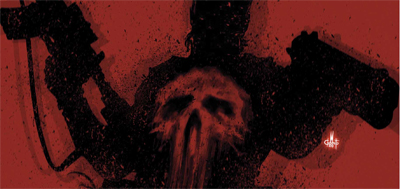
Seeing red…

Continue reading

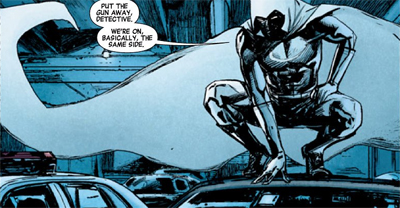
Brian Michael Bendis and Alex Maleev’s Moon Knight (Review/Retrospective)

This March, to celebrate the release of Captain America: The Winter Soldier, we’ll be taking a look at some classic and not-so-classic Avengers comic books. Check back daily for the latest updates!

One of the more endearing aspects of comic book publishing is the way that the “little guys” occasionally get a shot. There are mountains of titles published each month featuring iconic characters like Batman or Wolverine, but the major companies are occasionally willing to check chances on more quirky and unknown characters using top-tier talent. One of the big surprises of DC’s “new 52” relaunch was the decision to put superstar writer Geoff Johns on pop culture joke Aquaman.

Despite the fact that he has never quite set the world on fire, Marvel seems willing to invest in repeated attempts to launch the character of Moon Knight. Most recently, writer Warren Ellis has launched a new volume of the comic with artist Declan Shalvey. However, before the latest relaunch, Marvel tried another high-profile take on Moon Knight written by Brian Michael Bendis and illustrated by Alex Maleev, the duo responsible for one of the best-loved runs ever published on Daredevil.

The series made it to twelve issues, before Marvel cancelled it due to disappointing sales. Bendis has insisted that it was always the plan to end the series after twelve issues, but it seems strange that the series was not announced as a miniseries. Still, it’s easy to understand why Moon Knight struggled to find an audience. It’s great to have Bendis and Maleev crafting an on-going street-level comic book, but the series seems almost at war with itself, struggling with the difficulties of fitting this character in this particular role.

Oh what a knight...

Oh what a knight…

Continue reading

Fear Itself (Review/Retrospective)

This March, to celebrate the release of Captain America: The Winter Soldier, we’ll be taking a look at some classic and not-so-classic Avengers comic books. Check back daily for the latest updates!

Part of what is so remarkable about Fear Itself is how uncomfortably it fits into the “huge event” role that Marvel cast for it. Matt Fraction’s seven-issues-and-change epic crossover event is really just a Thor story arc that dips its toe in the waters of Ed Brubaker’s Captain America. Instead, Marvel cast it as this gigantic universe-altering mega-important miniseries with over 100 crossovers and tie-ins from all corners of the Marvel Universe.

Positioned to capitalise on the release of both Kenneth Branagh’s Thor and Joe Johnson’s Captain America: The First Avenger, Fear Itself seems like a story told in the wrong place at the wrong time. Like Brian Bendis’ Secret Invasion would undoubtedly have worked better as an arc of New Avengers than as a full-blown “nothing is ever the same again” epic, Fear Itself would have been a much stronger comic had it been allowed to play out on a smaller stage.

Hammer time!

Hammer time!

Still, despite the problems inherent in large-scale epic crossovers, Fear Itself works surprisingly well. Indeed, it it probably the strongest Marvel “mega-event” of the past decade if only because it is built on a strong ideological premise and develops some of the underlying themes and ideas of Fraction’s other Marvel work. Treated as a seven-issue story arc from Matt Fraction’s The Mighty Thor, it’s a fascinating climax of ideas that bubble away in the background of his run.

The choice to let Fraction craft Fear Itself, with assists from Ed Brubaker on the prologue and epilogue to the event, is inspired. Fraction is not the most consistent of comic book writers, but he is also incredibly wry and self-aware. There’s a sense of charming self-deprecating to Fear Itself, as Fraction allows the characters involved to reflect on the absurdity of it all without ever losing track of their humanity. Fear Itself might be far from perfect, but it is clever, fun and thoughtful. And those are endearing virtues.

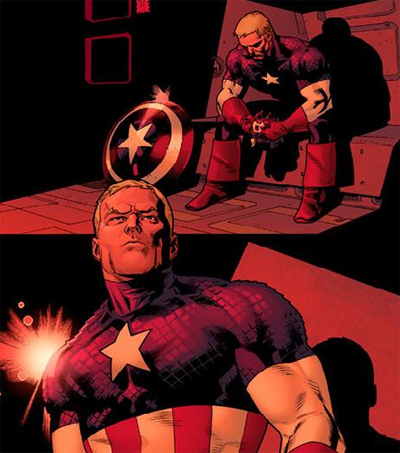
Suit up!

Suit up!

Continue reading

Captain America: Man Out of Time by Mark Waid and Jorge Molina (Review)

This March, to celebrate the release of Captain America: The Winter Soldier, we’ll be taking a look at some classic and not-so-classic Avengers comic books. Check back daily for the latest updates!

Captain America: Man Out of Time suffers under the weight of its nostalgia.

The past few years have been kind to fans of the star-spangled Avenger. Ed Brubaker enjoyed an extended run on the character that enjoys favourable comparisons to the best work by the best writers ever to work with Steve Rogers. A Captain America film finally saw theatrical release with Captain America: The First Avenger. So it made sense for Marvel to try to extend the brand in 2011, as that blockbuster was ready to hit cinemas and as the character’s stock was at an all-time high.

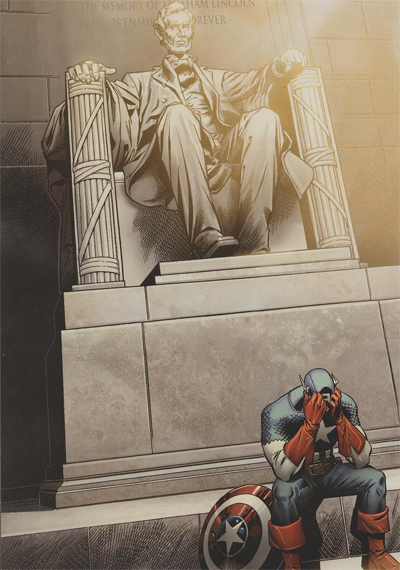
"It's okay, Cap. The First Avenger wasn't THAT bad..."

“It’s okay, Cap. The First Avenger wasn’t THAT bad…”

Mark Waid was a great choice to assist in this. Waid is a well-liked comic book writer with a long history at Marvel that includes two extended well-received runs on the character. Waid has written a number of genuine comic book classics, and he’s a writer who tends to handle nostalgia very well. So tasking Mark Waid with writing a comic book set in the early days of Captain America’s revival was a no-brainer. A five-issue miniseries about Captain America waking up in contemporary times written by Mark Waid? That should be a default slam dunk.

Unfortunately, there was a miscalculation somewhere. Man Out of Time feels sappy ans manipulative, with little new or interesting (or insightful) to offer about its temporally dislocated protagonist.

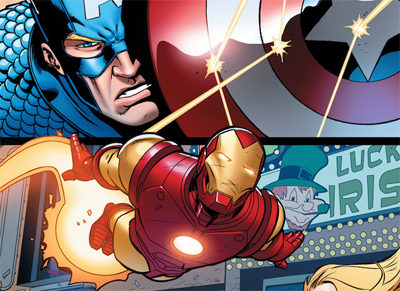
The man in the iron mask...

The man in the iron mask…

Continue reading

Greg Rucka and Marco Checchetto’s Run on The Punisher, Vol. 9 (Review)

This March, to celebrate the release of Captain America: The Winter Soldier, we’ll be taking a look at some classic and not-so-classic Avengers comic books. Check back daily for the latest updates!

The Punisher isn’t really a complex character.

Indeed, despite his popularity and appeal, there’s really only so much you can do with the character before it feels like you’re repeating yourself. He is a vigilante who brutally murders criminals, possibly because criminals killed his family. That’s part of the reason why Rick Remender’s Punisher run was so exhilarating. It genuinely felt unlike anything that had been done with the character before – even if Remender had to take Frank Castle off the reservation to do it.

Writer Greg Rucka and artist Marco Checchetto came up with their ingenious way of making the Punisher seem novel again. Realising that readers have probably become a little too over-familiar with Frank Castle and his world, Rucka and Checchetto shrewdly decide to look at Frank Castle from the outside, treating the Punisher as something like a force of nature, a terror glimpsed fleetingly as he stalks the concrete jungle.

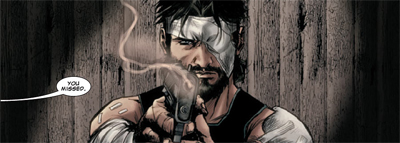
A smoking gun...

A smoking gun…

Continue reading

Warren Ellis and Mike Deodato Jr.’s Run on Thunderbolts (Review/Retrospective)

This March, to celebrate the release of Captain America: The Winter Soldier, we’ll be taking a look at some classic and not-so-classic Avengers comic books. Check back daily for the latest updates!

Warren Ellis and Mike Deodato Jr.’s year-long twelve-issue run on Thunderbolts is a phenomenal piece of work from a mainstream comic book company. It’s an absurdly fun comic book – one that goes completely off the rails any number of times, moving with momentum of a runaway freight train. Ellis’ unhinged plotting and dialogue find a perfect partner in Deodato’s dark and moody (yet photo-realistic) artwork.

While Ellis includes quite a bit of social, political and even meta commentary in this year-long anti-hero team-up book, there’s a sense that Thunderbolts was written with an intention of going completely overboard, basking in the surreal absurdity of superhero storytelling conventions while playing with a selection of (mostly) second-tier characters that free Ellis’ hand significantly. There are few dependencies and obligations that Ellis has with this cast, allowing him to go to town with them.

In many respects, Thunderbolts feels like a slightly more cynical, slightly more grounded counterpart to his (roughly) contemporaneous Nextwave: Agents of H.A.T.E. Over course, “slightly more grounded” simply means that a middle-aged civil servant in a goblin outfit is the villain of the piece, rather than a hyper-intelligent talking dinosaur.

Norman Osborn is a perfectly sane individual...

Norman Osborn is a perfectly sane individual…

Continue reading

Roger Langridge & Chris Samnee’s Thor: The Mighty Avenger (Review)

This March, to celebrate the release of Captain America: The Winter Soldier, we’ll be taking a look at some classic and not-so-classic Avengers comic books. Check back daily for the latest updates!

There really aren’t enough all-ages friendly comic books, and there certainly aren’t enough comic books that you can pop into a curious stranger’s hands and say “hey! read this!” In this era of blockbuster movies and hit television shows based off comic book properties, you’d imagine that companies would be working hard to attract new fans, trying to make comics accessible and enjoyable to those with little experience of picking up a comic book or graphic novel.

Thor: The Mighty Avenger is a wonderfully accessible piece of work that provides a brilliant introduction to Marvel’s take on the classic Norse God of Thunder. However, it remains a tragedy that this is one of very few efforts to provide such a comic, and also that Thor: The Mighty Avenger came to such an unceremonious end, cancelled after only eight issues.

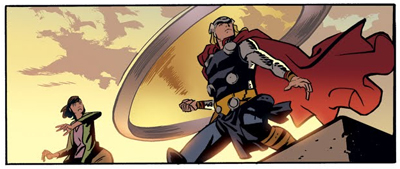
Taking Thor for a spin...

Taking Thor for a spin…

Continue reading

Avengers: Season One by Peter David et al (Review)

This March, to celebrate the release of Captain America: The Winter Soldier, we’ll be taking a look at some classic and not-so-classic Avengers comic books. Check back daily for the latest updates!

What exactly is the point of Marvel’s Season One initiative? Is it to update the origins of classic superheroes to make them accessible to modern and casual audiences? Is it to re-tell familiar stories just with modern touches like Facebook and iPhone references? Is it to dance between the rain drops and package an adventure from the early days of our heroes’ careers without disrupting established continuity? Is it an attempt to reach beyond the core comic book audience? Is it an attempt to package some material for feature film adaptation?

It’ hard to know. Marvel has made some nods towards accessibility in recent years, but all too often these feel more like sales gimmicks than genuine attempts to court new readers. Written by comic book superstar (and successful novelist in his own right) Peter David, Avengers: Season One should be something of a slam dunk. It’s a book featuring characters from a multi-billion dollar movie franchise, in a stand-alone graphic novel, with a slew of great writers and untethered to serialised long-form storytelling.

Unfortunately, Avengers: Season One winds up feeling like a mess.

Here come the heroes...

Here come the heroes…

Continue reading

Cullen Bunn’s Run on Captain America & … (Review)

This March, to celebrate the release of Captain America: The Winter Soldier, we’ll be taking a look at some classic and not-so-classic Avengers comic books. Check back daily for the latest updates!

Following Ed Brubaker on a Captain America book was always going to be tough, even if Brubaker had simply been providing the story for his last couple of Captain America & Bucky issues. Indeed, Cullen Bunn took over for Brubaker on one of three on-going Captain America books; with Brubaker still writing Captain America and Winter Soldier. As such, Bunn is somewhat trapped. He can’t really continue Brubaker’s still-unfolding story, but he can’t strike out with his own bold direction like Rick Remender would on a relaunched Captain America.

So it’s no surprise that Bunn’s thirteen issue Captain America & … run feels fairly indistinct. It’s a competently-produced piece of comic book writing, but it doesn’t stand out in the way that it needs to, feeling neither weighty nor fun enough to make the book stand out from the crowd.

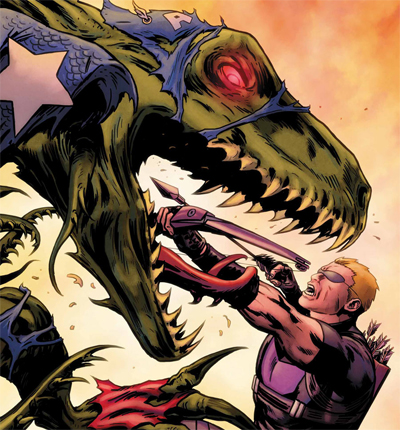
He always said Cap was a dinosaur...

He always said Cap was a dinosaur…

Continue reading

Brian Michael Bendis’ Avengers – The Age of Ultron (Review)

This March, to celebrate the release of Captain America: The Winter Soldier, we’ll be taking a look at some classic and not-so-classic Avengers comic books. Check back daily for the latest updates!

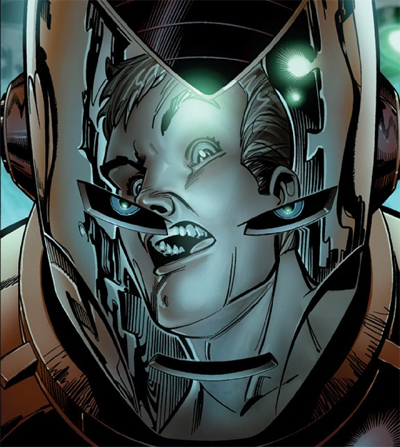
Age of Ultron is Brian Michael Bendis’ last hurrah on Marvel’s massive Avengers franchise. Bendis began writing Avengers when it was a third-tier comic book property, and he was – in a large part – responsible for turning the comic franchise into a sales juggernaut. The fact that Marvel was simultaneously working on a massive cinematic universe built around these characters – if only because they’d sold off most of the other ones – probably didn’t hurt.

So, with Bendis moving off the Avengers franchise, ceding the crown of lead Avengers writer to up-and-comer Jonathan Hickman, he wrote Age of Ultron. It was a story the author had been hinting at for quite some time, from the first arc of his relaunched adjectiveless Avengers title through to his short run on Moon Knight. Having completed a grand sweeping story arc running from Avengers Disassembled through to Siege, Age of Ultron feels like an epilogue to Bendis’ run – a post-script to the tenure of the man who changed the franchise.

It also feels, rather awkwardly, like the most self-consciously Avengers-y Avengers story ever aveng(er)ed.

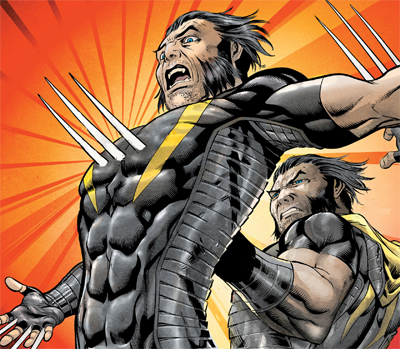
Over-exposure is killing Wolverine...

Over-exposure is killing Wolverine…

Continue reading